Kansas: Right-of-way and turning — Part 4 Practice Test
Who yields at intersections and four-way stops, turning lanes, turnabouts, U-turns, roundabouts, passing and merging. — Part 4
Independent educational site · not affiliated with any government agency or DMV
Ready? Test yourself
- Instant feedback with an explanation
- Every answer cites its source in the manual
- Your best score is saved on this device
Questions are original and based on the official manual "Kansas Driving Handbook" (Revised February 2022), Kansas Department of Revenue, Division of Vehicles.
All 36 questions in this practice test
Take the test above first, then use this list to study. Tap “Show answer” to see the correct answer and explanation.
Show the questions and answersHide the questions
-
If crossing several lanes is necessary, how should you change lanes?
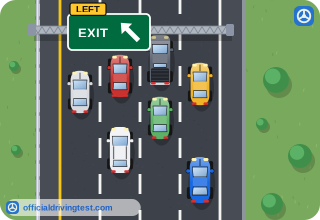
- All of the lanes in a single quick move
- Two lanes at a time after one signal
- One lane at a time
- Across all lanes while sounding your horn
Show answer
Correct answer: One lane at a time
It is very difficult to know that all lanes are free and safe to cross, so change lanes one at a time.
Source: Kansas Driving Handbook (Revised February 2022), page 64
-
Under normal circumstances, how long can a vehicle take to get through an intersection when going straight after stopping?
- 1 to 2 seconds
- 7 to 8 seconds
- 9 to 10 seconds
- 3 to 5 seconds
Show answer
Correct answer: 3 to 5 seconds
Under normal circumstances, a vehicle going straight after stopping at an intersection can get through within 3 to 5 seconds.
Source: Kansas Driving Handbook (Revised February 2022), page 65
-
Under normal circumstances, how long can a vehicle take to complete a right turn and pick up speed?
- 5 to 8 seconds
- 12 to 15 seconds
- 8 to 10 seconds
- 20 to 24 seconds
Show answer
Correct answer: 12 to 15 seconds
Under normal circumstances, a vehicle can complete a right turn and pick up speed within 12 to 15 seconds.
Source: Kansas Driving Handbook (Revised February 2022), page 65
-
Under normal circumstances, how long may it take to complete a left turn and get up to speed?
- 6 to 8 seconds
- 9 to 11 seconds
- 15 to 18 seconds
- 21 to 24 seconds
Show answer
Correct answer: 15 to 18 seconds
Under normal circumstances, it may take 15 to 18 seconds to complete a left turn and get up to speed.
Source: Kansas Driving Handbook (Revised February 2022), page 65
-
Even if you have a green traffic signal light, when should you not start across the intersection?
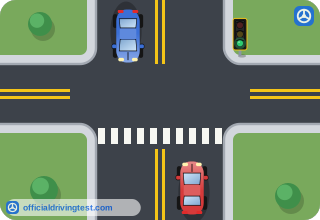
- When vehicles are blocking the way across
- When any oncoming vehicle is more than a block away
- When your turn signal has been on for less than three seconds
- When the light has been green for more than a few seconds
Show answer
Correct answer: When vehicles are blocking the way across
Even with a green light, do not start across the intersection when vehicles are blocking the way, or you may be caught there when the light turns red.
Source: Kansas Driving Handbook (Revised February 2022), page 65
-
If you are caught in the intersection when the light changes to red, what is true of your vehicle?
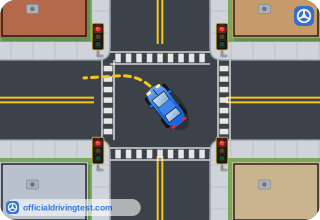
- It will be illegally blocking traffic flow
- It has the right to finish the turn before cross traffic moves
- It must back up behind the stop line
- It may wait there until oncoming traffic has stopped
Show answer
Correct answer: It will be illegally blocking traffic flow
If you are caught in the intersection when the light changes to red, your vehicle will be illegally blocking traffic flow.
Source: Kansas Driving Handbook (Revised February 2022), page 65
-
What should you do when an approaching vehicle has its turn signal on?
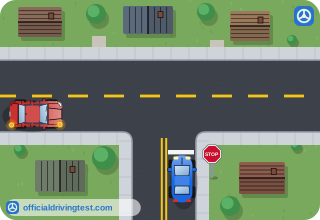
- Turn into the lane right away, since the signal means the driver is turning
- Flash your headlights and then turn into the lane
- Wait until the driver actually starts to turn
- Sound your horn once and then turn into the lane
Show answer
Correct answer: Wait until the driver actually starts to turn
The driver may plan to turn later or may have forgotten to cancel the signal, so wait until the other driver actually starts to turn.
Source: Kansas Driving Handbook (Revised February 2022), page 65
-
Which vehicles does the manual say may have turn signals that do not self-cancel?
- Passenger cars and small pickup trucks
- Large commercial vehicles and motorcycles
- Public transit buses and school buses
- Delivery vans and slow-moving farm tractors
Show answer
Correct answer: Large commercial vehicles and motorcycles
The manual says an active turn signal may be a leftover from a prior turn, particularly on large commercial vehicles and motorcycles whose signals may not self-cancel.
Source: Kansas Driving Handbook (Revised February 2022), page 65
-
What is the danger of staying alongside the vehicle you are passing for a long time?
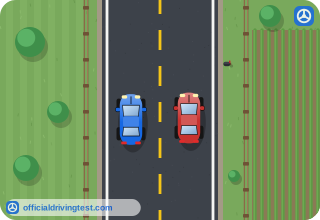
- Your vehicle may be cited for blocking the passing lane
- The other driver may speed up to stay beside you
- The other vehicle may move toward your lane
- You may lose track of the speed limit signs
Show answer
Correct answer: The other vehicle may move toward your lane
The longer your vehicle stays alongside the other vehicle, the longer you are in danger of the other vehicle moving toward your lane.
Source: Kansas Driving Handbook (Revised February 2022), page 65
-
From how far behind the vehicle to be passed should you begin to pass?
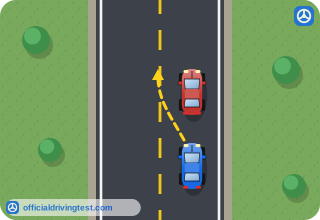
- At least two seconds behind it
- About one second behind it
- No more than one car length behind it
- Alongside it before you signal
Show answer
Correct answer: At least two seconds behind it
You should pass from at least two seconds behind the vehicle to be passed to avoid striking the rear side of the vehicle.
Source: Kansas Driving Handbook (Revised February 2022), page 65
-
When you are aware that a vehicle wants to pass you, which part of your lane should you move to?
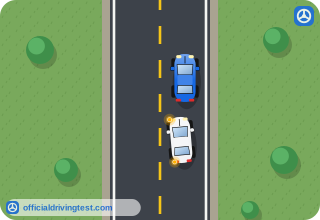
- The left side of the lane
- The right side of the lane
- The exact center of the lane
- The shoulder of the road
Show answer
Correct answer: The right side of the lane
When you are aware that a vehicle wants to pass, keep right by moving to the right side of the lane.
Source: Kansas Driving Handbook (Revised February 2022), page 66
-
As a rule, how many vehicles should you pass at a time?
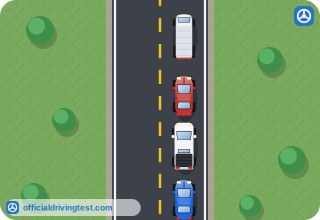
- Two vehicles
- One vehicle
- Three vehicles
- As many as the passing lane allows
Show answer
Correct answer: One vehicle
It is difficult to determine the time needed to pass, so as a rule you should only pass one vehicle at a time.
Source: Kansas Driving Handbook (Revised February 2022), page 66
-
According to the manual, how long may the time needed to pass be?
- About 5 to 8 seconds
- About 10 to 12 seconds
- No more than 15 seconds
- As many as 20 to 30 seconds
Show answer
Correct answer: As many as 20 to 30 seconds
The amount of time needed to pass is hard to determine and may be as many as 20 to 30 seconds.
Source: Kansas Driving Handbook (Revised February 2022), page 66
-
If you can see an oncoming vehicle, what should you do about passing?
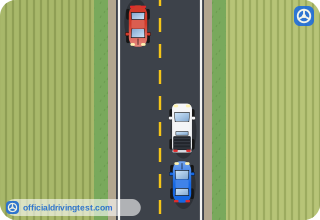
- Do not attempt to pass
- Pass only if the oncoming vehicle slows down
- Pass only after you sound your horn
- Attempt to pass only if you signal first
Show answer
Correct answer: Do not attempt to pass
It is difficult to judge the speed of oncoming vehicles, so if you can see an oncoming vehicle, do not attempt to pass.
Source: Kansas Driving Handbook (Revised February 2022), page 66
-
How does an oncoming vehicle that is more than 25 seconds from you generally appear?
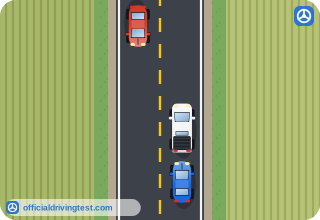
- To be traveling faster than it really is
- To be much closer than it really is
- To be standing still
- To be moving with the speed of traffic
Show answer
Correct answer: To be standing still
An oncoming vehicle that is more than 25 seconds away generally appears to be standing still, so it is hard to judge its speed.
Source: Kansas Driving Handbook (Revised February 2022), page 66
-
When driving at 55 to 60 mph and passing, how far ahead must you be able to see on hills and curves?
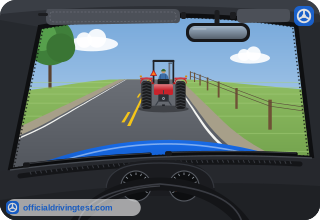
- At least 1/10 of a mile
- At least 1/6 of a mile
- At least 2/3 of a mile
- At least 1/3 of a mile
Show answer
Correct answer: At least 1/3 of a mile
You must be able to see at least 1/3 of a mile, or about 20 to 25 seconds, ahead when driving at 55 to 60 mph.
Source: Kansas Driving Handbook (Revised February 2022), page 66
-
Anytime your view is blocked by a curve or a hill, what should you assume?
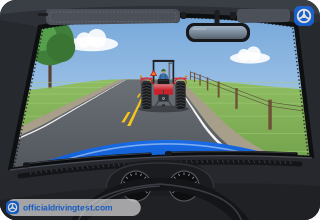
- That oncoming drivers will move to the shoulder for you
- That there is an oncoming vehicle just out of sight
- That the vehicle ahead will speed up on the hill
- That there is a railroad crossing beyond the hill
Show answer
Correct answer: That there is an oncoming vehicle just out of sight
When a curve or hill blocks your view, assume there is an oncoming vehicle just out of sight and do not start to pass.
Source: Kansas Driving Handbook (Revised February 2022), page 66
-
Where is it dangerous and illegal to pass?
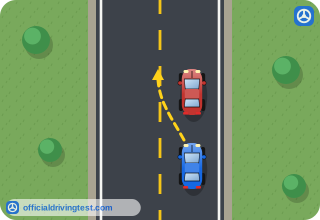
- On a straight, level road during daylight hours
- On any road with a posted limit above 55 mph
- Where a vehicle is likely to enter or cross the roadway
- On a road with a paved shoulder and no curves
Show answer
Correct answer: Where a vehicle is likely to enter or cross the roadway
It is dangerous and illegal to pass where a vehicle is likely to enter or cross the roadway, such as intersections and shopping center entrances.
Source: Kansas Driving Handbook (Revised February 2022), page 66
-
Which of these may cause you to lose your time and space for passing?
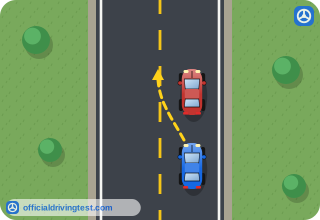
- A narrow bridge or other situation that reduces lane width
- A long straight road with a wide, clear shoulder
- A dry road with no pedestrians or bicyclists nearby
- An empty passing lane that is marked with a dashed line
Show answer
Correct answer: A narrow bridge or other situation that reduces lane width
A narrow bridge or another situation that reduces lane width can make you lose your time and space for passing.
Source: Kansas Driving Handbook (Revised February 2022), page 66
-
Before you pass, what must you be sure of about returning to the driving lane?
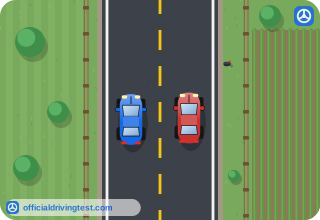
- That you have enough space to return to it
- That another driver will make space for you to return
- That the vehicle you pass will slow down to let you in
- That the oncoming driver will move over to give you room
Show answer
Correct answer: That you have enough space to return to it
Do not pass unless you have enough space to return to the driving lane, and do not count on other drivers to make space for you.
Source: Kansas Driving Handbook (Revised February 2022), page 66
-
You are facing a green light. What must you do about pedestrians in the intersection?
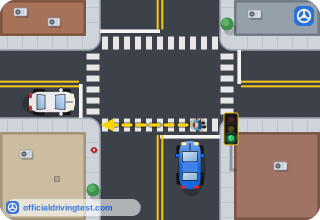
- Go ahead, because you have the green light
- Yield only to those in a crosswalk
- Honk to clear the intersection
- Yield the right-of-way to all of them
Show answer
Correct answer: Yield the right-of-way to all of them
Even facing a green light you must yield to all pedestrians in the intersection, and you may only assume right-of-way when your intended path is clear.
Source: Kansas Driving Handbook (Revised February 2022), page 80
-
When preparing to make a left turn or U-turn, what should you do about pedestrians even if you have a green arrow?
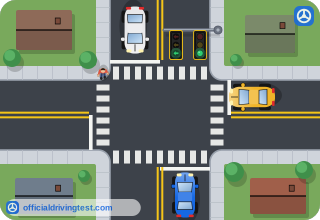
- Assume the arrow means the path is clear
- Look only for oncoming vehicles
- Check for pedestrians in your path
- Look only for pedestrians in a crosswalk
Show answer
Correct answer: Check for pedestrians in your path
Even with a green arrow, you check for pedestrians in your path before a left turn or U-turn.
Source: Kansas Driving Handbook (Revised February 2022), page 80
-
As you prepare for a right turn on a red traffic signal, whom should you be especially cautious of?
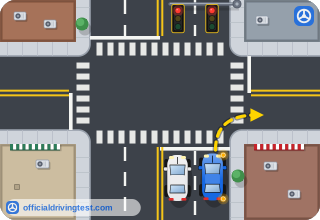
- Pedestrians approaching on your right
- Pedestrians approaching on your left
- Vehicles stopped behind you
- Vehicles turning left from the opposite direction
Show answer
Correct answer: Pedestrians approaching on your right
When preparing for a right turn, especially on a red traffic signal, you should be cautious of pedestrians approaching on your right.
Source: Kansas Driving Handbook (Revised February 2022), page 80
-
How must a driver treat a bicyclist at an intersection?
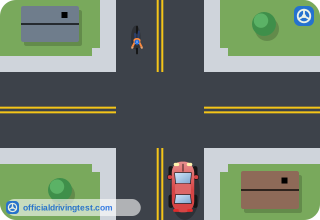
- Yield as you would for pedestrians and other vehicles
- Speed up and pass before the bicyclist enters
- Yield only when the bicyclist signals
- Yield only on roads with a bike lane
Show answer
Correct answer: Yield as you would for pedestrians and other vehicles
Drivers must yield to bicyclists in intersections as they would for pedestrians and other vehicles.
Source: Kansas Driving Handbook (Revised February 2022), page 81
-
When a bicycle path or bike lane intersects a road, who must yield the right-of-way?
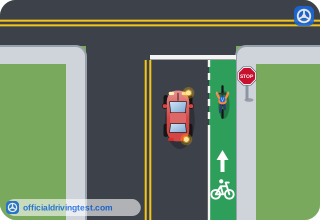
- The bicyclist must yield to the driver
- Whoever arrives first at the crossing
- The driver on the road must yield to the bicyclist
- The driver, but only if a traffic signal is present
Show answer
Correct answer: The driver on the road must yield to the bicyclist
A driver must yield the right-of-way to a bicyclist when a bicycle path or bike lane intersects a road.
Source: Kansas Driving Handbook (Revised February 2022), page 81
-
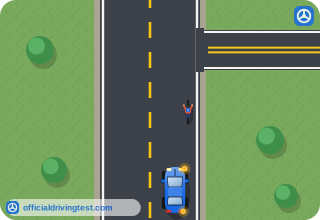
You are about to make a right turn and a bicyclist is just ahead of you. What must you not do?
- Slow down and signal
- Wait for the bicyclist to clear the intersection
- Pass the bicyclist immediately before the turn
- Check for bicyclists entering your lane
Show answer
Correct answer: Pass the bicyclist immediately before the turn
Before a right turn you must not pass a bicyclist immediately before the turn; slow down and let the cyclist clear the intersection first.
Source: Kansas Driving Handbook (Revised February 2022), page 81
-
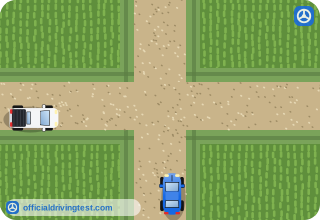
What should you do when approaching an uncontrolled rural intersection, one not controlled by yield or stop signs?
- Keep your speed because you have the right of way
- Speed up to clear the intersection before other traffic arrives
- Sound your horn and continue at the same speed
- Slow down and be prepared to stop for crossing or oncoming traffic
Show answer
Correct answer: Slow down and be prepared to stop for crossing or oncoming traffic
Uncontrolled rural intersections can be very dangerous, so slow down and be prepared to stop for crossing or oncoming traffic.
Source: Kansas Driving Handbook (Revised February 2022), page 90
-
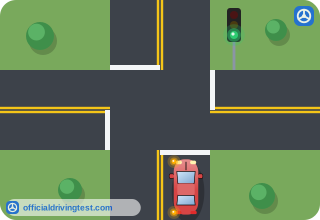
When you stop before making a turn, how should you keep the front wheels?
- Aimed straight ahead
- Turned toward the direction of the turn
- Turned toward the curb
- Turned away from the curb
Show answer
Correct answer: Aimed straight ahead
The handbook says to keep the front wheels aimed straight ahead when stopped before a turn.
Source: Kansas Driving Handbook (Revised February 2022), page 104
-
While making a turn on the road test, what should your mirror checks make sure of?
- That no vehicle behind you is trying to pass on the left
- That the vehicle ahead has finished its own turn
- That the vehicle does not hit anything inside the turn
- That the vehicle behind is not following too closely
Show answer
Correct answer: That the vehicle does not hit anything inside the turn
You keep checking your mirror to make sure the vehicle does not hit anything on the inside of the turn.
Source: Kansas Driving Handbook (Revised February 2022), page 104
-
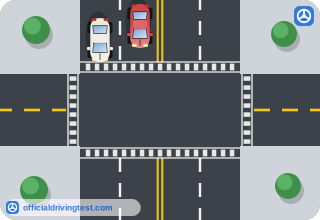
After completing a turn on the road test, which lane should you move into when it is safe?
- The center lane
- The right-most lane, if not already in it
- The left-most lane
- Any lane that has the fewest vehicles
Show answer
Correct answer: The right-most lane, if not already in it
After a turn you accelerate, signal, make a head check and move into the right-most lane when it is safe to do so, if not already there.
Source: Kansas Driving Handbook (Revised February 2022), page 104
-
What should you not do while proceeding through an intersection on the road test?
- Yield to pedestrians
- Slow down
- Keep both hands on the wheel
- Change lanes
Show answer
Correct answer: Change lanes
The handbook says not to change lanes while proceeding through the intersection.
Source: Kansas Driving Handbook (Revised February 2022), page 104
-
On a multiple lane road, in which lane should you finish a left turn?
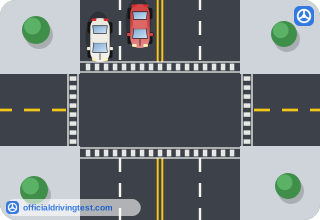
- The left-most lane, right of the centerline
- The right-most lane, next to the curb
- Whichever lane has the fewest vehicles
- The center lane when it is clear
Show answer
Correct answer: The left-most lane, right of the centerline
A vehicle should finish a left turn in the left-most lane, the one directly to the right of the centerline.
Source: Kansas Driving Handbook (Revised February 2022), page 106
-
On a multiple lane road, in which lane should you finish a right turn?
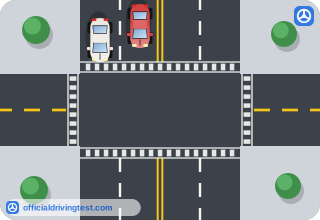
- The left-most lane
- The center lane
- The right-most (curb) lane
- The lane with the least traffic
Show answer
Correct answer: The right-most (curb) lane
The handbook says to finish a right turn in the right-most (curb) lane.
Source: Kansas Driving Handbook (Revised February 2022), page 106
-
Unless it is blocked, which lane should you move to or stay in during the road test?
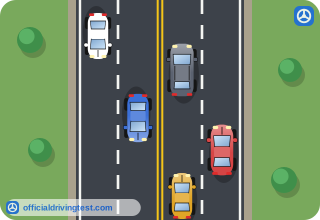
- The left-most lane
- The right-most lane
- The center lane
- The lane with the fastest traffic
Show answer
Correct answer: The right-most lane
The handbook says to move to or remain in the right-most lane unless the lane is blocked.
Source: Kansas Driving Handbook (Revised February 2022), page 106
-
During the multiple lane parts of the road test, what lane changes will you be asked to make?
- To the left, and then back to the right
- Only to the right, then stay in that lane
- To the right, and then back to the left
- Only to the left, then remain in that lane
Show answer
Correct answer: To the left, and then back to the right
You will be asked to change lanes to the left, and then back to the right.
Source: Kansas Driving Handbook (Revised February 2022), page 105
-
What should you do upon completing a lane change on the road test?
- Leave the turn signal on until the next turn
- Brake gently to show you have finished
- Cancel your turn signal and check traffic
- Honk to tell the driver behind you
Show answer
Correct answer: Cancel your turn signal and check traffic
The handbook says to cancel your turn signal upon completion of the lane change and check traffic.
Source: Kansas Driving Handbook (Revised February 2022), page 105