Iowa: Speed and following distance — Part 4 Practice Test
Questions in this part include: “Who is responsible for making sure your speed matches the conditions?” · “When are roadways safest?”
Independent educational site · not affiliated with any government agency or DMV
Ready? Test yourself
- Instant feedback with an explanation
- Every answer cites its source in the manual
- Your best score is saved on this device
Questions are original and based on the official manual "Iowa Driver’s License Manual" (July 2026), Iowa Department of Transportation.
All 16 questions in this practice test
Take the test above first, then use this list to study. Tap “Show answer” to see the correct answer and explanation.
Show the questions and answersHide the questions
-
Who is responsible for making sure your speed matches the conditions?
- The agency that posted the speed limit
- Other drivers around you
- The police officer on patrol
- You, the driver
Show answer
Correct answer: You, the driver
The manual says it is your responsibility to ensure that your speed matches conditions.
Source: Iowa Driver’s License Manual (July 2026), page 47
-
Why does the manual tell you to keep your speed down?
- Higher speeds make your headlights less effective when you drive at night
- Higher speeds make it much harder to control your vehicle if things go wrong
- Higher speeds cause your tires to lose air more quickly on every road
- Higher speeds are not allowed on roads with a painted center line
Show answer
Correct answer: Higher speeds make it much harder to control your vehicle if things go wrong
Higher speeds make controlling your vehicle much more difficult if things go wrong.
Source: Iowa Driver’s License Manual (July 2026), page 47
-
What does the manual say vehicles moving faster or slower than the flow of traffic cause?
- More lane changes, passing, and following too closely
- Smoother traffic flow, because drivers adjust sooner
- Fewer lane changes, because lanes stay open longer
- Shorter trips, because slower drivers are passed quickly
Show answer
Correct answer: More lane changes, passing, and following too closely
Vehicles moving faster or slower than traffic increase lane changes, passing, and following too closely, which increases the chance of collisions.
Source: Iowa Driver’s License Manual (July 2026), page 48
-
When are roadways safest?
- When all vehicles travel the same speed but do not exceed the speed limit
- When most vehicles travel a little above the posted speed limit
- When faster vehicles pass slower ones as often as they possibly can
- When every driver chooses the speed that feels most comfortable
Show answer
Correct answer: When all vehicles travel the same speed but do not exceed the speed limit
The safest roadways are those where all vehicles travel the same speed but do not exceed the speed limit.
Source: Iowa Driver’s License Manual (July 2026), page 48
-
If you spot a slow vehicle early, what do you have time to do?
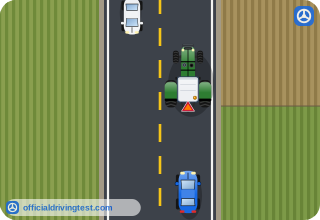
- Brake hard to match its speed at once
- Tap the horn to ask it to speed up
- Change lanes or slow down safely
- Follow closely until it turns off
Show answer
Correct answer: Change lanes or slow down safely
If you spot slow vehicles early, you have time to change lanes or slow down safely; slowing suddenly can cause a crash.
Source: Iowa Driver’s License Manual (July 2026), page 48
-
Which driving behavior does the manual say causes many collisions?
- Driving below the speed limit in the right lane
- Signaling too early before a turn
- Checking mirrors too often
- Following the vehicle ahead too closely
Show answer
Correct answer: Following the vehicle ahead too closely
Many collisions are caused by following the vehicle ahead too closely.
Source: Iowa Driver’s License Manual (July 2026), page 48
-
What do higher speeds require when you are following another vehicle?
- Shorter stopping distances
- The same stopping distance as slower speeds
- Less attention to the vehicle ahead
- Greater stopping distances
Show answer
Correct answer: Greater stopping distances
Higher speeds require greater stopping distances, so keep this in mind when following another vehicle.
Source: Iowa Driver’s License Manual (July 2026), page 48
-
If you are being tailgated, how can you give the tailgater a better view of what is ahead?
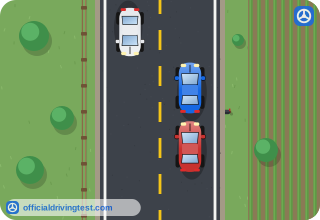
- Move slightly to the left
- Move onto the shoulder and slow down
- Move slightly to the right
- Move to the center of your lane and speed up
Show answer
Correct answer: Move slightly to the right
When tailgated, you should move slightly to the right to give the tailgater a better view of what is ahead.
Source: Iowa Driver’s License Manual (July 2026), page 48
-
If you are being tailgated, when should you signal for turns, stops, or lane changes?
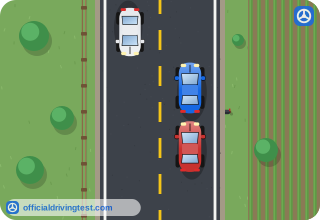
- Early
- At the last moment
- Only at intersections
- Only when other cars are close
Show answer
Correct answer: Early
The manual says to signal early for turns, stops, or lane changes when you are being tailgated.
Source: Iowa Driver’s License Manual (July 2026), page 48
-
Which action may encourage a tailgater to pass you?
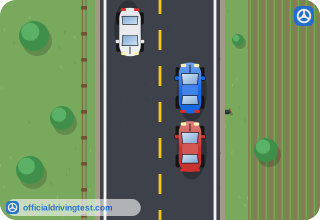
- Slowing down
- Speeding up
- Turning on your hazard lights
- Moving to the left side of your lane
Show answer
Correct answer: Slowing down
The manual says to try slowing down and encouraging the driver behind you to pass.
Source: Iowa Driver’s License Manual (July 2026), page 48
-
If you are being tailgated and everything else fails, what should you do?
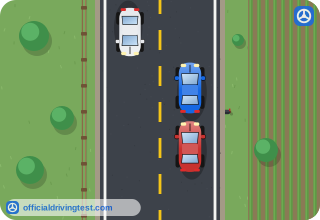
- Speed up to open a gap
- Brake hard to make the driver back off
- Pull out of the traffic flow
- Stop in the traffic lane
Show answer
Correct answer: Pull out of the traffic flow
If all else fails with a tailgater, you should pull out of the traffic flow.
Source: Iowa Driver’s License Manual (July 2026), page 48
-
Why is driving on loose gravel harder than driving on pavement?
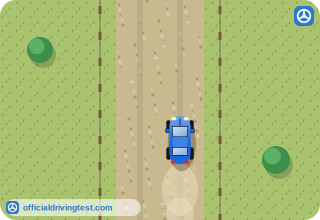
- Your tires don't have the traction needed to give you stable control
- Gravel roads are always much narrower than paved roads are
- Gravel roads are always posted with much lower speed limits
- Loose gravel makes your brake lights hard for others to see
Show answer
Correct answer: Your tires don't have the traction needed to give you stable control
On loose gravel the tires lack the traction needed for stable control.
Source: Iowa Driver’s License Manual (July 2026), page 55
-
How should you steer on loose gravel?
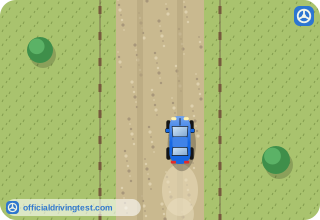
- Turn sharply to keep the tires gripping
- Steer back and forth to clear the gravel
- Avoid sudden turning
- Hold the wheel loosely so the tires can slide
Show answer
Correct answer: Avoid sudden turning
The manual advises slowing down and avoiding sudden turning on loose gravel.
Source: Iowa Driver’s License Manual (July 2026), page 55
-
How should you accelerate and brake on loose gravel?
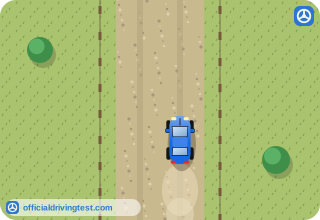
- Slowly
- Quickly, to regain traction
- Only by braking and never by accelerating
- With sudden, short taps
Show answer
Correct answer: Slowly
On loose gravel, accelerate and brake slowly.
Source: Iowa Driver’s License Manual (July 2026), page 55
-
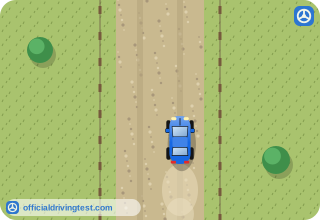
What should you do with your following distance on loose gravel?
- Shorten it to stay closer to the car ahead
- Keep it the same as on pavement
- Increase it
- Match it to the speed of dust clouds
Show answer
Correct answer: Increase it
On loose gravel you should slow down and increase your following distance.
Source: Iowa Driver’s License Manual (July 2026), page 55
-
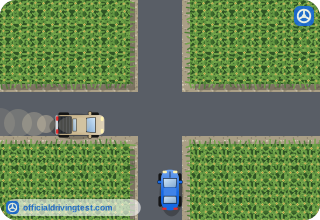
What does the manual advise about trees, cornfields, buildings, hills, and dust that block your view on rural roads?
- Speed up to pass through blind areas as quickly as possible
- Identify blind spots to better anticipate potential dangers
- Use your horn continuously while you drive through the blind area
- Drive in the center of the road so that you can see farther
Show answer
Correct answer: Identify blind spots to better anticipate potential dangers
The manual says to identify blind spots to better anticipate and be prepared for potential dangers.
Source: Iowa Driver’s License Manual (July 2026), page 55