Iowa: Railroad crossings — Part 1 Practice Test
Questions in this part include: “Where are railroad crossing (crossbuck) signs placed?” · “How are passively protected railroad crossings marked?”
Independent educational site · not affiliated with any government agency or DMV
Ready? Test yourself
- Instant feedback with an explanation
- Every answer cites its source in the manual
- Your best score is saved on this device
Questions are original and based on the official manual "Iowa Driver’s License Manual" (July 2026), Iowa Department of Transportation.
All 23 questions in this practice test
Take the test above first, then use this list to study. Tap “Show answer” to see the correct answer and explanation.
Show the questions and answersHide the questions
-
Where are railroad crossing (crossbuck) signs placed?
- Only at crossings that have flashing lights
- At each crossing
- Only at crossings on interstate highways
- Only at crossings with several tracks
Show answer
Correct answer: At each crossing
Railroad crossing signs are placed at each crossing.
Source: Iowa Driver’s License Manual (July 2026), page 7
-
What does a number sign under the crossbucks show?
- How many sets of train tracks you must cross
- How many trains use the crossing each day
- How many feet away the next crossing is
- How many cars may wait between the tracks
Show answer
Correct answer: How many sets of train tracks you must cross
The number sign under the crossbucks shows how many sets of train tracks you must cross.
Source: Iowa Driver’s License Manual (July 2026), page 7
-
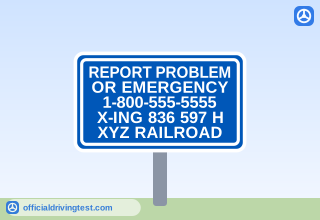
Where is the blue Emergency Notification System (ENS) sign posted?
- Only on the right side before the crossing
- Only at crossings without gates
- On both sides of the railroad crossing
- On the road a mile before each crossing
Show answer
Correct answer: On both sides of the railroad crossing
The blue Emergency Notification System (ENS) sign is posted on both sides of the railroad crossing.
Source: Iowa Driver’s License Manual (July 2026), page 8
-
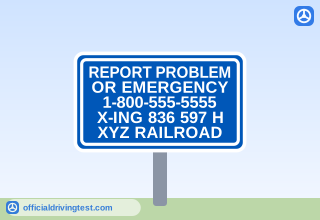
What does the Emergency Notification System (ENS) sign at a railroad crossing include?
- The names of nearby towns and the distance to each one
- The train schedule and the expected delay for the crossing
- The speed limit for trains and the date the crossing was built
- A phone number for the railroad and a unique crossing ID number
Show answer
Correct answer: A phone number for the railroad and a unique crossing ID number
The ENS sign includes a phone number to contact the railroad and a unique crossing identification number.
Source: Iowa Driver’s License Manual (July 2026), page 8
-
What should drivers use the Emergency Notification System (ENS) sign information to report?
- Stalled vehicles, malfunctioning signals, or other hazards at the crossing
- Trains that are running ahead of schedule or late
- Questions about train schedules and ticket prices for travelers
- Complaints about the noise of train horns near homes
Show answer
Correct answer: Stalled vehicles, malfunctioning signals, or other hazards at the crossing
Drivers should use the phone number and crossing ID to report stalled vehicles, malfunctioning signals, or other hazardous situations at the crossing.
Source: Iowa Driver’s License Manual (July 2026), page 8
-
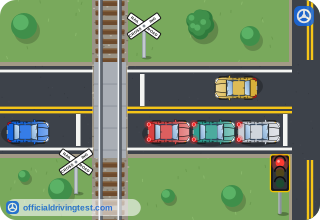
Why should you never stop your vehicle on railroad tracks?
- Trains cannot stop quickly
- Tracks are slippery in all weather
- A stopped vehicle sets off the crossing signals
- Railroad police ticket every stopped vehicle
Show answer
Correct answer: Trains cannot stop quickly
The manual tells drivers to use extra caution at railroad crossings and never stop on the tracks, because trains cannot stop quickly.
Source: Iowa Driver’s License Manual (July 2026), page 12
-
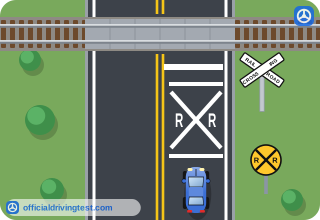
What should you do as you approach railroad tracks?
- Put your windows up and turn on your radio to stay alert
- Speed up so you clear the tracks quickly
- Eliminate distractions, put windows down, and turn off music
- Flash your headlights to warn the train
Show answer
Correct answer: Eliminate distractions, put windows down, and turn off music
The manual says that as you approach tracks you should eliminate distractions, put your windows down, and turn off your music so you can notice a train.
Source: Iowa Driver’s License Manual (July 2026), page 12
-
What do highway-railroad crossings post in case of an emergency?
- The speed limit of the nearest train and a mile marker
- The name of the railroad and a number to call
- The county sheriff's name and a service center address
- The date of the last track inspection and a map
Show answer
Correct answer: The name of the railroad and a number to call
Highway-railroad crossings have the name of the railroad and a number to call posted in case of emergency.
Source: Iowa Driver’s License Manual (July 2026), page 12
-
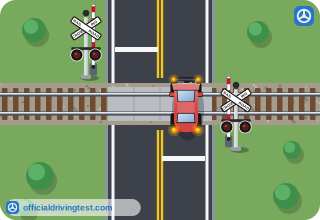
If you become aware of a signal malfunction or a stalled vehicle at a railroad crossing, what should you do?
- Wait at the crossing until a train comes and signals you
- Stay at the crossing and direct other drivers across
- Report it the next time you renew your license
- Call the number posted to notify the appropriate railroad
Show answer
Correct answer: Call the number posted to notify the appropriate railroad
The manual says to call the number posted at the crossing to notify the appropriate railroad of a signal malfunction or other dangerous situation.
Source: Iowa Driver’s License Manual (July 2026), page 12
-
Which railroad crossings are called actively protected?
- Crossings where a police officer always directs traffic
- Crossings that have an EXEMPT sign posted
- Crossings equipped with lights and/or gates
- Crossings that only buses may use
Show answer
Correct answer: Crossings equipped with lights and/or gates
Actively protected railroad crossings are equipped with lights and/or gates.
Source: Iowa Driver’s License Manual (July 2026), page 12
-
What does it mean when a railroad crossing's lights are flashing or its gates are down?
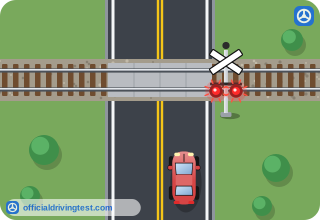
- A train is approaching
- The crossing is closed for repairs
- A train has just passed and you may go
- The signals are malfunctioning
Show answer
Correct answer: A train is approaching
Flashing lights or lowered gates at a railroad crossing mean a train is approaching, so drivers must always obey these warning signals.
Source: Iowa Driver’s License Manual (July 2026), page 12
-
How are passively protected railroad crossings marked?
- With flashing red lights and gates that lower
- With flashing lights but no gate arms
- With a flagger holding a stop/slow paddle
- Only with a crossbuck and a stop or yield sign
Show answer
Correct answer: Only with a crossbuck and a stop or yield sign
Passively protected crossings have no lights or gates and are only marked with a crossbuck and a stop or yield sign.
Source: Iowa Driver’s License Manual (July 2026), page 12
-
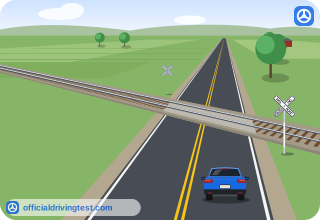
What should you do at a passively protected railroad crossing?
- Keep your speed and rely on the lights to warn you
- Slow down and look for an oncoming train
- Speed up so you clear the tracks before a train comes
- Wait for the gates to lower before you slow down
Show answer
Correct answer: Slow down and look for an oncoming train
At a passively protected crossing you should slow down and look for an oncoming train, and never rely on lights or gates because you should always expect a train.
Source: Iowa Driver’s License Manual (July 2026), page 12
-
Which of these drivers must stop before crossing railroad tracks, unless an exception applies?
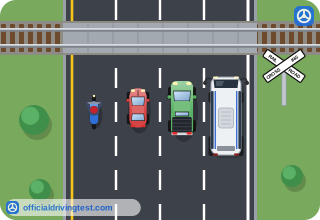
- The driver of a charter bus
- The driver of a pickup truck with an empty bed
- The driver of a sports car
- The driver of a motorcycle
Show answer
Correct answer: The driver of a charter bus
All school buses, charter buses, drivers carrying passengers for hire and vehicles required to be placarded for hazardous materials must stop before crossing railroad tracks.
Source: Iowa Driver’s License Manual (July 2026), page 12
-
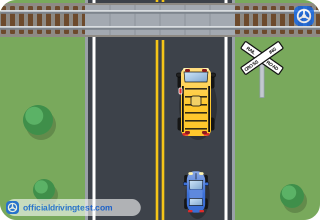
How close to railroad tracks must a school bus stop before crossing?
- Within 5 to 15 feet
- Within 50 to 100 feet
- Within 15 to 50 feet
- Within 25 to 75 feet
Show answer
Correct answer: Within 15 to 50 feet
School buses, charter buses, drivers carrying passengers for hire and vehicles placarded for hazardous materials must stop within 15 to 50 feet of the tracks before crossing.
Source: Iowa Driver’s License Manual (July 2026), page 12
-
When does a driver who normally must stop at a railroad crossing not have to stop?
- When no other vehicle is behind the driver
- When a police officer or traffic signal directs traffic to proceed
- When the driver can see far down the tracks in both directions
- When the vehicle is traveling empty with no passengers
Show answer
Correct answer: When a police officer or traffic signal directs traffic to proceed
A driver does not have to stop if a police officer or highway traffic signal directs highway traffic to proceed.
Source: Iowa Driver’s License Manual (July 2026), page 12
-
A vehicle that normally must stop at railroad crossings does not have to stop at a crossing marked with which sign?
- A railroad advance warning sign
- A low ground clearance sign
- An Emergency Notification System sign
- An EXEMPT sign
Show answer
Correct answer: An EXEMPT sign
The stop requirement does not apply at a crossing that is marked with an EXEMPT sign.
Source: Iowa Driver’s License Manual (July 2026), page 12
-
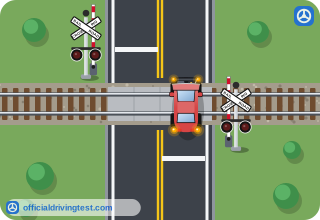
Which sign gives the number to call if your vehicle is stuck or stalls at a railroad crossing?
- The blue and white ENS sign
- The yellow advance warning sign
- The white crossbuck sign
- The red YIELD sign
Show answer
Correct answer: The blue and white ENS sign
You should call the number on the blue and white Emergency Notification System (ENS) sign at the crossing.
Source: Iowa Driver’s License Manual (July 2026), page 12
-
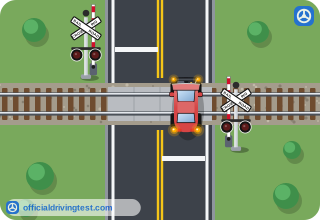
When you call the number on an Emergency Notification System sign about a stuck vehicle, what should you share with the dispatcher?
- Your driver's license number
- Your vehicle's license plate number
- The train's engine number
- The crossing ID number
Show answer
Correct answer: The crossing ID number
The caller should share the crossing ID number shown on the sign with the dispatcher.
Source: Iowa Driver’s License Manual (July 2026), page 12
-
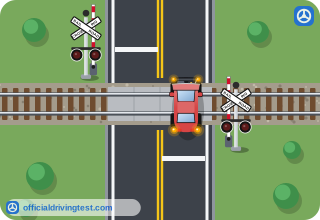
What should you do if your vehicle is stuck at a railroad crossing that has no Emergency Notification System sign?
- Wait for a train crew to find you
- Call 911
- Call the county treasurer's office
- Call your insurance company
Show answer
Correct answer: Call 911
If there is no Emergency Notification System sign, the manual says to call 911.
Source: Iowa Driver’s License Manual (July 2026), page 12
-
Where is the only safe and legal place for anyone to cross railroad tracks?
- At designated crossings
- At any point where the tracks are level with the ground
- Anywhere there is no train visible in either direction
- At any road shoulder next to the tracks
Show answer
Correct answer: At designated crossings
The only safe and legal place for anyone to cross railroad tracks is at designated crossings.
Source: Iowa Driver’s License Manual (July 2026), page 12
-
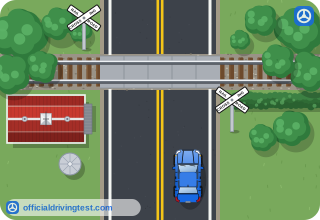
Not every railroad crossing has gates. What should you watch for that tells you railroad tracks cross the road ahead?
- Gates that come down at every crossing
- A police officer posted at the crossing
- Advance warning signs and pavement markings
- Bright orange cones placed on the road
Show answer
Correct answer: Advance warning signs and pavement markings
Not all train tracks have gates. Watch for advance warning signs and pavement markings indicating railroad tracks cross the road ahead.
Source: Iowa Driver’s License Manual (July 2026), page 12
-
Why do rail cars have reflective stripes?
- To help railroad crews count and identify each car in a yard
- To be easier to see at night and in low visibility
- To reduce the heat of the sun on the cars during summer
- To show nearby drivers how fast the train is moving
Show answer
Correct answer: To be easier to see at night and in low visibility
Rail cars have reflective stripes to enhance their visibility at night and in low-visibility conditions such as rain, snow, or fog.
Source: Iowa Driver’s License Manual (July 2026), page 12