Indiana: Seat belts and child safety Practice Test
Seat belts, child restraints, booster seats, air bags and head restraints.
Independent educational site · not affiliated with any government agency or DMV
Ready? Test yourself
- Instant feedback with an explanation
- Every answer cites its source in the manual
- Your best score is saved on this device
Questions are original and based on the official manual "Indiana Driver’s Manual" (July 2026), Indiana Bureau of Motor Vehicles.
All 22 questions in this practice test
Take the test above first, then use this list to study. Tap “Show answer” to see the correct answer and explanation.
Show the questions and answersHide the questions
-
Under Indiana law, who must wear the factory-installed seat belt any time the motor vehicle is in motion?
- Only the driver
- All occupants of the vehicle
- Only front-seat occupants
- Only passengers under 16
Show answer
Correct answer: All occupants of the vehicle
Indiana law requires all occupants of a motor vehicle equipped with a manufacturer-installed seat belt to wear it any time the vehicle is in motion.
Source: Indiana Driver’s Manual (July 2026), page 11 · Open this page in the manual (Manual page 11)
-
Who must wear a seat belt in an autocycle?
- The operator and each occupant
- The operator only
- Only occupants under 18 years of age
- Only the occupant in the front seat
Show answer
Correct answer: The operator and each occupant
The operator and each occupant of an autocycle must wear a seat belt.
Source: Indiana Driver’s Manual (July 2026), page 15 · Open this page in the manual (Manual page 15)
-
What happens to the effectiveness of restraint devices like air bags and safety belts as speed increases?
- It increases
- It declines
- It stays the same
- It improves only for air bags
Show answer
Correct answer: It declines
The manual says the effectiveness of restraint devices like air bags and safety belts declines as speed increases.
Source: Indiana Driver’s Manual (July 2026), page 40 · Open this page in the manual (Manual page 40)
-
Who does Indiana law require to use seat belts when a vehicle is in operation?
- Only the driver
- Only the driver and the front-seat passengers
- The driver and all passengers
- Only passengers riding in the rear seat
Show answer
Correct answer: The driver and all passengers
The manual says Indiana law requires a driver and all passengers to use seat belts at all times when a vehicle is in operation.
Source: Indiana Driver’s Manual (July 2026), page 55 · Open this page in the manual (Manual page 55)
-
What does the manual say about seat belts for operators of buses?
- They are also required to use a seat belt
- They are exempt from the seat belt requirement
- They must use one only on highways
- They must use one only when carrying passengers
Show answer
Correct answer: They are also required to use a seat belt
The manual says operators of buses are also required to use a seat belt.
Source: Indiana Driver’s Manual (July 2026), page 55 · Open this page in the manual (Manual page 55)
-
Is a seat belt required in a vehicle that has air bags?
- No, air bags replace the need for a seat belt
- Yes, but only for the driver of the vehicle
- Yes, it must be used even with one or more air bags
- No, a seat belt is needed only on highways
Show answer
Correct answer: Yes, it must be used even with one or more air bags
The manual says a seat belt must be used even in a vehicle with one or more air bags.
Source: Indiana Driver’s Manual (July 2026), page 55 · Open this page in the manual (Manual page 55)
-
What could happen if you do not use a seat belt in a vehicle with air bags?
- The air bag will not deploy in a collision
- You could be injured by the air bag
- The air bag will deploy with less force
- The seat belt will lock the air bag in place
Show answer
Correct answer: You could be injured by the air bag
The manual says failure to use a seat belt could result in injury from the air bag.
Source: Indiana Driver’s Manual (July 2026), page 55 · Open this page in the manual (Manual page 55)
-
Where should seat belts be positioned on your body?
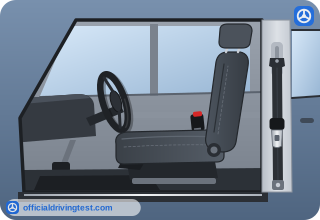
- High on the waist and loose over the shoulder
- Across the stomach and under the arm
- Around the ribs and across the throat
- Low on the hips and flat across the collar bone
Show answer
Correct answer: Low on the hips and flat across the collar bone
The manual says everyone should wear their seat belts low on the hips and flat across the collar bone.
Source: Indiana Driver’s Manual (July 2026), page 55 · Open this page in the manual (Manual page 55)
-
What is the minimum distance the driver should sit from the steering wheel?
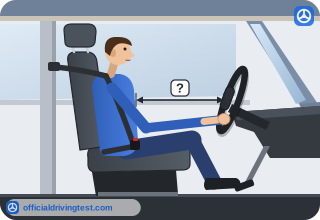
- At least 6 inches
- At least 12 inches
- At least 8 inches
- At least 18 inches
Show answer
Correct answer: At least 12 inches
The manual says the driver should sit at least 12 inches away from the steering wheel.
Source: Indiana Driver’s Manual (July 2026), page 55 · Open this page in the manual (Manual page 55)
-
How should head restraints be positioned?
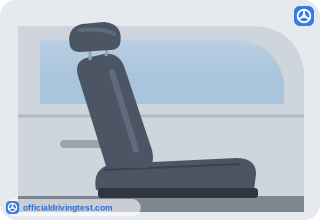
- Level with the neck and a few inches behind the head
- Lower than the top of the head and as far back as possible
- Level with the ears and angled away from the head
- Higher than the top and as close as possible to the back of the head
Show answer
Correct answer: Higher than the top and as close as possible to the back of the head
The manual says head restraints should be higher than the top and as close as possible to the back of an individual's head.
Source: Indiana Driver’s Manual (July 2026), page 55 · Open this page in the manual (Manual page 55)
-
What must a driver or passenger have to be excused from wearing a seat belt for medical reasons?
- Written documentation of the medical reasons from a physician
- A signed statement from the driver's employer about the condition
- A letter from the person's insurance company or agent
- A card issued by the driver education instructor or school
Show answer
Correct answer: Written documentation of the medical reasons from a physician
The manual says the medical exemption applies provided the person has written documentation of the medical reasons from a physician.
Source: Indiana Driver’s Manual (July 2026), page 56 · Open this page in the manual (Manual page 56)
-
Which of these people is not required to use a seat belt?
- The operator of a bus
- The operator of a truck on a construction site
- An occupant of the treatment area of an ambulance
- A front-seat passenger in a passenger car
Show answer
Correct answer: An occupant of the treatment area of an ambulance
The manual lists an occupant of the treatment area of an ambulance as exempt, while bus operators and drivers must wear seat belts.
Source: Indiana Driver’s Manual (July 2026), page 56 · Open this page in the manual (Manual page 56)
-
A seat belt is not required for an occupant of which area?
- The living quarters area of a recreational vehicle
- The front passenger seat of a recreational vehicle
- The cab of a tractor trailer
- The driver's seat of a motor home
Show answer
Correct answer: The living quarters area of a recreational vehicle
The manual lists an occupant of the living quarters area of a recreational vehicle as exempt.
Source: Indiana Driver’s Manual (July 2026), page 56 · Open this page in the manual (Manual page 56)
-
Who in a truck on a construction site is exempt from the seat belt requirement?
- Only the operator
- Every occupant, including the operator
- Any occupant other than the operator
- No one in the truck
Show answer
Correct answer: Any occupant other than the operator
The manual exempts an occupant, other than the operator, of a truck on a construction site.
Source: Indiana Driver’s Manual (July 2026), page 56 · Open this page in the manual (Manual page 56)
-
Seat belts are not required when traveling in a commercial or United States Postal Service vehicle that does what?
- Travels on highways at high speed for most of its route
- Makes frequent stops to pick up or deliver goods and services
- Operates only during daylight hours on paved roads
- Carries more than one passenger at a time in the cab
Show answer
Correct answer: Makes frequent stops to pick up or deliver goods and services
The manual exempts travel in a commercial or Postal Service vehicle that makes frequent stops for the purpose of pickup or delivery of goods and services.
Source: Indiana Driver’s Manual (July 2026), page 56 · Open this page in the manual (Manual page 56)
-
Passengers younger than what age are required by law to be properly secured in a child restraint system?
- Five years
- Six years
- Ten years
- Eight years
Show answer
Correct answer: Eight years
The manual says passengers younger than eight years of age must be properly secured in a child restraint system such as a car seat or booster seat.
Source: Indiana Driver’s Manual (July 2026), page 56 · Open this page in the manual (Manual page 56)
-
If a car has a passenger-side air bag, the National Safety Council recommends putting children younger than what age in the back seat?
- 5 years
- 12 years
- 8 years
- 10 years
Show answer
Correct answer: 12 years
The manual says the National Safety Council recommends putting children younger than 12 years of age in the back seat.
Source: Indiana Driver’s Manual (July 2026), page 56 · Open this page in the manual (Manual page 56)
-
According to Appendix B, what is the best way to reduce the chance of injury or death in a crash?
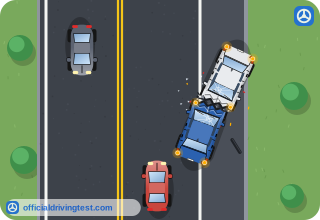
- Driving only during daylight hours
- Wearing a seat belt
- Driving with no passengers
- Keeping the radio off
Show answer
Correct answer: Wearing a seat belt
Wearing a seat belt is not just the law but also the best way to reduce the chance of injury or death in a crash.
Source: Indiana Driver’s Manual (July 2026), page 71 · Open this page in the manual (Manual page 71)
-
How often do the tips for parents say to require seat belt use?
- Only on highways
- Only when driving alone
- Only at night
- At all times
Show answer
Correct answer: At all times
The tips for parents say to require seat belt use at all times.
Source: Indiana Driver’s Manual (July 2026), page 72 · Open this page in the manual (Manual page 72)
-
Anyone under what age who operates or rides an off-road vehicle (ORV) shall wear a helmet?
- Under 14
- Under 16
- Under 18
- Under 21
Show answer
Correct answer: Under 18
Anyone under 18 years of age who operates or rides an ORV shall wear a helmet.
Source: Indiana Driver’s Manual (July 2026), page 72 · Open this page in the manual (Manual page 72)
-
An ORV helmet must meet standards established by which organization?
- The Indiana Bureau of Motor Vehicles
- The United States Department of Transportation
- The Indiana Department of Natural Resources
- The National Safety Council
Show answer
Correct answer: The United States Department of Transportation
The helmet must meet standards established by the United States Department of Transportation under 49 CFR 571.218.
Source: Indiana Driver’s Manual (July 2026), page 72 · Open this page in the manual (Manual page 72)
-
What may the owner of an off-road vehicle (ORV) not knowingly do?
- Sell it to a person who does not hold a valid driver's license
- Operate it on private property at any time between sunset and sunrise
- Keep it in a garage that is not locked when it is not in use
- Permit someone under 18 to operate it without a helmet meeting the standards
Show answer
Correct answer: Permit someone under 18 to operate it without a helmet meeting the standards
The owner may not knowingly authorize or permit a person under 18 to operate the ORV without a helmet that meets the standards.
Source: Indiana Driver’s Manual (July 2026), page 72 · Open this page in the manual (Manual page 72)