Indiana: Right-of-way and turning
Who yields at intersections and all-way stops, turns, U-turns, roundabouts, passing and funeral processions. Split into 2 shorter tests so you're not stuck in one long quiz.
Independent educational site · not affiliated with any government agency or DMV
Choose a part
Right-of-way and turning — Part 1
Questions in this part include: “How many vehicles at a time may move into an intersection to turn left?”
StartRight-of-way and turning — Part 2
Questions in this part include: “What guides drivers to the proper lane in advance of the circulatory roadway of a roundabout?”
StartAll 44 Right-of-way and turning questions with answers
Choose a part above to take a practice test, or study every question and answer here.
Show the questions and answersHide the questions
-
Which traffic has the right of way when you are facing a red light?
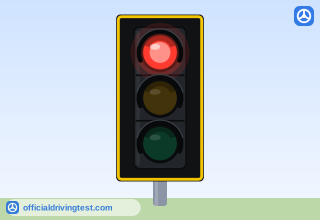
- Traffic traveling in the same direction that you are
- Only vehicles that are turning left
- Traffic entering the intersection from other directions
- Only vehicles that are turning right
Show answer
Correct answer: Traffic entering the intersection from other directions
A red light means stop, and traffic entering the intersection from other directions has the right of way.
Source: Indiana Driver’s Manual (July 2026), page 33 · Open this page in the manual (Manual page 33)
-
You face a green arrow displayed with a red or green light. What may you do?
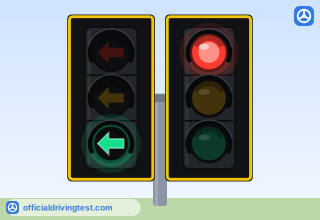
- Turn only after yielding to all oncoming traffic
- Turn through the intersection, as long as it is clear
- Turn only after coming to a full stop
- Go straight only, because the arrow shows direction
Show answer
Correct answer: Turn through the intersection, as long as it is clear
Facing a green arrow with a red or green light, you have the right of way and may turn as long as the intersection is clear.
Source: Indiana Driver’s Manual (July 2026), page 34 · Open this page in the manual (Manual page 34)
-
What must you do when turning left on a green light that is displayed without an arrow?
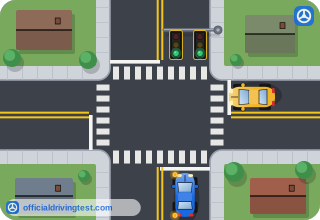
- Speed up so you turn before oncoming traffic arrives
- Turn first, because the green light gives you the right of way
- Wait for a green arrow to appear before turning
- Yield the right of way to all oncoming traffic
Show answer
Correct answer: Yield the right of way to all oncoming traffic
With a green light and no arrow, you may turn if the intersection is clear but you must yield the right of way to all oncoming traffic.
Source: Indiana Driver’s Manual (July 2026), page 34 · Open this page in the manual (Manual page 34)
-
How many vehicles at a time may move into an intersection to turn left?
- One vehicle
- Two vehicles
- Three vehicles
- Any number that will fit
Show answer
Correct answer: One vehicle
The manual says only one vehicle at a time may move into an intersection to turn left.
Source: Indiana Driver’s Manual (July 2026), page 34 · Open this page in the manual (Manual page 34)
-
The light turns red while you are in the middle of an intersection. When may you turn?
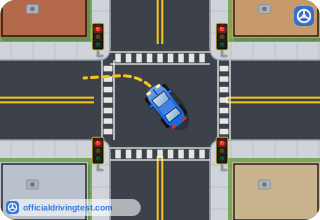
- Immediately, because oncoming traffic must yield to you
- Once oncoming traffic has stopped
- Only after the light turns green again
- Only after you back out of the intersection
Show answer
Correct answer: Once oncoming traffic has stopped
If you are in the middle of an intersection when your right of way has ended, you may turn once oncoming traffic has stopped.
Source: Indiana Driver’s Manual (July 2026), page 34 · Open this page in the manual (Manual page 34)
-
Before turning right through a red light or arrow, where permissible, what must you do first?
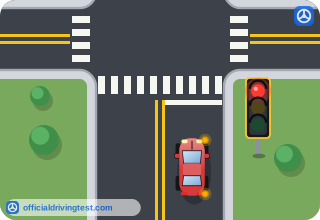
- Slow down and roll through if the intersection looks clear
- Wait for oncoming traffic to turn left first
- Flash your headlights at the cross traffic
- Come to a full stop
Show answer
Correct answer: Come to a full stop
To turn right on red, when permissible, you must come to a full stop and check for vehicles, pedestrians and signs.
Source: Indiana Driver’s Manual (July 2026), page 34 · Open this page in the manual (Manual page 34)
-
Which check is required before you turn right through a red light, when permissible?
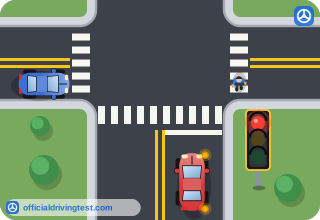
- That there is not a "No Turn on Red" sign
- That the cross street has a stop sign
- That no vehicle behind you is closer than a block
- That the intersection has a marked crosswalk
Show answer
Correct answer: That there is not a "No Turn on Red" sign
Before a right turn on red you must also check that there is not a "No Turn on Red" sign and use the correct lane.
Source: Indiana Driver’s Manual (July 2026), page 34 · Open this page in the manual (Manual page 34)
-
When may you turn left through an intersection with a red light or arrow?
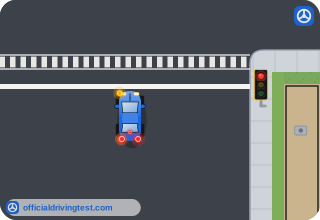
- When turning from a two-way street onto a one-way street
- When turning from a one-way street onto a two-way street
- When turning from a one-way street onto a one-way street
- When no oncoming traffic is visible
Show answer
Correct answer: When turning from a one-way street onto a one-way street
A left turn on red is allowed only when turning from a one-way street onto a one-way street, after a full stop and the required checks.
Source: Indiana Driver’s Manual (July 2026), page 34 · Open this page in the manual (Manual page 34)
-
You are turning left at a yellow flashing light that has no arrow. What must you do?
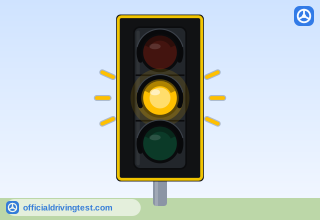
- Stop completely and wait for the light to turn green
- Turn ahead of oncoming traffic, because you have the right of way
- Turn only after the cross street traffic has passed
- Yield to oncoming traffic and pedestrians
Show answer
Correct answer: Yield to oncoming traffic and pedestrians
At a yellow flashing light, a driver turning left must yield to oncoming traffic and pedestrians.
Source: Indiana Driver’s Manual (July 2026), page 34 · Open this page in the manual (Manual page 34)
-
You face a yellow flashing light with no arrow. What must traffic on the cross street do?
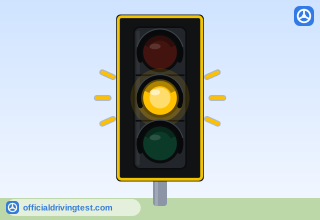
- Yield the right of way to you
- Proceed first, since their light is not flashing
- Proceed first, because cross traffic has the right of way
- Take turns with you, first come first served
Show answer
Correct answer: Yield the right of way to you
At a yellow flashing light, all traffic on the cross street is required to yield the right of way to you.
Source: Indiana Driver’s Manual (July 2026), page 34 · Open this page in the manual (Manual page 34)
-
At a red flashing light where cross-traffic is not required to stop, when may you proceed?
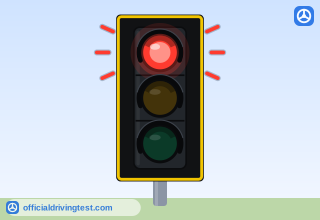
- As soon as you have stopped and the cross-traffic driver waves you on
- Whenever cross-traffic has slowed down to let you through
- Only after cross-traffic has stopped completely
- Only when the intersection is clear and you will not interfere with cross-traffic
Show answer
Correct answer: Only when the intersection is clear and you will not interfere with cross-traffic
Facing a red flashing light where cross-traffic need not stop, you may proceed only when the intersection is clear and you will not interfere with the right of way of cross-traffic.
Source: Indiana Driver’s Manual (July 2026), page 34 · Open this page in the manual (Manual page 34)
-
At a red flashing light where all traffic must stop, which vehicles must you yield to before you proceed?
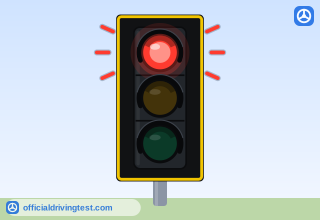
- Vehicles already in the intersection and vehicles that stopped before entering it
- Only vehicles that are turning left or crossing from the cross street
- Only vehicles that arrive at the intersection after you have stopped
- Only emergency vehicles, school buses and vehicles that are turning
Show answer
Correct answer: Vehicles already in the intersection and vehicles that stopped before entering it
After stopping you may proceed only after yielding to any vehicle already in the intersection and any vehicle that stopped before entering it.
Source: Indiana Driver’s Manual (July 2026), page 34 · Open this page in the manual (Manual page 34)
-
What must a driver do when approaching a yield sign?
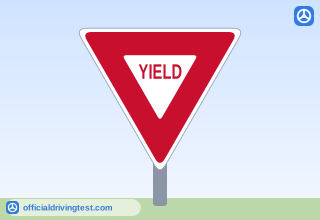
- Always come to a complete stop before entering
- Maintain speed whenever no other vehicle is in sight
- Slow down and be prepared to come to a complete stop
- Stop only if a pedestrian is crossing
Show answer
Correct answer: Slow down and be prepared to come to a complete stop
A yield sign indicates that a driver must slow down and be prepared to come to a complete stop if a vehicle or pedestrian with the right of way is approaching.
Source: Indiana Driver’s Manual (July 2026), page 35 · Open this page in the manual (Manual page 35)
-
When you approach a yield sign, what should a vehicle with the right of way coming from another direction not have to do?
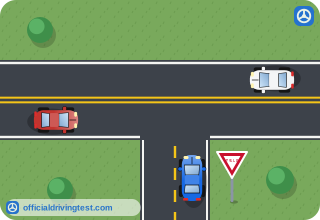
- Move over to let you merge
- Brake to avoid a collision with you
- Sound its horn to warn you
- Wait for you to complete your turn
Show answer
Correct answer: Brake to avoid a collision with you
If you are approaching a yield sign, a vehicle approaching from another direction with the right of way should not have to brake to avoid a collision with you.
Source: Indiana Driver’s Manual (July 2026), page 35 · Open this page in the manual (Manual page 35)
-
At an intersection with a non-operating signal, you stop and a vehicle arrives at the same time as you. When must you yield to that vehicle?
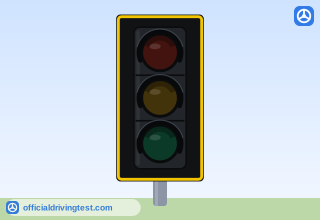
- When it is to your right
- When it is to your left
- When it is larger than your vehicle
- When it is going straight
Show answer
Correct answer: When it is to your right
After stopping at a non-operating signal, you must yield to any vehicle that arrived at the same time as you and is to your right.
Source: Indiana Driver’s Manual (July 2026), page 35 · Open this page in the manual (Manual page 35)
-
Before entering a street from an alley or driveway, what should you do?
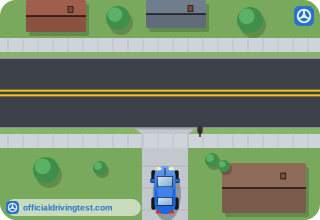
- Slow down and sound your horn
- Enter first, because you are the vehicle on the left
- Stop and yield the right of way to other vehicles
- Stop only if a vehicle is visible on the street
Show answer
Correct answer: Stop and yield the right of way to other vehicles
Before entering a street from an alley or driveway, you should stop and yield the right of way to other vehicles.
Source: Indiana Driver’s Manual (July 2026), page 35 · Open this page in the manual (Manual page 35)
-
What is the first rule for a safe and legal turn?
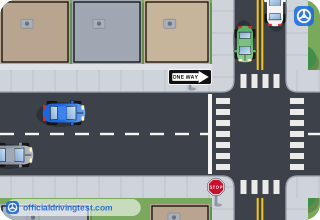
- Slow to a stop before you reach the intersection and look both ways
- Sound your horn as you begin the turn to warn other drivers
- Move into the proper lane well before the turn, using your turn signal
- Brake hard just before you reach the corner and then turn quickly
Show answer
Correct answer: Move into the proper lane well before the turn, using your turn signal
The manual states that the first rule is to move into the proper lane well before the turn, using your turn signal.
Source: Indiana Driver’s Manual (July 2026), page 38 · Open this page in the manual (Manual page 38)
-
To turn left, in which lane should you be?
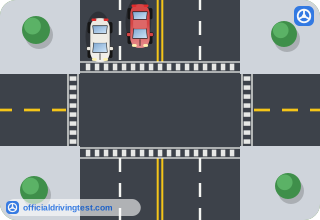
- The center lane of the road, whatever the traffic
- The far-left lane for your direction of travel
- Any lane that is open at the time you decide to turn
- The lane with the least traffic as you approach it
Show answer
Correct answer: The far-left lane for your direction of travel
The manual says to be in the far-left lane for your direction of travel to turn left.
Source: Indiana Driver’s Manual (July 2026), page 38 · Open this page in the manual (Manual page 38)
-
To turn right, in which lane should you be?
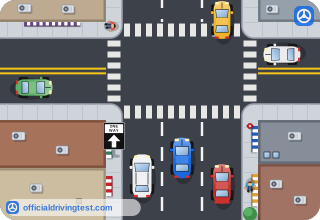
- The center lane of the road, whatever the traffic
- Any lane that is open at the time you decide to turn
- The lane with the least traffic as you approach it
- The far-right lane for your direction of travel
Show answer
Correct answer: The far-right lane for your direction of travel
The manual says to be in the far-right lane for your direction of travel to turn right.
Source: Indiana Driver’s Manual (July 2026), page 38 · Open this page in the manual (Manual page 38)
-
When you make a turn, to whom must you yield the right-of-way?
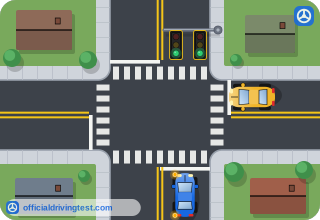
- Oncoming vehicles and pedestrians
- Only vehicles that are already in the intersection
- Only emergency vehicles that are approaching
- No one, if you have signaled in advance
Show answer
Correct answer: Oncoming vehicles and pedestrians
The manual says to yield the right-of-way to oncoming vehicles and pedestrians when turning.
Source: Indiana Driver’s Manual (July 2026), page 38 · Open this page in the manual (Manual page 38)
-
Busy roads often have a center lane designated solely for what?
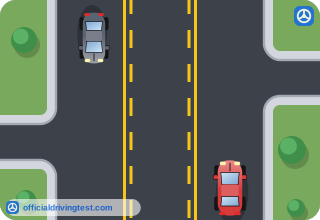
- Left-turning vehicles
- Passing slower vehicles
- Vehicles that are parking
- Emergency vehicles only
Show answer
Correct answer: Left-turning vehicles
The manual says a center lane is designated solely for left-turning vehicles.
Source: Indiana Driver’s Manual (July 2026), page 39 · Open this page in the manual (Manual page 39)
-
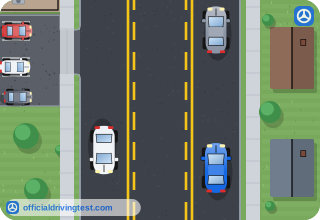
Which rule applies to a center lane designated for left turns?
- Use it to pass slower traffic when the road is clear
- Use it as an extra through lane in heavy traffic
- Never use it for passing other vehicles
- Use it to pass vehicles that are turning left
Show answer
Correct answer: Never use it for passing other vehicles
The manual says never to use this type of center lane for passing other vehicles.
Source: Indiana Driver’s Manual (July 2026), page 39 · Open this page in the manual (Manual page 39)
-
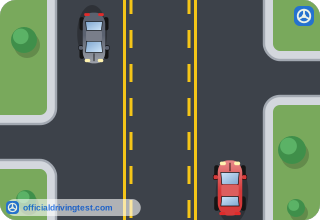
What should you always be aware of when you drive on a road with a specially designated center lane for left turns?
- Vehicles in the center lane may stop suddenly without using any signal
- Vehicles traveling in the opposite direction may enter it to turn left in front of you
- Vehicles behind you may use the center lane to pass you when it is clear
- Vehicles in the right lane may cross into the center lane without warning
Show answer
Correct answer: Vehicles traveling in the opposite direction may enter it to turn left in front of you
The manual warns that vehicles traveling in the opposite direction may be entering the center lane to turn left in front of your vehicle.
Source: Indiana Driver’s Manual (July 2026), page 39 · Open this page in the manual (Manual page 39)
-
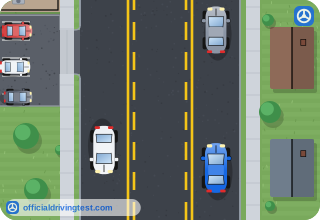
How can a designated center lane for left turns usually be identified?
- By a flashing yellow signal above the lane
- By red reflectors along both edges of the lane
- By a solid white line on each side of the lane
- By a “CENTER LANE ONLY” sign or by pavement arrows
Show answer
Correct answer: By a “CENTER LANE ONLY” sign or by pavement arrows
The manual says these lanes can usually be identified by a sign stating “CENTER LANE ONLY” or by pavement arrows, though some have neither.
Source: Indiana Driver’s Manual (July 2026), page 39 · Open this page in the manual (Manual page 39)
-
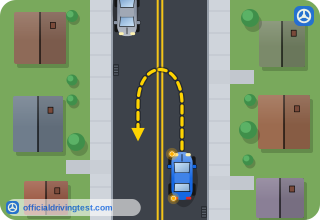
A U-turn is a maneuver in which a driver changes direction by making what kind of turn?
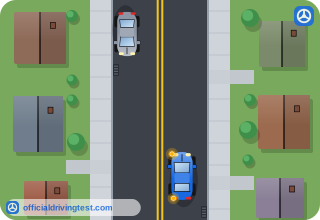
- A 180-degree turn
- A 90-degree turn
- A 120-degree turn
- A 270-degree turn
Show answer
Correct answer: A 180-degree turn
The manual defines a U-turn as a maneuver in which a driver changes direction by making a 180-degree turn.
Source: Indiana Driver’s Manual (July 2026), page 39 · Open this page in the manual (Manual page 39)
-
When should a U-turn be undertaken?
- Whenever the road ahead is clear
- Only on roads with a posted speed limit
- Only when it is not prohibited by law
- Only on roads with two or more lanes
Show answer
Correct answer: Only when it is not prohibited by law
The manual says a U-turn is potentially dangerous and should only be undertaken when not prohibited by law.
Source: Indiana Driver’s Manual (July 2026), page 39 · Open this page in the manual (Manual page 39)
-
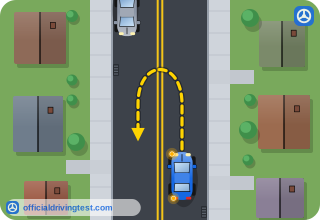
When making a U-turn, to whom must you always yield the right of way?
- Only vehicles that are behind you
- Oncoming vehicles and pedestrians
- Only vehicles that are turning right
- Only emergency vehicles that are approaching
Show answer
Correct answer: Oncoming vehicles and pedestrians
The manual says to always yield right of way to oncoming vehicles and pedestrians when making a U-turn.
Source: Indiana Driver’s Manual (July 2026), page 39 · Open this page in the manual (Manual page 39)
-
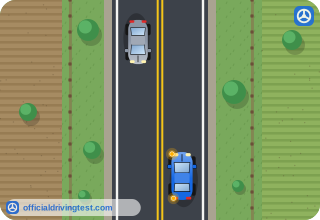
Where should you never make a U-turn?
- On a quiet residential street where the posted speed limit is low
- At an intersection that is controlled by a stop sign or a traffic signal
- On a street that has a two-way center turn lane running down the middle
- On a curve in the road or when approaching the crest of a hill or grade
Show answer
Correct answer: On a curve in the road or when approaching the crest of a hill or grade
The manual says never to make a U-turn on a curve or when approaching the crest of a hill or grade.
Source: Indiana Driver’s Manual (July 2026), page 39 · Open this page in the manual (Manual page 39)
-
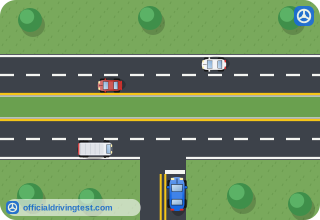
At a median U-turn or J-turn intersection, where the left turn is prohibited in the intersection itself, how is the left turn made?
- The driver turns left from the far-right lane after coming to a complete stop
- The driver turns left from the center lane after yielding to oncoming traffic
- The driver goes through the intersection and makes a U-turn at an upcoming median opening
- The driver turns right and then makes a left turn at the very next cross street
Show answer
Correct answer: The driver goes through the intersection and makes a U-turn at an upcoming median opening
The manual says the left turn is made after proceeding through the intersection and making a U-turn at an upcoming median opening.
Source: Indiana Driver’s Manual (July 2026), page 39 · Open this page in the manual (Manual page 39)
-
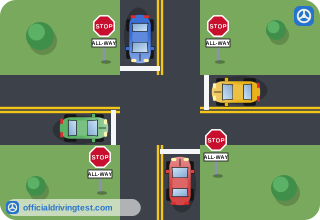
At an all-way stop, which vehicle is the first to proceed through the intersection?
- The largest vehicle at the intersection
- The first vehicle to stop at the intersection
- The vehicle that is going straight
- The vehicle that is turning left
Show answer
Correct answer: The first vehicle to stop at the intersection
The manual says that at an all-way stop the first vehicle to stop is the first to proceed.
Source: Indiana Driver’s Manual (July 2026), page 39 · Open this page in the manual (Manual page 39)
-
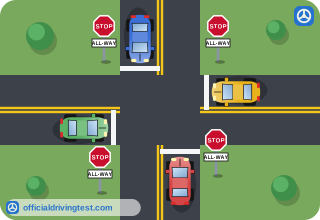
At an all-way stop, you arrive at the same time as another driver. Who shall yield the right-of-way?
- The vehicle on the right
- The vehicle that is going straight
- The vehicle that is turning right
- The vehicle on the left
Show answer
Correct answer: The vehicle on the left
The manual says that when two drivers arrive at the same time, the vehicle on the left shall yield the right-of-way.
Source: Indiana Driver’s Manual (July 2026), page 39 · Open this page in the manual (Manual page 39)
-
At an all-way stop, what is better if there is any doubt about who has the right of way or a chance of a crash?
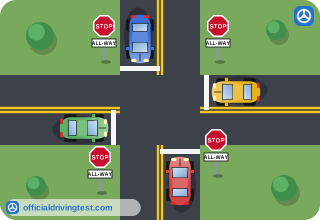
- To yield the right of way to the other driver
- To sound your horn and proceed
- To proceed before the other driver does
- To flash your headlights and wait
Show answer
Correct answer: To yield the right of way to the other driver
The manual says it is better to yield the right of way to the other driver when in doubt or when a crash is possible.
Source: Indiana Driver’s Manual (July 2026), page 39 · Open this page in the manual (Manual page 39)
-
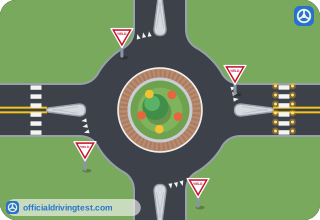
In which direction does traffic proceed in a roundabout?
- Clockwise
- Left to right across the center island
- Counterclockwise
- Toward the nearest exit only
Show answer
Correct answer: Counterclockwise
The manual says traffic in a roundabout proceeds in a counterclockwise direction.
Source: Indiana Driver’s Manual (July 2026), page 40 · Open this page in the manual (Manual page 40)
-
How does traffic enter or exit a roundabout?
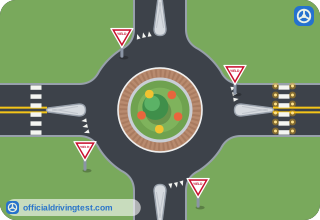
- Only through left turns
- Only through right turns
- Through either left or right turns
- Straight across the center island
Show answer
Correct answer: Only through right turns
The manual says traffic enters or exits a roundabout only through right turns.
Source: Indiana Driver’s Manual (July 2026), page 40 · Open this page in the manual (Manual page 40)
-
When approaching a roundabout, which traffic always yields?
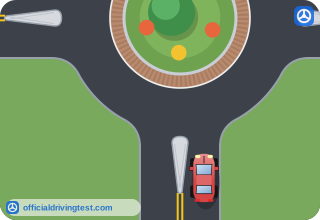
- Circulating traffic, which yields to incoming traffic
- The vehicle that is closest to the center island
- The vehicle that arrived at the yield line last
- Incoming traffic, which yields to the circulating traffic
Show answer
Correct answer: Incoming traffic, which yields to the circulating traffic
The manual says incoming traffic always yields to the circulating traffic.
Source: Indiana Driver’s Manual (July 2026), page 40 · Open this page in the manual (Manual page 40)
-
In a multi-lane roundabout, when should drivers know which lane they need to be in?
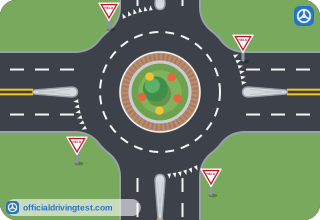
- Before entering the roundabout
- After they pass the first exit
- While they are in the circulatory roadway
- When they reach the center island
Show answer
Correct answer: Before entering the roundabout
The manual says drivers should know which lane they need to be in prior to entering the roundabout.
Source: Indiana Driver’s Manual (July 2026), page 40 · Open this page in the manual (Manual page 40)
-
What should drivers not do in the circulatory roadway of a multi-lane roundabout?
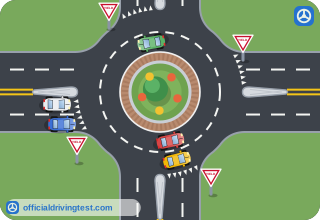
- Use their turn signals
- Yield to pedestrians
- Change lanes
- Drive in the right lane
Show answer
Correct answer: Change lanes
The manual says drivers should not change lanes in the circulatory roadway.
Source: Indiana Driver’s Manual (July 2026), page 40 · Open this page in the manual (Manual page 40)
-
What guides drivers to the proper lane in advance of the circulatory roadway of a roundabout?
- Flashing lights on the center island
- Signs, pavement markings, or both
- A police officer at each entrance
- Raised lane dividers only
Show answer
Correct answer: Signs, pavement markings, or both
The manual says signs, pavement markings, or both guide drivers to the proper lane in advance.
Source: Indiana Driver’s Manual (July 2026), page 40 · Open this page in the manual (Manual page 40)
-
How does a traffic circle differ from a roundabout?
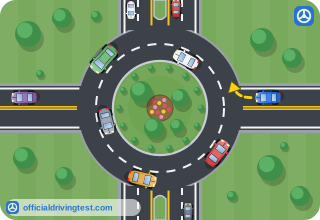
- It never has more than one lane in the circulatory roadway
- It has no crosswalks for pedestrians to use at all
- It always has a larger center island than a roundabout
- It may have clockwise and counterclockwise traffic
Show answer
Correct answer: It may have clockwise and counterclockwise traffic
The manual says a traffic circle may have clockwise and counterclockwise traffic.
Source: Indiana Driver’s Manual (July 2026), page 40 · Open this page in the manual (Manual page 40)
-
What may control the approaches to the circulatory roadway of a traffic circle?
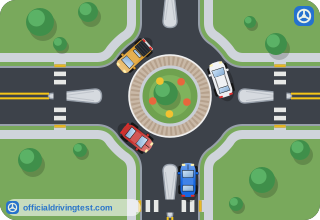
- Stop signs instead of yield signs
- Only traffic signals at every approach
- Only lane control signs and arrows
- Only pavement markings and arrows
Show answer
Correct answer: Stop signs instead of yield signs
The manual says the approaches to a traffic circle may be controlled by stop signs instead of yield signs.
Source: Indiana Driver’s Manual (July 2026), page 40 · Open this page in the manual (Manual page 40)
-
When you approach or drive through a multi-lane roundabout, to which vehicles must you yield the right of way?
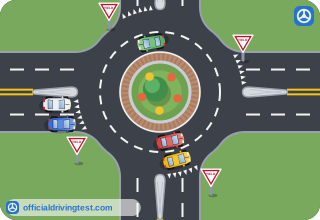
- Smaller vehicles that are following behind you
- Vehicles that are about to exit the roundabout ahead
- Large vehicles driving through the roundabout at the same time
- Any vehicle approaching from your right at the same time
Show answer
Correct answer: Large vehicles driving through the roundabout at the same time
The manual says drivers must yield the right of way to large vehicles driving through the roundabout at the same time.
Source: Indiana Driver’s Manual (July 2026), page 40 · Open this page in the manual (Manual page 40)
-
If two large trucks are approaching or driving through a roundabout at the same time, which driver must yield the right of way?
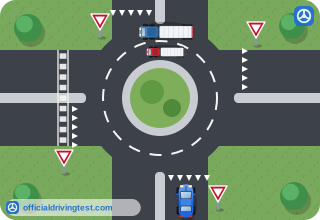
- The driver in the left lane
- The driver in the right lane
- The driver of the heavier truck
- The driver who entered the roundabout last
Show answer
Correct answer: The driver in the right lane
The manual says the driver in the right lane must yield to the driver in the left lane.
Source: Indiana Driver’s Manual (July 2026), page 40 · Open this page in the manual (Manual page 40)
-
Which vehicles have the right of way regardless of a traffic signal that indicates otherwise?
- Official processions, such as a funeral procession
- Commercial trucks carrying cargo
- Vehicles with their hazard lights flashing
- Vehicles carrying passengers to an airport
Show answer
Correct answer: Official processions, such as a funeral procession
The manual says official processions, such as a funeral procession, have the right of way regardless of a traffic signal that indicates otherwise.
Source: Indiana Driver’s Manual (July 2026), page 54 · Open this page in the manual (Manual page 54)
-
What do the tips for teen drivers say to do before entering an intersection?

- Speed up so you clear it before cross traffic arrives
- Make sure the intersection is clear before you proceed
- Sound the horn to warn other drivers
- Flash your headlights at oncoming vehicles
Show answer
Correct answer: Make sure the intersection is clear before you proceed
Before entering an intersection, make sure it is clear before you proceed.
Source: Indiana Driver’s Manual (July 2026), page 71 · Open this page in the manual (Manual page 71)