Indiana: Railroad crossings Practice Test
Railroad signs and signals, vehicles that must stop, blocked crossings and the Emergency Notification System.
Independent educational site · not affiliated with any government agency or DMV
Ready? Test yourself
- Instant feedback with an explanation
- Every answer cites its source in the manual
- Your best score is saved on this device
Questions are original and based on the official manual "Indiana Driver’s Manual" (July 2026), Indiana Bureau of Motor Vehicles.
All 24 questions in this practice test
Take the test above first, then use this list to study. Tap “Show answer” to see the correct answer and explanation.
Show the questions and answersHide the questions
-
How far from the nearest rail must vehicles that are required by law to stop at a railroad crossing stop?
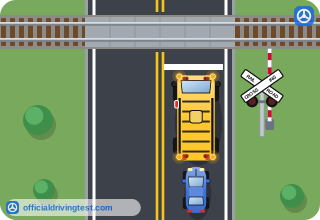
- Not closer than 5 feet or farther than 15 feet
- Not closer than 25 feet or farther than 100 feet
- Not closer than 50 feet or farther than 100 feet
- Not closer than 15 feet or farther than 50 feet
Show answer
Correct answer: Not closer than 15 feet or farther than 50 feet
Some vehicles are required by law to always stop not closer than 15 feet or farther than 50 feet from the nearest rail.
Source: Indiana Driver’s Manual (July 2026), page 48 · Open this page in the manual (Manual page 48)
-
Which of these vehicles must always stop at railroad crossings?
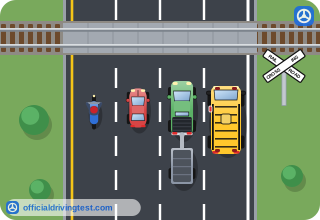
- A passenger car
- A school bus
- A motorcycle
- A pickup truck hauling lumber
Show answer
Correct answer: A school bus
The manual lists all school buses among the vehicles that must stop at railroad crossings.
Source: Indiana Driver’s Manual (July 2026), page 48 · Open this page in the manual (Manual page 48)
-
The requirement for some vehicles to stop at railroad crossings does not apply at which crossing?
- A crossing on a rural road with no houses
- Abandoned tracks with appropriate signs placed
- A crossing that has no gates or lights
- A crossing where no train can be seen coming
Show answer
Correct answer: Abandoned tracks with appropriate signs placed
The requirement does not apply to abandoned railroad tracks where appropriate signs have been placed or the tracks crossing the roadway have been removed.
Source: Indiana Driver’s Manual (July 2026), page 48 · Open this page in the manual (Manual page 48)
-
What does the manual say about the warning devices at railroad crossings?
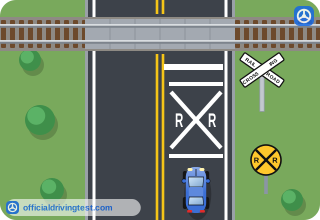
- Every crossing has lights and gates
- Every crossing has pavement markings and a crossbuck
- Crossings with signs never have signals
- You should not expect to see all of them at every crossing
Show answer
Correct answer: You should not expect to see all of them at every crossing
Special signs, signals and pavement markings are used, but not all of them at every crossing.
Source: Indiana Driver’s Manual (July 2026), page 48 · Open this page in the manual (Manual page 48)
-
What do crossbucks at a railroad crossing mark?
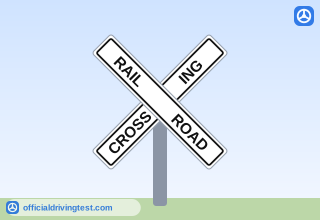
- The location of the tracks
- The speed limit for trains
- The distance to the next station
- The end of a no-passing zone
Show answer
Correct answer: The location of the tracks
The manual says crossbucks at a railroad crossing mark the location of the tracks.
Source: Indiana Driver’s Manual (July 2026), page 48 · Open this page in the manual (Manual page 48)
-
How should you treat a crossbuck that is displayed alone?
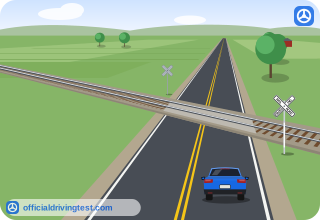
- As a stop sign
- As a signal to speed up
- As a yield sign
- As a no-passing sign
Show answer
Correct answer: As a yield sign
When displayed alone, a crossbuck is treated as a yield sign, and you must stop if a train is approaching.
Source: Indiana Driver’s Manual (July 2026), page 48 · Open this page in the manual (Manual page 48)
-
What must you do when a crossbuck is displayed with a stop sign?
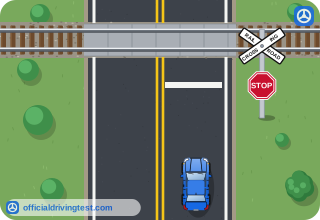
- Stop completely, cross only when no train approaches
- Slow down and cross once you see no train coming
- Stop only if you can see a train approaching
- Treat it as a yield sign and then cross carefully
Show answer
Correct answer: Stop completely, cross only when no train approaches
With a crossbuck and a stop sign you must come to a complete stop and proceed over the tracks only after making certain that a train is not approaching.
Source: Indiana Driver’s Manual (July 2026), page 48 · Open this page in the manual (Manual page 48)
-
When may you proceed after stopping for active warning bells, flashing lights, or lights and gates at a railroad crossing?
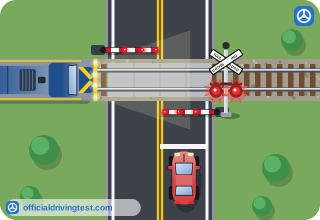
- As soon as you can no longer see a train coming
- After waiting at least ten seconds for the train
- When it is canceled or an officer or flagman directs you
- When the driver behind you sounds the horn at you
Show answer
Correct answer: When it is canceled or an officer or flagman directs you
You must not proceed until the active warning is canceled or a law enforcement officer or railroad flagman directs you to proceed.
Source: Indiana Driver’s Manual (July 2026), page 48 · Open this page in the manual (Manual page 48)
-
Driving around a crossing gate that is down is:
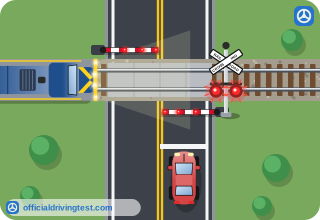
- Allowed if no train is visible
- Illegal
- Allowed at a slow speed
- Allowed if the gate has been down a long time
Show answer
Correct answer: Illegal
The manual states it is illegal to drive around a crossing gate that is down.
Source: Indiana Driver’s Manual (July 2026), page 48 · Open this page in the manual (Manual page 48)
-
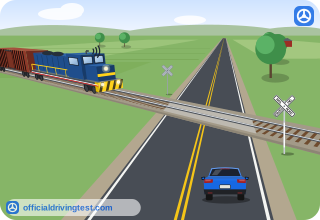
Why does the manual say you should never try to race a train to a crossing?
- Trains always travel faster than the speed limit
- Train horns cannot be heard from inside a car
- Crossing gates close without warning
- A train’s actual speed can be very deceiving
Show answer
Correct answer: A train’s actual speed can be very deceiving
Due to the size of trains, their actual speed can be very deceiving, so you should never try to race a train to a crossing.
Source: Indiana Driver’s Manual (July 2026), page 48 · Open this page in the manual (Manual page 48)
-
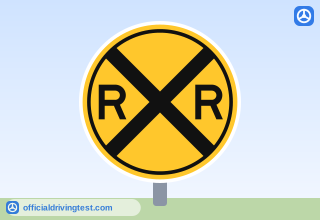
What does a round yellow warning sign with a black X and the letters R and R tell drivers?
- A school zone is ahead
- A work zone is ahead
- A railroad crossing is ahead
- A narrow bridge is ahead
Show answer
Correct answer: A railroad crossing is ahead
A round yellow sign with a black X and the letters R and R warns that a railroad crossing is ahead.
Source: Indiana Driver’s Manual (July 2026), page 48 · Open this page in the manual (Manual page 48)
-
What should you avoid doing while crossing railroad tracks?
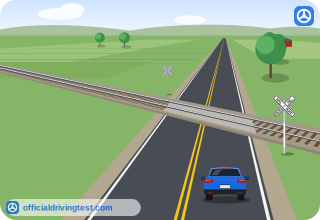
- Stopping or shifting gears
- Using your turn signal
- Looking for another train
- Checking your mirrors
Show answer
Correct answer: Stopping or shifting gears
The manual says to avoid stopping or shifting gears while crossing railroad tracks.
Source: Indiana Driver’s Manual (July 2026), page 49 · Open this page in the manual (Manual page 49)
-
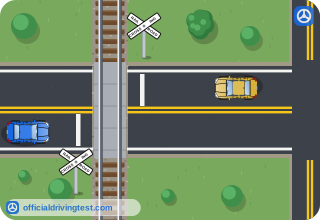
When should a driver begin to cross railroad tracks?
- As soon as the vehicle ahead of you has started across
- Whenever no train can be seen in either direction
- Only when the tracks can be cleared without stopping
- After slowing to a crawl and shifting into a lower gear
Show answer
Correct answer: Only when the tracks can be cleared without stopping
A driver should never begin to cross unless the tracks can be cleared without stopping on them.
Source: Indiana Driver’s Manual (July 2026), page 49 · Open this page in the manual (Manual page 49)
-
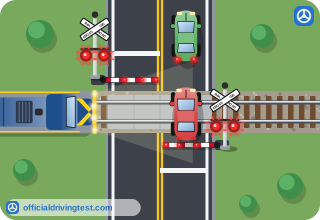
What should all occupants do if the vehicle stalls on railroad tracks?
- Stay buckled in until help arrives
- Immediately leave the vehicle
- Stay inside and keep trying to restart it
- Remain inside and sound the horn
Show answer
Correct answer: Immediately leave the vehicle
If a vehicle stalls on the tracks, all occupants should immediately leave it.
Source: Indiana Driver’s Manual (July 2026), page 49 · Open this page in the manual (Manual page 49)
-
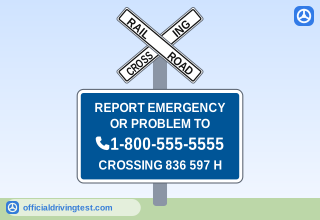
What does the emergency notification sign at a railroad crossing let you do?
- Find out when the next train will arrive
- Report a vehicle that drove around the gate
- Request a tow truck for your vehicle
- Contact the railroad about a blocked crossing
Show answer
Correct answer: Contact the railroad about a blocked crossing
The sign gives contact information to call the railroad about a blocked crossing.
Source: Indiana Driver’s Manual (July 2026), page 49 · Open this page in the manual (Manual page 49)
-
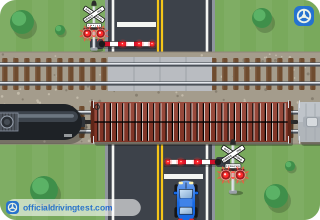
Where there is more than one track, what must a driver waiting for the track to clear make sure of?
- That another train is not coming on the other track
- That the gate arms have been raised on both sides
- That the first train has stopped completely
- That the signal ahead of the crossing is green
Show answer
Correct answer: That another train is not coming on the other track
After the first train clears, the driver must check that another train is not coming on the other track.
Source: Indiana Driver’s Manual (July 2026), page 49 · Open this page in the manual (Manual page 49)
-
What is a ‘local quiet zone’ at a railroad crossing?
- A place where trains must stop and wait before entering any gated crossing in town
- A place where vehicles may not stop within 50 feet of the tracks at any crossing
- A place where locomotive horns are not sounded by approaching trains at some gated crossings
- A place where crossing gates stay down until the train has fully passed through
Show answer
Correct answer: A place where locomotive horns are not sounded by approaching trains at some gated crossings
Local quiet zones are where locomotive horns are not sounded by approaching trains at some gated crossings.
Source: Indiana Driver’s Manual (July 2026), page 49 · Open this page in the manual (Manual page 49)
-
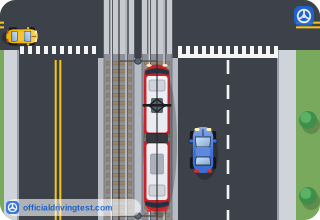
Some trains operate on tracks in the middle of streets. How do traffic signals show an approaching train?
- They flash yellow in all directions
- They flash red in all directions
- They turn green in the train's direction
- They turn dark until the train has passed
Show answer
Correct answer: They flash red in all directions
Where trains run in the middle of streets, signals flash red in all directions, and drivers should treat it like any other crossing warning.
Source: Indiana Driver’s Manual (July 2026), page 49 · Open this page in the manual (Manual page 49)
-
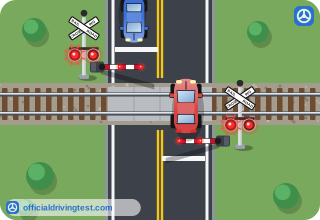
Once the crossing lights flash and the gate begins to lower, about how long do you have to escape from the crossing?
- About 20 seconds
- About 5 seconds
- About 45 seconds
- About 2 minutes
Show answer
Correct answer: About 20 seconds
You have approximately 20 seconds to escape once the lights begin to flash and the gate begins to lower.
Source: Indiana Driver’s Manual (July 2026), page 49 · Open this page in the manual (Manual page 49)
-
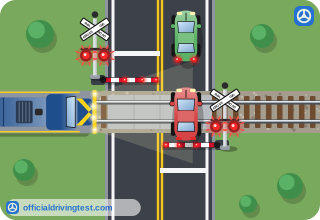
If you are stuck on a crossing and a train is approaching, at what angle should you run away from the tracks?
- A 30-degree angle
- A 60-degree angle
- A 45-degree angle
- A 90-degree angle
Show answer
Correct answer: A 45-degree angle
The manual says to run at a 45-degree angle away from the tracks.
Source: Indiana Driver’s Manual (July 2026), page 49 · Open this page in the manual (Manual page 49)
-
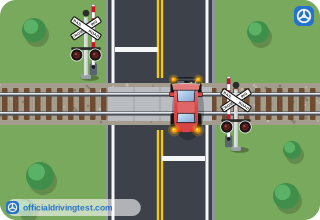
Your vehicle is disabled on a railroad crossing and no train is approaching. What should you do immediately?
- Call a tow truck company to move the vehicle
- Call the Emergency Notification System (ENS)
- Wait inside the vehicle for a train to appear
- Try to push the vehicle off the tracks yourself
Show answer
Correct answer: Call the Emergency Notification System (ENS)
With no train present, you should immediately call the Emergency Notification System (ENS).
Source: Indiana Driver’s Manual (July 2026), page 49 · Open this page in the manual (Manual page 49)
-
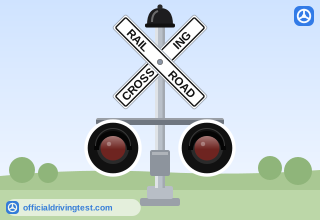
Where is the Emergency Notification System phone number located at a crossing?
- On the yellow warning sign ahead of the crossing
- On the white crossbuck sign at the crossing
- On the red STOP sign at the crossing
- On the blue sign attached to the crossing gate
Show answer
Correct answer: On the blue sign attached to the crossing gate
The phone number is on the blue sign attached to the railroad track crossing gate.
Source: Indiana Driver’s Manual (July 2026), page 49 · Open this page in the manual (Manual page 49)
-
What should you tell the Emergency Notification System when you call?
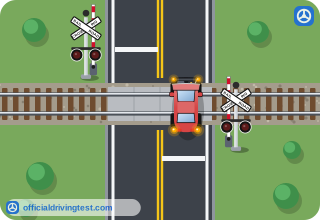
- Exactly what obstruction is present and your location
- Your license number and your vehicle registration
- The time the next train is scheduled to arrive
- Your insurance company and policy number
Show answer
Correct answer: Exactly what obstruction is present and your location
You should tell them exactly what obstruction is present and your location.
Source: Indiana Driver’s Manual (July 2026), page 49 · Open this page in the manual (Manual page 49)
-
After you have notified the ENS about a blocked crossing with no train present, what should you do next?
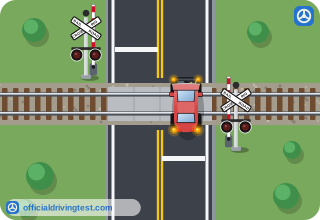
- Wait by the vehicle until the railroad responds
- Walk along the tracks to look for a train
- Call 911 and report the problem
- Contact your insurance company
Show answer
Correct answer: Call 911 and report the problem
After notifying ENS, you should call 911 and report the problem.
Source: Indiana Driver’s Manual (July 2026), page 49 · Open this page in the manual (Manual page 49)