Indiana: Pedestrians Practice Test
Yielding to people in crosswalks, pedestrian signals and walking safely.
Independent educational site · not affiliated with any government agency or DMV
Ready? Test yourself
- Instant feedback with an explanation
- Every answer cites its source in the manual
- Your best score is saved on this device
Questions are original and based on the official manual "Indiana Driver’s Manual" (July 2026), Indiana Bureau of Motor Vehicles.
All 18 questions in this practice test
Take the test above first, then use this list to study. Tap “Show answer” to see the correct answer and explanation.
Show the questions and answersHide the questions
-
What do pedestrian signals display when pedestrians may safely cross a street or intersection?
- A flashing raised hand symbol
- The word WALK or a symbol of a person walking
- The words DON'T WALK in red
- A green arrow pointing across the street
Show answer
Correct answer: The word WALK or a symbol of a person walking
Pedestrian signals display the word WALK or a symbol of a person walking when pedestrians may safely cross.
Source: Indiana Driver’s Manual (July 2026), page 36 · Open this page in the manual (Manual page 36)
-
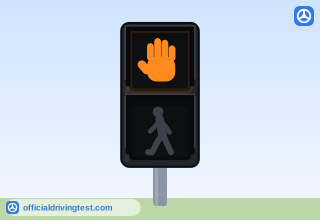
What do the words DON'T WALK or a symbol of a raised hand on a pedestrian signal mean?
- Pedestrians may cross but must yield to turning vehicles
- The pedestrian signal is not working
- The crosswalk is reserved for bicyclists
- It is not safe for pedestrians to cross the street
Show answer
Correct answer: It is not safe for pedestrians to cross the street
DON'T WALK or a raised hand is displayed when it is not safe for pedestrians to cross a street or intersection.
Source: Indiana Driver’s Manual (July 2026), page 36 · Open this page in the manual (Manual page 36)
-
What does it mean when the DON'T WALK words or raised hand symbol flash?
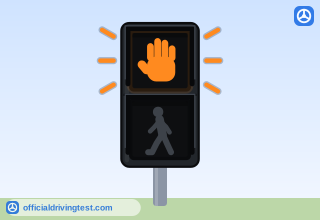
- The time in which to safely cross is ending
- A pedestrian has pushed the button to cross
- The signal is broken and must be treated as a stop sign
- Drivers must stop to let pedestrians start crossing
Show answer
Correct answer: The time in which to safely cross is ending
The words or symbols flash to alert pedestrians that the time in which to safely cross the street or intersection is ending.
Source: Indiana Driver’s Manual (July 2026), page 36 · Open this page in the manual (Manual page 36)
-
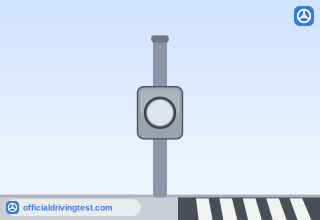
What is the purpose of a button near the base of a pedestrian signal?
- It extends the green light for vehicles
- It turns off the flashing raised hand
- It may be pushed to activate the walk signal
- It calls a police officer to the crossing
Show answer
Correct answer: It may be pushed to activate the walk signal
At some intersections a button near the base of the pedestrian signal may be pushed to activate the walk signal.
Source: Indiana Driver’s Manual (July 2026), page 36 · Open this page in the manual (Manual page 36)
-
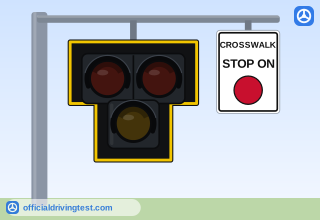
Where may a pedestrian hybrid beacon be found?
- At a railroad crossing
- At a mid-block crosswalk
- At a freeway entrance ramp
- At a school bus stop
Show answer
Correct answer: At a mid-block crosswalk
A pedestrian hybrid beacon is a signal used to facilitate pedestrian crossing and may be found at a mid-block crosswalk.
Source: Indiana Driver’s Manual (July 2026), page 36 · Open this page in the manual (Manual page 36)
-
What does a pedestrian hybrid beacon display when no pedestrian has activated it?
- A flashing yellow light
- Two steady red lights
- Alternating flashing red lights
- Nothing; it is dark
Show answer
Correct answer: Nothing; it is dark
The pedestrian hybrid beacon is dark unless it has been activated by a pedestrian.
Source: Indiana Driver’s Manual (July 2026), page 36 · Open this page in the manual (Manual page 36)
-
A pedestrian activates a pedestrian hybrid beacon. What does it display first?
- A flashing yellow light
- Two steady red lights
- A steady yellow light
- Two alternating flashing red lights
Show answer
Correct answer: A flashing yellow light
Once activated, the beacon first displays a flashing yellow light to allow drivers to clear the crossing.
Source: Indiana Driver’s Manual (July 2026), page 36 · Open this page in the manual (Manual page 36)
-
At a pedestrian hybrid beacon, what does the steady yellow light that follows the flashing yellow warn drivers of?
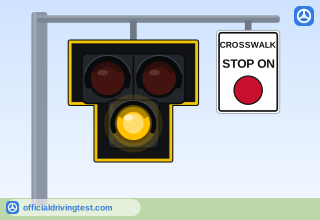
- A pedestrian is waiting to cross
- The beacon is about to go dark
- Their right of way is ending
- They may now proceed through the crossing
Show answer
Correct answer: Their right of way is ending
The steady yellow light warns drivers that their right of way is ending.
Source: Indiana Driver’s Manual (July 2026), page 36 · Open this page in the manual (Manual page 36)
-
What do drivers see at a pedestrian hybrid beacon while the pedestrian crosses?
- A flashing yellow light
- Two steady red lights
- A steady yellow light
- The beacon is dark
Show answer
Correct answer: Two steady red lights
Two steady red lights are displayed while the pedestrian crosses.
Source: Indiana Driver’s Manual (July 2026), page 36 · Open this page in the manual (Manual page 36)
-
At a pedestrian hybrid beacon, what do the two flashing red lights allow drivers to do?
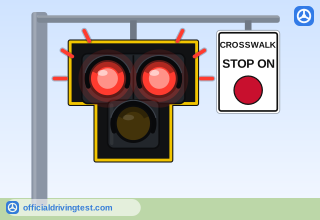
- Proceed through without checking for pedestrians
- Wait until the pedestrian activates the beacon again
- Turn around and go back
- Proceed through if the crossing is clear of pedestrians
Show answer
Correct answer: Proceed through if the crossing is clear of pedestrians
The two red lights flash to allow drivers to proceed through if the crossing is clear of pedestrians.
Source: Indiana Driver’s Manual (July 2026), page 36 · Open this page in the manual (Manual page 36)
-
What should you never do in a roundabout?
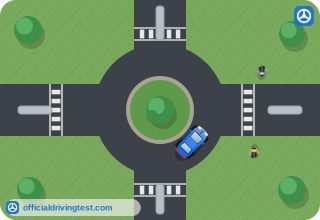
- Walk on the crosswalk of a splitter island
- Look both ways before you cross at the crosswalk
- Wait on the sidewalk for traffic to clear
- Walk across the circulating lanes to the center island
Show answer
Correct answer: Walk across the circulating lanes to the center island
In a roundabout, never walk across the circulating lane(s) to the center island.
Source: Indiana Driver’s Manual (July 2026), page 40 · Open this page in the manual (Manual page 40)
-
Vehicles approaching a roundabout must yield to whom?
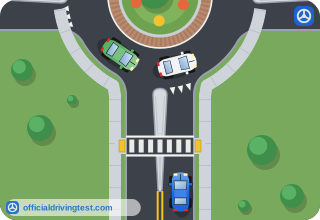
- Pedestrians in the crosswalk and traffic in the roundabout
- Only traffic that is already circulating in the roundabout
- Only pedestrians who are standing on the center island
- Only vehicles that are waiting at the yield line ahead
Show answer
Correct answer: Pedestrians in the crosswalk and traffic in the roundabout
Vehicles approaching a roundabout must yield to pedestrians in the crosswalk and to traffic in the roundabout.
Source: Indiana Driver’s Manual (July 2026), page 40 · Open this page in the manual (Manual page 40)
-
When pedestrians are in the vicinity, what should you always do?
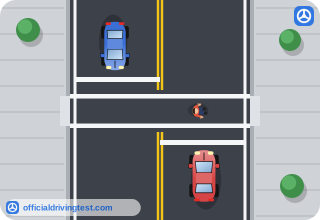
- Sound your horn to warn the pedestrians
- Speed up to clear the crosswalk first
- Yield the right of way to pedestrians
- Stop only when a pedestrian signal tells you to
Show answer
Correct answer: Yield the right of way to pedestrians
The first pedestrian rule in the manual is to always yield the right of way to pedestrians.
Source: Indiana Driver’s Manual (July 2026), page 55 · Open this page in the manual (Manual page 55)
-
Which turn must you not make when pedestrians are in the vicinity?
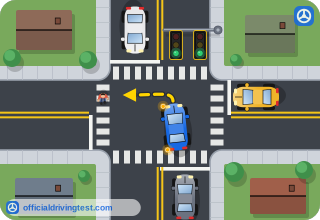
- A turn made at a crosswalk when the pedestrian signal is not displaying any message
- A turn that makes a pedestrian stop, slow down, or make a special effort to avoid a collision
- A turn made in front of a pedestrian who is waiting on the sidewalk and not crossing
- A turn made at an intersection that has no crosswalk markings painted on the road
Show answer
Correct answer: A turn that makes a pedestrian stop, slow down, or make a special effort to avoid a collision
The manual says not to make a turn that causes a pedestrian to stop, slow down, or make some other special effort to avoid a collision.
Source: Indiana Driver’s Manual (July 2026), page 55 · Open this page in the manual (Manual page 55)
-
Why should you take special care when children are in the vicinity?
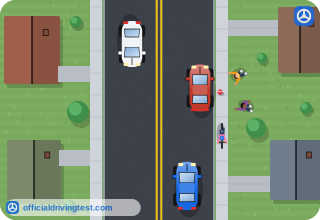
- Children may cross only at marked crosswalks
- Children always stop at the curb before crossing
- Children have the right of way over other pedestrians
- Children are not fully aware of the dangers of traffic
Show answer
Correct answer: Children are not fully aware of the dangers of traffic
The manual says children are not fully aware of the dangers of traffic and may cross at unexpected places.
Source: Indiana Driver’s Manual (July 2026), page 55 · Open this page in the manual (Manual page 55)
-
What indicates that pedestrians are nearby?
- Yellow curbs or fire lanes
- Crosswalks or a pedestrian signal
- Advisory speed plaques
- Painted lane lines and edge lines
Show answer
Correct answer: Crosswalks or a pedestrian signal
The manual says crosswalks or a pedestrian signal indicate that pedestrians are nearby.
Source: Indiana Driver’s Manual (July 2026), page 55 · Open this page in the manual (Manual page 55)
-
Which traveling aids does a person who is visually impaired often use?
- A red-tipped cane or a hearing dog
- A yellow flag or a bright vest
- A flashing light or a small horn
- A white cane or a trained guide dog
Show answer
Correct answer: A white cane or a trained guide dog
The manual says traveling aids for a person who is visually impaired are often a white cane or a trained guide dog.
Source: Indiana Driver’s Manual (July 2026), page 55 · Open this page in the manual (Manual page 55)
-
When must drivers yield the right of way to persons who are visually impaired?
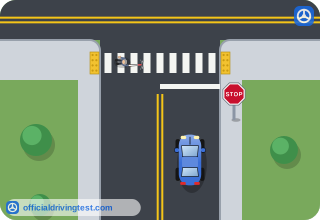
- Always
- Only at marked crosswalks
- Only at traffic signals
- Only when the person is crossing
Show answer
Correct answer: Always
The manual says drivers must always yield the right of way to persons who are visually impaired.
Source: Indiana Driver’s Manual (July 2026), page 55 · Open this page in the manual (Manual page 55)