Indiana: Pavement markings Practice Test
Yellow and white lines, no-passing zones, lane markings, bike lanes and other markings in the Indiana Driver’s Manual.
Independent educational site · not affiliated with any government agency or DMV
Ready? Test yourself
- Instant feedback with an explanation
- Every answer cites its source in the manual
- Your best score is saved on this device
Questions are original and based on the official manual "Indiana Driver’s Manual" (July 2026), Indiana Bureau of Motor Vehicles.
All 10 questions in this practice test
Take the test above first, then use this list to study. Tap “Show answer” to see the correct answer and explanation.
Show the questions and answersHide the questions
-
What do yellow lane markings separate?

- Lanes of traffic going in opposite directions
- Lanes of traffic going in the same direction
- Travel lanes from the roadside shoulder
- Parking spaces from travel lanes
Show answer
Correct answer: Lanes of traffic going in opposite directions
Yellow lane markings separate multiple lanes of traffic going in opposite directions.
Source: Indiana Driver’s Manual (July 2026), page 37 · Open this page in the manual (Manual page 37)
-
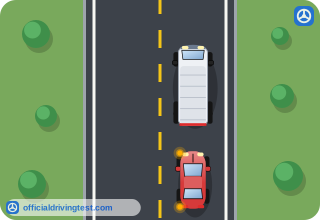
When may you cross a broken yellow line to pass another vehicle?
- Only when you are turning left
- Only when no other vehicle is in sight
- When it is safe to do so
- Never, under any circumstances
Show answer
Correct answer: When it is safe to do so
The manual says you may cross a broken yellow line to pass another vehicle when it is safe.
Source: Indiana Driver’s Manual (July 2026), page 37 · Open this page in the manual (Manual page 37)
-
You should not cross a solid yellow line except to do what?

- Pass a slow-moving vehicle
- Make a turn
- Avoid a stopped vehicle
- Pass a bicycle rider
Show answer
Correct answer: Make a turn
The manual says you should not cross a solid yellow line except to turn.
Source: Indiana Driver’s Manual (July 2026), page 37 · Open this page in the manual (Manual page 37)
-
What do white lane markings separate?

- Lanes of traffic going in opposite directions
- Travel lanes from bike lanes only
- Lanes of traffic from the median
- Lanes of traffic going in the same direction
Show answer
Correct answer: Lanes of traffic going in the same direction
White lane markings separate multiple lanes of traffic going in the same direction.
Source: Indiana Driver’s Manual (July 2026), page 37 · Open this page in the manual (Manual page 37)
-
What does the manual say about crossing a solid white line?

- You should not cross it
- You may cross it whenever the lane is clear
- You may cross it only to pass on the left
- You may cross it only during daylight hours
Show answer
Correct answer: You should not cross it
You may cross a broken white line to change lanes when safe, but you should not cross a solid white line.
Source: Indiana Driver’s Manual (July 2026), page 37 · Open this page in the manual (Manual page 37)
-
When may you cross a broken white line?

- Only when you are turning left
- Only when a police officer allows it
- When it is safe to change lanes
- Only when you are in an emergency
Show answer
Correct answer: When it is safe to change lanes
You may cross a broken white line when it is safe to change lanes.
Source: Indiana Driver’s Manual (July 2026), page 37 · Open this page in the manual (Manual page 37)
-
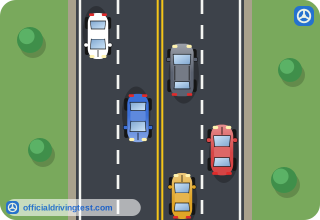
What do lane markings do?
- Show drivers the posted speed limit and the distance to the next exit
- Separate traffic and alert drivers when it is permissible to pass other vehicles
- Mark the places where drivers must stop for pedestrians and trains
- Tell drivers which lanes are reserved for buses and for carpools
Show answer
Correct answer: Separate traffic and alert drivers when it is permissible to pass other vehicles
Lane markings separate traffic and alert drivers when it is permissible to pass other vehicles.
Source: Indiana Driver’s Manual (July 2026), page 37 · Open this page in the manual (Manual page 37)
-
A pavement marking shows a bicycle with two arrows above it. What is it intended to do?

- Show that the lane is reserved only for the use of bicycles
- Mark a lane that only buses and taxis are allowed to use
- Alert road users to expect cyclists to occupy travel lanes
- Show the places where cyclists must walk their bicycles
Show answer
Correct answer: Alert road users to expect cyclists to occupy travel lanes
Sharrow markings alert other road users to expect cyclists to occupy travel lanes.
Source: Indiana Driver’s Manual (July 2026), page 53 · Open this page in the manual (Manual page 53)
-
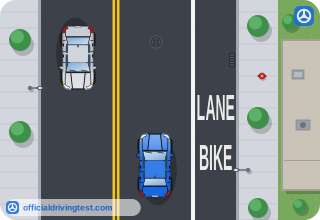
What color of pavement may be used to enhance the visibility of bike lanes?
- Red
- Green
- Yellow
- Blue
Show answer
Correct answer: Green
Green colored pavement may be used to enhance the visibility of bike lanes.
Source: Indiana Driver’s Manual (July 2026), page 53 · Open this page in the manual (Manual page 53)
-
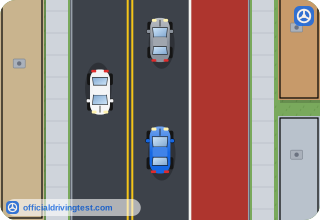
What may red colored pavement be used to enhance the visibility of?
- Bike lanes
- School zones
- Railroad crossings
- Bus or transit lanes
Show answer
Correct answer: Bus or transit lanes
Red colored pavement may be used to enhance the visibility of bus or transit lanes.
Source: Indiana Driver’s Manual (July 2026), page 53 · Open this page in the manual (Manual page 53)