Indiana: Parking rules Practice Test
Parking on hills, parallel parking, accessible parking, parking placards, reversing and the places where you may not park.
Independent educational site · not affiliated with any government agency or DMV
Ready? Test yourself
- Instant feedback with an explanation
- Every answer cites its source in the manual
- Your best score is saved on this device
Questions are original and based on the official manual "Indiana Driver’s Manual" (July 2026), Indiana Bureau of Motor Vehicles.
All 30 questions in this practice test
Take the test above first, then use this list to study. Tap “Show answer” to see the correct answer and explanation.
Show the questions and answersHide the questions
-
What does a parking placard allow the holder to do?
- Park in a fire lane whenever the placard is displayed
- Park next to a yellow curb for any length of time
- Use parking spaces designated for individuals with disabilities
- Park in the diagonally striped space next to a reserved space
Show answer
Correct answer: Use parking spaces designated for individuals with disabilities
A parking placard allows the holder to use spaces designated for individuals with disabilities.
Source: Indiana Driver’s Manual (July 2026), page 18 · Open this page in the manual (Manual page 18)
-
Besides people with a permanent or temporary disability, who else can receive a parking placard?
- Any driver who is 65 years of age or older at a BMV branch
- A person issued or eligible for a Disabled Hoosier Veteran license plate
- Any person who holds a valid motorcycle learner’s permit
- A person whose driver’s license has recently been reinstated by BMV
Show answer
Correct answer: A person issued or eligible for a Disabled Hoosier Veteran license plate
The placard is also available to a person who has been issued or is eligible to receive a Disabled Hoosier Veteran (DHV) license plate.
Source: Indiana Driver’s Manual (July 2026), page 18 · Open this page in the manual (Manual page 18)
-
Which type of organization may apply for a parking placard?
- Any company that operates a fleet of ten or more vehicles for the public
- Any hotel, store, or shopping center that provides customer parking
- Any dealership that sells accessible vehicles to the general public
- A company empowered to run programs or transportation for people with disabilities
Show answer
Correct answer: A company empowered to run programs or transportation for people with disabilities
A company empowered to operate programs or provide transportation or facilities for persons with physical disabilities may apply for a placard.
Source: Indiana Driver’s Manual (July 2026), page 18 · Open this page in the manual (Manual page 18)
-
Who must affirm that you qualify when you apply for a parking placard?
- A health care provider
- A BMV license examiner
- A state police officer
- A county clerk’s office
Show answer
Correct answer: A health care provider
You must have a health care provider complete the application affirming that you qualify.
Source: Indiana Driver’s Manual (July 2026), page 18 · Open this page in the manual (Manual page 18)
-
After the application form is completed, where may you get a parking placard?
- Only at a county courthouse after the form is notarized
- Only from the health care provider who completed the form
- At any BMV branch or by mailing the form to the address on it
- Only online, with no paperwork sent by mail or in person
Show answer
Correct answer: At any BMV branch or by mailing the form to the address on it
You may get a placard at any BMV branch or by mailing the form to the address on it.
Source: Indiana Driver’s Manual (July 2026), page 18 · Open this page in the manual (Manual page 18)
-
When is certification by a health care provider not required for a parking placard?
- When the applicant’s disability is temporary rather than permanent
- When the person has or is eligible for a Disabled Hoosier Veteran plate
- When the applicant is 65 years of age or older at the time
- When the applicant mails the application to the address on the form
Show answer
Correct answer: When the person has or is eligible for a Disabled Hoosier Veteran plate
Certification is not required when the person has received or is eligible to receive a Disabled Hoosier Veteran license plate.
Source: Indiana Driver’s Manual (July 2026), page 18 · Open this page in the manual (Manual page 18)
-
Under what condition does a placard for a permanent disability expire?
- Five years after the date the placard was issued
- On the holder’s next birthday after the placard is issued
- When the holder’s driver’s license is next renewed
- When the provider certifies the disability is no longer permanent
Show answer
Correct answer: When the provider certifies the disability is no longer permanent
A permanent placard does not expire unless the health care provider certifies that the disability is no longer considered permanent (or IDVA certifies the holder is no longer a Disabled Hoosier Veteran).
Source: Indiana Driver’s Manual (July 2026), page 18 · Open this page in the manual (Manual page 18)
-
When does a temporary parking placard expire?
- On the provider’s date, or after one year, whichever is first
- Exactly 90 days after the date the placard was issued to you
- On January 1 of the year after the placard was issued
- When the holder’s driver’s license next expires
Show answer
Correct answer: On the provider’s date, or after one year, whichever is first
A temporary placard expires on the date the health care provider indicates or one year after issuance, whichever occurs first.
Source: Indiana Driver’s Manual (July 2026), page 18 · Open this page in the manual (Manual page 18)
-
When does a parking placard issued to a company expire (apart from the company ceasing its programs)?
- On the first anniversary of the date the placard was issued
- On January 1 of the year after the placard is issued
- On January 1 of the fourth year after the year of issue
- On the company’s next vehicle registration date
Show answer
Correct answer: On January 1 of the fourth year after the year of issue
A company placard expires on January 1 of the fourth year after the year it is issued, or when the company ceases its programs, whichever occurs first.
Source: Indiana Driver’s Manual (July 2026), page 18 · Open this page in the manual (Manual page 18)
-
What could result from using an expired parking placard?
- An automatic license suspension
- A fine
- A requirement to retake the knowledge exam
- Nothing, if it is displayed
Show answer
Correct answer: A fine
Use of an expired placard could result in a fine.
Source: Indiana Driver’s Manual (July 2026), page 18 · Open this page in the manual (Manual page 18)
-
Is parking allowed in the diagonally striped space next to a reserved parking space if you have a valid placard?
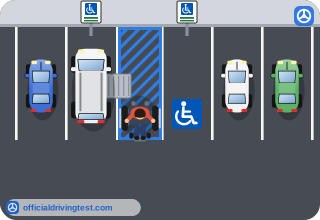
- Yes, for up to 15 minutes
- Yes, if no other spaces are free
- Yes, during daylight hours only
- No, it is prohibited at all times
Show answer
Correct answer: No, it is prohibited at all times
Parking in the diagonally striped space is prohibited at all times, even with a valid placard.
Source: Indiana Driver’s Manual (July 2026), page 18 · Open this page in the manual (Manual page 18)
-
A green and white sign reads "2 HR PARKING 8:30 AM TO 5:30 PM" with a double-headed arrow. Which regulation sign is it?
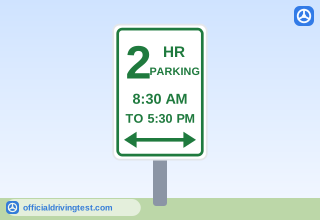
- Limited Parking
- Reserved Parking
- Pay Parking
- No Parking Any Time
Show answer
Correct answer: Limited Parking
A green and white sign reading "2 HR PARKING 8:30 AM TO 5:30 PM" with a double-headed arrow is the "Limited Parking" sign.
Source: Indiana Driver’s Manual (July 2026), page 31 · Open this page in the manual (Manual page 31)
-
A white rectangular sign shows a tow truck pulling a car. Which regulation sign is it?
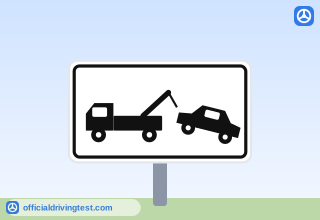
- Restricted Lane
- No Parking
- Tow-Away Zone
- Emergency Stopping Only
Show answer
Correct answer: Tow-Away Zone
A white rectangular sign showing a tow truck pulling a car is the "Tow-Away Zone" sign.
Source: Indiana Driver’s Manual (July 2026), page 32 · Open this page in the manual (Manual page 32)
-
When you parallel park, what is the minimum distance to keep between your vehicle and the vehicle parked in front of the empty space?
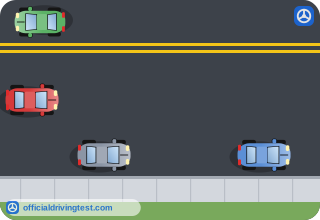
- At least two feet
- At least six inches
- At least five feet
- At least ten feet
Show answer
Correct answer: At least two feet
The manual says to position your vehicle parallel with the car in front of the space and keep at least two feet from it.
Source: Indiana Driver’s Manual (July 2026), page 54 · Open this page in the manual (Manual page 54)
-
When you position your vehicle to parallel park, what do you align your rear bumper with?
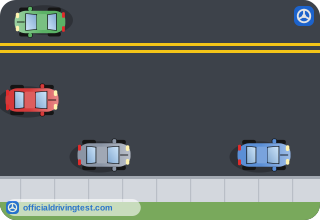
- The front bumper of the vehicle parked behind the empty space
- The front door of the vehicle parked in front of the empty space
- The rear bumper of the vehicle parked in front of the empty space
- The curb at the back end of the empty parking space
Show answer
Correct answer: The rear bumper of the vehicle parked in front of the empty space
Step 2 of the parallel parking procedure says to align your rear bumper with the rear bumper of the vehicle parked in front of the empty space.
Source: Indiana Driver’s Manual (July 2026), page 54 · Open this page in the manual (Manual page 54)
-
While parallel parking, you turn the wheel sharply to the right and reverse slowly until your vehicle is at what angle?
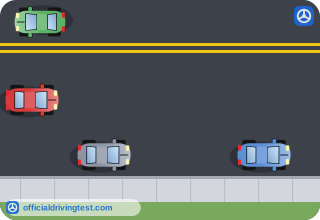
- A 30-degree angle
- A 45-degree angle
- A 60-degree angle
- A 90-degree angle
Show answer
Correct answer: A 45-degree angle
Step 3 says to turn the wheel sharply to the right and reverse slowly until the vehicle is at a 45-degree angle.
Source: Indiana Driver’s Manual (July 2026), page 54 · Open this page in the manual (Manual page 54)
-
When parallel parking, you reverse slowly until the front of your vehicle is even with which part of the parallel car before turning the wheel sharply to the right?
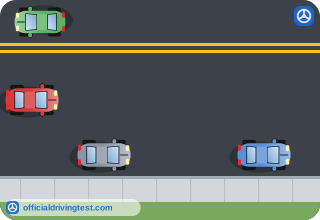
- Its rear bumper
- Its front bumper
- Its rear door
- Its front door
Show answer
Correct answer: Its front door
The manual says to reverse slowly until the front of the vehicle is even with the front door of the parallel car.
Source: Indiana Driver’s Manual (July 2026), page 54 · Open this page in the manual (Manual page 54)
-
When you park facing downhill, which way should you turn your vehicle's wheels?
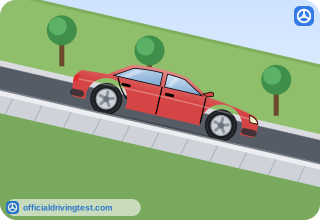
- Away from the curb
- Toward the curb
- Straight ahead
- Parallel to the street
Show answer
Correct answer: Toward the curb
The manual says to turn the wheels toward the curb when parking facing downhill.
Source: Indiana Driver’s Manual (July 2026), page 54 · Open this page in the manual (Manual page 54)
-
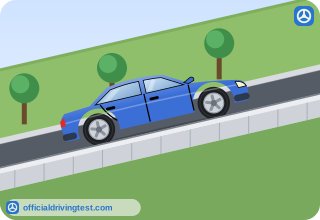
When you park facing uphill next to a curb, which way should you turn your vehicle's wheels?
- Toward the curb
- Straight ahead
- Whichever way is easier
- Away from the curb
Show answer
Correct answer: Away from the curb
The manual says to turn the wheels away from the curb when parking facing uphill.
Source: Indiana Driver’s Manual (July 2026), page 54 · Open this page in the manual (Manual page 54)
-
When you park facing uphill and there is no curb, which way should you turn your vehicle's wheels?
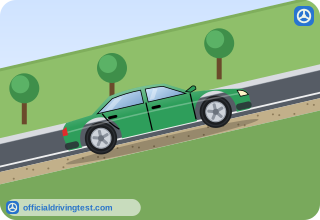
- Away from the street
- Toward the street
- Straight ahead
- Parallel to the street
Show answer
Correct answer: Away from the street
If there is no curb when parking uphill, the manual says to turn the wheels away from the street.
Source: Indiana Driver’s Manual (July 2026), page 54 · Open this page in the manual (Manual page 54)
-
What should you use when entering traffic from a parking space?

- Your horn only
- Your hazard lights
- Your turn signal
- Your high beams
Show answer
Correct answer: Your turn signal
The manual says to use your turn signal when entering traffic from a parking space.
Source: Indiana Driver’s Manual (July 2026), page 54 · Open this page in the manual (Manual page 54)
-
What should you do when backing out of a parking place?
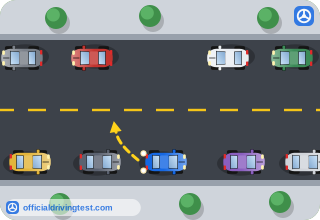
- Look in both directions and double-check for cars and pedestrians
- Look only toward the direction of the nearest approaching traffic
- Back out quickly so other drivers have time to see you
- Rely on your rearview mirror and avoid turning your head
Show answer
Correct answer: Look in both directions and double-check for cars and pedestrians
The manual says to look in both directions and double-check for cars and pedestrians when backing out of a parking place.
Source: Indiana Driver’s Manual (July 2026), page 54 · Open this page in the manual (Manual page 54)
-
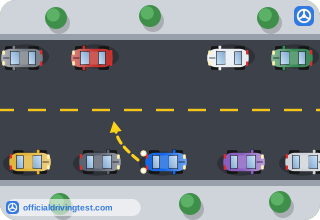
Why is reversing more difficult than driving forward?
- Your vehicle's brakes work less well in reverse
- Your steering wheel turns the opposite way in reverse
- Your field of vision is blocked by the vehicle itself
- Your tires have less grip when moving backward
Show answer
Correct answer: Your field of vision is blocked by the vehicle itself
The manual says reversing is harder because the vehicle itself blocks your field of vision, and speed and direction are harder to control.
Source: Indiana Driver’s Manual (July 2026), page 54 · Open this page in the manual (Manual page 54)
-
What is the correct way to look behind you when you reverse?
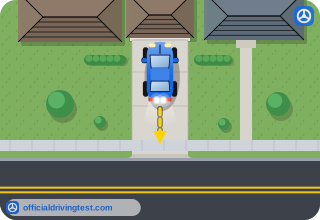
- Turn your body to the left and look through the side window
- Turn your body to the right and look through the back window
- Look only at the rearview mirror and go slowly
- Look only at the side mirrors and keep a steady speed
Show answer
Correct answer: Turn your body to the right and look through the back window
The manual says to turn your body to the right to look through the back window and never use only the rearview mirror.
Source: Indiana Driver’s Manual (July 2026), page 54 · Open this page in the manual (Manual page 54)
-
Which way of turning around does the manual say you must never use?
- Turning around in a parking lot
- Turning around in a wide driveway
- Turning around on a quiet side street
- Backing into an intersection
Show answer
Correct answer: Backing into an intersection
The manual says never to back into an intersection in order to turn around.
Source: Indiana Driver’s Manual (July 2026), page 54 · Open this page in the manual (Manual page 54)
-
Parking within how close to a fire hydrant is prohibited?
- 5 feet
- 15 feet
- 10 feet
- 20 feet
Show answer
Correct answer: 15 feet
The list of illegal parking areas includes within 15 feet of a fire hydrant.
Source: Indiana Driver’s Manual (July 2026), page 54 · Open this page in the manual (Manual page 54)
-
Parking next to a curb of which color is prohibited?
- White
- Blue
- Green
- Yellow
Show answer
Correct answer: Yellow
The list of illegal parking areas includes spots adjacent to yellow curbs.
Source: Indiana Driver’s Manual (July 2026), page 54 · Open this page in the manual (Manual page 54)
-
Is parking allowed in the diagonally striped area next to an accessible parking space if you have a valid parking placard?
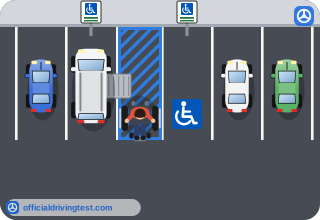
- No, it is prohibited even with a valid placard
- Yes, but only for a short time while loading
- Yes, a valid parking placard allows it at any time
- Yes, if no wheelchair user is parked nearby
Show answer
Correct answer: No, it is prohibited even with a valid placard
The manual says parking in the striped area is prohibited even if you have a valid parking placard.
Source: Indiana Driver’s Manual (July 2026), page 55 · Open this page in the manual (Manual page 55)
-
Why is parking in the diagonally striped area next to an accessible parking space prohibited?
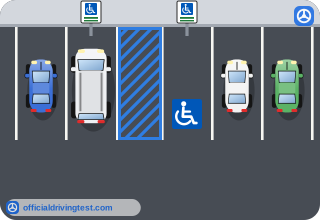
- It keeps the aisle clear for emergency vehicles
- It gives other drivers room to turn into the space
- It lets a wheelchair user transfer in and out of a vehicle
- It is kept clear for shopping cart returns
Show answer
Correct answer: It lets a wheelchair user transfer in and out of a vehicle
The manual says the striped space allows a wheelchair user to transfer in and out of the vehicle and to deploy a ramp.
Source: Indiana Driver’s Manual (July 2026), page 55 · Open this page in the manual (Manual page 55)
-
How are reserved parking spots for those with disabilities marked?
- With a sign and pavement markings
- With a sign posted at the entrance only
- With pavement markings on the ground only
- With a painted curb and no sign
Show answer
Correct answer: With a sign and pavement markings
The manual says reserved parking spots for those with disabilities are marked with a sign and pavement markings.
Source: Indiana Driver’s Manual (July 2026), page 55 · Open this page in the manual (Manual page 55)