Indiana: Exam Simulator
40 random questions from every topic, like a mini exam.
Independent educational site · not affiliated with any government agency or DMV
Ready? Test yourself
40 questions (the state does not publish how many its test has); pass mark 80%, as on the real test.
- Instant feedback with an explanation
- Every answer cites its source in the manual
- Your best score is saved on this device
Questions are original and based on the official manual "Indiana Driver’s Manual" (July 2026), Indiana Bureau of Motor Vehicles.
Sample questions
The exam simulator picks 40 random questions from every topic each time you start. Here are a few examples.
Show the questions and answersHide the questions
-
In which BMV credential category is a commercial driver's license (CDL) included?
- Driver's licenses
- Learner's permits
- Identification cards
- Endorsements
Show answer
Correct answer: Driver's licenses
The manual places the driver's license and the commercial driver's license (CDL) together in the Driver's Licenses category.
Source: Indiana Driver’s Manual (July 2026), page 1 · Open this page in the manual (Manual page 1)
-
When changing lanes to prepare for a turn, what must you do before turning or changing lanes?
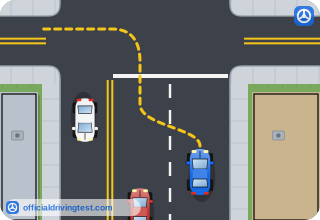
- Sound your horn
- Come to a complete stop
- Give a proper signal
- Turn on your hazard lights
Show answer
Correct answer: Give a proper signal
The manual says you must give a proper signal before turning or changing lanes.
Source: Indiana Driver’s Manual (July 2026), page 37 · Open this page in the manual (Manual page 37)
-
What do yellow lane markings separate?
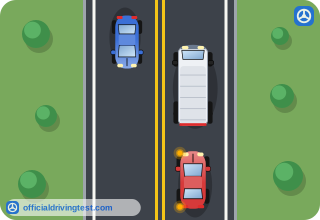
- Lanes of traffic going in opposite directions
- Lanes of traffic going in the same direction
- Travel lanes from the roadside shoulder
- Parking spaces from travel lanes
Show answer
Correct answer: Lanes of traffic going in opposite directions
Yellow lane markings separate multiple lanes of traffic going in opposite directions.
Source: Indiana Driver’s Manual (July 2026), page 37 · Open this page in the manual (Manual page 37)
-
On the highway, which lane should be left for faster-moving or passing vehicles?
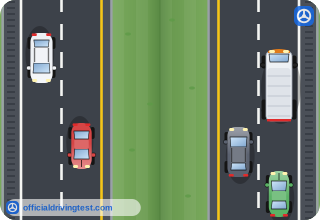
- The right-hand lane
- The lane closest to the shoulder
- The left-hand lane
- Whichever lane has the fewest vehicles
Show answer
Correct answer: The left-hand lane
Slower vehicles use the right lane, and the left-hand lane is left for faster-moving or passing vehicles.
Source: Indiana Driver’s Manual (July 2026), page 37 · Open this page in the manual (Manual page 37)
-
What does a parking placard allow the holder to do?
- Park in a fire lane whenever the placard is displayed
- Park next to a yellow curb for any length of time
- Use parking spaces designated for individuals with disabilities
- Park in the diagonally striped space next to a reserved space
Show answer
Correct answer: Use parking spaces designated for individuals with disabilities
A parking placard allows the holder to use spaces designated for individuals with disabilities.
Source: Indiana Driver’s Manual (July 2026), page 18 · Open this page in the manual (Manual page 18)
-
How many background colors are commonly used for traffic signs?
- Five
- Nine
- Seven
- Twelve
Show answer
Correct answer: Seven
The manual states that seven colors are commonly used for signs.
Source: Indiana Driver’s Manual (July 2026), page 27 · Open this page in the manual (Manual page 27)
-
Which agencies post the traffic signs that drivers see on Indiana streets and highways?
- The Indiana Department of Transportation and local governments
- The Indiana State Police and county court clerks across the state
- The Indiana BMV and the Indiana General Assembly each year
- The Federal Highway Administration and the Indiana BMV
Show answer
Correct answer: The Indiana Department of Transportation and local governments
The manual says traffic signs are posted by the Indiana Department of Transportation and local governments.
Source: Indiana Driver’s Manual (July 2026), page 27 · Open this page in the manual (Manual page 27)
-
What are traffic control devices such as stop lights and signs used for?
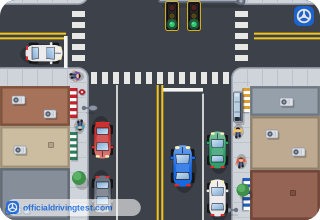
- To control traffic flow and indicate right of way at intersections and crossings
- To record the speed of vehicles passing through intersections and crossings
- To mark the boundary between city and county roads and streets in towns
- To show drivers the location of nearby parks, rest areas and fuel stops
Show answer
Correct answer: To control traffic flow and indicate right of way at intersections and crossings
The manual says traffic control devices such as stop lights and signs control traffic flow and indicate right of way at intersections and pedestrian crossings.
Source: Indiana Driver’s Manual (July 2026), page 33 · Open this page in the manual (Manual page 33)
-
Which traffic has the right of way when you are facing a red light?
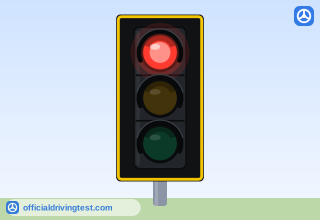
- Traffic traveling in the same direction that you are
- Only vehicles that are turning left
- Traffic entering the intersection from other directions
- Only vehicles that are turning right
Show answer
Correct answer: Traffic entering the intersection from other directions
A red light means stop, and traffic entering the intersection from other directions has the right of way.
Source: Indiana Driver’s Manual (July 2026), page 33 · Open this page in the manual (Manual page 33)
-
How far from the nearest rail must vehicles that are required by law to stop at a railroad crossing stop?
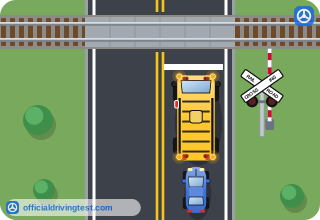
- Not closer than 5 feet or farther than 15 feet
- Not closer than 25 feet or farther than 100 feet
- Not closer than 50 feet or farther than 100 feet
- Not closer than 15 feet or farther than 50 feet
Show answer
Correct answer: Not closer than 15 feet or farther than 50 feet
Some vehicles are required by law to always stop not closer than 15 feet or farther than 50 feet from the nearest rail.
Source: Indiana Driver’s Manual (July 2026), page 48 · Open this page in the manual (Manual page 48)