Indiana: Emergencies — Part 3 Practice Test
Questions in this part include: “What does the manual say usually happens when a vehicle plunges into water?” · “Which items does the manual say to store in your vehicle so you are more visible to passing motorists?”
Independent educational site · not affiliated with any government agency or DMV
Ready? Test yourself
- Instant feedback with an explanation
- Every answer cites its source in the manual
- Your best score is saved on this device
Questions are original and based on the official manual "Indiana Driver’s Manual" (July 2026), Indiana Bureau of Motor Vehicles.
All 20 questions in this practice test
Take the test above first, then use this list to study. Tap “Show answer” to see the correct answer and explanation.
Show the questions and answersHide the questions
-
According to the manual, it is safer to hit something that is not moving than to hit something
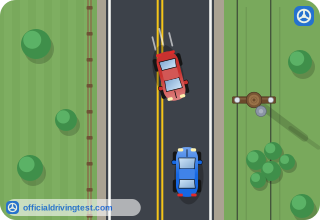
- head-on
- moving in the same direction as you
- that will give way, such as shrubs
- with a sideswipe
Show answer
Correct answer: head-on
The manual states that hitting something that is not moving is safer than hitting something head-on.
Source: Indiana Driver’s Manual (July 2026), page 58 · Open this page in the manual (Manual page 58)
-
What may a sideswipe do when a collision cannot be avoided?
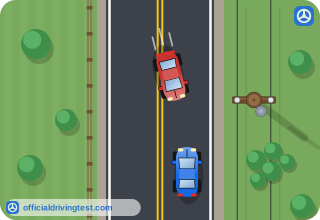
- Throw your vehicle off balance
- Make the collision head-on
- Help you slow down
- Lock your steering wheel
Show answer
Correct answer: Help you slow down
The manual says a sideswipe may help you slow down.
Source: Indiana Driver’s Manual (July 2026), page 58 · Open this page in the manual (Manual page 58)
-
If your vehicle's wheels drift onto the shoulder, what should you do?
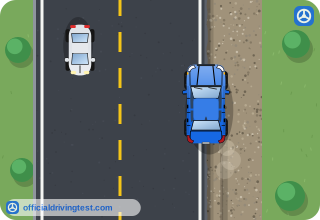
- Steer sharply back onto the pavement right away to regain the lane quickly
- Drive along the shoulder and ease up on the gas, then turn back gradually
- Brake hard to stop on the shoulder at once, then pull back out
- Speed up to get back onto the road quickly before traffic arrives
Show answer
Correct answer: Drive along the shoulder and ease up on the gas, then turn back gradually
Turn back only after slowing down, driving along the shoulder and easing up on the gas pedal.
Source: Indiana Driver’s Manual (July 2026), page 59 · Open this page in the manual (Manual page 59)
-
Why should you not turn back onto the pavement right away after your wheels drift onto the shoulder?
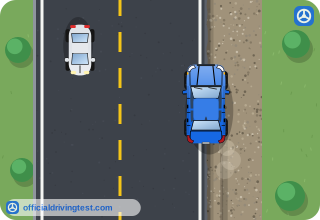
- The shoulder is always safer than the pavement
- The tires would lose air pressure
- It would automatically lock the steering wheel
- It might throw your vehicle off balance
Show answer
Correct answer: It might throw your vehicle off balance
Turning back onto the pavement right away might throw your vehicle off balance.
Source: Indiana Driver’s Manual (July 2026), page 59 · Open this page in the manual (Manual page 59)
-
What does the manual say usually happens when a vehicle plunges into water?
- It will usually float several minutes before sinking
- It sinks completely within only a few seconds
- It floats for several hours before it sinks
- It stays level and its doors open easily under water
Show answer
Correct answer: It will usually float several minutes before sinking
The vehicle will usually float several minutes before sinking, allowing escape through an open window.
Source: Indiana Driver’s Manual (July 2026), page 59 · Open this page in the manual (Manual page 59)
-
If your vehicle plunges into water, why should you not attempt to open a door?
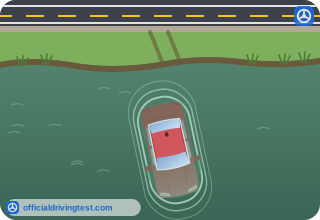
- Doors lock automatically when the engine is off and the vehicle is wet
- Door handles stop working once the vehicle is in water, so they are useless
- The weight of the water makes a door nearly impossible to open
- The doors are always held shut by the seat belts of the passengers
Show answer
Correct answer: The weight of the water makes a door nearly impossible to open
The weight of the water makes it nearly impossible to open a door, and water will flood the passenger compartment through an open door.
Source: Indiana Driver’s Manual (July 2026), page 59 · Open this page in the manual (Manual page 59)
-
If your vehicle plunges into water, what should you do right after removing your seat belt?
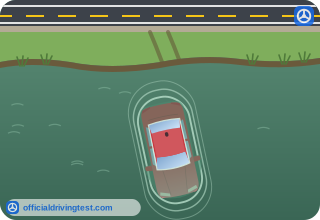
- Open a door
- Open a window
- Swim for shore
- Wait inside until the vehicle sinks
Show answer
Correct answer: Open a window
The manual lists removing your seat belt and then opening a window.
Source: Indiana Driver’s Manual (July 2026), page 59 · Open this page in the manual (Manual page 59)
-
After a vehicle plunges into water, when might automatic windows not open?
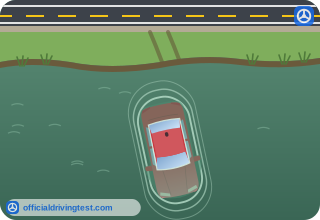
- If the vehicle floats level on the surface of the water
- If the seat belts have not yet been removed by the driver
- If the doors of the vehicle have already been opened
- If the impact is so severe that it damages the electrical system
Show answer
Correct answer: If the impact is so severe that it damages the electrical system
Automatic windows will open unless the impact is so severe that it damages the electrical system.
Source: Indiana Driver’s Manual (July 2026), page 59 · Open this page in the manual (Manual page 59)
-
If your vehicle plunges into water with children in the rear seat, what should you do?
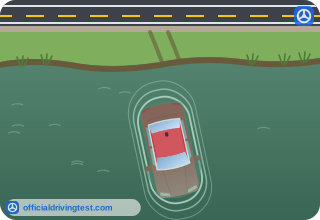
- Get them out of rear seat belts and child restraints, with older children helping
- Leave them buckled in the rear seat until rescuers arrive to help them
- Exit first yourself, then pull the children out through the nearest door
- Tell the children to stay in the rear seat while you open a window
Show answer
Correct answer: Get them out of rear seat belts and child restraints, with older children helping
The manual says to get children out of rear seat belts and child restraints, asking older children to assist the younger ones.
Source: Indiana Driver’s Manual (July 2026), page 59 · Open this page in the manual (Manual page 59)
-
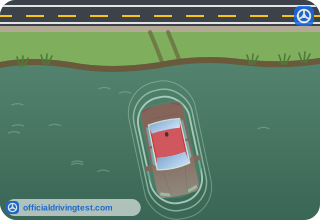
If your vehicle plunges into water, where should you move passengers as calmly as possible?
- To the rear seats
- To the cargo area
- To the front seats
- To the floor behind the front seats
Show answer
Correct answer: To the front seats
The manual says to move passengers to the front seats as calmly as possible.
Source: Indiana Driver’s Manual (July 2026), page 59 · Open this page in the manual (Manual page 59)
-
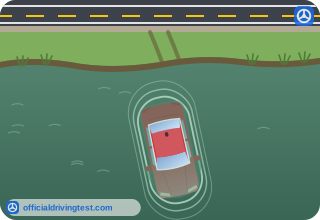
After exiting a vehicle that has plunged into water, where should you go?
- Straight into the water to swim ashore
- Onto the roof of the vehicle
- Back inside to wait with the windows open
- To the front bumper
Show answer
Correct answer: Onto the roof of the vehicle
The manual says to exit the vehicle and move to the roof, which keeps you as dry as possible.
Source: Indiana Driver’s Manual (July 2026), page 59 · Open this page in the manual (Manual page 59)
-
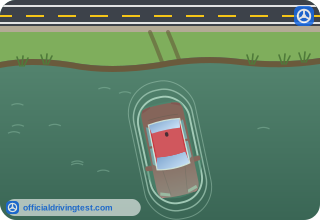
Once you are on the roof of a vehicle that has plunged into water, what should you do?
- Swim for shore at once
- Wave for help without calling anyone
- Climb back inside to get your phone
- Call 911 and locate the nearest dry land
Show answer
Correct answer: Call 911 and locate the nearest dry land
The manual says that once on the roof you should call 911 and locate the nearest dry land.
Source: Indiana Driver’s Manual (July 2026), page 59 · Open this page in the manual (Manual page 59)
-
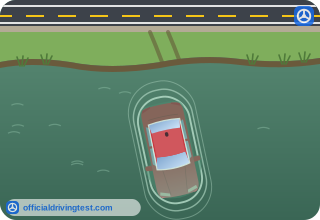
When should you swim for shore after your vehicle plunges into water?
- Only as a last resort, if help has not arrived by the time the vehicle sinks
- As soon as you have managed to climb out of the sinking vehicle
- Before you call 911, to reach dry land as fast as you can
- Only after you have first tried to open each door of the vehicle
Show answer
Correct answer: Only as a last resort, if help has not arrived by the time the vehicle sinks
Swimming for shore is only a last resort, if no help has arrived by the time the vehicle sinks below the waterline.
Source: Indiana Driver’s Manual (July 2026), page 59 · Open this page in the manual (Manual page 59)
-
After escaping a vehicle that plunged into water, what should you never do?
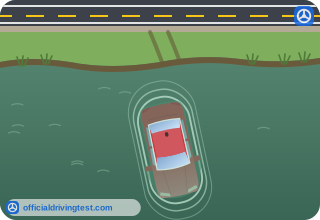
- Move to the roof of the vehicle while you wait
- Call 911 once you are out of the water
- Re-enter the vehicle to gather possessions
- Look for the nearest dry land to reach later
Show answer
Correct answer: Re-enter the vehicle to gather possessions
The manual says never to re-enter the vehicle to gather possessions.
Source: Indiana Driver’s Manual (July 2026), page 59 · Open this page in the manual (Manual page 59)
-
During a roadside emergency, what should you do if possible?
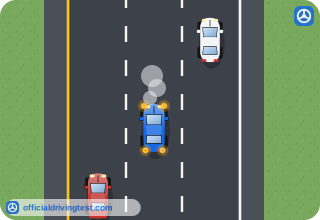
- Stop in the center of your lane so others see you
- Stop just past the crest of a hill
- Pull your vehicle onto the roadside shoulder
- Stay in the left lane with your engine running
Show answer
Correct answer: Pull your vehicle onto the roadside shoulder
The manual says that if possible you should always pull your vehicle onto the roadside shoulder.
Source: Indiana Driver’s Manual (July 2026), page 60 · Open this page in the manual (Manual page 60)
-
Which lights should you turn on during a roadside emergency?
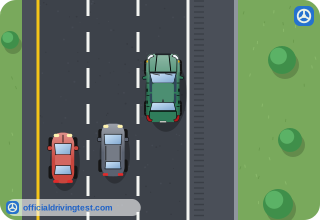
- Your high beam headlights
- Your flashing hazard lights
- Your fog lights
- Your left turn signal
Show answer
Correct answer: Your flashing hazard lights
The manual says to turn on your flashing hazard lights.
Source: Indiana Driver’s Manual (July 2026), page 60 · Open this page in the manual (Manual page 60)
-
What does the manual say to keep within reach of the vehicle operator for a roadside emergency?
- A spare set of keys for the vehicle
- A tire pressure gauge and a spare fuse
- A paper road map of your region
- A flashlight with fresh batteries
Show answer
Correct answer: A flashlight with fresh batteries
A flashlight with fresh batteries should be within reach of the vehicle operator.
Source: Indiana Driver’s Manual (July 2026), page 60 · Open this page in the manual (Manual page 60)
-
Which items does the manual say to store in your vehicle so you are more visible to passing motorists?
- A reflective vest and a red emergency reflective triangle
- An orange traffic cone and a white warning flag
- A flashing amber beacon and a loud whistle
- A reflective bumper sticker and a spare headlight
Show answer
Correct answer: A reflective vest and a red emergency reflective triangle
A reflective safety vest and a red emergency reflective triangle make you more visible to passing motorists.
Source: Indiana Driver’s Manual (July 2026), page 60 · Open this page in the manual (Manual page 60)
-
What should you pack in your vehicle during winter months in case you must wait for emergency responders or a tow?
- A tow rope and an ice scraper
- Extra fuel and a set of tire chains
- Blankets, extra gloves, and warm hats
- Road salt and a portable heater
Show answer
Correct answer: Blankets, extra gloves, and warm hats
The manual says to pack blankets, extra gloves, and warm hats in winter.
Source: Indiana Driver’s Manual (July 2026), page 60 · Open this page in the manual (Manual page 60)
-
If you must exit your vehicle while on a roadside shoulder, how should you do it?
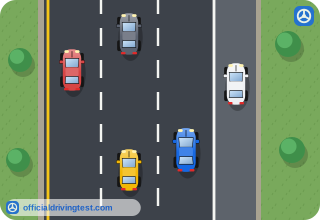
- On the driver side, after checking your side mirror for oncoming traffic
- Exit on the passenger side, after checking your immediate vicinity first
- On whichever side is closer to traffic, after turning off the hazard lights
- On the passenger side, after walking around the front of the vehicle first
Show answer
Correct answer: Exit on the passenger side, after checking your immediate vicinity first
The manual says to exit on the passenger side and only after checking your immediate vicinity.
Source: Indiana Driver’s Manual (July 2026), page 60 · Open this page in the manual (Manual page 60)