Indiana: Emergencies — Part 2 Practice Test
Questions in this part include: “Instead of triangles, a disabled truck, bus, or tractor-trailer driver may display at least how many fuses?” · “If an accident injures or kills another person, what is the driver required to provide?”
Independent educational site · not affiliated with any government agency or DMV
Ready? Test yourself
- Instant feedback with an explanation
- Every answer cites its source in the manual
- Your best score is saved on this device
Questions are original and based on the official manual "Indiana Driver’s Manual" (July 2026), Indiana Bureau of Motor Vehicles.
All 20 questions in this practice test
Take the test above first, then use this list to study. Tap “Show answer” to see the correct answer and explanation.
Show the questions and answersHide the questions
-
If your car stalls in a flooded area, what should you do?
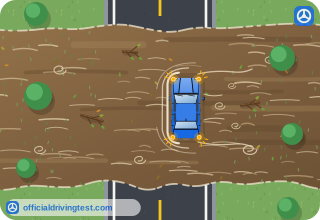
- Stay inside and wait for the water to drop
- Restart the engine repeatedly
- Abandon it as soon as possible
- Roll up the windows and wait for help
Show answer
Correct answer: Abandon it as soon as possible
The manual says to abandon the car as soon as possible because flood waters can rise rapidly and sweep a car and its occupants away.
Source: Indiana Driver’s Manual (July 2026), page 44 · Open this page in the manual (Manual page 44)
-
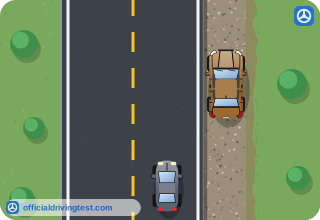
If your car becomes disabled and you pull onto the shoulder, what should be turned on if available?
- The interior dome light
- The high beams
- The vehicle's hazard lights
- The parking brake light
Show answer
Correct answer: The vehicle's hazard lights
The manual says the disabled vehicle's hazard lights, if available, should be turned on.
Source: Indiana Driver’s Manual (July 2026), page 57 · Open this page in the manual (Manual page 57)
-
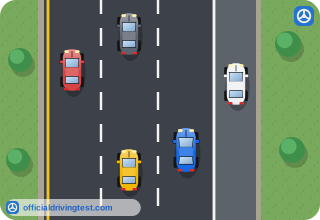
In the daytime, how many red flags must drivers of disabled cars display?
- One
- Three
- Two
- Four
Show answer
Correct answer: Two
The manual says drivers of disabled cars must display two red flags in the daytime.
Source: Indiana Driver’s Manual (July 2026), page 57 · Open this page in the manual (Manual page 57)
-
If your car is stopped within 500 feet of a curve, hilltop, or other obstruction, how far from your car must a warning device be displayed at least?
- At least 250 feet
- At least 500 feet
- At least 300 feet
- At least 750 feet
Show answer
Correct answer: At least 500 feet
The manual says a warning device must be displayed at least 500 feet from your car in that situation.
Source: Indiana Driver’s Manual (July 2026), page 57 · Open this page in the manual (Manual page 57)
-
How many bi-directional emergency reflective triangles must the driver of a disabled truck, bus, or tractor-trailer display on a traveled roadway or its shoulder?
- Two
- Four
- Six
- Three
Show answer
Correct answer: Three
The manual says the driver must display three bi-directional emergency reflective triangles, or at least six fuses or three liquid-burning flares.
Source: Indiana Driver’s Manual (July 2026), page 57 · Open this page in the manual (Manual page 57)
-
Instead of triangles, a disabled truck, bus, or tractor-trailer driver may display at least how many fuses?
- Two
- Six
- Three
- Four
Show answer
Correct answer: Six
The manual says the driver may display at least six fuses instead of three triangles or three liquid-burning flares.
Source: Indiana Driver’s Manual (July 2026), page 57 · Open this page in the manual (Manual page 57)
-
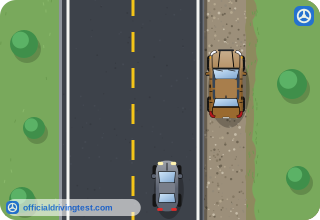
During times when headlights are not needed, what may you use in place of flares, reflectors, or electric lanterns?
- Orange traffic cones or pieces of white cloth on the road
- Bright headlights aimed toward the approaching traffic
- Only the vehicle's hazard lights shown at the roadside
- Bi-directional emergency reflective triangles or red flags
Show answer
Correct answer: Bi-directional emergency reflective triangles or red flags
The manual says to use bi-directional emergency reflective triangles or red flags in place of flares, reflectors, or electric lanterns when headlights are not needed.
Source: Indiana Driver’s Manual (July 2026), page 57 · Open this page in the manual (Manual page 57)
-
Where must the driver of a vehicle involved in an accident stop?
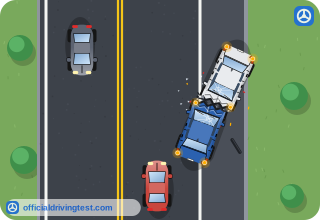
- Immediately, or as close to the scene as possible without blocking traffic more than necessary
- At the next exit or parking lot, at least a mile from the scene of the accident
- Only if the accident causes an injury; otherwise the driver may continue on
- Wherever the vehicle can be stopped quickly, even if it blocks a traffic lane
Show answer
Correct answer: Immediately, or as close to the scene as possible without blocking traffic more than necessary
The driver must stop immediately or as close as possible to the scene, without obstructing traffic more than necessary.
Source: Indiana Driver’s Manual (July 2026), page 58 · Open this page in the manual (Manual page 58)
-
An accident occurs on the traveled portion of a highway and nobody is hurt. What must the driver do with the vehicle?
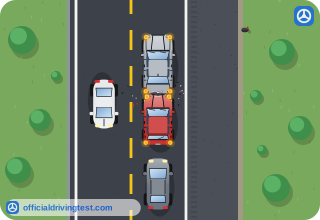
- Leave it where it stopped until police arrive and give directions
- Turn off its engine and push it to the next exit on the highway
- Move it off the highway to a location as close to the accident as possible
- Move it to the left lane and turn on the hazard lights until help comes
Show answer
Correct answer: Move it off the highway to a location as close to the accident as possible
If the accident occurs on the traveled portion of a highway, the driver must move the vehicle off the highway as close to the accident as possible.
Source: Indiana Driver’s Manual (July 2026), page 58 · Open this page in the manual (Manual page 58)
-
In which situation should a driver not move the vehicle after an accident?
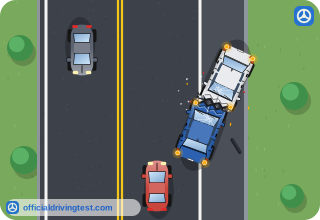
- When the vehicle is blocking a lane of traffic on the highway
- When it involves hazardous materials, injury, death, or entrapment
- When the other driver asks to wait for an insurance agent
- When the accident happens during rain, snow, or poor light
Show answer
Correct answer: When it involves hazardous materials, injury, death, or entrapment
The driver should not move the motor vehicle if the accident involves hazardous materials or results in injury, death, or entrapment.
Source: Indiana Driver’s Manual (July 2026), page 58 · Open this page in the manual (Manual page 58)
-
Besides showing a driver's license, what must a driver who stays at the scene of an accident give to everyone involved?
- Name, phone number, and the number of the insurance policy
- Name, date of birth, and the title number of the vehicle
- Name, employer, and the date of the vehicle's last inspection
- Name, address, and the registration number of the motor vehicle
Show answer
Correct answer: Name, address, and the registration number of the motor vehicle
The driver must give their name, address, and the vehicle's registration number to everyone involved, and show their driver's license.
Source: Indiana Driver’s Manual (July 2026), page 58 · Open this page in the manual (Manual page 58)
-
If an accident injures or kills another person, what is the driver required to provide?
- Reasonable assistance to those injured or trapped, as directed by law enforcement, medical personnel, or a 911 operator
- Transportation to the nearest hospital for each person who is injured, using the driver's own vehicle
- Medical treatment for injured people, but only if the driver has first aid training
- Nothing further, once the police have been told the location of the accident
Show answer
Correct answer: Reasonable assistance to those injured or trapped, as directed by law enforcement, medical personnel, or a 911 operator
The driver must give reasonable assistance to people injured or trapped in vehicles, as directed by law enforcement, medical personnel, or a 911 operator.
Source: Indiana Driver’s Manual (July 2026), page 58 · Open this page in the manual (Manual page 58)
-
After an accident, who should the driver make sure is notified as soon as possible?
- Only the BMV, which must be told in person at a branch
- The owner of the nearest property along the roadway
- Law enforcement: local police, sheriff, or state police
- A towing company, before any other agency is told
Show answer
Correct answer: Law enforcement: local police, sheriff, or state police
As soon as possible, the driver should make sure law enforcement (local police, sheriff, or state police) are notified of the accident.
Source: Indiana Driver’s Manual (July 2026), page 58 · Open this page in the manual (Manual page 58)
-
You hit an unattended vehicle and cannot find its owner. What must you do after stopping and staying at the scene?
- Drive away if the damage to the unattended vehicle looks minor
- Take reasonable steps to notify the owner, then call law enforcement
- Wait 24 hours and then report the damage to the BMV by mail
- Move the damaged vehicle to a safe place nearby and then leave
Show answer
Correct answer: Take reasonable steps to notify the owner, then call law enforcement
If the owner cannot be located, the driver must call a law enforcement agency to provide information.
Source: Indiana Driver’s Manual (July 2026), page 58 · Open this page in the manual (Manual page 58)
-
What does the manual say about accelerating when it appears your car will hit something?
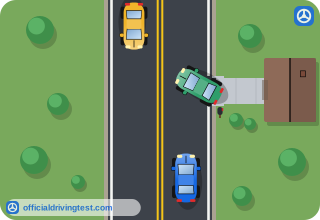
- Accelerating should never be used as a way to avoid a collision
- Accelerating may sometimes be the best or only way to avoid a collision
- Accelerating is allowed only when you are driving on a freeway
- Accelerating is allowed only after your brakes have already failed
Show answer
Correct answer: Accelerating may sometimes be the best or only way to avoid a collision
Speeding up is one of three possible actions, and accelerating may sometimes be the best or only way to avoid a collision.
Source: Indiana Driver’s Manual (July 2026), page 58 · Open this page in the manual (Manual page 58)
-
If you feel you cannot stop in time to avoid a collision, what should you do?
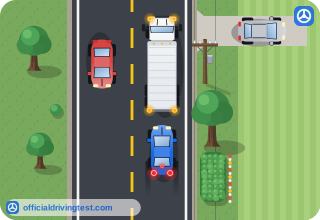
- Hold the steering wheel straight and brake as hard as you can
- Sound your horn and keep going in a straight line
- Shift into reverse and back away
- Turn your vehicle away from the potential collision
Show answer
Correct answer: Turn your vehicle away from the potential collision
If you cannot stop in time, the manual says to turn your vehicle away from the potential collision.
Source: Indiana Driver’s Manual (July 2026), page 58 · Open this page in the manual (Manual page 58)
-
If a collision looks possible, which way should you turn?
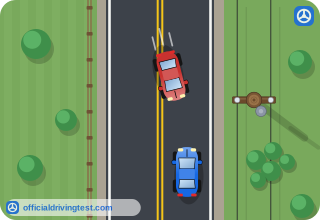
- Away from oncoming traffic, even if it means leaving the road
- Toward oncoming traffic, because it is moving
- Straight ahead, staying on the pavement no matter what
- Toward the center of the road, to keep both wheels on the pavement
Show answer
Correct answer: Away from oncoming traffic, even if it means leaving the road
The manual says to turn away from oncoming traffic, even if it means leaving the road.
Source: Indiana Driver’s Manual (July 2026), page 58 · Open this page in the manual (Manual page 58)
-
If you must leave the road to avoid a collision, how should you do it?
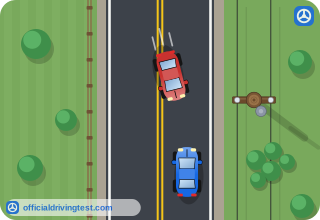
- Skid off the road, because skidding quickly helps you lose speed
- Lock the brakes before leaving the pavement to slow down fully
- Drive off the road rather than skid off, which allows more control
- Turn off the engine and coast off the road to avoid accelerating
Show answer
Correct answer: Drive off the road rather than skid off, which allows more control
Driving rather than skidding off the road allows for more control.
Source: Indiana Driver’s Manual (July 2026), page 58 · Open this page in the manual (Manual page 58)
-
If you cannot avoid hitting something, which should you choose?
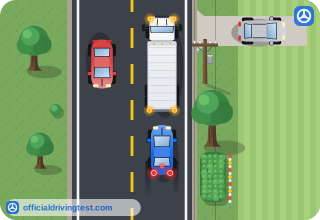
- A solid object, such as a wall or a large tree
- Something that will give way, such as brush or shrubs
- A parked vehicle, because it will not move
- Any object, as long as it is straight ahead
Show answer
Correct answer: Something that will give way, such as brush or shrubs
The manual says to choose to hit something that will give way, such as brush or shrubs, rather than something hard.
Source: Indiana Driver’s Manual (July 2026), page 58 · Open this page in the manual (Manual page 58)
-
Rather than hitting something that is not moving, you should try to hit something that is
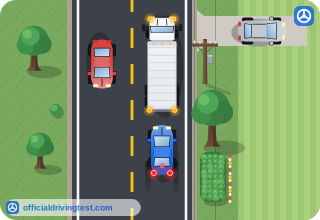
- moving toward you in the opposite direction
- parked beside the road and not moving at all
- made of a hard material that will not give way
- moving in the same direction as you
Show answer
Correct answer: moving in the same direction as you
The manual says to hit something moving in the same direction rather than something that is not moving.
Source: Indiana Driver’s Manual (July 2026), page 58 · Open this page in the manual (Manual page 58)