Illinois: Speed & following distance
Illinois speed limits, safe following distance and driving for conditions. Split into 2 shorter tests so you're not stuck in one long quiz.
Independent educational site · not affiliated with any government agency or DMV
All 45 Speed & following distance questions with answers
Choose a part above to take a practice test, or study every question and answer here.
Show the questions and answersHide the questions
-
When may you drive at the maximum allowable speed?
- At any time of day or night
- Only under safe conditions
- Whenever traffic is light
- Only in the left lane
Show answer
Correct answer: Only under safe conditions
You may drive at the maximum allowable speed only under safe conditions.
Source: Illinois Rules of the Road (2026), page 24
-
When no minimum speed limit is posted, how slowly may you drive?
- As slowly as you like, since there is no posted minimum on the road
- No slower than 45 mph on any road, including city/town streets
- No slower than half of the posted maximum speed limit at all times
- Not so slowly that you interfere with the normal movement of traffic
Show answer
Correct answer: Not so slowly that you interfere with the normal movement of traffic
When minimum limits are not posted, you should not drive so slowly as to create interference with the normal movement of traffic.
Source: Illinois Rules of the Road (2026), page 24
-
Unless otherwise posted, what is the speed limit on Illinois interstates and tollways?
- 55 mph
- 70 mph
- 65 mph
- 75 mph
Show answer
Correct answer: 70 mph
Unless otherwise posted, the speed limit on interstates and tollways is 70 mph.
Source: Illinois Rules of the Road (2026), page 24
-
Unless otherwise posted, what is the speed limit on highways with four lanes?
- 55 mph
- 70 mph
- 45 mph
- 65 mph
Show answer
Correct answer: 65 mph
Unless otherwise posted, the speed limit on highways with four lanes is 65 mph.
Source: Illinois Rules of the Road (2026), page 24
-
Unless otherwise posted, what is the speed limit on other highways and in rural areas?
- 55 mph
- 45 mph
- 65 mph
- 70 mph
Show answer
Correct answer: 55 mph
Unless otherwise posted, the speed limit on other highways and rural areas is 55 mph.
Source: Illinois Rules of the Road (2026), page 24
-
Unless otherwise posted, what is the speed limit in city/town areas?
- 20 mph
- 25 mph
- 30 mph
- 35 mph
Show answer
Correct answer: 30 mph
Unless otherwise posted, the speed limit in city/town areas is 30 mph.
Source: Illinois Rules of the Road (2026), page 24
-
Unless otherwise posted, what is the speed limit in alleys?
- 15 mph
- 5 mph
- 10 mph
- 20 mph
Show answer
Correct answer: 15 mph
Unless otherwise posted, the speed limit in alleys is 15 mph.
Source: Illinois Rules of the Road (2026), page 24
-
What is the speed limit in a school zone on school days when children are present and signs are posted?
- 15 mph
- 25 mph
- 20 mph
- 30 mph
Show answer
Correct answer: 20 mph
The school zone speed limit is 20 mph on school days between 6:30 a.m. and 4 p.m. when children are present and signs are posted.
Source: Illinois Rules of the Road (2026), page 24
-
During which hours does the 20 mph school zone speed limit apply on school days, when children are present and signs are posted?
- Between 7 a.m. and 3 p.m.
- Between 6:30 a.m. and 4 p.m.
- Between 8 a.m. and 5 p.m.
- At all hours, every day
Show answer
Correct answer: Between 6:30 a.m. and 4 p.m.
The 20 mph school zone limit applies on school days between 6:30 a.m. and 4 p.m. when children are present and signs are posted.
Source: Illinois Rules of the Road (2026), page 24
-
Who has the discretion to post speed limits different from the standard Illinois limits?
- Individual drivers
- Insurance companies
- Driving schools
- Local municipalities
Show answer
Correct answer: Local municipalities
Local municipalities have the discretion to post speed limits different from those listed.
Source: Illinois Rules of the Road (2026), page 24
-
In which situation does the manual say you must slow down?
- When entering a straight, empty road
- When approaching the top of a hill
- When leaving a school zone at 5 p.m.
- When the road ahead is dry and clear
Show answer
Correct answer: When approaching the top of a hill
You must slow down when approaching and crossing an intersection, going around a curve, approaching the top of a hill, or traveling on a narrow and winding roadway.
Source: Illinois Rules of the Road (2026), page 24
-
What is a "street sideshow," which is illegal in Illinois?
- A permitted parade of classic cars on a closed public street
- Vehicles pulled over on the shoulder to watch a roadside event
- Vehicles blocking traffic to perform unauthorized stunts or speed contests
- A group of vehicles traveling together in a funeral procession
Show answer
Correct answer: Vehicles blocking traffic to perform unauthorized stunts or speed contests
A street sideshow is an event where vehicles block or impede traffic to perform unauthorized stunts, speed contests or exhibitions of speed, and taking part is illegal.
Source: Illinois Rules of the Road (2026), page 30
-
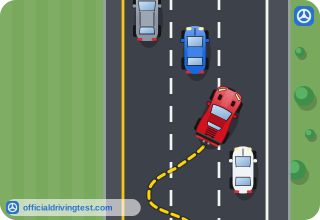
Weaving from lane to lane to move faster than the traffic flow is:
- Allowed if you signal
- Unlawful
- Allowed on interstates
- Allowed at night
Show answer
Correct answer: Unlawful
Weaving from lane to lane to move faster than the traffic flow is unlawful.
Source: Illinois Rules of the Road (2026), page 29
-
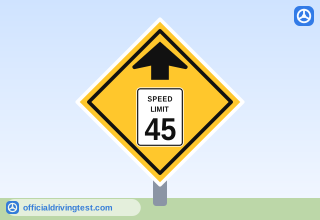
What should you do when you see a Speed Zone Ahead sign?
- Stop at the next intersection ahead
- Move into the far left lane right away
- Be prepared to alter your current speed
- Turn on your hazard flashers until past it
Show answer
Correct answer: Be prepared to alter your current speed
The Speed Zone Ahead sign warns that there is a speed zone ahead, so be prepared to alter your current speed.
Source: Illinois Rules of the Road (2026), page 66
-
On a freeway with a posted minimum speed limit, when is driving slower than that minimum legal?
- Whenever you are in the right lane
- Only when necessary for safety
- Whenever traffic is light
- Never, under any conditions
Show answer
Correct answer: Only when necessary for safety
Driving slower than the minimum speed limit is illegal unless necessary for safety.
Source: Illinois Rules of the Road (2026), page 66
-
Besides school days when children are present, when else does a posted reduced school zone speed apply?
- When a light is flashing
- Only during summer school
- On weekends and holidays
- Only after dark
Show answer
Correct answer: When a light is flashing
The posted speed applies on school days when children are present, where a potential hazard exists because of the children's close proximity to traffic, or when a light is flashing.
Source: Illinois Rules of the Road (2026), page 69
-
What is the cause of most rear-end crashes?
- Driving too slowly
- Worn tires
- Sudden lane changes
- Following too closely
Show answer
Correct answer: Following too closely
Following a vehicle too closely, or tailgating, is the cause of most rear-end crashes.
Source: Illinois Rules of the Road (2026), page 83
-
Which rule does the manual recommend for determining a safe following distance?
- The one-second rule
- The three-second rule
- The five-second rule
- The ten-second rule
Show answer
Correct answer: The three-second rule
The manual says to use the three-second rule to determine a safe following distance.
Source: Illinois Rules of the Road (2026), page 83
-
When using the three-second rule, what do you pick on the road ahead to count from?
- The brake lights of the car ahead
- A broken white lane line
- A fixed object such as a sign
- A moving car two vehicles ahead
Show answer
Correct answer: A fixed object such as a sign
To use the three-second rule, select a fixed object on the road ahead, such as a sign, tree, or overpass.
Source: Illinois Rules of the Road (2026), page 83
-
Using the three-second rule, you are following too closely if your vehicle reaches the fixed object:
- Before the count of one-thousand-three
- After the count of one-thousand-three
- After the count of one-thousand-four
- Only after the count of one-thousand-five
Show answer
Correct answer: Before the count of one-thousand-three
Your vehicle should not reach the object before the count of one-thousand-three; if it does, you are following too closely.
Source: Illinois Rules of the Road (2026), page 83
-
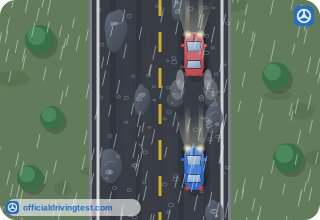
The three-second rule applies on a good road in good weather. What should you do when road or weather conditions are not good?
- Keep the same three-second distance
- Reduce your following distance
- Use your high beams to see farther
- Increase your following distance even more
Show answer
Correct answer: Increase your following distance even more
If the road and/or weather conditions are not good, increase your following distance even more.
Source: Illinois Rules of the Road (2026), page 83
-
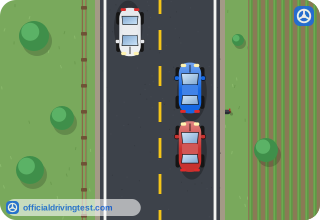
What should you do if you are being tailgated?
- Tap your brakes repeatedly to warn the driver
- Change lanes or slowly pull off and let it pass
- Speed up to increase the gap behind you
- Brake suddenly so the driver backs off
Show answer
Correct answer: Change lanes or slowly pull off and let it pass
If you are being tailgated, move to another lane or slowly pull off the road and allow the vehicle to pass.
Source: Illinois Rules of the Road (2026), page 83
-
How should you choose your driving speed, according to the manual?
- Always drive at exactly the posted speed limit
- Match the flow of traffic, even above the posted limit
- Match conditions and traffic flow, up to the posted limit
- Stay well below the flow of traffic at all times
Show answer
Correct answer: Match conditions and traffic flow, up to the posted limit
Your speed should be adjusted for the conditions and match the flow of traffic, as long as it does not surpass the maximum posted speed limit.
Source: Illinois Rules of the Road (2026), page 84
-
What happens to your vehicle's stopping distance when you double your speed?
- It quadruples
- It doubles
- It triples
- It stays the same
Show answer
Correct answer: It quadruples
The manual states that doubling your speed quadruples your vehicle's stopping distance.
Source: Illinois Rules of the Road (2026), page 84
-
Which tires will stop a vehicle faster, according to the manual?
- Small, narrow tires with little tread
- Small tires with worn tread
- Large tires with little tread
- Large, wide tires with good tread
Show answer
Correct answer: Large, wide tires with good tread
Large, wide tires with good tread will stop a vehicle faster than small, narrow tires with little tread.
Source: Illinois Rules of the Road (2026), page 84
-
Which wind condition can make it very difficult to stop?
- A light crosswind
- A strong tailwind
- A strong headwind
- Calm air
Show answer
Correct answer: A strong tailwind
When deciding your speed, consider the wind: a strong tailwind can make it very difficult to stop.
Source: Illinois Rules of the Road (2026), page 84
-
Compared with older, worn brakes, how do newer brakes stop a vehicle?
- They take longer to stop it
- At exactly the same rate
- More quickly
- Only with more pedal pressure
Show answer
Correct answer: More quickly
Newer brakes stop a vehicle more quickly than older, worn brakes.
Source: Illinois Rules of the Road (2026), page 84
-
Which of these does the manual list as affecting how quickly a vehicle can stop?
- Weight distribution and shock absorbers
- The paint color and the interior trim
- The number of doors and seats inside
- The kind of radio and speakers installed
Show answer
Correct answer: Weight distribution and shock absorbers
Vehicle design, weight distribution, suspension and shock absorbers all affect how quickly a vehicle can stop.
Source: Illinois Rules of the Road (2026), page 84
-
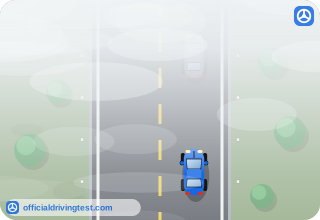
When driving in fog, what should you do with cruise control and following distance?
- Turn off cruise control and increase following distance
- Use cruise control and keep a normal following distance
- Use cruise control and reduce your following distance
- Turn off cruise control and follow closely to see taillights
Show answer
Correct answer: Turn off cruise control and increase following distance
In fog, turn off the cruise control and increase your following distance.
Source: Illinois Rules of the Road (2026), page 84
-
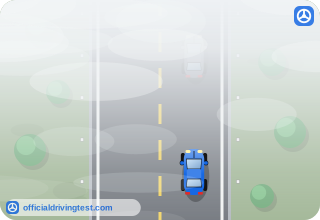
While driving in fog, you see headlights or taillights ahead. What should you do?
- Speed up to follow them
- Switch to high beams
- Pass the vehicle quickly
- Slow down even more
Show answer
Correct answer: Slow down even more
In fog, if you see headlights or taillights, slow down even more; the driver may be in the center of the road, stopped, or barely moving.
Source: Illinois Rules of the Road (2026), page 84
-
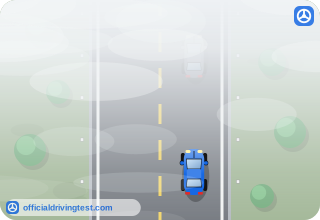
If fog is too dense to drive safely, what does the manual say to do?
- Keep driving at 5-10 mph
- Follow closely behind a truck
- Pull off the roadway and stop
- Stop in your lane with flashers on
Show answer
Correct answer: Pull off the roadway and stop
If the fog is too dense, pull off the roadway and stop; the manual says not to drive at 5-10 mph.
Source: Illinois Rules of the Road (2026), page 84
-
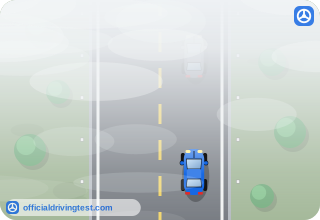
In fog, why should you brake early when approaching a stop?
- To warn other drivers
- To dry your brakes
- To save fuel
- To test your tires
Show answer
Correct answer: To warn other drivers
In fog, brake early when approaching a stop to warn other drivers.
Source: Illinois Rules of the Road (2026), page 84
-
Why does the roadway become slippery when rain begins to fall lightly?
- The pavement cools down too quickly
- Rain washes the paint off the lane lines
- Water mixes with dust, oil, and leaves
- Tires heat up faster on wet pavement
Show answer
Correct answer: Water mixes with dust, oil, and leaves
When rain begins to fall lightly, water, dust, oil, and leaves cause the roadway to become slippery.
Source: Illinois Rules of the Road (2026), page 85
-
What should you do to avoid hydroplaning?
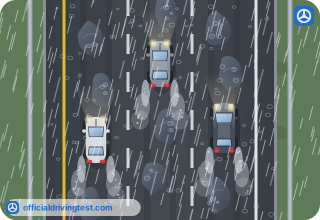
- Slow down
- Speed up
- Brake hard
- Use cruise control
Show answer
Correct answer: Slow down
The manual says to slow down to avoid hydroplaning.
Source: Illinois Rules of the Road (2026), page 85
-
According to the manual, high winds are especially a problem for drivers of which vehicles?
- Trucks, campers, and trailers-in-tow
- Small sedans and compact cars
- Low sports cars and coupes
- Front-wheel-drive passenger cars
Show answer
Correct answer: Trucks, campers, and trailers-in-tow
Wind can be a difficult problem, especially for drivers of trucks, recreational vehicles, campers and trailers-in-tow.
Source: Illinois Rules of the Road (2026), page 85
-
In high winds, when should you reduce your speed and make steering corrections?
- Only when driving over railroad tracks at night
- Only when entering or leaving a parking garage
- Only when stopped at a red traffic signal
- When going from a protected area to an open area
Show answer
Correct answer: When going from a protected area to an open area
In high winds, reduce speed and make steering corrections when going from a protected area to an open area and when meeting large vehicles such as trucks and buses.
Source: Illinois Rules of the Road (2026), page 85
-
What weather often accompanies high winds?
- Dense fog
- Heavy rain or sleet
- Clear skies
- Hail only
Show answer
Correct answer: Heavy rain or sleet
Heavy rain or sleet often accompanies high winds, so be alert to wet or slippery areas.
Source: Illinois Rules of the Road (2026), page 85
-
According to the manual, which is the most difficult driving season?
- Winter
- Spring
- Summer
- Fall
Show answer
Correct answer: Winter
Winter is the most difficult driving season due to possible ice, snow, lower temperatures, and fewer daylight hours.
Source: Illinois Rules of the Road (2026), page 85
-
When should you turn off the cruise control in winter?
- Only on dry, clear pavement at any speed
- Only when driving at night in the city
- Only when driving on expressways
- If the pavement is wet, icy, or snowy
Show answer
Correct answer: If the pavement is wet, icy, or snowy
Turn off the cruise control if the pavement is wet, icy, or snowy.
Source: Illinois Rules of the Road (2026), page 85
-
What does the manual say about driving with snow tires or chains?
- They don't let you drive bad roads at normal speed
- They let you drive at normal speeds on snowy roads
- They are required on all Illinois roads in winter
- They remove the need to begin braking early
Show answer
Correct answer: They don't let you drive bad roads at normal speed
Snow tires give extra traction and chains increase safety, but neither allows you to drive on bad roads at normal speeds.
Source: Illinois Rules of the Road (2026), page 85
-
How should you apply your brakes on winter roads?

- Hard and fast to stop quickly
- Only at the last moment
- Only with the parking brake
- Gently, in slow, steady strokes
Show answer
Correct answer: Gently, in slow, steady strokes
Gently apply brakes in slow, steady strokes; this helps you determine how much traction is available.
Source: Illinois Rules of the Road (2026), page 85
-
Which road surfaces may stay icy after the rest of the roadway is clear and dry?
- Long, straight stretches in full sun
- Bridges, shaded spots, and overpasses
- Newly paved roads in city areas
- Roads right next to gas stations
Show answer
Correct answer: Bridges, shaded spots, and overpasses
Approach bridges, shaded spots, overpasses and turns slowly because they may remain icy after the rest of the roadway is clear and dry.
Source: Illinois Rules of the Road (2026), page 85
-
When driving at night, what can you use as guides on the roadway?
- The taillights of the car ahead
- The street lights only
- The edge lines and center lines
- Reflectors on parked cars
Show answer
Correct answer: The edge lines and center lines
At night, use the edge lines and center lines of the roadway as guides.
Source: Illinois Rules of the Road (2026), page 87
-
When should you slow down for a curve?
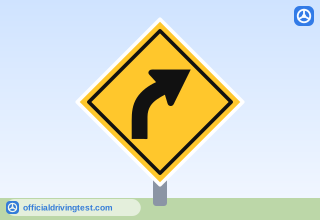
- In the middle of the curve
- Before entering the curve
- As you leave the curve
- You should not slow down
Show answer
Correct answer: Before entering the curve
Slow down before entering a curve, and do not brake suddenly.
Source: Illinois Rules of the Road (2026), page 87
-
Why should you not brake suddenly in a curve?
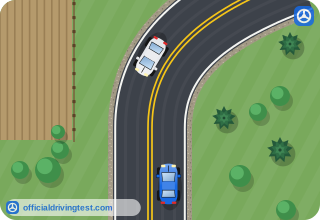
- It wears out the brake pads too quickly
- It wastes a large amount of fuel
- It may cause skidding or locked wheels
- It can drain the vehicle's battery
Show answer
Correct answer: It may cause skidding or locked wheels
Braking suddenly in a curve may cause skidding or locked wheels.
Source: Illinois Rules of the Road (2026), page 87