Illinois: Speed & following distance — Part 2 Practice Test
Questions in this part include: “What happens to your vehicle's stopping distance when you double your speed?” · “In high winds, when should you reduce your speed and make steering corrections?”
Independent educational site · not affiliated with any government agency or DMV
Ready? Test yourself
- Instant feedback with an explanation
- Every answer cites its source in the manual
- Your best score is saved on this device
Questions are original and based on the official manual "Illinois Rules of the Road" (2026), Illinois Secretary of State.
All 22 questions in this practice test
Take the test above first, then use this list to study. Tap “Show answer” to see the correct answer and explanation.
Show the questions and answersHide the questions
-
What happens to your vehicle's stopping distance when you double your speed?
- It quadruples
- It doubles
- It triples
- It stays the same
Show answer
Correct answer: It quadruples
The manual states that doubling your speed quadruples your vehicle's stopping distance.
Source: Illinois Rules of the Road (2026), page 84
-
Which tires will stop a vehicle faster, according to the manual?
- Small, narrow tires with little tread
- Small tires with worn tread
- Large tires with little tread
- Large, wide tires with good tread
Show answer
Correct answer: Large, wide tires with good tread
Large, wide tires with good tread will stop a vehicle faster than small, narrow tires with little tread.
Source: Illinois Rules of the Road (2026), page 84
-
Which wind condition can make it very difficult to stop?
- A light crosswind
- A strong tailwind
- A strong headwind
- Calm air
Show answer
Correct answer: A strong tailwind
When deciding your speed, consider the wind: a strong tailwind can make it very difficult to stop.
Source: Illinois Rules of the Road (2026), page 84
-
Compared with older, worn brakes, how do newer brakes stop a vehicle?
- They take longer to stop it
- At exactly the same rate
- More quickly
- Only with more pedal pressure
Show answer
Correct answer: More quickly
Newer brakes stop a vehicle more quickly than older, worn brakes.
Source: Illinois Rules of the Road (2026), page 84
-
Which of these does the manual list as affecting how quickly a vehicle can stop?
- Weight distribution and shock absorbers
- The paint color and the interior trim
- The number of doors and seats inside
- The kind of radio and speakers installed
Show answer
Correct answer: Weight distribution and shock absorbers
Vehicle design, weight distribution, suspension and shock absorbers all affect how quickly a vehicle can stop.
Source: Illinois Rules of the Road (2026), page 84
-
When driving in fog, what should you do with cruise control and following distance?
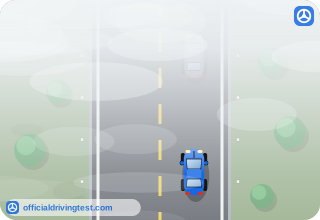
- Turn off cruise control and increase following distance
- Use cruise control and keep a normal following distance
- Use cruise control and reduce your following distance
- Turn off cruise control and follow closely to see taillights
Show answer
Correct answer: Turn off cruise control and increase following distance
In fog, turn off the cruise control and increase your following distance.
Source: Illinois Rules of the Road (2026), page 84
-
While driving in fog, you see headlights or taillights ahead. What should you do?
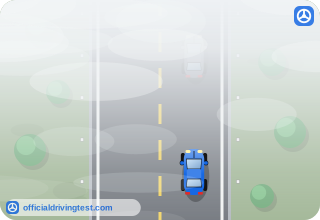
- Speed up to follow them
- Switch to high beams
- Pass the vehicle quickly
- Slow down even more
Show answer
Correct answer: Slow down even more
In fog, if you see headlights or taillights, slow down even more; the driver may be in the center of the road, stopped, or barely moving.
Source: Illinois Rules of the Road (2026), page 84
-
If fog is too dense to drive safely, what does the manual say to do?
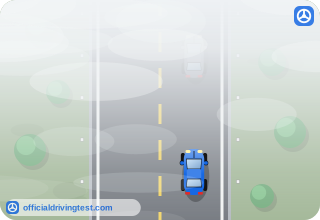
- Keep driving at 5-10 mph
- Follow closely behind a truck
- Pull off the roadway and stop
- Stop in your lane with flashers on
Show answer
Correct answer: Pull off the roadway and stop
If the fog is too dense, pull off the roadway and stop; the manual says not to drive at 5-10 mph.
Source: Illinois Rules of the Road (2026), page 84
-
In fog, why should you brake early when approaching a stop?
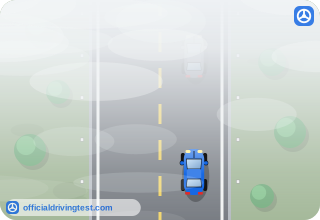
- To warn other drivers
- To dry your brakes
- To save fuel
- To test your tires
Show answer
Correct answer: To warn other drivers
In fog, brake early when approaching a stop to warn other drivers.
Source: Illinois Rules of the Road (2026), page 84
-
Why does the roadway become slippery when rain begins to fall lightly?
- The pavement cools down too quickly
- Rain washes the paint off the lane lines
- Water mixes with dust, oil, and leaves
- Tires heat up faster on wet pavement
Show answer
Correct answer: Water mixes with dust, oil, and leaves
When rain begins to fall lightly, water, dust, oil, and leaves cause the roadway to become slippery.
Source: Illinois Rules of the Road (2026), page 85
-
What should you do to avoid hydroplaning?
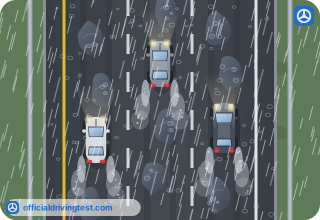
- Slow down
- Speed up
- Brake hard
- Use cruise control
Show answer
Correct answer: Slow down
The manual says to slow down to avoid hydroplaning.
Source: Illinois Rules of the Road (2026), page 85
-
According to the manual, high winds are especially a problem for drivers of which vehicles?
- Trucks, campers, and trailers-in-tow
- Small sedans and compact cars
- Low sports cars and coupes
- Front-wheel-drive passenger cars
Show answer
Correct answer: Trucks, campers, and trailers-in-tow
Wind can be a difficult problem, especially for drivers of trucks, recreational vehicles, campers and trailers-in-tow.
Source: Illinois Rules of the Road (2026), page 85
-
In high winds, when should you reduce your speed and make steering corrections?
- Only when driving over railroad tracks at night
- Only when entering or leaving a parking garage
- Only when stopped at a red traffic signal
- When going from a protected area to an open area
Show answer
Correct answer: When going from a protected area to an open area
In high winds, reduce speed and make steering corrections when going from a protected area to an open area and when meeting large vehicles such as trucks and buses.
Source: Illinois Rules of the Road (2026), page 85
-
What weather often accompanies high winds?
- Dense fog
- Heavy rain or sleet
- Clear skies
- Hail only
Show answer
Correct answer: Heavy rain or sleet
Heavy rain or sleet often accompanies high winds, so be alert to wet or slippery areas.
Source: Illinois Rules of the Road (2026), page 85
-
According to the manual, which is the most difficult driving season?
- Winter
- Spring
- Summer
- Fall
Show answer
Correct answer: Winter
Winter is the most difficult driving season due to possible ice, snow, lower temperatures, and fewer daylight hours.
Source: Illinois Rules of the Road (2026), page 85
-
When should you turn off the cruise control in winter?
- Only on dry, clear pavement at any speed
- Only when driving at night in the city
- Only when driving on expressways
- If the pavement is wet, icy, or snowy
Show answer
Correct answer: If the pavement is wet, icy, or snowy
Turn off the cruise control if the pavement is wet, icy, or snowy.
Source: Illinois Rules of the Road (2026), page 85
-
What does the manual say about driving with snow tires or chains?
- They don't let you drive bad roads at normal speed
- They let you drive at normal speeds on snowy roads
- They are required on all Illinois roads in winter
- They remove the need to begin braking early
Show answer
Correct answer: They don't let you drive bad roads at normal speed
Snow tires give extra traction and chains increase safety, but neither allows you to drive on bad roads at normal speeds.
Source: Illinois Rules of the Road (2026), page 85
-
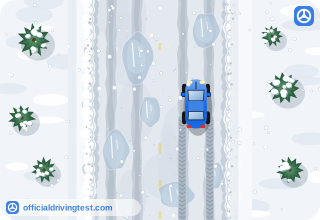
How should you apply your brakes on winter roads?
- Hard and fast to stop quickly
- Only at the last moment
- Only with the parking brake
- Gently, in slow, steady strokes
Show answer
Correct answer: Gently, in slow, steady strokes
Gently apply brakes in slow, steady strokes; this helps you determine how much traction is available.
Source: Illinois Rules of the Road (2026), page 85
-
Which road surfaces may stay icy after the rest of the roadway is clear and dry?
- Long, straight stretches in full sun
- Bridges, shaded spots, and overpasses
- Newly paved roads in city areas
- Roads right next to gas stations
Show answer
Correct answer: Bridges, shaded spots, and overpasses
Approach bridges, shaded spots, overpasses and turns slowly because they may remain icy after the rest of the roadway is clear and dry.
Source: Illinois Rules of the Road (2026), page 85
-
When driving at night, what can you use as guides on the roadway?
- The taillights of the car ahead
- The street lights only
- The edge lines and center lines
- Reflectors on parked cars
Show answer
Correct answer: The edge lines and center lines
At night, use the edge lines and center lines of the roadway as guides.
Source: Illinois Rules of the Road (2026), page 87
-
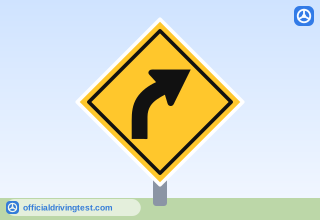
When should you slow down for a curve?
- In the middle of the curve
- Before entering the curve
- As you leave the curve
- You should not slow down
Show answer
Correct answer: Before entering the curve
Slow down before entering a curve, and do not brake suddenly.
Source: Illinois Rules of the Road (2026), page 87
-
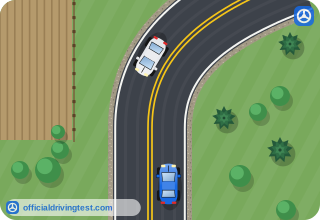
Why should you not brake suddenly in a curve?
- It wears out the brake pads too quickly
- It wastes a large amount of fuel
- It may cause skidding or locked wheels
- It can drain the vehicle's battery
Show answer
Correct answer: It may cause skidding or locked wheels
Braking suddenly in a curve may cause skidding or locked wheels.
Source: Illinois Rules of the Road (2026), page 87