Illinois: Road signs
Regulatory, warning, guide and work zone signs and what they require. Split into 2 shorter tests so you're not stuck in one long quiz.
Independent educational site · not affiliated with any government agency or DMV
All 37 Road signs questions with answers
Choose a part above to take a practice test, or study every question and answer here.
Show the questions and answersHide the questions
-
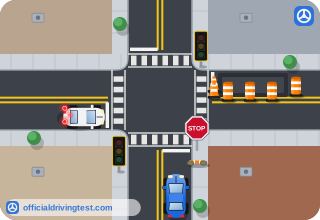
How should you treat a temporary STOP sign erected by highway authorities?
- As a YIELD sign
- As a suggestion you may ignore when clear
- As a warning sign only
- As if it were a permanent STOP sign
Show answer
Correct answer: As if it were a permanent STOP sign
A temporary STOP sign put up by highway authorities should be treated as if it were a permanent STOP sign.
Source: Illinois Rules of the Road (2026), page 63
-
When a STOP sign is handheld by a school guard or flagger, how long must you stay stopped?
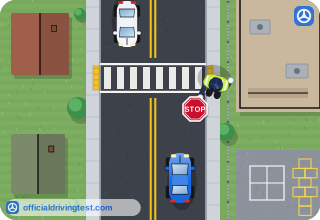
- Until the authorized person signals that it is safe to proceed
- For three full seconds, then proceed with caution
- Until the vehicle ahead of you starts moving again
- Until the person holding the sign turns away from you
Show answer
Correct answer: Until the authorized person signals that it is safe to proceed
With a handheld STOP sign, you stop until an authorized person, such as a school guard or construction zone flagger, signals that it is safe to proceed.
Source: Illinois Rules of the Road (2026), page 63
-
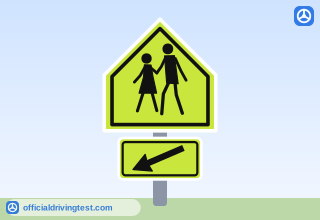
A five-sided school sign shows two children walking with a downward pointing arrow. What does it tell you?
- A playground is nearby
- A school bus stop is ahead
- The school zone has ended
- You are at a school crossing
Show answer
Correct answer: You are at a school crossing
If the sign shows two children walking with a downward pointing arrow, you are at a school crossing.
Source: Illinois Rules of the Road (2026), page 64
-
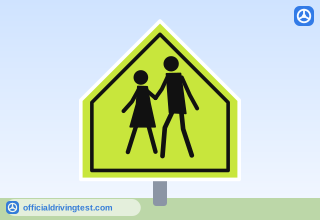
A five-sided school sign shows two children walking, with no arrow. What does it tell you?
- A school is nearby
- You are at a school crossing
- A pedestrian bridge is ahead
- Children may not cross here
Show answer
Correct answer: A school is nearby
If the sign shows two children walking, a school is nearby.
Source: Illinois Rules of the Road (2026), page 64
-
Where does the three-sided yellow NO PASSING ZONE sign appear?
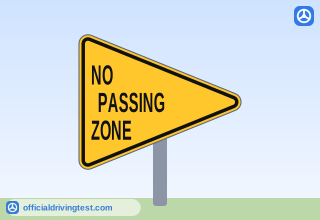
- On the right side of the road at the end of the zone
- On the left side of a two-lane, two-way roadway
- Overhead, above the center of the roadway
- On the right side of a four-lane divided highway
Show answer
Correct answer: On the left side of a two-lane, two-way roadway
The NO PASSING ZONE sign appears on the left side of a two-lane, two-way roadway at the beginning of the no-passing area.
Source: Illinois Rules of the Road (2026), page 64
-
Which type of sign instructs you on what to do and must be obeyed?
- Warning signs
- Regulatory signs
- Guide signs
- Route markers
Show answer
Correct answer: Regulatory signs
Regulatory signs instruct you on what to do and must be obeyed.
Source: Illinois Rules of the Road (2026), page 65
-
Which of these may you see posted underneath a STOP sign at an intersection?
- A 3-WAY, 5-WAY, or ALL-WAY sign
- A YIELD AHEAD or MERGE sign
- A PASS WITH CARE sign
- A SPEED ZONE AHEAD sign
Show answer
Correct answer: A 3-WAY, 5-WAY, or ALL-WAY sign
The manual says you may see 3-WAY, 5-WAY, or ALL-WAY signs underneath the stop sign.
Source: Illinois Rules of the Road (2026), page 65
-
If you must stop at a YIELD sign, where should you stop?
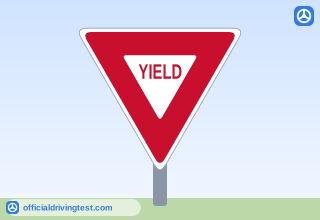
- Beside the YIELD sign, even inside the crosswalk
- In the center of the intersection
- At a marked crosswalk or before entering the intersection
- Anywhere past the YIELD sign that seems safe
Show answer
Correct answer: At a marked crosswalk or before entering the intersection
At a YIELD sign, when stopping, do so at a marked crosswalk or before entering the intersection.
Source: Illinois Rules of the Road (2026), page 65
-
What kinds of signs are associated with merging lanes?
- Only red regulatory signs
- Only guide signs and route markers
- Regulatory signs and guide signs
- Only advisory and warning signs
Show answer
Correct answer: Only advisory and warning signs
There is no regulatory sign associated with merging lanes; there are only advisory and warning signs.
Source: Illinois Rules of the Road (2026), page 65
-
Where is a DO NOT ENTER sign posted?
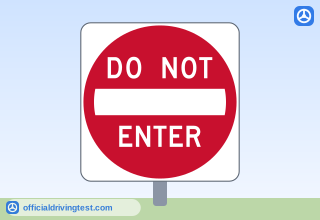
- On one-way streets and roads you may not enter
- At the start of every school zone and playground
- Wherever a two-lane road suddenly narrows
- Before every railroad crossing in rural areas
Show answer
Correct answer: On one-way streets and roads you may not enter
The DO NOT ENTER sign is posted on one-way streets and other roadways where you are not allowed to enter, such as an expressway ramp from the wrong direction.
Source: Illinois Rules of the Road (2026), page 65
-
Where will you see a WRONG WAY sign on an expressway ramp?
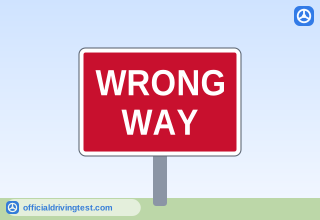
- At the top of the ramp, before the DO NOT ENTER sign
- At the point where the ramp merges into traffic
- Only at ramps that are closed for construction
- A short distance past the DO NOT ENTER sign
Show answer
Correct answer: A short distance past the DO NOT ENTER sign
The WRONG WAY sign is on expressway ramps a short distance past the DO NOT ENTER sign, telling you that you are traveling in the wrong direction.
Source: Illinois Rules of the Road (2026), page 66
-
No U-Turn signs may be posted where an opening in a divided highway leads to the other side. Who may use that opening?
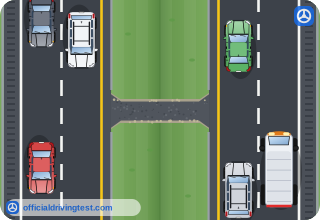
- Any driver who has missed an exit
- Trucks and buses only
- Only authorized vehicles
- Any driver, when traffic is light
Show answer
Correct answer: Only authorized vehicles
These openings are only for authorized vehicles such as police cars, ambulances, snow plows, construction/maintenance equipment and other emergency vehicles.
Source: Illinois Rules of the Road (2026), page 66
-
What do No Right Turn and No Left Turn signs indicate?
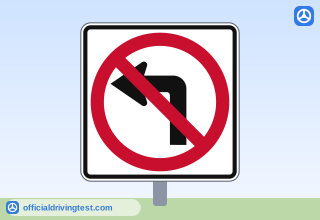
- Turns are allowed only on a green arrow
- No turning in the direction of the arrow
- Turns are allowed only after a complete stop
- Turns are not allowed during rush hour only
Show answer
Correct answer: No turning in the direction of the arrow
No Right/Left Turn signs indicate that turns are not allowed in the direction shown by the arrow.
Source: Illinois Rules of the Road (2026), page 66
-
On a street posted with One-Way signs, which direction may you travel?
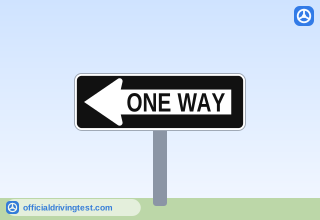
- Either direction if no traffic is coming
- Opposite the arrow when turning into a driveway
- Either direction during nighttime hours
- Only in the direction of the arrow
Show answer
Correct answer: Only in the direction of the arrow
One-Way signs are used on one-way streets or driveways, and you must always go only in the direction of the arrow.
Source: Illinois Rules of the Road (2026), page 67
-
What does a No Turn on Red sign prohibit?
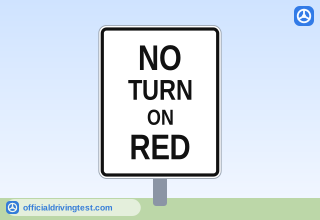
- Any turn while the light is green
- Turning left from a two-way street on a green arrow
- Right on red, or left on red between one-way streets
- U-turns at intersections that have traffic lights
Show answer
Correct answer: Right on red, or left on red between one-way streets
The sign tells you that a right turn on a red light, or a left turn on a red light at intersecting one-way streets, is prohibited.
Source: Illinois Rules of the Road (2026), page 67
-
Instead of the word "red," what may a No Turn on Red sign show?
- A red triangle
- A red circle
- A red square
- A red arrow
Show answer
Correct answer: A red circle
The No Turn on Red sign may show a red circle instead of the word red.
Source: Illinois Rules of the Road (2026), page 67
-
What does the Approaching a Divided Highway sign tell you?
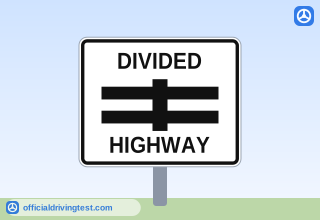
- The road you are on is about to end ahead
- The road ahead narrows down to a single lane
- You are leaving a divided roadway for a two-way road
- A median divides the road you will turn onto or cross
Show answer
Correct answer: A median divides the road you will turn onto or cross
The sign informs you that a median separates both directions of traffic on the road you are going to turn onto or cross.
Source: Illinois Rules of the Road (2026), page 67
-
When you see a Keep Right sign approaching a traffic island or median, what must you do?
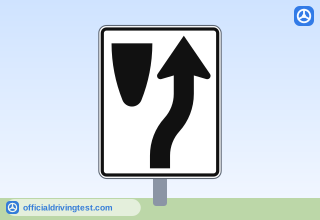
- Drive to the side indicated by the arrow
- Drive on whichever side has less traffic
- Stop before passing the traffic island
- Merge into the leftmost lane of traffic
Show answer
Correct answer: Drive to the side indicated by the arrow
The Keep Right sign tells you where to drive around islands, medians, or obstructions; you must drive to the side indicated by the arrow.
Source: Illinois Rules of the Road (2026), page 67
-
On a multilane highway with a Slower Traffic Keep Right sign, where should a slow driver drive?
- In the left lane
- In the center lane
- In the right lane
- On the shoulder
Show answer
Correct answer: In the right lane
The sign tells the slow driver to drive in the right lane.
Source: Illinois Rules of the Road (2026), page 67
-
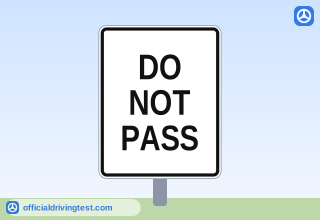
Where a Do Not Pass sign is posted on a two-lane, two-way road, what else will you find?
- White dashed lines in the center of the road
- A flashing yellow beacon on the sign
- A reduced speed limit sign below it
- Yellow "no passing" lines on the road
Show answer
Correct answer: Yellow "no passing" lines on the road
The Do Not Pass sign is posted on some two-lane roads where traffic goes in both directions, and there will also be yellow "no passing" lines on the road.
Source: Illinois Rules of the Road (2026), page 68
-
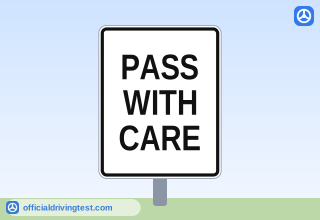
What does a Pass with Care sign tell you?
- You have reached the end of the no-passing zone
- You may pass on the right shoulder with care
- Passing is allowed only by trucks and buses
- You must not pass any vehicle for the next mile
Show answer
Correct answer: You have reached the end of the no-passing zone
Pass with Care informs you that you have reached the end of the no-passing zone; you may pass only when it is safe.
Source: Illinois Rules of the Road (2026), page 68
-
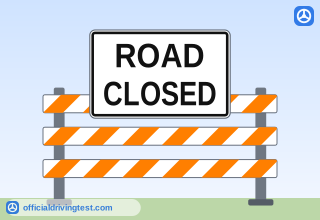
What does a Road Closed sign mean?
- Only local traffic may continue
- The road is closed only at night
- The road is closed to all traffic
- Trucks must use another route
Show answer
Correct answer: The road is closed to all traffic
The Road Closed sign is used when the road is closed to all traffic; you may not continue on the road.
Source: Illinois Rules of the Road (2026), page 68
-
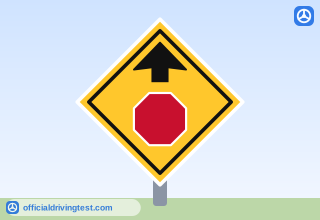
Why are Stop Ahead, Yield Ahead, and Signal Ahead warning signs also used in high-speed areas?
- Because drivers there often ignore signals
- Because a longer distance is needed to stop
- Because signals there are often out of order
- Because trucks may not stop in these areas
Show answer
Correct answer: Because a longer distance is needed to stop
Advance warning signs are also used in high-speed areas because of the longer distance needed to slow down or stop.
Source: Illinois Rules of the Road (2026), page 69
-
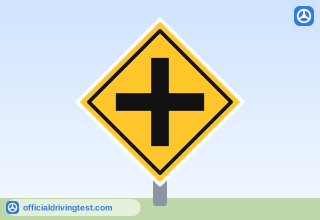
Besides an intersection-ahead warning sign, what else may be posted before an intersection?
- A sign showing the distance to the next city
- A sign listing the speed limit on the cross street
- A sign showing the nearest hospital
- A sign naming the intersecting road
Show answer
Correct answer: A sign naming the intersecting road
Intersection warning signs warn of intersections ahead, and a sign naming the intersecting road also may be posted.
Source: Illinois Rules of the Road (2026), page 70
-
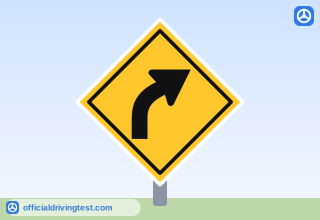
On a warning sign posted before turns and curves, what tells you what to expect?
- The shape of the arrow
- The color of the sign
- The size of the sign
- The number of arrows
Show answer
Correct answer: The shape of the arrow
Certain signs are posted before turns and curves, and the shape of the arrow tells you what to expect.
Source: Illinois Rules of the Road (2026), page 70
-
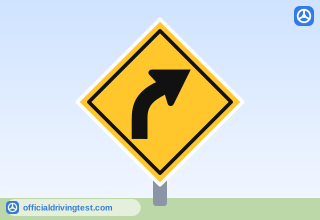
What may a small sign posted below a turn or curve arrow sign show?
- The length of the curve
- The minimum speed allowed
- The maximum safe speed
- The name of the road
Show answer
Correct answer: The maximum safe speed
A small sign showing the maximum safe speed may also be posted below the arrow.
Source: Illinois Rules of the Road (2026), page 70
-
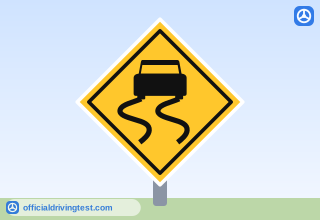
Why should you slow down on wet pavement, as warned by the Slippery Pavement sign?
- Wet roads make your headlights dimmer
- The speed limit is lowered when it rains
- Wet pavement causes your brakes to lock
- It takes longer to stop
Show answer
Correct answer: It takes longer to stop
All roads are slippery when wet; slow down when coming upon wet pavement because it takes longer to stop.
Source: Illinois Rules of the Road (2026), page 70
-
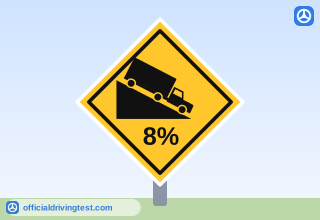
What should you do when you see a Downgrade sign?
- Slow your speed before starting down the hill
- Speed up so you can climb the next hill
- Shift into neutral to coast down the hill
- Pull onto the shoulder and wait for traffic
Show answer
Correct answer: Slow your speed before starting down the hill
The Downgrade sign warns of a dangerous hill that may be long, steep, or have sharp curves; slow your speed before starting down the hill.
Source: Illinois Rules of the Road (2026), page 71
-
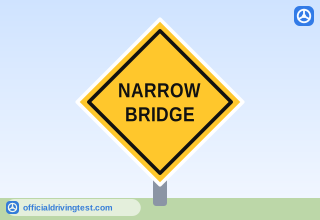
According to the Narrow Bridge sign explanation, a bridge width is generally how much less than the width of the approach pavement?
- 6 feet less
- 1 foot less
- 2 feet less
- 4 feet less
Show answer
Correct answer: 2 feet less
A bridge width is generally 2 feet less than the width of the approach pavement.
Source: Illinois Rules of the Road (2026), page 71
-
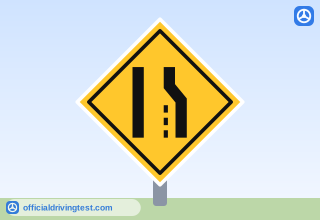
According to the Reduction in Lanes explanation, a reduction in lanes can be which of these?
- Temporary or permanent
- Only temporary, never permanent
- Only permanent, never temporary
- Only during construction work
Show answer
Correct answer: Temporary or permanent
Reduction in lanes can be temporary, due to construction or maintenance activities, or permanent.
Source: Illinois Rules of the Road (2026), page 71
-
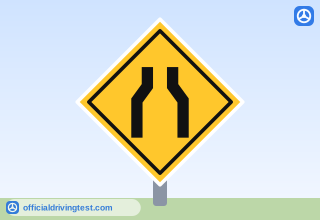
What does the Road Narrows sign warn you of?
- A bridge that is closed ahead
- A divided highway that begins
- A two-lane road that suddenly narrows
- A curve with a lower safe speed
Show answer
Correct answer: A two-lane road that suddenly narrows
The Road Narrows sign warns you that a two-lane road suddenly narrows.
Source: Illinois Rules of the Road (2026), page 71
-
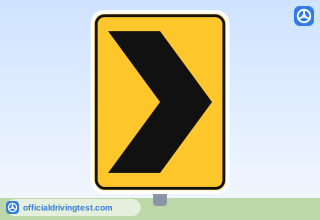
Where may you find several Change in Direction signs?
- At the start of a school zone
- Along a straight, level highway
- At the entrance to a parking lot
- On the outside of a sharp curve
Show answer
Correct answer: On the outside of a sharp curve
You may find several Change in Direction signs on the outside of a sharp curve or on approaches to a narrow bridge.
Source: Illinois Rules of the Road (2026), page 72
-
What separates traffic going in opposite directions on a divided highway?
- A center strip
- A double white line
- A row of traffic cones
- A shared left turn lane
Show answer
Correct answer: A center strip
Divided highways have a center strip that separates traffic going in opposite directions.
Source: Illinois Rules of the Road (2026), page 72
-
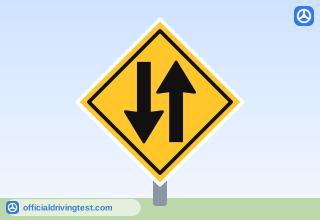
What does the Two-Way Roadway sign inform you?
- You are entering a one-way street
- A divided highway begins ahead
- You are leaving a divided roadway
- The road ahead is closed to all traffic
Show answer
Correct answer: You are leaving a divided roadway
The Two-Way Roadway sign informs you that you are leaving a divided roadway and approaching a two-way highway.
Source: Illinois Rules of the Road (2026), page 72
-
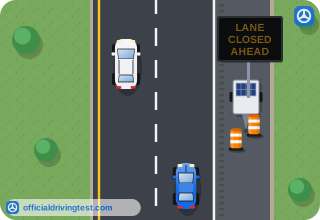
What is the purpose of portable changeable message signs?
- To show advertising for local businesses
- To post permanent speed limits
- To mark the edges of parking lots
- To give real-time road information and guidance
Show answer
Correct answer: To give real-time road information and guidance
Portable changeable message signs provide real-time information about road conditions and provide guidance; it is important to follow their messages.
Source: Illinois Rules of the Road (2026), page 73
-
What do route marker signs do?
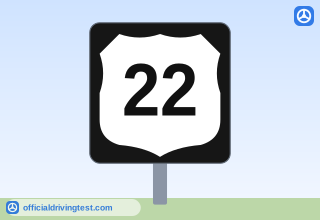
- Direct you to specific roads
- Warn you of hazards ahead
- Tell you the speed limit
- Mark parks and recreation areas
Show answer
Correct answer: Direct you to specific roads
Route markers are used alone or with smaller signs and direct you to specific roads.
Source: Illinois Rules of the Road (2026), page 74
-
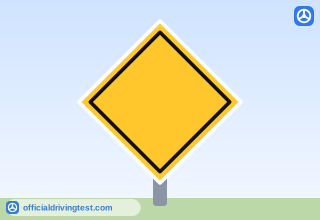
What should you do when you see a diamond-shaped WARNING sign?
- Stop completely, then proceed
- Keep your speed and watch for signals
- Pull onto the shoulder and wait
- Slow down and use caution
Show answer
Correct answer: Slow down and use caution
The diamond-shaped sign warns you about hazards or possible hazards on or near the roadway; slow down and use caution.
Source: Illinois Rules of the Road (2026), page 63