Illinois: Road signs — Part 2 Practice Test
Questions in this part include: “What separates traffic going in opposite directions on a divided highway?”
Independent educational site · not affiliated with any government agency or DMV
Ready? Test yourself
- Instant feedback with an explanation
- Every answer cites its source in the manual
- Your best score is saved on this device
Questions are original and based on the official manual "Illinois Rules of the Road" (2026), Illinois Secretary of State.
All 18 questions in this practice test
Take the test above first, then use this list to study. Tap “Show answer” to see the correct answer and explanation.
Show the questions and answersHide the questions
-
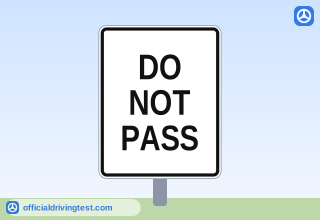
Where a Do Not Pass sign is posted on a two-lane, two-way road, what else will you find?
- White dashed lines in the center of the road
- A flashing yellow beacon on the sign
- A reduced speed limit sign below it
- Yellow "no passing" lines on the road
Show answer
Correct answer: Yellow "no passing" lines on the road
The Do Not Pass sign is posted on some two-lane roads where traffic goes in both directions, and there will also be yellow "no passing" lines on the road.
Source: Illinois Rules of the Road (2026), page 68
-
What does a Pass with Care sign tell you?
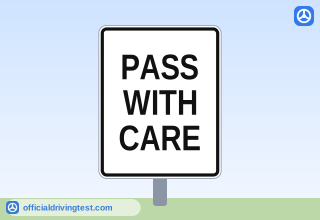
- You have reached the end of the no-passing zone
- You may pass on the right shoulder with care
- Passing is allowed only by trucks and buses
- You must not pass any vehicle for the next mile
Show answer
Correct answer: You have reached the end of the no-passing zone
Pass with Care informs you that you have reached the end of the no-passing zone; you may pass only when it is safe.
Source: Illinois Rules of the Road (2026), page 68
-
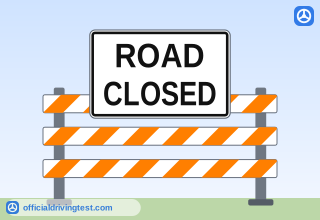
What does a Road Closed sign mean?
- Only local traffic may continue
- The road is closed only at night
- The road is closed to all traffic
- Trucks must use another route
Show answer
Correct answer: The road is closed to all traffic
The Road Closed sign is used when the road is closed to all traffic; you may not continue on the road.
Source: Illinois Rules of the Road (2026), page 68
-
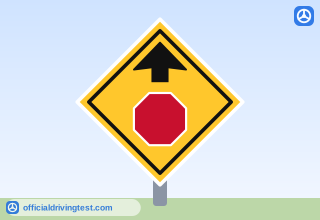
Why are Stop Ahead, Yield Ahead, and Signal Ahead warning signs also used in high-speed areas?
- Because drivers there often ignore signals
- Because a longer distance is needed to stop
- Because signals there are often out of order
- Because trucks may not stop in these areas
Show answer
Correct answer: Because a longer distance is needed to stop
Advance warning signs are also used in high-speed areas because of the longer distance needed to slow down or stop.
Source: Illinois Rules of the Road (2026), page 69
-
Besides an intersection-ahead warning sign, what else may be posted before an intersection?
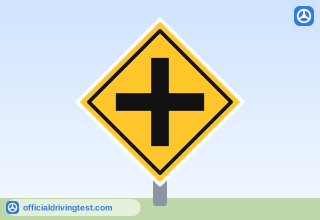
- A sign showing the distance to the next city
- A sign listing the speed limit on the cross street
- A sign showing the nearest hospital
- A sign naming the intersecting road
Show answer
Correct answer: A sign naming the intersecting road
Intersection warning signs warn of intersections ahead, and a sign naming the intersecting road also may be posted.
Source: Illinois Rules of the Road (2026), page 70
-
On a warning sign posted before turns and curves, what tells you what to expect?
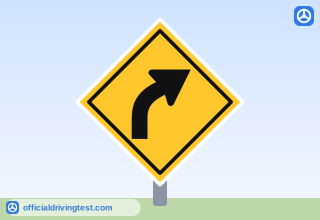
- The shape of the arrow
- The color of the sign
- The size of the sign
- The number of arrows
Show answer
Correct answer: The shape of the arrow
Certain signs are posted before turns and curves, and the shape of the arrow tells you what to expect.
Source: Illinois Rules of the Road (2026), page 70
-
What may a small sign posted below a turn or curve arrow sign show?
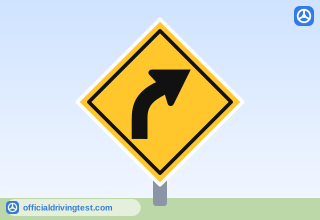
- The length of the curve
- The minimum speed allowed
- The maximum safe speed
- The name of the road
Show answer
Correct answer: The maximum safe speed
A small sign showing the maximum safe speed may also be posted below the arrow.
Source: Illinois Rules of the Road (2026), page 70
-
Why should you slow down on wet pavement, as warned by the Slippery Pavement sign?
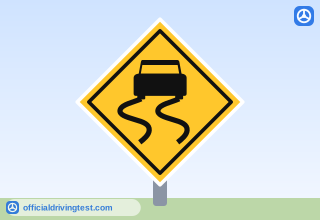
- Wet roads make your headlights dimmer
- The speed limit is lowered when it rains
- Wet pavement causes your brakes to lock
- It takes longer to stop
Show answer
Correct answer: It takes longer to stop
All roads are slippery when wet; slow down when coming upon wet pavement because it takes longer to stop.
Source: Illinois Rules of the Road (2026), page 70
-
What should you do when you see a Downgrade sign?
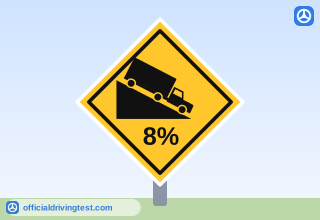
- Slow your speed before starting down the hill
- Speed up so you can climb the next hill
- Shift into neutral to coast down the hill
- Pull onto the shoulder and wait for traffic
Show answer
Correct answer: Slow your speed before starting down the hill
The Downgrade sign warns of a dangerous hill that may be long, steep, or have sharp curves; slow your speed before starting down the hill.
Source: Illinois Rules of the Road (2026), page 71
-
According to the Narrow Bridge sign explanation, a bridge width is generally how much less than the width of the approach pavement?
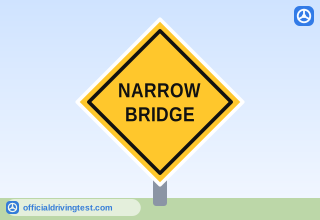
- 6 feet less
- 1 foot less
- 2 feet less
- 4 feet less
Show answer
Correct answer: 2 feet less
A bridge width is generally 2 feet less than the width of the approach pavement.
Source: Illinois Rules of the Road (2026), page 71
-
According to the Reduction in Lanes explanation, a reduction in lanes can be which of these?
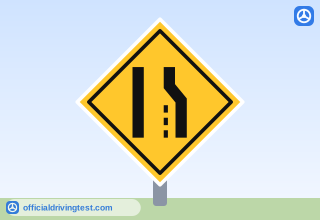
- Temporary or permanent
- Only temporary, never permanent
- Only permanent, never temporary
- Only during construction work
Show answer
Correct answer: Temporary or permanent
Reduction in lanes can be temporary, due to construction or maintenance activities, or permanent.
Source: Illinois Rules of the Road (2026), page 71
-
What does the Road Narrows sign warn you of?
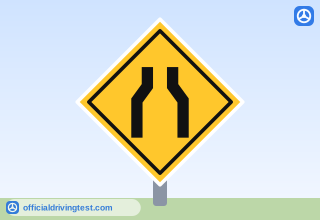
- A bridge that is closed ahead
- A divided highway that begins
- A two-lane road that suddenly narrows
- A curve with a lower safe speed
Show answer
Correct answer: A two-lane road that suddenly narrows
The Road Narrows sign warns you that a two-lane road suddenly narrows.
Source: Illinois Rules of the Road (2026), page 71
-
Where may you find several Change in Direction signs?
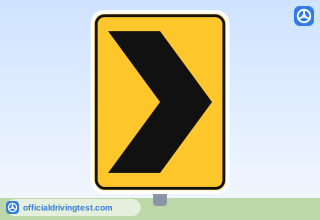
- At the start of a school zone
- Along a straight, level highway
- At the entrance to a parking lot
- On the outside of a sharp curve
Show answer
Correct answer: On the outside of a sharp curve
You may find several Change in Direction signs on the outside of a sharp curve or on approaches to a narrow bridge.
Source: Illinois Rules of the Road (2026), page 72
-
What separates traffic going in opposite directions on a divided highway?
- A center strip
- A double white line
- A row of traffic cones
- A shared left turn lane
Show answer
Correct answer: A center strip
Divided highways have a center strip that separates traffic going in opposite directions.
Source: Illinois Rules of the Road (2026), page 72
-
What does the Two-Way Roadway sign inform you?
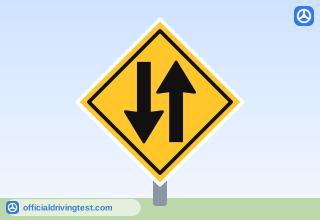
- You are entering a one-way street
- A divided highway begins ahead
- You are leaving a divided roadway
- The road ahead is closed to all traffic
Show answer
Correct answer: You are leaving a divided roadway
The Two-Way Roadway sign informs you that you are leaving a divided roadway and approaching a two-way highway.
Source: Illinois Rules of the Road (2026), page 72
-
What is the purpose of portable changeable message signs?
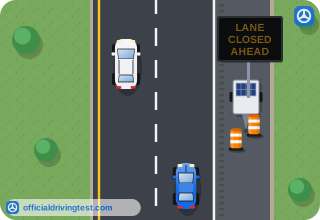
- To show advertising for local businesses
- To post permanent speed limits
- To mark the edges of parking lots
- To give real-time road information and guidance
Show answer
Correct answer: To give real-time road information and guidance
Portable changeable message signs provide real-time information about road conditions and provide guidance; it is important to follow their messages.
Source: Illinois Rules of the Road (2026), page 73
-
What do route marker signs do?
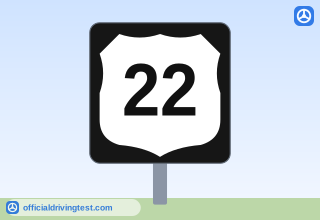
- Direct you to specific roads
- Warn you of hazards ahead
- Tell you the speed limit
- Mark parks and recreation areas
Show answer
Correct answer: Direct you to specific roads
Route markers are used alone or with smaller signs and direct you to specific roads.
Source: Illinois Rules of the Road (2026), page 74
-
What should you do when you see a diamond-shaped WARNING sign?
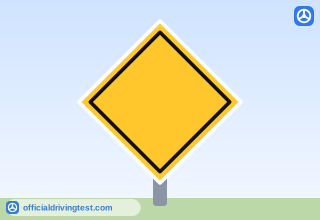
- Stop completely, then proceed
- Keep your speed and watch for signals
- Pull onto the shoulder and wait
- Slow down and use caution
Show answer
Correct answer: Slow down and use caution
The diamond-shaped sign warns you about hazards or possible hazards on or near the roadway; slow down and use caution.
Source: Illinois Rules of the Road (2026), page 63