Illinois: Pedestrian rights
Crosswalks, yielding to pedestrians and people with disabilities, and skating rules. Split into 2 shorter tests so you're not stuck in one long quiz.
Independent educational site · not affiliated with any government agency or DMV
All 41 Pedestrian rights questions with answers
Choose a part above to take a practice test, or study every question and answer here.
Show the questions and answersHide the questions
-
In a marked school zone during school hours, what must you do for children or adults in the crosswalk area?
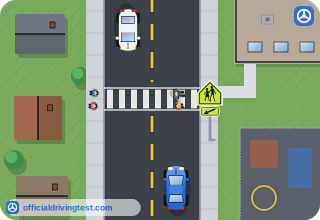
- Sound your horn and continue slowly
- Stop and yield the right of way to them
- Yield only to children, not to adults
- Drive around them at 20 mph
Show answer
Correct answer: Stop and yield the right of way to them
In a marked school zone, a driver must reduce speed to 20 mph and stop and yield the right of way to any children or adults in the crosswalk area.
Source: Illinois Rules of the Road (2026), page 26
-
A pedestrian is in a marked crosswalk. What must a driver do?
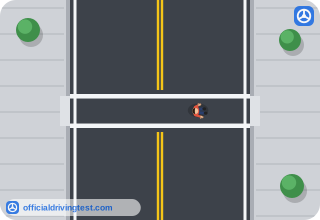
- Come to a complete stop and yield
- Slow down and drive around them
- Sound the horn and keep going
- Yield only if there is a signal
Show answer
Correct answer: Come to a complete stop and yield
A driver must come to a complete stop and yield when a pedestrian is in a marked crosswalk.
Source: Illinois Rules of the Road (2026), page 27
-
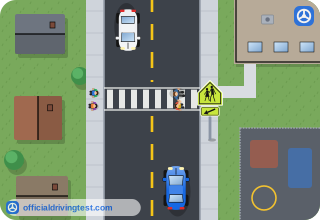
On school days, children are in close proximity to a school zone crosswalk. What must a driver do?
- Slow to 30 mph and keep going
- Honk to warn the children
- Come to a complete stop and yield
- Pass them in the other lane
Show answer
Correct answer: Come to a complete stop and yield
On school days, a driver must come to a complete stop and yield when children are in close proximity to a school zone crosswalk.
Source: Illinois Rules of the Road (2026), page 27
-
A pedestrian is in an unmarked crosswalk on your side of the roadway, and there are no traffic control signals. What must you do?

- Continue; it is unmarked
- Yield to the pedestrian
- Honk and keep going
- Yield only to children
Show answer
Correct answer: Yield to the pedestrian
A driver must yield when a pedestrian is in an unmarked crosswalk on the driver's side of the roadway and there are no traffic control signals.
Source: Illinois Rules of the Road (2026), page 27
-
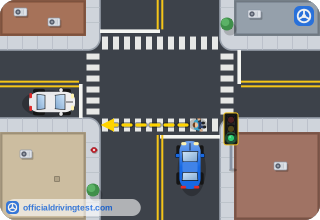
A pedestrian entered the crosswalk before the traffic light changed and is still crossing when your light turns green. What must you do?
- Go; your light is green
- Honk so they hurry up
- Drive around them
- Yield to the pedestrian
Show answer
Correct answer: Yield to the pedestrian
A driver must yield when a pedestrian enters a crosswalk before the traffic light changes.
Source: Illinois Rules of the Road (2026), page 27
-
When must a driver yield to a pedestrian at an intersection?
- Only when the pedestrian is in a marked crosswalk
- When the pedestrian walks with a "walk" signal
- Only when a crossing guard is present
- Only when the driver is going straight
Show answer
Correct answer: When the pedestrian walks with a "walk" signal
A driver must yield when a pedestrian walks with a green light, to a "walking person" symbol or to a "walk" signal.
Source: Illinois Rules of the Road (2026), page 27
-
When making a turn at any intersection, to whom must you yield?

- No one
- Only buses
- Only police
- Pedestrians
Show answer
Correct answer: Pedestrians
The manual lists making a turn at any intersection among the times a driver must yield to pedestrians.
Source: Illinois Rules of the Road (2026), page 27
-
A pedestrian is leaving a building and stepping onto the street from a driveway. What must you do?
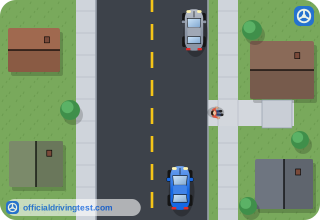
- Yield to the pedestrian
- Sound your horn first
- Keep going; you have priority
- Yield only on a school day
Show answer
Correct answer: Yield to the pedestrian
A driver must yield when a pedestrian leaves or enters a street or highway from an alley, building, private road, or driveway.
Source: Illinois Rules of the Road (2026), page 27
-
You are turning on a flashing yellow arrow and a pedestrian enters the intersection. What must you do?
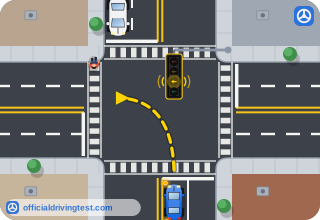
- Finish your turn first
- Honk and keep turning
- Yield to the pedestrian
- Drive around the person
Show answer
Correct answer: Yield to the pedestrian
A driver must yield when a pedestrian enters an intersection with a flashing yellow arrow.
Source: Illinois Rules of the Road (2026), page 27
-
To which persons does the manual specifically say a driver must yield?
- Persons with physical, hearing, or visual disabilities
- Only persons who are using a white cane or guide dog
- Only persons crossing in a marked school zone crosswalk
- Only persons who are wearing reflective safety vests
Show answer
Correct answer: Persons with physical, hearing, or visual disabilities
A driver must yield to a person with disabilities, including physical, hearing and visual disabilities.
Source: Illinois Rules of the Road (2026), page 27
-
When passing a pedestrian walking on the road or shoulder, what minimum distance must you keep?

- 1 foot
- 2 feet
- 3 feet
- 10 feet
Show answer
Correct answer: 3 feet
When passing a pedestrian walking on the road or shoulder, keep a minimum of 3 feet between your vehicle and the pedestrian.
Source: Illinois Rules of the Road (2026), page 28
-
A vehicle ahead has stopped at a crosswalk to let a pedestrian cross. May you pass it on a two-lane, two-way roadway?
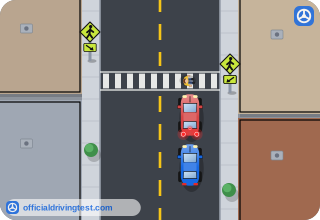
- Yes, if you pass slowly
- Yes, if you sound your horn
- No, passing is not allowed
- Yes, on the right shoulder
Show answer
Correct answer: No, passing is not allowed
Passing is not allowed when a vehicle has stopped at a crosswalk or intersection to allow a pedestrian to cross.
Source: Illinois Rules of the Road (2026), page 29
-
According to the Illinois manual, which of these people counts as a pedestrian?
- A person riding a skateboard
- A person riding a bicycle
- A person riding a moped
- A person riding a horse
Show answer
Correct answer: A person riding a skateboard
The manual defines a pedestrian as any person afoot or wearing in-line speed skates or riding a skateboard, including a person with a physical, hearing, or visual disability.
Source: Illinois Rules of the Road (2026), page 40
-
A pedestrian is crossing the road at a place that is not a marked or unmarked crosswalk. Who must yield the right of way?
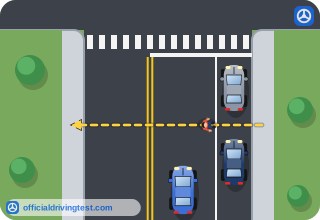
- The driver, in every case
- Whoever arrived there first
- The pedestrian must yield to drivers
- Neither; both proceed with caution
Show answer
Correct answer: The pedestrian must yield to drivers
When crossing anywhere other than a marked or unmarked crosswalk, pedestrians must give the right of way to drivers.
Source: Illinois Rules of the Road (2026), page 40
-
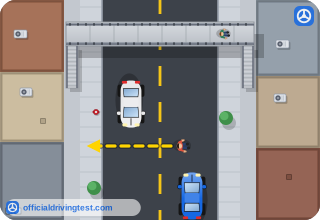
If a pedestrian tunnel or pedestrian crossing bridge is available, what should a pedestrian do?
- Cross at the nearest intersection
- Use the tunnel or bridge
- Cross wherever traffic is lightest
- Cross only with a crossing guard
Show answer
Correct answer: Use the tunnel or bridge
The manual says a pedestrian tunnel or pedestrian crossing bridge should be used when available.
Source: Illinois Rules of the Road (2026), page 40
-
When may pedestrians walk on the roadway itself?
- Whenever traffic is light
- Only during daylight hours
- Only on roads posted 30 mph or less
- Only if there is no sidewalk or shoulder
Show answer
Correct answer: Only if there is no sidewalk or shoulder
Pedestrians must not walk on a roadway unless there is no sidewalk or shoulder next to it.
Source: Illinois Rules of the Road (2026), page 40
-
When pedestrians must walk on a road with two-way traffic, which way should they walk?
- Facing oncoming traffic
- With their back to traffic
- In the center of the road
- On whichever side is shaded
Show answer
Correct answer: Facing oncoming traffic
In two-way traffic, pedestrians should walk facing oncoming traffic, as far from the outside edge of the road as possible.
Source: Illinois Rules of the Road (2026), page 40
-
A highway has no sidewalk but does have a shoulder. Where should pedestrians walk?
- On the edge of the travel lane
- On the shoulder, right next to the traffic lane
- On the shoulder, as far from the roadway as possible
- In the travel lane, moving with traffic
Show answer
Correct answer: On the shoulder, as far from the roadway as possible
If a highway has a shoulder but no sidewalk, pedestrians should always walk on the shoulder as far from the roadway as possible.
Source: Illinois Rules of the Road (2026), page 40
-
A pedestrian using a white cane or a guide dog is crossing in front of you. Who has the right of way?

- You do, if you have a green light
- The pedestrian with the disability
- You do, if you signaled first
- Whoever reached the intersection first
Show answer
Correct answer: The pedestrian with the disability
When approaching a pedestrian with a disability using a guide dog, white cane, wheelchair, or other assistive device, the person with a disability has the right of way.
Source: Illinois Rules of the Road (2026), page 40
-
When joggers or walkers use public roads, what kind of roads should they try to select?
- Narrow roads with little traffic
- Roads with a center turn lane
- Roads with a posted limit of 45 mph
- Wide roads with good shoulders
Show answer
Correct answer: Wide roads with good shoulders
Joggers/walkers should use jogging paths when provided; on public roads they should try to select wide roads with good shoulders.
Source: Illinois Rules of the Road (2026), page 40
-
What should joggers and walkers do at night or when visibility is poor?
- Stay in well-lit areas and wear reflective clothing
- Walk with traffic so drivers see them from behind
- Carry a flashlight and walk in the travel lane
- Wear dark clothing and stay on the shoulder
Show answer
Correct answer: Stay in well-lit areas and wear reflective clothing
At night or when visibility is poor, joggers/walkers should be in well-lit areas and wear reflective clothing.
Source: Illinois Rules of the Road (2026), page 40
-
In Illinois, standing on the roadway to ask for a ride (hitchhiking) is:
- Allowed during daylight only
- Allowed if you face traffic
- Illegal
- Allowed on roads without a shoulder
Show answer
Correct answer: Illegal
The manual states that standing on the roadway to ask for a ride (hitchhiking) is illegal.
Source: Illinois Rules of the Road (2026), page 40
-
Pedestrians of what age may skate on public roadways where this is allowed?
- 16 or older
- 18 or older
- 21 or older
- Any age
Show answer
Correct answer: 18 or older
Pedestrians ages 18 or older may skate on public roadways posted 45 mph or less, from sunrise to sunset, if traffic is not impeded.
Source: Illinois Rules of the Road (2026), page 40
-
Pedestrians may skate on public roadways only where the posted speed limit is at most:
- 25 mph
- 30 mph
- 35 mph
- 45 mph
Show answer
Correct answer: 45 mph
Skating on public roadways is allowed for pedestrians 18 or older where the posted limit is 45 mph or less, from sunrise to sunset, without impeding traffic.
Source: Illinois Rules of the Road (2026), page 40
-
During what hours may pedestrians skate on public roadways where skating is allowed?
- From sunrise to sunset
- At any hour of the day
- From sunset to sunrise
- Only between 6 a.m. and 9 p.m.
Show answer
Correct answer: From sunrise to sunset
The manual allows it only from sunrise to sunset, and only as long as vehicle traffic is not impeded or obstructed.
Source: Illinois Rules of the Road (2026), page 40
-
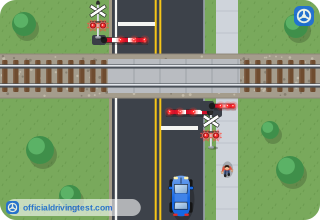
What must pedestrians always do at railroad and bridge gates and other barriers?
- Cross quickly if no train or boat is visible
- Walk around them if the road looks clear
- Obey them
- Wait for a driver to wave them across
Show answer
Correct answer: Obey them
The manual says pedestrians must always obey railroad and bridge gates and other barriers.
Source: Illinois Rules of the Road (2026), page 40
-
When children are near, when should drivers be extremely watchful?

- When stopped at a red light
- When backing in or out of a driveway
- When merging onto an expressway
- When driving through a toll plaza
Show answer
Correct answer: When backing in or out of a driveway
To keep children safe, drivers should be extremely watchful when backing in or out of a driveway when children are near.
Source: Illinois Rules of the Road (2026), page 41
-
Which of these does the manual list as a special hazard area for children, marked by signs drivers should watch for?
- Toll plazas
- Expressway ramps
- Bus stops
- Truck weigh stations
Show answer
Correct answer: Bus stops
Drivers should watch for signs that mark special hazard areas such as school zones, bus stops, playgrounds, parks, and schools.
Source: Illinois Rules of the Road (2026), page 41
-
What does the manual say about pedestrians walking on a highway under the influence of alcohol or other drugs?
- It is fine if they walk on the shoulder
- It is fine if they face oncoming traffic
- It is fine if they wear reflective clothing
- They should not walk on a highway at all
Show answer
Correct answer: They should not walk on a highway at all
Pedestrians should not walk on a highway when under the influence of alcohol or other drugs.
Source: Illinois Rules of the Road (2026), page 40
-
What does the manual say about pedestrians standing on or next to a highway to ask drivers for money or business?
- They should not do it
- It is allowed at red lights
- It is allowed with a permit
- It is allowed on the shoulder
Show answer
Correct answer: They should not do it
Pedestrians should not stand on or next to a highway to ask drivers or passengers for money or business.
Source: Illinois Rules of the Road (2026), page 40
-
Where should drivers be ready to reduce speed because children are most likely to be there?
- On expressways near exit ramps
- In residential and school areas
- Only near toll plazas
- Only on rural highways
Show answer
Correct answer: In residential and school areas
Drivers should be ready to reduce speed in residential areas, school areas, and places where children are most likely to be.
Source: Illinois Rules of the Road (2026), page 41
-
Why must you watch both sides of the street for pedestrians when you see a Pedestrian Crosswalk sign?
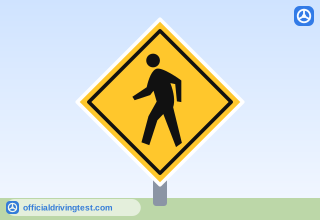
- Crosswalks are not always located at intersections
- Pedestrians must cross from the left side only
- The sign is posted only on one-way streets
- Pedestrians always have to use the right side
Show answer
Correct answer: Crosswalks are not always located at intersections
Crosswalks are not always located at intersections, so you must watch both sides of the street for pedestrians.
Source: Illinois Rules of the Road (2026), page 68
-
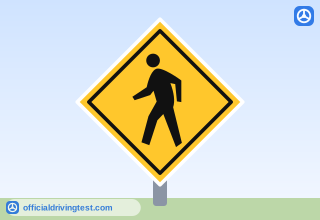
What may accompany a Pedestrian Crosswalk sign to increase driver awareness of an approaching crosswalk?
- A steady red light above the sign
- A rumble strip across the lane
- A yellow flashing beacon on the sign
- An orange flag on top of the sign
Show answer
Correct answer: A yellow flashing beacon on the sign
Pedestrian crosswalk signs may be accompanied by a yellow flashing beacon, which helps increase driver awareness of the crosswalk and possible pedestrians.
Source: Illinois Rules of the Road (2026), page 68
-
At school street crossings, who may assist the adult crossing guards?
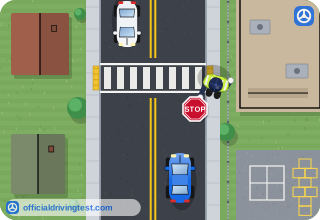
- Parents waiting in parked cars
- School safety patrol members
- School bus drivers
- Any licensed driver who stops
Show answer
Correct answer: School safety patrol members
Adult crossing guards, auxiliary police, or police officers often supervise school crossings, and school safety patrol members may assist the crossing guards.
Source: Illinois Rules of the Road (2026), page 69
-
According to the manual, how must pedestrians yield the right of way to drivers?
- By making eye contact before stepping off the curb
- By crossing only when no vehicles are within sight
- By raising a hand to signal drivers before crossing
- By obeying signals and walk lights and using crosswalks
Show answer
Correct answer: By obeying signals and walk lights and using crosswalks
Pedestrians yield the right of way to drivers by obeying traffic signals, observing walk lights, and using crosswalks.
Source: Illinois Rules of the Road (2026), page 78
-
What may a pedestrian facing a Walk signal (walking person) do?
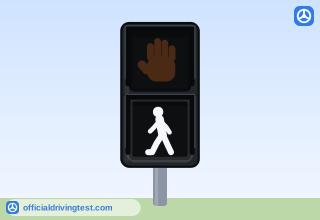
- Cross in any direction, including diagonally
- Cross the roadway in the direction of the signal
- Only wait at the curb until the signal flashes
- Cross only if no vehicles are turning
Show answer
Correct answer: Cross the roadway in the direction of the signal
A pedestrian facing the Walk signal may cross the roadway in the direction of the signal.
Source: Illinois Rules of the Road (2026), page 78
-
What does a flashing orange upraised hand (Don't Walk) tell a pedestrian waiting at the curb?
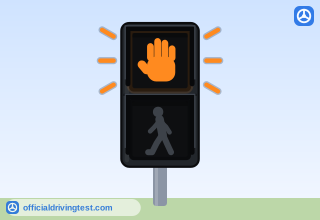
- Cross quickly before the signal changes
- Cross only in the middle of the block
- Do not start to enter the roadway
- Begin crossing if no cars are turning
Show answer
Correct answer: Do not start to enter the roadway
A flashing orange upraised hand means do not start to enter the roadway.
Source: Illinois Rules of the Road (2026), page 78
-
A pedestrian started crossing during the steady Walk signal and is partway across when the Don't Walk hand begins flashing. What may the pedestrian do?
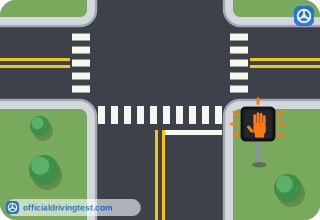
- Continue to a sidewalk or safety island
- Turn around and return to the starting curb only
- Stop and wait in the roadway for the next Walk
- Wave down drivers to stop before continuing
Show answer
Correct answer: Continue to a sidewalk or safety island
If you have partially completed crossing during the walk signal, you may continue to a sidewalk or safety island.
Source: Illinois Rules of the Road (2026), page 78
-
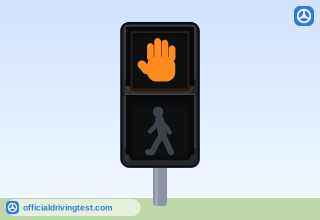
What does a constantly lit orange upraised hand (Don't Walk) mean for a pedestrian?
- Cross only if no cars are coming
- Cross quickly before it flashes
- Cross if a driver waves you across
- Do not enter the roadway
Show answer
Correct answer: Do not enter the roadway
A constantly lit orange upraised hand means do not enter the roadway.
Source: Illinois Rules of the Road (2026), page 78
-
What should a pedestrian facing a constant yellow light (upraised hand) do?
- Cross quickly before the light turns red for traffic
- Not cross unless a sign or police officer directs it
- Cross whenever there is a safe gap in the traffic
- Cross only after pressing the pedestrian push button
Show answer
Correct answer: Not cross unless a sign or police officer directs it
At a constant yellow light (upraised hand), a pedestrian must not cross unless directed by a pedestrian control sign or a police officer.
Source: Illinois Rules of the Road (2026), page 78
-
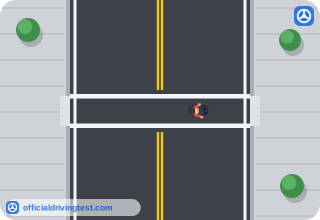
Who has the right of way when a pedestrian is in a crosswalk?
- The vehicle, if it arrived first
- The pedestrian
- The vehicle, if the light is green
- Whoever signals first
Show answer
Correct answer: The pedestrian
Pedestrians in crosswalks have the right of way over vehicles.
Source: Illinois Rules of the Road (2026), page 80