Illinois: Pedestrian rights — Part 1 Practice Test
Questions in this part include: “When must a driver yield to a pedestrian at an intersection?” · “When pedestrians must walk on a road with two-way traffic, which way should they walk?”
Independent educational site · not affiliated with any government agency or DMV
Ready? Test yourself
- Instant feedback with an explanation
- Every answer cites its source in the manual
- Your best score is saved on this device
Questions are original and based on the official manual "Illinois Rules of the Road" (2026), Illinois Secretary of State.
All 21 questions in this practice test
Take the test above first, then use this list to study. Tap “Show answer” to see the correct answer and explanation.
Show the questions and answersHide the questions
-
In a marked school zone during school hours, what must you do for children or adults in the crosswalk area?
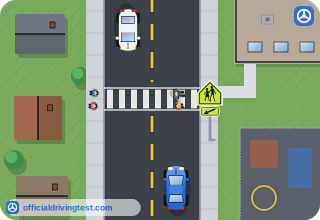
- Sound your horn and continue slowly
- Stop and yield the right of way to them
- Yield only to children, not to adults
- Drive around them at 20 mph
Show answer
Correct answer: Stop and yield the right of way to them
In a marked school zone, a driver must reduce speed to 20 mph and stop and yield the right of way to any children or adults in the crosswalk area.
Source: Illinois Rules of the Road (2026), page 26
-
A pedestrian is in a marked crosswalk. What must a driver do?
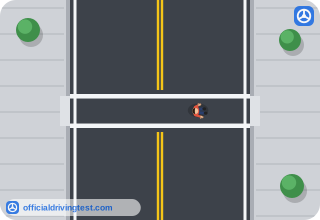
- Come to a complete stop and yield
- Slow down and drive around them
- Sound the horn and keep going
- Yield only if there is a signal
Show answer
Correct answer: Come to a complete stop and yield
A driver must come to a complete stop and yield when a pedestrian is in a marked crosswalk.
Source: Illinois Rules of the Road (2026), page 27
-
On school days, children are in close proximity to a school zone crosswalk. What must a driver do?
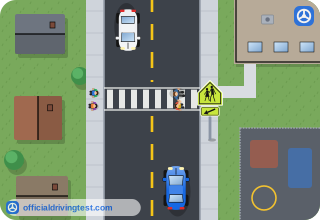
- Slow to 30 mph and keep going
- Honk to warn the children
- Come to a complete stop and yield
- Pass them in the other lane
Show answer
Correct answer: Come to a complete stop and yield
On school days, a driver must come to a complete stop and yield when children are in close proximity to a school zone crosswalk.
Source: Illinois Rules of the Road (2026), page 27
-
A pedestrian is in an unmarked crosswalk on your side of the roadway, and there are no traffic control signals. What must you do?

- Continue; it is unmarked
- Yield to the pedestrian
- Honk and keep going
- Yield only to children
Show answer
Correct answer: Yield to the pedestrian
A driver must yield when a pedestrian is in an unmarked crosswalk on the driver's side of the roadway and there are no traffic control signals.
Source: Illinois Rules of the Road (2026), page 27
-
A pedestrian entered the crosswalk before the traffic light changed and is still crossing when your light turns green. What must you do?
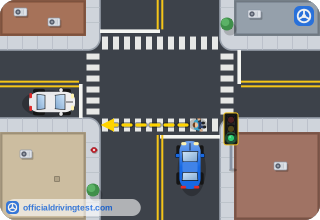
- Go; your light is green
- Honk so they hurry up
- Drive around them
- Yield to the pedestrian
Show answer
Correct answer: Yield to the pedestrian
A driver must yield when a pedestrian enters a crosswalk before the traffic light changes.
Source: Illinois Rules of the Road (2026), page 27
-
When must a driver yield to a pedestrian at an intersection?
- Only when the pedestrian is in a marked crosswalk
- When the pedestrian walks with a "walk" signal
- Only when a crossing guard is present
- Only when the driver is going straight
Show answer
Correct answer: When the pedestrian walks with a "walk" signal
A driver must yield when a pedestrian walks with a green light, to a "walking person" symbol or to a "walk" signal.
Source: Illinois Rules of the Road (2026), page 27
-
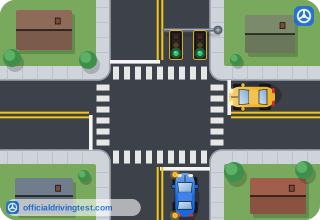
When making a turn at any intersection, to whom must you yield?
- No one
- Only buses
- Only police
- Pedestrians
Show answer
Correct answer: Pedestrians
The manual lists making a turn at any intersection among the times a driver must yield to pedestrians.
Source: Illinois Rules of the Road (2026), page 27
-
A pedestrian is leaving a building and stepping onto the street from a driveway. What must you do?
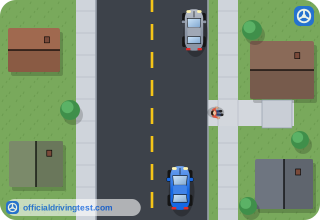
- Yield to the pedestrian
- Sound your horn first
- Keep going; you have priority
- Yield only on a school day
Show answer
Correct answer: Yield to the pedestrian
A driver must yield when a pedestrian leaves or enters a street or highway from an alley, building, private road, or driveway.
Source: Illinois Rules of the Road (2026), page 27
-
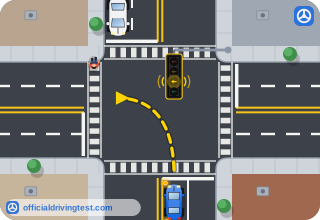
You are turning on a flashing yellow arrow and a pedestrian enters the intersection. What must you do?
- Finish your turn first
- Honk and keep turning
- Yield to the pedestrian
- Drive around the person
Show answer
Correct answer: Yield to the pedestrian
A driver must yield when a pedestrian enters an intersection with a flashing yellow arrow.
Source: Illinois Rules of the Road (2026), page 27
-
To which persons does the manual specifically say a driver must yield?
- Persons with physical, hearing, or visual disabilities
- Only persons who are using a white cane or guide dog
- Only persons crossing in a marked school zone crosswalk
- Only persons who are wearing reflective safety vests
Show answer
Correct answer: Persons with physical, hearing, or visual disabilities
A driver must yield to a person with disabilities, including physical, hearing and visual disabilities.
Source: Illinois Rules of the Road (2026), page 27
-
When passing a pedestrian walking on the road or shoulder, what minimum distance must you keep?

- 1 foot
- 2 feet
- 3 feet
- 10 feet
Show answer
Correct answer: 3 feet
When passing a pedestrian walking on the road or shoulder, keep a minimum of 3 feet between your vehicle and the pedestrian.
Source: Illinois Rules of the Road (2026), page 28
-
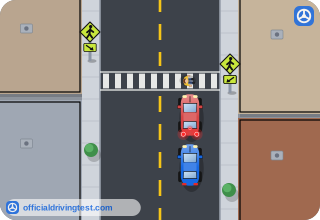
A vehicle ahead has stopped at a crosswalk to let a pedestrian cross. May you pass it on a two-lane, two-way roadway?
- Yes, if you pass slowly
- Yes, if you sound your horn
- No, passing is not allowed
- Yes, on the right shoulder
Show answer
Correct answer: No, passing is not allowed
Passing is not allowed when a vehicle has stopped at a crosswalk or intersection to allow a pedestrian to cross.
Source: Illinois Rules of the Road (2026), page 29
-
According to the Illinois manual, which of these people counts as a pedestrian?
- A person riding a skateboard
- A person riding a bicycle
- A person riding a moped
- A person riding a horse
Show answer
Correct answer: A person riding a skateboard
The manual defines a pedestrian as any person afoot or wearing in-line speed skates or riding a skateboard, including a person with a physical, hearing, or visual disability.
Source: Illinois Rules of the Road (2026), page 40
-
A pedestrian is crossing the road at a place that is not a marked or unmarked crosswalk. Who must yield the right of way?
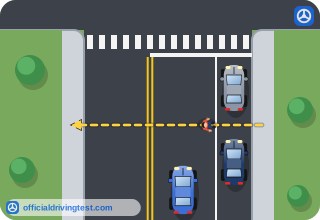
- The driver, in every case
- Whoever arrived there first
- The pedestrian must yield to drivers
- Neither; both proceed with caution
Show answer
Correct answer: The pedestrian must yield to drivers
When crossing anywhere other than a marked or unmarked crosswalk, pedestrians must give the right of way to drivers.
Source: Illinois Rules of the Road (2026), page 40
-
If a pedestrian tunnel or pedestrian crossing bridge is available, what should a pedestrian do?
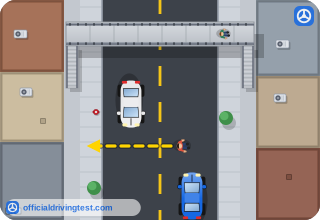
- Cross at the nearest intersection
- Use the tunnel or bridge
- Cross wherever traffic is lightest
- Cross only with a crossing guard
Show answer
Correct answer: Use the tunnel or bridge
The manual says a pedestrian tunnel or pedestrian crossing bridge should be used when available.
Source: Illinois Rules of the Road (2026), page 40
-
When may pedestrians walk on the roadway itself?
- Whenever traffic is light
- Only during daylight hours
- Only on roads posted 30 mph or less
- Only if there is no sidewalk or shoulder
Show answer
Correct answer: Only if there is no sidewalk or shoulder
Pedestrians must not walk on a roadway unless there is no sidewalk or shoulder next to it.
Source: Illinois Rules of the Road (2026), page 40
-
When pedestrians must walk on a road with two-way traffic, which way should they walk?
- Facing oncoming traffic
- With their back to traffic
- In the center of the road
- On whichever side is shaded
Show answer
Correct answer: Facing oncoming traffic
In two-way traffic, pedestrians should walk facing oncoming traffic, as far from the outside edge of the road as possible.
Source: Illinois Rules of the Road (2026), page 40
-
A highway has no sidewalk but does have a shoulder. Where should pedestrians walk?
- On the edge of the travel lane
- On the shoulder, right next to the traffic lane
- On the shoulder, as far from the roadway as possible
- In the travel lane, moving with traffic
Show answer
Correct answer: On the shoulder, as far from the roadway as possible
If a highway has a shoulder but no sidewalk, pedestrians should always walk on the shoulder as far from the roadway as possible.
Source: Illinois Rules of the Road (2026), page 40
-
A pedestrian using a white cane or a guide dog is crossing in front of you. Who has the right of way?

- You do, if you have a green light
- The pedestrian with the disability
- You do, if you signaled first
- Whoever reached the intersection first
Show answer
Correct answer: The pedestrian with the disability
When approaching a pedestrian with a disability using a guide dog, white cane, wheelchair, or other assistive device, the person with a disability has the right of way.
Source: Illinois Rules of the Road (2026), page 40
-
When joggers or walkers use public roads, what kind of roads should they try to select?
- Narrow roads with little traffic
- Roads with a center turn lane
- Roads with a posted limit of 45 mph
- Wide roads with good shoulders
Show answer
Correct answer: Wide roads with good shoulders
Joggers/walkers should use jogging paths when provided; on public roads they should try to select wide roads with good shoulders.
Source: Illinois Rules of the Road (2026), page 40
-
What should joggers and walkers do at night or when visibility is poor?
- Stay in well-lit areas and wear reflective clothing
- Walk with traffic so drivers see them from behind
- Carry a flashlight and walk in the travel lane
- Wear dark clothing and stay on the shoulder
Show answer
Correct answer: Stay in well-lit areas and wear reflective clothing
At night or when visibility is poor, joggers/walkers should be in well-lit areas and wear reflective clothing.
Source: Illinois Rules of the Road (2026), page 40