Illinois: Parking rules
Where you may not stop or park, parking on hills and disability parking. Split into 2 shorter tests so you're not stuck in one long quiz.
Independent educational site · not affiliated with any government agency or DMV
All 41 Parking rules questions with answers
Choose a part above to take a practice test, or study every question and answer here.
Show the questions and answersHide the questions
-
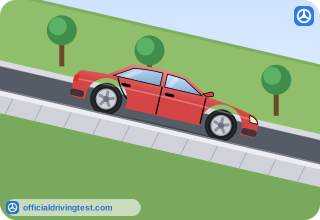
Any time you park on a hill, what should you do with the gear selector and brake?
- Put it in neutral and leave the brake released
- Put it in reverse and release the parking brake
- Leave the engine idling in drive with hazard lights
- Put it in park and set the parking brake if needed
Show answer
Correct answer: Put it in park and set the parking brake if needed
When parking on a hill, put the gear selector in park and set the parking/emergency brake if necessary.
Source: Illinois Rules of the Road (2026), page 34
-
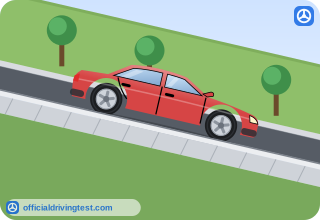
When parking facing downhill on a street with a curb, which way should you turn the front wheels?
- Toward the curb
- Away from the curb
- Straight ahead
- Toward the center of the street
Show answer
Correct answer: Toward the curb
Facing downhill with a curb, turn the front wheels toward the curb so the vehicle will roll toward the curb.
Source: Illinois Rules of the Road (2026), page 34
-
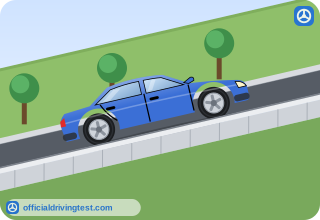
When parking facing uphill on a street with a curb, which way should you turn the front wheels?
- Toward the curb
- Straight ahead
- Away from the curb
- Either way, if the brake is set
Show answer
Correct answer: Away from the curb
Facing uphill with a curb, turn the front wheels away from the curb.
Source: Illinois Rules of the Road (2026), page 34
-
When parking on a hill on a street without a curb, which way should you turn the wheels?

- Toward the center line of the road you are on
- Toward the side of the road where you are parked
- Straight ahead, parallel to the edge of the road
- Away from the side of the road where you parked
Show answer
Correct answer: Toward the side of the road where you are parked
Without curbing, turn the wheels toward the side of the road on which your vehicle is parked.
Source: Illinois Rules of the Road (2026), page 34
-
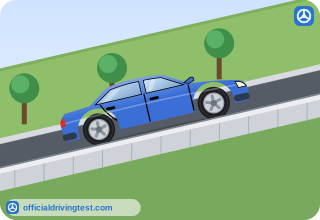
When starting a vehicle parked on a hill, what should you do?
- Signal, then pull out quickly to get up to speed
- Check traffic, then pull out with the brake still on
- Rev the engine, then pull out without signaling
- Release the brake, signal, check traffic, then go
Show answer
Correct answer: Release the brake, signal, check traffic, then go
When starting from an uphill or downhill location, release the parking/emergency brake, give the correct signal, check for oncoming traffic, and proceed when safe.
Source: Illinois Rules of the Road (2026), page 34
-
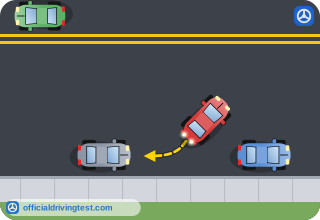
When parallel parking on a street with two-way traffic, your right-hand wheels must be parallel to and within how far of the curb?
- 12 inches
- 18 inches
- 6 inches
- 24 inches
Show answer
Correct answer: 12 inches
On two-way streets, park so the right-hand wheels are parallel to and within 12 inches of the curb.
Source: Illinois Rules of the Road (2026), page 35
-
Where may you park on a one-way street?
- Within 12 inches of the right curb only
- Within 18 inches of the left curb only
- Within 12 inches of the right or left curb
- Within 24 inches of either curb
Show answer
Correct answer: Within 12 inches of the right or left curb
On a one-way street or road, the vehicle should be parked within 12 inches of the right or left curb.
Source: Illinois Rules of the Road (2026), page 35
-
In which direction must a parked vehicle face?
- Facing oncoming traffic so you can see it
- In the direction traffic is moving
- In either direction on a one-way street
- Whichever way is closest to the curb
Show answer
Correct answer: In the direction traffic is moving
The manual states that vehicles must be parked in the direction in which traffic is moving.
Source: Illinois Rules of the Road (2026), page 35
-
When disability parking privileges are being used, what is required of the placard or plate holder?
- They must be the registered owner of the vehicle
- They only need to be listed on the vehicle registration
- They may lend the placard to any family member
- They must be present and enter or exit the vehicle
Show answer
Correct answer: They must be present and enter or exit the vehicle
The authorized holder of the placard or plates must be present and must enter or exit the vehicle when the parking privileges are used.
Source: Illinois Rules of the Road (2026), page 35
-
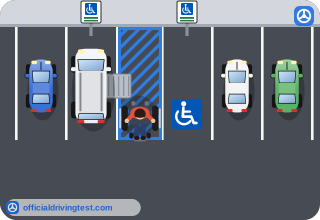
May a vehicle with a disability placard park in the striped area next to an accessible parking space?
- No, not even with a placard or disability plates
- Yes, if all accessible spaces are already full
- Yes, but only for up to 15 minutes
- Yes, if the vehicle has disability license plates
Show answer
Correct answer: No, not even with a placard or disability plates
The striped area is part of the reserved space, and vehicles may not park there even with a placard or disability plates.
Source: Illinois Rules of the Road (2026), page 35
-
Which vehicles may park in spaces equipped with electric vehicle charging stations?
- Any vehicle for up to 2 hours
- Any vehicle with its hazard lights on
- Only electric vehicles
- Any vehicle with a valid parking permit
Show answer
Correct answer: Only electric vehicles
Only electric vehicles are allowed to park in spaces designated for electric vehicle charging.
Source: Illinois Rules of the Road (2026), page 35
-
Are all of Illinois's statewide stopping, standing, and parking restrictions shown on signs?
- Yes, every restriction must be posted
- No, some are not always shown by signs
- Yes, but only in business districts
- No, only local rules are ever posted
Show answer
Correct answer: No, some are not always shown by signs
Local rules may be posted on signs, but there are statewide regulations that are not always indicated by signs.
Source: Illinois Rules of the Road (2026), page 35
-
Stopping, standing, or parking on the roadway side of a parked vehicle is also known as:

- Parallel parking
- Angle parking
- Curb parking
- Double parking
Show answer
Correct answer: Double parking
Stopping, standing, or parking on the roadway side of any parked vehicle is prohibited and is also known as double parking.
Source: Illinois Rules of the Road (2026), page 35
-
Which of these is a place where stopping, standing, or parking is prohibited?
- 35 feet before a YIELD sign, on your side of the road
- 30 feet away from a fire station driveway entrance
- In a marked, buffered, or barrel-protected bike lane
- 20 feet away from a fire hydrant on a city street
Show answer
Correct answer: In a marked, buffered, or barrel-protected bike lane
Stopping, standing, or parking is prohibited in a marked, buffered, or barrel-protected bike lane.
Source: Illinois Rules of the Road (2026), page 35
-
Is it legal to stop, stand, or park on a bridge, overpass, or railroad track?
- Yes, with hazard lights on
- No, it is prohibited
- Yes, for up to 5 minutes
- Yes, outside of cities
Show answer
Correct answer: No, it is prohibited
Stopping, standing, or parking is prohibited on any bridge, overpass, railroad track, or within a highway tunnel.
Source: Illinois Rules of the Road (2026), page 35
-
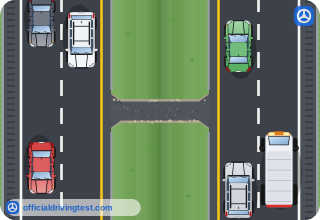
Stopping or parking in the area between the roadways of a divided highway, including crossovers, is:
- Allowed with hazard lights on
- Allowed only at night
- Allowed for up to 10 minutes
- Prohibited
Show answer
Correct answer: Prohibited
Stopping, standing, or parking is prohibited in the area between roadways of a divided highway, including crossovers.
Source: Illinois Rules of the Road (2026), page 35
-
Standing or parking a vehicle in front of a public or private driveway is:
- Allowed as long as the vehicle is occupied
- Prohibited, even if the vehicle is occupied
- Allowed for up to 15 minutes with flashers on
- Allowed if the driveway owner is notified
Show answer
Correct answer: Prohibited, even if the vehicle is occupied
Standing or parking a vehicle, whether occupied or not, is prohibited in front of a public or private driveway.
Source: Illinois Rules of the Road (2026), page 35
-
Standing or parking a vehicle is prohibited within how many feet of a fire hydrant?
- 10 feet
- 20 feet
- 25 feet
- 15 feet
Show answer
Correct answer: 15 feet
Standing or parking, whether the vehicle is occupied or not, is prohibited within 15 feet of a fire hydrant.
Source: Illinois Rules of the Road (2026), page 35
-
Standing or parking a vehicle is prohibited within how many feet of a crosswalk at an intersection?
- 10 feet
- 30 feet
- 20 feet
- 50 feet
Show answer
Correct answer: 20 feet
Standing or parking is prohibited within 20 feet of a fire station driveway or crosswalk at an intersection.
Source: Illinois Rules of the Road (2026), page 36
-
Standing or parking a vehicle is prohibited within how many feet of a STOP sign, YIELD sign, or traffic control signal?
- 15 feet
- 30 feet
- 20 feet
- 50 feet
Show answer
Correct answer: 30 feet
Standing or parking, whether occupied or not, is prohibited within 30 feet of a STOP sign, YIELD sign, or traffic control signal.
Source: Illinois Rules of the Road (2026), page 36
-
Parking a vehicle is prohibited within how many feet of the nearest rail of a railroad crossing?
- 15 feet
- 30 feet
- 100 feet
- 50 feet
Show answer
Correct answer: 50 feet
Parking, whether the vehicle is occupied or not, is prohibited within 50 feet of the nearest rail of a railroad crossing.
Source: Illinois Rules of the Road (2026), page 36
-
When parking on a highway between sunset and sunrise outside an urban district, what is required?
- Front and rear parking lights must be on
- Only the rear hazard lights must be on
- High-beam headlights must be left on
- No lights are needed if the car is empty
Show answer
Correct answer: Front and rear parking lights must be on
Parking on a highway between sunset and sunrise is prohibited unless the front and rear parking lights are displayed or the vehicle is in an urban district where lights are not required.
Source: Illinois Rules of the Road (2026), page 36
-
If the headlights are on while a vehicle is parked, how must they be set?
- On high beam
- Flashing
- Dimmed
- Aimed at the curb
Show answer
Correct answer: Dimmed
The manual states that headlights on parked vehicles must be dimmed.
Source: Illinois Rules of the Road (2026), page 36
-
Which parking offense is listed as a reason your driver’s license may be suspended?
- Parking over two hours at a meter
- Parking on your own home driveway
- Unauthorized parking in a disability space
- Parking facing uphill without a curb
Show answer
Correct answer: Unauthorized parking in a disability space
Unauthorized parking in a space designated for persons with disabilities is on the suspension list.
Source: Illinois Rules of the Road (2026), page 60
-
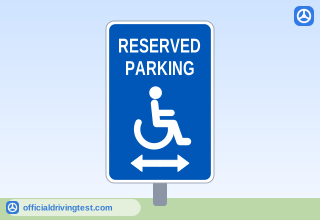
Parking spaces with a Parking for Persons with Disabilities sign are reserved for which vehicles?
- Any vehicle that is stopping for less than 15 minutes
- Vehicles of drivers over age 65, with or without plates
- Vehicles with disability license plates or placards
- Delivery vehicles that have their hazard lights turned on
Show answer
Correct answer: Vehicles with disability license plates or placards
These spaces are reserved for vehicles displaying Persons with Disabilities license plates or parking placards.
Source: Illinois Rules of the Road (2026), page 74
-
Who may designate curb markings, fire lanes and pavement markings as "No Parking" areas?
- The state police only
- Local authorities
- Property owners
- The fire department only
Show answer
Correct answer: Local authorities
Curb markings, fire lanes and pavement markings may be designated as "No Parking" areas by local authorities.
Source: Illinois Rules of the Road (2026), page 80
-
When are front and rear parking lights required?
- Whenever the engine is running
- When stopped on a highway at night
- Only when driving in thick fog
- Only when parked in a parking lot
Show answer
Correct answer: When stopped on a highway at night
Front and rear parking lights are required for any vehicle stopped on a highway at night.
Source: Illinois Rules of the Road (2026), page 92
-
Do Persons with Disabilities License Plates exempt the holder from parking meter fees and time limits?
- Yes, at every parking meter in Illinois
- No, meter fees and time limits still apply
- Yes, but only at meters over 30 minutes
- Yes, but only in city-owned parking lots
Show answer
Correct answer: No, meter fees and time limits still apply
The manual says these plates DO NOT exempt the authorized holder from parking meter fees and time limitations at parking meters.
Source: Illinois Rules of the Road (2026), page 99
-
A person with a permanent disability does not own a vehicle and relies on someone else for transportation. How many sets of disability plates may an immediate family member in the same household obtain?
- Two sets
- One set
- Three sets
- Four sets
Show answer
Correct answer: Two sets
The manual says an immediate family member residing in the same household may obtain two sets of plates in this situation.
Source: Illinois Rules of the Road (2026), page 99
-
Which of these may also obtain Persons with Disabilities License Plates?
- Any business that offers customer parking
- Car dealers selling wheelchair-ready vans
- School districts transporting eligible persons
- Anyone with a short-term, temporary injury
Show answer
Correct answer: School districts transporting eligible persons
The manual lists corporations, school districts, LLCs, nursing homes, convalescent homes and special education cooperatives transporting eligible persons as able to obtain these plates.
Source: Illinois Rules of the Road (2026), page 99
-
Who may be issued a disability parking placard in Illinois?
- Only drivers who own a vehicle titled in their name
- Any Illinois resident with a physician-certified disability
- Only Illinois residents who are age 65 or older
- Only residents enrolled in the Benefit Access Program
Show answer
Correct answer: Any Illinois resident with a physician-certified disability
The manual says disability parking placards may be issued to any Illinois resident with a physician-certified disability.
Source: Illinois Rules of the Road (2026), page 99
-
When may a disability parking placard be used in a vehicle parked at a designated accessible parking space?
- Any time a family member is driving the vehicle
- Whenever the vehicle is registered to the holder
- Only when the vehicle is parked at a meter
- Only when the person with the disability is present
Show answer
Correct answer: Only when the person with the disability is present
The manual says a placard may only be used if the person with the disability is present and entering or exiting the vehicle while parked at a designated accessible space.
Source: Illinois Rules of the Road (2026), page 99
-
How many types of disability parking placards are described in the Illinois manual?
- Two
- Three
- Four
- Five
Show answer
Correct answer: Four
The manual lists four types: Meter-Exempt Permanent, Permanent, Temporary and Organization.
Source: Illinois Rules of the Road (2026), page 99
-
A Meter-Exempt Permanent placard exempts the holder from parking meter fees and time limits at meters exceeding what time limit?
- 15 minutes
- 1 hour
- 2 hours
- 30 minutes
Show answer
Correct answer: 30 minutes
The manual says this placard exempts the holder from meter fees and time limitations at meters exceeding a 30-minute time limit.
Source: Illinois Rules of the Road (2026), page 99
-
The Meter-Exempt Permanent placard is issued to persons whose permanent disability does what?
- Is expected to last for less than six months in total
- Significantly impairs their ability to access a parking meter
- Requires them to use a wheelchair-accessible van only
- Prevents them from holding any Illinois driver's license
Show answer
Correct answer: Significantly impairs their ability to access a parking meter
The manual says the Meter-Exempt Permanent placard is issued to persons with permanent disabilities that significantly impair their ability to access a parking meter.
Source: Illinois Rules of the Road (2026), page 99
-
A temporary disability parking placard issued by the Secretary of State may be valid for no longer than how long?
- 90 days
- 30 days
- Six months
- One year
Show answer
Correct answer: Six months
The manual says a temporary placard is valid for the time the certifying physician indicates, not to exceed six months if issued by the Secretary of State.
Source: Illinois Rules of the Road (2026), page 99
-
A temporary disability parking placard issued by a local municipality may be valid for no longer than how long?
- Six months
- 90 days
- 30 days
- One year
Show answer
Correct answer: 90 days
The manual says a temporary placard issued by a local municipality may not exceed 90 days.
Source: Illinois Rules of the Road (2026), page 99
-
Within the legal maximum, who sets how long a temporary disability parking placard is valid?
- The local police department
- The placard holder's insurer
- The Department on Aging
- The certifying physician
Show answer
Correct answer: The certifying physician
The manual says a temporary placard is valid for the length of time indicated by the certifying physician, up to the stated maximum.
Source: Illinois Rules of the Road (2026), page 99
-
Does a Temporary disability parking placard exempt the holder from parking meter fees and time limits?
- Yes, at all meters
- Yes, for six months
- No, it does not
- Yes, over 30 minutes
Show answer
Correct answer: No, it does not
The manual states that the Temporary placard DOES NOT exempt the authorized holder from parking meter fees and time limitations.
Source: Illinois Rules of the Road (2026), page 99
-
To whom is an Organization disability parking placard issued?
- Organizations offering free transportation to persons with disabilities
- Stores that provide accessible parking spaces for their customers
- Any business that employs one or more persons with disabilities
- Taxi companies that charge regular fares to all of their riders
Show answer
Correct answer: Organizations offering free transportation to persons with disabilities
The manual says the Organization placard is issued to organizations that offer free transportation to persons with disabilities.
Source: Illinois Rules of the Road (2026), page 99
-
When may the holder of an Organization disability placard park in spaces reserved for persons with disabilities?
- Any time the organization's vehicle is parked
- Only at meters with a 30-minute limit or less
- Only on weekends and on state holidays
- When transporting persons with disabilities
Show answer
Correct answer: When transporting persons with disabilities
The manual says the Organization placard allows parking in reserved spaces when transporting persons with disabilities.
Source: Illinois Rules of the Road (2026), page 99