Illinois: Parking rules — Part 1 Practice Test
Questions in this part include: “Where may you park on a one-way street?” · “Is it legal to stop, stand, or park on a bridge, overpass, or railroad track?”
Independent educational site · not affiliated with any government agency or DMV
Ready? Test yourself
- Instant feedback with an explanation
- Every answer cites its source in the manual
- Your best score is saved on this device
Questions are original and based on the official manual "Illinois Rules of the Road" (2026), Illinois Secretary of State.
All 21 questions in this practice test
Take the test above first, then use this list to study. Tap “Show answer” to see the correct answer and explanation.
Show the questions and answersHide the questions
-
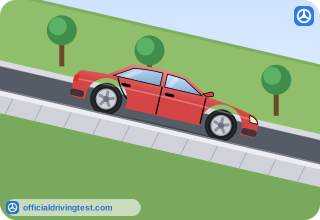
Any time you park on a hill, what should you do with the gear selector and brake?
- Put it in neutral and leave the brake released
- Put it in reverse and release the parking brake
- Leave the engine idling in drive with hazard lights
- Put it in park and set the parking brake if needed
Show answer
Correct answer: Put it in park and set the parking brake if needed
When parking on a hill, put the gear selector in park and set the parking/emergency brake if necessary.
Source: Illinois Rules of the Road (2026), page 34
-
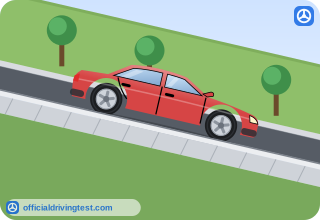
When parking facing downhill on a street with a curb, which way should you turn the front wheels?
- Toward the curb
- Away from the curb
- Straight ahead
- Toward the center of the street
Show answer
Correct answer: Toward the curb
Facing downhill with a curb, turn the front wheels toward the curb so the vehicle will roll toward the curb.
Source: Illinois Rules of the Road (2026), page 34
-
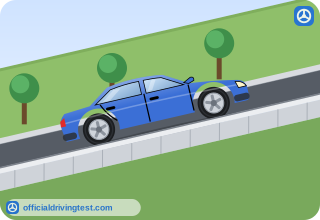
When parking facing uphill on a street with a curb, which way should you turn the front wheels?
- Toward the curb
- Straight ahead
- Away from the curb
- Either way, if the brake is set
Show answer
Correct answer: Away from the curb
Facing uphill with a curb, turn the front wheels away from the curb.
Source: Illinois Rules of the Road (2026), page 34
-
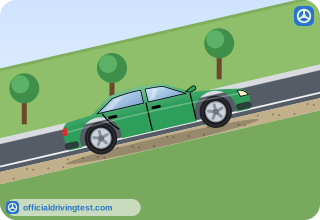
When parking on a hill on a street without a curb, which way should you turn the wheels?
- Toward the center line of the road you are on
- Toward the side of the road where you are parked
- Straight ahead, parallel to the edge of the road
- Away from the side of the road where you parked
Show answer
Correct answer: Toward the side of the road where you are parked
Without curbing, turn the wheels toward the side of the road on which your vehicle is parked.
Source: Illinois Rules of the Road (2026), page 34
-
When starting a vehicle parked on a hill, what should you do?
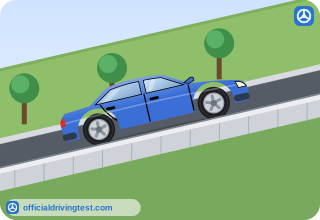
- Signal, then pull out quickly to get up to speed
- Check traffic, then pull out with the brake still on
- Rev the engine, then pull out without signaling
- Release the brake, signal, check traffic, then go
Show answer
Correct answer: Release the brake, signal, check traffic, then go
When starting from an uphill or downhill location, release the parking/emergency brake, give the correct signal, check for oncoming traffic, and proceed when safe.
Source: Illinois Rules of the Road (2026), page 34
-
When parallel parking on a street with two-way traffic, your right-hand wheels must be parallel to and within how far of the curb?
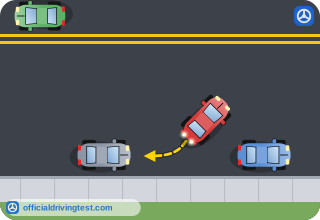
- 12 inches
- 18 inches
- 6 inches
- 24 inches
Show answer
Correct answer: 12 inches
On two-way streets, park so the right-hand wheels are parallel to and within 12 inches of the curb.
Source: Illinois Rules of the Road (2026), page 35
-
Where may you park on a one-way street?
- Within 12 inches of the right curb only
- Within 18 inches of the left curb only
- Within 12 inches of the right or left curb
- Within 24 inches of either curb
Show answer
Correct answer: Within 12 inches of the right or left curb
On a one-way street or road, the vehicle should be parked within 12 inches of the right or left curb.
Source: Illinois Rules of the Road (2026), page 35
-
In which direction must a parked vehicle face?
- Facing oncoming traffic so you can see it
- In the direction traffic is moving
- In either direction on a one-way street
- Whichever way is closest to the curb
Show answer
Correct answer: In the direction traffic is moving
The manual states that vehicles must be parked in the direction in which traffic is moving.
Source: Illinois Rules of the Road (2026), page 35
-
When disability parking privileges are being used, what is required of the placard or plate holder?
- They must be the registered owner of the vehicle
- They only need to be listed on the vehicle registration
- They may lend the placard to any family member
- They must be present and enter or exit the vehicle
Show answer
Correct answer: They must be present and enter or exit the vehicle
The authorized holder of the placard or plates must be present and must enter or exit the vehicle when the parking privileges are used.
Source: Illinois Rules of the Road (2026), page 35
-
May a vehicle with a disability placard park in the striped area next to an accessible parking space?
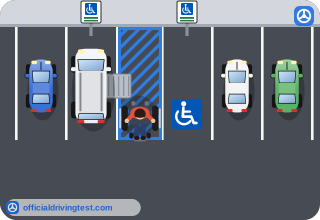
- No, not even with a placard or disability plates
- Yes, if all accessible spaces are already full
- Yes, but only for up to 15 minutes
- Yes, if the vehicle has disability license plates
Show answer
Correct answer: No, not even with a placard or disability plates
The striped area is part of the reserved space, and vehicles may not park there even with a placard or disability plates.
Source: Illinois Rules of the Road (2026), page 35
-
Which vehicles may park in spaces equipped with electric vehicle charging stations?
- Any vehicle for up to 2 hours
- Any vehicle with its hazard lights on
- Only electric vehicles
- Any vehicle with a valid parking permit
Show answer
Correct answer: Only electric vehicles
Only electric vehicles are allowed to park in spaces designated for electric vehicle charging.
Source: Illinois Rules of the Road (2026), page 35
-
Are all of Illinois's statewide stopping, standing, and parking restrictions shown on signs?
- Yes, every restriction must be posted
- No, some are not always shown by signs
- Yes, but only in business districts
- No, only local rules are ever posted
Show answer
Correct answer: No, some are not always shown by signs
Local rules may be posted on signs, but there are statewide regulations that are not always indicated by signs.
Source: Illinois Rules of the Road (2026), page 35
-
Stopping, standing, or parking on the roadway side of a parked vehicle is also known as:
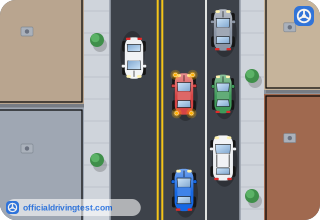
- Parallel parking
- Angle parking
- Curb parking
- Double parking
Show answer
Correct answer: Double parking
Stopping, standing, or parking on the roadway side of any parked vehicle is prohibited and is also known as double parking.
Source: Illinois Rules of the Road (2026), page 35
-
Which of these is a place where stopping, standing, or parking is prohibited?
- 35 feet before a YIELD sign, on your side of the road
- 30 feet away from a fire station driveway entrance
- In a marked, buffered, or barrel-protected bike lane
- 20 feet away from a fire hydrant on a city street
Show answer
Correct answer: In a marked, buffered, or barrel-protected bike lane
Stopping, standing, or parking is prohibited in a marked, buffered, or barrel-protected bike lane.
Source: Illinois Rules of the Road (2026), page 35
-
Is it legal to stop, stand, or park on a bridge, overpass, or railroad track?
- Yes, with hazard lights on
- No, it is prohibited
- Yes, for up to 5 minutes
- Yes, outside of cities
Show answer
Correct answer: No, it is prohibited
Stopping, standing, or parking is prohibited on any bridge, overpass, railroad track, or within a highway tunnel.
Source: Illinois Rules of the Road (2026), page 35
-
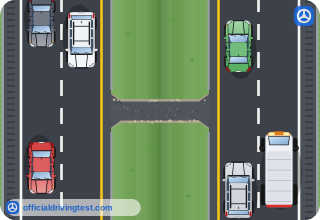
Stopping or parking in the area between the roadways of a divided highway, including crossovers, is:
- Allowed with hazard lights on
- Allowed only at night
- Allowed for up to 10 minutes
- Prohibited
Show answer
Correct answer: Prohibited
Stopping, standing, or parking is prohibited in the area between roadways of a divided highway, including crossovers.
Source: Illinois Rules of the Road (2026), page 35
-
Standing or parking a vehicle in front of a public or private driveway is:
- Allowed as long as the vehicle is occupied
- Prohibited, even if the vehicle is occupied
- Allowed for up to 15 minutes with flashers on
- Allowed if the driveway owner is notified
Show answer
Correct answer: Prohibited, even if the vehicle is occupied
Standing or parking a vehicle, whether occupied or not, is prohibited in front of a public or private driveway.
Source: Illinois Rules of the Road (2026), page 35
-
Standing or parking a vehicle is prohibited within how many feet of a fire hydrant?
- 10 feet
- 20 feet
- 25 feet
- 15 feet
Show answer
Correct answer: 15 feet
Standing or parking, whether the vehicle is occupied or not, is prohibited within 15 feet of a fire hydrant.
Source: Illinois Rules of the Road (2026), page 35
-
Standing or parking a vehicle is prohibited within how many feet of a crosswalk at an intersection?
- 10 feet
- 30 feet
- 20 feet
- 50 feet
Show answer
Correct answer: 20 feet
Standing or parking is prohibited within 20 feet of a fire station driveway or crosswalk at an intersection.
Source: Illinois Rules of the Road (2026), page 36
-
Standing or parking a vehicle is prohibited within how many feet of a STOP sign, YIELD sign, or traffic control signal?
- 15 feet
- 30 feet
- 20 feet
- 50 feet
Show answer
Correct answer: 30 feet
Standing or parking, whether occupied or not, is prohibited within 30 feet of a STOP sign, YIELD sign, or traffic control signal.
Source: Illinois Rules of the Road (2026), page 36
-
Parking a vehicle is prohibited within how many feet of the nearest rail of a railroad crossing?
- 15 feet
- 30 feet
- 100 feet
- 50 feet
Show answer
Correct answer: 50 feet
Parking, whether the vehicle is occupied or not, is prohibited within 50 feet of the nearest rail of a railroad crossing.
Source: Illinois Rules of the Road (2026), page 36