Illinois: Emergency vehicles & work zones
The Move Over law, school buses, work zones and police stops. Split into 3 shorter tests so you're not stuck in one long quiz.
Independent educational site · not affiliated with any government agency or DMV
Choose a part
Emergency vehicles & work zones — Part 1
Questions in this part include: “When will many officers tell you the specific reason for a traffic stop?”
StartEmergency vehicles & work zones — Part 2
Questions in this part include: “In a construction zone, when may the speed limit be further reduced?”
StartEmergency vehicles & work zones — Part 3
Questions in this part include: “What is the mandatory fine for a conviction of passing a stopped school bus with its stop arm extended?”
StartAll 52 Emergency vehicles & work zones questions with answers
Choose a part above to take a practice test, or study every question and answer here.
Show the questions and answersHide the questions
-
When a police officer signals you to stop, what should you do?
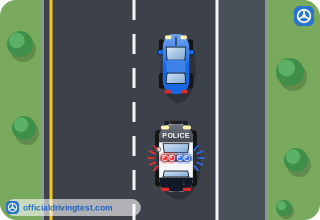
- Stop right away in your traffic lane and wait there
- Pull onto the left shoulder next to the center median
- Slow down, signal, and pull onto the right-hand shoulder
- Keep driving until you reach your destination
Show answer
Correct answer: Slow down, signal, and pull onto the right-hand shoulder
You should slow down, activate your turn signal, and safely pull over onto the right-hand shoulder of the roadway.
Source: Illinois Rules of the Road (2026), page 21
-
You are being stopped by police, but there is no shoulder or it is too narrow. What should you do?
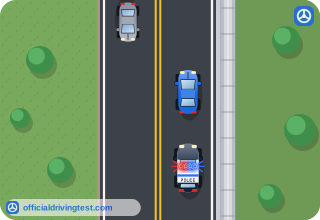
- Stop in the traffic lane with your hazards on
- Find the next safest location and pull over
- Stop at once, even on a bridge or curve
- Turn around and head to the nearest parking lot
Show answer
Correct answer: Find the next safest location and pull over
If there is no shoulder or it is too narrow to pull over, find the next safest location and pull over.
Source: Illinois Rules of the Road (2026), page 21
-
When pulling over for a police officer, where should you NOT stop your vehicle?
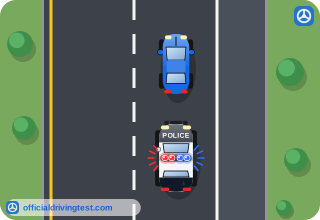
- On a wide right-hand shoulder
- At a well-lit, safe location
- On a straight road with room to pass
- On a bridge or a curve
Show answer
Correct answer: On a bridge or a curve
Do not stop on bridges, curves, next to guardrails, concrete walls, medians, or any place where it would be difficult for other vehicles to pass.
Source: Illinois Rules of the Road (2026), page 21
-
Why should a vehicle pulled over for police not be stopped too close to the solid white line?
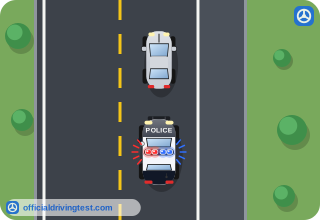
- It blocks the officer's radar reading
- It may get struck by oncoming traffic
- It is where the officer must park
- It makes the license plate hard to read
Show answer
Correct answer: It may get struck by oncoming traffic
A vehicle stopped too close to the solid white line may get struck by oncoming traffic.
Source: Illinois Rules of the Road (2026), page 21
-
During a traffic stop, where should your hands be?
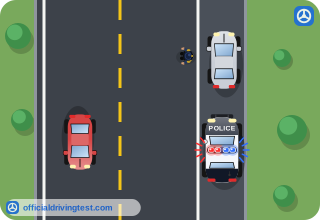
- In your lap, out of the officer's view
- Reaching for your papers in the glove box
- Out the window holding your license
- Clearly in sight on the steering wheel
Show answer
Correct answer: Clearly in sight on the steering wheel
Stay in the vehicle with both hands clearly in sight on the steering wheel until the officer instructs you otherwise or the stop is complete.
Source: Illinois Rules of the Road (2026), page 21
-
From which side of your vehicle may a police officer approach during a traffic stop?
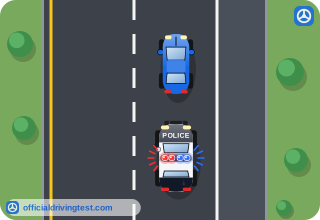
- Either the driver or the passenger side
- Only the driver side
- Only the passenger side
- Only from the front of the vehicle
Show answer
Correct answer: Either the driver or the passenger side
Be prepared for the officer to approach from either the driver or passenger side of your vehicle.
Source: Illinois Rules of the Road (2026), page 21
-
Why should you not get out of your vehicle during a traffic stop unless asked?
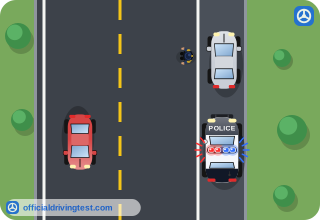
- It automatically doubles the fine on your ticket
- It counts as refusing a chemical test
- It can be seen as aggressive and a threat to the officer
- It means the stop must start over from the beginning
Show answer
Correct answer: It can be seen as aggressive and a threat to the officer
Getting out of the vehicle can be perceived as aggressive behavior and a threat to the police officer's safety.
Source: Illinois Rules of the Road (2026), page 21
-
Your proof of insurance is in the glove box when an officer asks for it. What should you do first?
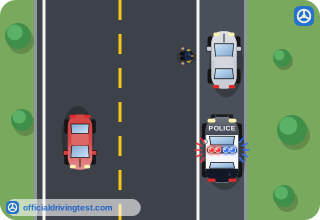
- Tell the officer where it is and follow the officer's directions
- Quickly reach into the glove box before the officer arrives
- Step out and get it from the passenger side yourself
- Say you have none and bring it to court later instead
Show answer
Correct answer: Tell the officer where it is and follow the officer's directions
If these items are in the glove box, under the seat or on a cellphone, inform the officer and follow the officer's directions before retrieving them.
Source: Illinois Rules of the Road (2026), page 21
-
An unmarked vehicle signals you to stop and you cannot tell if it is law enforcement. Which is one of the actions the manual lists?

- Speed up to get away from the vehicle as fast as possible
- Drive slowly to a well-lit, populated location and pull over
- Stop at once on a dark, empty road and get out of the car
- Ignore the vehicle completely and continue at normal speed
Show answer
Correct answer: Drive slowly to a well-lit, populated location and pull over
Drive slowly and carefully below the speed limit and pull over at a well-lit, populated location, drive to the nearest police station, or call 911.
Source: Illinois Rules of the Road (2026), page 21
-
If you cannot identify an unmarked police vehicle behind you, what can you turn on to communicate your intentions to the officer?

- Your high beams
- Your fog lights
- Your horn
- Your hazard lights
Show answer
Correct answer: Your hazard lights
Activating your vehicle's hazard lights is a helpful way to communicate your intentions with the police officer.
Source: Illinois Rules of the Road (2026), page 21
-
You are stopped by police at night. What does the manual say is acceptable?
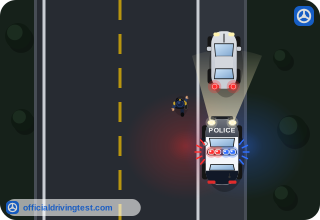
- Shining your high beams at the officer
- Turning on your vehicle's interior light
- Getting out to meet the officer halfway
- Driving on to a place of your choosing
Show answer
Correct answer: Turning on your vehicle's interior light
If you are being stopped at night, it is acceptable to turn on your vehicle's interior light.
Source: Illinois Rules of the Road (2026), page 21
-
When will many officers tell you the specific reason for a traffic stop?
- Before they leave their own vehicle, over the loudspeaker
- Only in writing, days later, by mail to your home address
- Never; officers are not allowed to give a reason at all
- After they have your license, registration, and insurance card
Show answer
Correct answer: After they have your license, registration, and insurance card
Many officers will not provide specific reasons for the stop until they have obtained your driver's license, vehicle registration, and insurance card.
Source: Illinois Rules of the Road (2026), page 21
-
If you believe an officer acted inappropriately during a traffic stop, to whom should you report it as soon as possible?
- The officer's superiors
- Your insurance company
- The Secretary of State
- The other drivers nearby
Show answer
Correct answer: The officer's superiors
The manual says to report the conduct to the officer's superiors as soon as possible.
Source: Illinois Rules of the Road (2026), page 22
-
What are police officers required to provide upon request during a traffic stop?
- Their home addresses
- A copy of their training records
- Their names and badge numbers
- Their supervisor's cellphone number
Show answer
Correct answer: Their names and badge numbers
Officers are required to provide their names and badge numbers upon request.
Source: Illinois Rules of the Road (2026), page 22
-
Where can written complaints about an officer's conduct be filed?
- The driver services facility where you took your driving exam
- The agency's internal affairs division or civilian complaint board
- The traffic court clerk on the day the ticket is due
- The insurance company listed on your proof of insurance card
Show answer
Correct answer: The agency's internal affairs division or civilian complaint board
Written complaints can be filed with the agency's internal affairs division or civilian complaint board.
Source: Illinois Rules of the Road (2026), page 22
-
Which traffic stops are Illinois police officers legally required to document?
- Only stops that end with a ticket being issued
- Only stops that end in an arrest of the driver
- Only stops made at night or in bad weather
- All traffic stops, regardless of the action taken
Show answer
Correct answer: All traffic stops, regardless of the action taken
Regardless of the action taken, officers must document all traffic stops, including the driver's name and address for data collection.
Source: Illinois Rules of the Road (2026), page 22
-
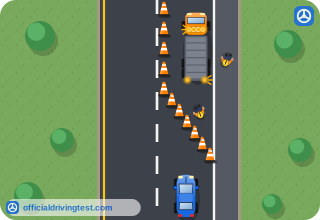
When entering a highway construction or maintenance area, what does Illinois law require of motorists?
- Keep the normal speed limit as long as no workers can be seen anywhere in the area
- Speed up to clear the work zone quickly, staying in the lane closest to the workers
- Use the hazard lights and pass any slow vehicles on the shoulder of the work zone
- Slow down, stop handheld phone use, yield to workers, and change lanes away from them if possible
Show answer
Correct answer: Slow down, stop handheld phone use, yield to workers, and change lanes away from them if possible
In work zones, motorists must slow down, discontinue cellphone use unless hands-free, yield to authorized vehicles or workers, change to a lane away from workers when possible, and proceed with caution.
Source: Illinois Rules of the Road (2026), page 25
-
When must you obey the posted construction zone speed limit?
- 24 hours a day, seven days a week, whether or not workers are present
- Only when workers are present and visible from the roadway
- Only on weekdays during daylight hours
- Only when a flagger is directing traffic
Show answer
Correct answer: 24 hours a day, seven days a week, whether or not workers are present
Motorists must obey the posted construction zone speed limit 24 hours a day, seven days a week, regardless of the presence of workers.
Source: Illinois Rules of the Road (2026), page 25
-
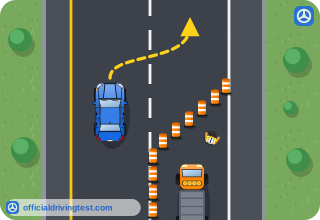
As you leave a work zone, how long should you keep a reduced speed?
- Only until you see the first 'end' sign of the zone
- For exactly one mile after the work zone ends
- Until safely past any workers or authorized vehicles
- You may speed up as soon as the lanes widen again
Show answer
Correct answer: Until safely past any workers or authorized vehicles
Maintain a reduced speed when leaving the work zone until safely past any workers or authorized vehicles.
Source: Illinois Rules of the Road (2026), page 25
-
In a construction zone, when may the speed limit be further reduced?
- When workers are present
- Only on weekends and holidays
- Only after dark each night
- Only in unincorporated areas
Show answer
Correct answer: When workers are present
The speed limit in a construction zone may be further reduced when workers are present.
Source: Illinois Rules of the Road (2026), page 25
-
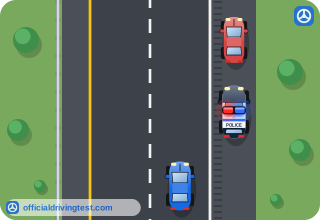
You approach a stationary emergency or maintenance vehicle with flashing lights. What does Illinois law require?
- Keep your speed and lane, since the vehicle is stopped and not moving at all
- Stop behind the vehicle and wait until its flashing lights are turned off
- Yield, change to a lane away from the workers if possible, and proceed with caution
- Pass as quickly as possible in the lane next to the vehicle to clear the area
Show answer
Correct answer: Yield, change to a lane away from the workers if possible, and proceed with caution
When approaching a stationary emergency/maintenance vehicle with its lights on, motorists must yield, change to a lane away from the emergency workers when possible, and proceed with caution.
Source: Illinois Rules of the Road (2026), page 25
-
Which light colors does the manual list for the visual signals of emergency/maintenance vehicles?
- Only red and blue, never any other
- Blue, red, amber, white, or green
- Only amber and white, never red
- Only red, blue, and purple lights
Show answer
Correct answer: Blue, red, amber, white, or green
Emergency/maintenance vehicles use visual signals by displaying blue, red, amber, white, or green oscillating, rotating or flashing lights.
Source: Illinois Rules of the Road (2026), page 25
-
You are passing a stationary emergency vehicle with flashing lights, but a lane change is not possible. What should you do?
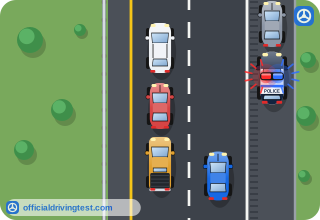
- Speed up to pass the vehicle quickly
- Drive onto the shoulder to go around
- Keep your speed; no change is needed
- Reduce speed and proceed with caution
Show answer
Correct answer: Reduce speed and proceed with caution
If a lane change is not possible, reduce speed and proceed with caution.
Source: Illinois Rules of the Road (2026), page 25
-
How does Illinois law define an "emergency scene"?
- Any place where two or more vehicles have stopped on the side of the road
- A location where a stationary authorized vehicle has activated its flashing lights
- Any stretch of road within one mile of a hospital or a fire station
- Only a location where a crash has caused injuries needing an ambulance
Show answer
Correct answer: A location where a stationary authorized vehicle has activated its flashing lights
An emergency scene is a location where a stationary authorized vehicle is present and has activated its oscillating, rotating, or flashing lights.
Source: Illinois Rules of the Road (2026), page 25
-
Within what distance of an emergency scene does Illinois law prohibit photography and the use of wireless/cellphones, except in certain circumstances?
- 100 feet
- 200 feet
- 1,000 feet
- 500 feet
Show answer
Correct answer: 500 feet
Illinois law prohibits photography and the use of wireless/cellphones within 500 feet of an emergency scene, except in certain circumstances.
Source: Illinois Rules of the Road (2026), page 25
-
An emergency vehicle using lights and/or sirens is approaching you. What does Illinois law require?
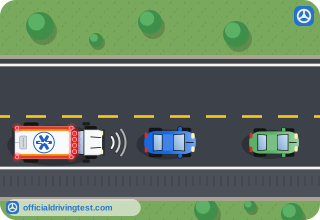
- Immediately pull to the right side of the road and let it pass
- Speed up so the emergency vehicle does not have to slow down
- Stop at once in your lane, even in the middle of an intersection
- Move to the left lane and keep driving at your current speed
Show answer
Correct answer: Immediately pull to the right side of the road and let it pass
Illinois law requires motorists to immediately pull to the right side of the road and allow the emergency vehicle to pass; sometimes a complete stop may be necessary.
Source: Illinois Rules of the Road (2026), page 25
-
You are stopped at an intersection with two-way traffic when an emergency vehicle with lights and siren approaches. What should you do?
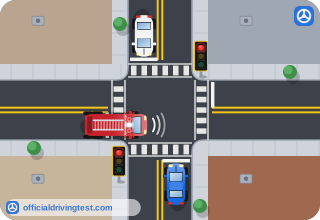
- Drive through the intersection quickly to clear its way
- Back up to make room behind your vehicle
- Remain stopped until it passes through the intersection
- Turn right on red to get out of its path
Show answer
Correct answer: Remain stopped until it passes through the intersection
If stopped at an intersection with two-way traffic, remain stopped until the emergency vehicle passes through the intersection.
Source: Illinois Rules of the Road (2026), page 25
-
When may you drive over a fire hose?
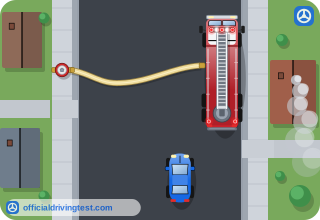
- Only when permitted by the fire official in command of the scene
- Whenever the fire trucks have turned off their flashing lights
- When you drive over it slowly, at under 5 mph
- Whenever no firefighters are standing nearby
Show answer
Correct answer: Only when permitted by the fire official in command of the scene
A driver is prohibited from driving over fire hoses unless permitted by a fire official in command of the scene.
Source: Illinois Rules of the Road (2026), page 25
-
When turning or changing lanes in a construction zone, what should you pay special attention to?
- Only the speed of the vehicle ahead of you
- Horn signals given by the workers in the area
- Signs, barricades, and pavement markings
- Only the lane markings painted before the work
Show answer
Correct answer: Signs, barricades, and pavement markings
In construction zones, pay special attention to signs, barricades, and pavement markings when turning or changing lanes.
Source: Illinois Rules of the Road (2026), page 32
-
In which situation are you NOT required to stop for a stopped school bus?
- On a four-lane roadway when the bus is stopped in the opposite direction
- On a two-lane city street when the bus is stopped in the opposite direction
- In a school parking lot when the bus is loading students at the curb
- On a two-lane rural road when the bus is facing toward you
Show answer
Correct answer: On a four-lane roadway when the bus is stopped in the opposite direction
A vehicle is not required to stop when both vehicles are on a four-lane roadway and the bus is stopped in the opposite direction; any other time you must stop.
Source: Illinois Rules of the Road (2026), page 32
-
Must you stop for a school bus that is stopped and loading passengers in a parking lot on school property?
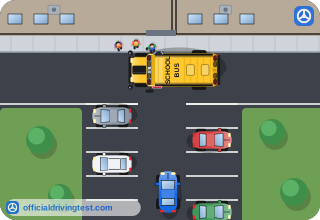
- No, the rule applies only on public roads
- Only if a crossing guard is present
- Yes, the stop rule applies there too
- Only during regular school hours
Show answer
Correct answer: Yes, the stop rule applies there too
The rule to stop for a stopped school bus loading or unloading passengers includes any parking lot located on school property.
Source: Illinois Rules of the Road (2026), page 33
-
In a rural area, at least how far in advance of a stop will a school bus give a warning?
- 100 feet
- 200 feet
- 500 feet
- 50 feet
Show answer
Correct answer: 200 feet
The school bus gives a warning at least 100 feet in advance of a stop, or 200 feet in rural areas.
Source: Illinois Rules of the Road (2026), page 33
-
Outside rural areas, at least how far in advance of a stop will a school bus give a warning?
- 50 feet
- 200 feet
- 300 feet
- 100 feet
Show answer
Correct answer: 100 feet
The school bus warning comes at least 100 feet before a stop (200 feet in rural areas).
Source: Illinois Rules of the Road (2026), page 33
-
When is a school bus's stop signal arm extended?
- After the bus has come to a complete stop
- When the bus is 100 feet from the stop
- As soon as the flashing lights come on
- Only after the first child leaves the bus
Show answer
Correct answer: After the bus has come to a complete stop
The bus driver flashes lights first; the stop signal arm is extended after the school bus has come to a complete stop.
Source: Illinois Rules of the Road (2026), page 33
-
When you meet a stopped school bus from the opposite direction, how long must you remain stopped?
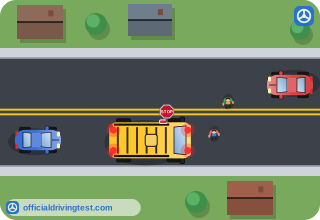
- Until all children have boarded the bus and taken a seat inside
- Until the bus doors close, even if the lights are still flashing
- Until the stop arm is in and the lights are off, or the driver signals you
- For one full minute, and then you may pass slowly with caution
Show answer
Correct answer: Until the stop arm is in and the lights are off, or the driver signals you
You must stay stopped until the stop signal arm is no longer extended and the flashing lights are off, or the school bus driver signals vehicles to pass.
Source: Illinois Rules of the Road (2026), page 33
-
What happens to your driver's license if you are convicted of passing a stopped school bus with its lights flashing and stop arm extended?
- Nothing, for a first offense
- It is suspended
- You receive a warning letter only
- It is cancelled permanently
Show answer
Correct answer: It is suspended
A conviction for passing a stopped school bus with flashing lights and the stop arm extended results in the suspension of your driver's license.
Source: Illinois Rules of the Road (2026), page 33
-
What is the mandatory fine for a conviction of passing a stopped school bus with its stop arm extended?
- $30
- $150
- $500
- $300
Show answer
Correct answer: $300
A conviction brings a mandatory fine of $300 plus community service set by the court.
Source: Illinois Rules of the Road (2026), page 33
-
Besides the mandatory fine, what else does a conviction for passing a stopped school bus bring?
- Community service set by the court
- A mandatory 30-day jail sentence
- Impoundment of the vehicle for a year
- Removal of the vehicle's license plates
Show answer
Correct answer: Community service set by the court
The conviction carries a mandatory $300 fine and community service in an amount set by the court.
Source: Illinois Rules of the Road (2026), page 33
-
If the owner was not driving when their vehicle illegally passed a stopped school bus and does not name the driver, what happens?
- The owner's driver's license is revoked for one full year
- The owner must pay a fine of $600 instead of $300
- The vehicle registration is suspended for three months
- The vehicle registration is suspended for six months
Show answer
Correct answer: The vehicle registration is suspended for three months
The owner must give the State's Attorney's Office the name of the driver, or the vehicle registration will be suspended for three months.
Source: Illinois Rules of the Road (2026), page 33
-
Which construction zones in Illinois are no passing zones?
- Only those with workers
- All construction zones
- Only those on interstates
- Only those with a sign
Show answer
Correct answer: All construction zones
All construction zones in Illinois are no passing zones.
Source: Illinois Rules of the Road (2026), page 29
-
Besides passing, which situation lets you drive away from the right half of the roadway?
- Approaching a stationary emergency or disabled vehicle on the side of the highway
- Driving on the left half of a clear two-lane road to see farther ahead
- Driving at the minimum speed on a four-lane highway in daylight
- Following a funeral procession through a city or town area
Show answer
Correct answer: Approaching a stationary emergency or disabled vehicle on the side of the highway
The manual lists approaching a stationary emergency vehicle or disabled vehicle on the side of the highway as an exception to driving on the right half.
Source: Illinois Rules of the Road (2026), page 29
-
Roadway construction is in or close to the right lane or right shoulder. What does this allow?
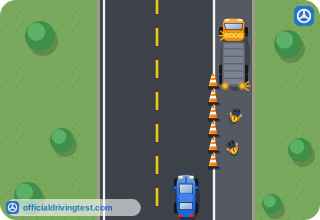
- Driving on the right shoulder past the workers
- Driving away from the right half of the roadway
- Ignoring the posted work zone speed limit
- Passing other vehicles within the work zone
Show answer
Correct answer: Driving away from the right half of the roadway
Roadway construction located in or close to the right lane or right shoulder is one of the exceptions to driving on the right half of the roadway.
Source: Illinois Rules of the Road (2026), page 29
-
Who is exempt from the rule that traffic must travel in the posted direction of one-way streets?
- Drivers who are delivering goods to businesses on that street
- Any driver using hazard lights while driving very slowly
- Drivers in a funeral procession with their headlights on
- Police and emergency vehicles using sirens or flashing lights
Show answer
Correct answer: Police and emergency vehicles using sirens or flashing lights
The one-way rule does not apply to police and emergency vehicles using sirens or flashing lights.
Source: Illinois Rules of the Road (2026), page 29
-
You are being taken into custody after a traffic stop. What should you NOT do?
- Stay calm and follow instructions
- Keep your hands where they are seen
- Resist the arrest
- Stay cooperative at the scene
Show answer
Correct answer: Resist the arrest
If a traffic stop results in an arrest, you should not resist arrest if taken into custody by the police.
Source: Illinois Rules of the Road (2026), page 22
-
Your license may be suspended for causing a crash in a construction zone by failing to do what?
- Turn on your hazard lights
- Honk before entering the zone
- Stop and show your license
- Reduce speed or change lanes
Show answer
Correct answer: Reduce speed or change lanes
Causing a crash in a construction zone, by failing to reduce speed or change lanes and resulting in property damage or injury, is a suspension offense.
Source: Illinois Rules of the Road (2026), page 59
-
Your license may be suspended if you fail to reduce speed and change lanes away from what, resulting in property damage or injury?
- A moving garbage truck on its route
- A delivery van parked at a curb
- A stationary emergency vehicle
- A slow-moving farm tractor
Show answer
Correct answer: A stationary emergency vehicle
Failure to reduce speed and change lanes away from a stationary emergency vehicle that results in property damage or injury is a suspension offense.
Source: Illinois Rules of the Road (2026), page 60
-
A second violation of speeding in a construction zone when workers are present can lead to suspension if it occurs within what period of the previous one?
- 30 days
- Six months
- Two years
- Ten years
Show answer
Correct answer: Two years
Speeding in a Construction Zone is a suspension offense for a second violation within two years of the previous one, when workers are present.
Source: Illinois Rules of the Road (2026), page 60
-
When you see Workers Ahead signs, what should you do?
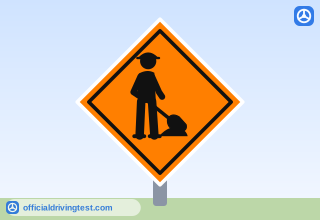
- Keep your current speed and move onto the shoulder
- Adjust to the posted construction zone speed limit
- Speed up to clear the work area as quickly as possible
- Stop and wait until a worker waves you on
Show answer
Correct answer: Adjust to the posted construction zone speed limit
Follow the signs and adjust your vehicle speed to the posted construction zone speed limit, stay alert, and keep a safe distance from all traffic barriers.
Source: Illinois Rules of the Road (2026), page 72
-
What is the purpose of warning cones, drums, and barricades in construction and maintenance zones?
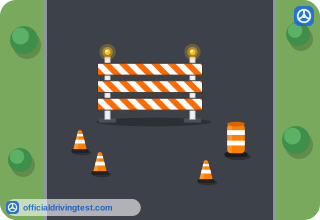
- To show where drivers may park
- To mark the end of the speed zone
- To show where workers take breaks
- To mark a path for you to follow
Show answer
Correct answer: To mark a path for you to follow
These devices protect you from dangerous locations by marking a path for you to follow in construction and maintenance zones.
Source: Illinois Rules of the Road (2026), page 73
-
In work zones, what do warning lights help do?
- Draw your attention to drums and barricades at night
- Tell you the posted construction zone speed limit
- Signal you to stop until a flagger waves you on
- Show where workers park their vehicles at night
Show answer
Correct answer: Draw your attention to drums and barricades at night
Warning lights help draw your attention to drums and barricades at night.
Source: Illinois Rules of the Road (2026), page 73
-
What do arrow boards in construction areas warn you about?
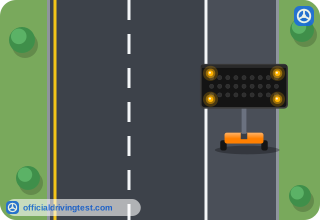
- The distance to the next exit ramp
- A reduced speed limit for trucks
- A lane closure ahead and which way to merge
- Where workers will direct you to stop
Show answer
Correct answer: A lane closure ahead and which way to merge
Arrow boards warn the motorist of an upcoming lane closure or caution when construction is ahead, and the direction to merge or move.
Source: Illinois Rules of the Road (2026), page 73
-
When approaching a flagger, what must you do if the flagger signals you to stop?
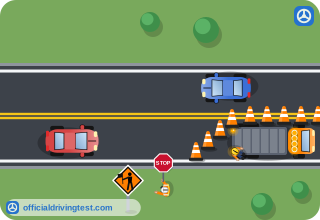
- Slow down and continue with caution
- You must stop
- Change lanes and pass the flagger
- Sound your horn and proceed
Show answer
Correct answer: You must stop
Slow down and be prepared to obey the signals of the flagger; you must stop if signaled to do so.
Source: Illinois Rules of the Road (2026), page 73