Illinois: Emergency vehicles & work zones — Part 2 Practice Test
Questions in this part include: “In a construction zone, when may the speed limit be further reduced?” · “In which situation are you NOT required to stop for a stopped school bus?”
Independent educational site · not affiliated with any government agency or DMV
Ready? Test yourself
- Instant feedback with an explanation
- Every answer cites its source in the manual
- Your best score is saved on this device
Questions are original and based on the official manual "Illinois Rules of the Road" (2026), Illinois Secretary of State.
All 17 questions in this practice test
Take the test above first, then use this list to study. Tap “Show answer” to see the correct answer and explanation.
Show the questions and answersHide the questions
-
As you leave a work zone, how long should you keep a reduced speed?
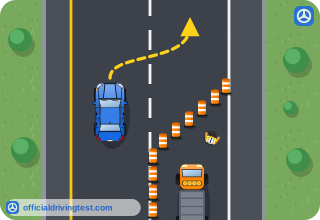
- Only until you see the first 'end' sign of the zone
- For exactly one mile after the work zone ends
- Until safely past any workers or authorized vehicles
- You may speed up as soon as the lanes widen again
Show answer
Correct answer: Until safely past any workers or authorized vehicles
Maintain a reduced speed when leaving the work zone until safely past any workers or authorized vehicles.
Source: Illinois Rules of the Road (2026), page 25
-
In a construction zone, when may the speed limit be further reduced?
- When workers are present
- Only on weekends and holidays
- Only after dark each night
- Only in unincorporated areas
Show answer
Correct answer: When workers are present
The speed limit in a construction zone may be further reduced when workers are present.
Source: Illinois Rules of the Road (2026), page 25
-
You approach a stationary emergency or maintenance vehicle with flashing lights. What does Illinois law require?
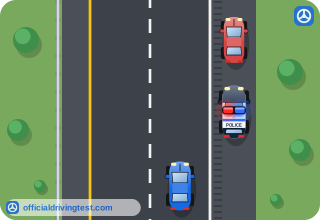
- Keep your speed and lane, since the vehicle is stopped and not moving at all
- Stop behind the vehicle and wait until its flashing lights are turned off
- Yield, change to a lane away from the workers if possible, and proceed with caution
- Pass as quickly as possible in the lane next to the vehicle to clear the area
Show answer
Correct answer: Yield, change to a lane away from the workers if possible, and proceed with caution
When approaching a stationary emergency/maintenance vehicle with its lights on, motorists must yield, change to a lane away from the emergency workers when possible, and proceed with caution.
Source: Illinois Rules of the Road (2026), page 25
-
Which light colors does the manual list for the visual signals of emergency/maintenance vehicles?
- Only red and blue, never any other
- Blue, red, amber, white, or green
- Only amber and white, never red
- Only red, blue, and purple lights
Show answer
Correct answer: Blue, red, amber, white, or green
Emergency/maintenance vehicles use visual signals by displaying blue, red, amber, white, or green oscillating, rotating or flashing lights.
Source: Illinois Rules of the Road (2026), page 25
-
You are passing a stationary emergency vehicle with flashing lights, but a lane change is not possible. What should you do?
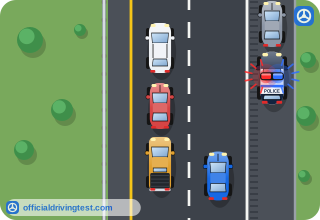
- Speed up to pass the vehicle quickly
- Drive onto the shoulder to go around
- Keep your speed; no change is needed
- Reduce speed and proceed with caution
Show answer
Correct answer: Reduce speed and proceed with caution
If a lane change is not possible, reduce speed and proceed with caution.
Source: Illinois Rules of the Road (2026), page 25
-
How does Illinois law define an "emergency scene"?
- Any place where two or more vehicles have stopped on the side of the road
- A location where a stationary authorized vehicle has activated its flashing lights
- Any stretch of road within one mile of a hospital or a fire station
- Only a location where a crash has caused injuries needing an ambulance
Show answer
Correct answer: A location where a stationary authorized vehicle has activated its flashing lights
An emergency scene is a location where a stationary authorized vehicle is present and has activated its oscillating, rotating, or flashing lights.
Source: Illinois Rules of the Road (2026), page 25
-
Within what distance of an emergency scene does Illinois law prohibit photography and the use of wireless/cellphones, except in certain circumstances?
- 100 feet
- 200 feet
- 1,000 feet
- 500 feet
Show answer
Correct answer: 500 feet
Illinois law prohibits photography and the use of wireless/cellphones within 500 feet of an emergency scene, except in certain circumstances.
Source: Illinois Rules of the Road (2026), page 25
-
An emergency vehicle using lights and/or sirens is approaching you. What does Illinois law require?
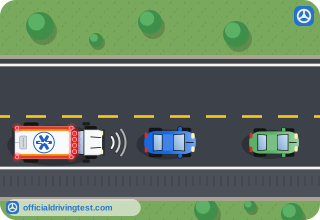
- Immediately pull to the right side of the road and let it pass
- Speed up so the emergency vehicle does not have to slow down
- Stop at once in your lane, even in the middle of an intersection
- Move to the left lane and keep driving at your current speed
Show answer
Correct answer: Immediately pull to the right side of the road and let it pass
Illinois law requires motorists to immediately pull to the right side of the road and allow the emergency vehicle to pass; sometimes a complete stop may be necessary.
Source: Illinois Rules of the Road (2026), page 25
-
You are stopped at an intersection with two-way traffic when an emergency vehicle with lights and siren approaches. What should you do?
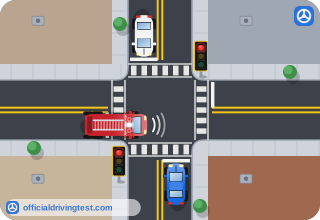
- Drive through the intersection quickly to clear its way
- Back up to make room behind your vehicle
- Remain stopped until it passes through the intersection
- Turn right on red to get out of its path
Show answer
Correct answer: Remain stopped until it passes through the intersection
If stopped at an intersection with two-way traffic, remain stopped until the emergency vehicle passes through the intersection.
Source: Illinois Rules of the Road (2026), page 25
-
When may you drive over a fire hose?
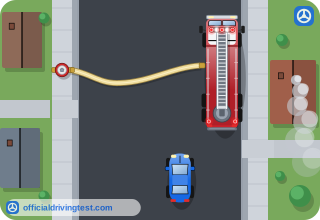
- Only when permitted by the fire official in command of the scene
- Whenever the fire trucks have turned off their flashing lights
- When you drive over it slowly, at under 5 mph
- Whenever no firefighters are standing nearby
Show answer
Correct answer: Only when permitted by the fire official in command of the scene
A driver is prohibited from driving over fire hoses unless permitted by a fire official in command of the scene.
Source: Illinois Rules of the Road (2026), page 25
-
When turning or changing lanes in a construction zone, what should you pay special attention to?
- Only the speed of the vehicle ahead of you
- Horn signals given by the workers in the area
- Signs, barricades, and pavement markings
- Only the lane markings painted before the work
Show answer
Correct answer: Signs, barricades, and pavement markings
In construction zones, pay special attention to signs, barricades, and pavement markings when turning or changing lanes.
Source: Illinois Rules of the Road (2026), page 32
-
In which situation are you NOT required to stop for a stopped school bus?
- On a four-lane roadway when the bus is stopped in the opposite direction
- On a two-lane city street when the bus is stopped in the opposite direction
- In a school parking lot when the bus is loading students at the curb
- On a two-lane rural road when the bus is facing toward you
Show answer
Correct answer: On a four-lane roadway when the bus is stopped in the opposite direction
A vehicle is not required to stop when both vehicles are on a four-lane roadway and the bus is stopped in the opposite direction; any other time you must stop.
Source: Illinois Rules of the Road (2026), page 32
-
Must you stop for a school bus that is stopped and loading passengers in a parking lot on school property?
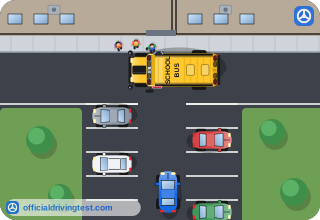
- No, the rule applies only on public roads
- Only if a crossing guard is present
- Yes, the stop rule applies there too
- Only during regular school hours
Show answer
Correct answer: Yes, the stop rule applies there too
The rule to stop for a stopped school bus loading or unloading passengers includes any parking lot located on school property.
Source: Illinois Rules of the Road (2026), page 33
-
In a rural area, at least how far in advance of a stop will a school bus give a warning?
- 100 feet
- 200 feet
- 500 feet
- 50 feet
Show answer
Correct answer: 200 feet
The school bus gives a warning at least 100 feet in advance of a stop, or 200 feet in rural areas.
Source: Illinois Rules of the Road (2026), page 33
-
Outside rural areas, at least how far in advance of a stop will a school bus give a warning?
- 50 feet
- 200 feet
- 300 feet
- 100 feet
Show answer
Correct answer: 100 feet
The school bus warning comes at least 100 feet before a stop (200 feet in rural areas).
Source: Illinois Rules of the Road (2026), page 33
-
When is a school bus's stop signal arm extended?
- After the bus has come to a complete stop
- When the bus is 100 feet from the stop
- As soon as the flashing lights come on
- Only after the first child leaves the bus
Show answer
Correct answer: After the bus has come to a complete stop
The bus driver flashes lights first; the stop signal arm is extended after the school bus has come to a complete stop.
Source: Illinois Rules of the Road (2026), page 33
-
When you meet a stopped school bus from the opposite direction, how long must you remain stopped?
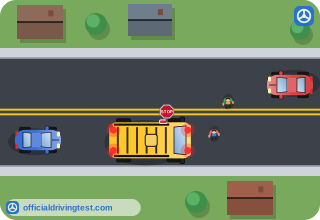
- Until all children have boarded the bus and taken a seat inside
- Until the bus doors close, even if the lights are still flashing
- Until the stop arm is in and the lights are off, or the driver signals you
- For one full minute, and then you may pass slowly with caution
Show answer
Correct answer: Until the stop arm is in and the lights are off, or the driver signals you
You must stay stopped until the stop signal arm is no longer extended and the flashing lights are off, or the school bus driver signals vehicles to pass.
Source: Illinois Rules of the Road (2026), page 33