Idaho: Sharing the road — Part 4 Practice Test
Bicyclists, motorcycles, large vehicles, horseback riders, wildlife and open range, and passing and being passed. — Part 4
Independent educational site · not affiliated with any government agency or DMV
Ready? Test yourself
- Instant feedback with an explanation
- Every answer cites its source in the manual
- Your best score is saved on this device
Questions are original and based on the official manual "Idaho Driver's Handbook" (July 2026), Idaho Transportation Department.
All 30 questions in this practice test
Take the test above first, then use this list to study. Tap “Show answer” to see the correct answer and explanation.
Show the questions and answersHide the questions
-
What following distance should you allow between your vehicle and a motorcycle?
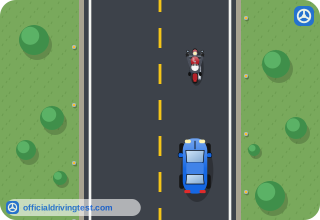
- About two seconds
- About one second
- Less than three seconds
- More than three seconds
Show answer
Correct answer: More than three seconds
The manual says to allow more than three seconds of following distance so you and the rider have time to maneuver or stop in an emergency.
Source: Idaho Driver's Handbook (July 2026), page 104 · Open this page in the manual (Manual page 104)
-
Generally speaking, what is true of large trucks and buses as they get larger?
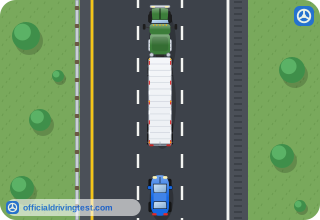
- The longer it takes them to stop
- The smaller their blind spots
- The less room they need to change lanes
- The shorter it takes them to pass
Show answer
Correct answer: The longer it takes them to stop
The manual lists that larger vehicles have larger blind spots, need more room to turn or change lanes, and take longer to stop and to pass.
Source: Idaho Driver's Handbook (July 2026), page 104 · Open this page in the manual (Manual page 104)
-
You are following a large vehicle and cannot see the driver's mirrors. What does this mean?
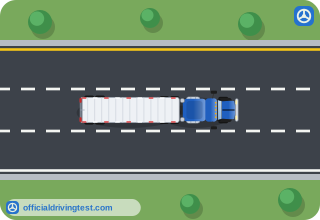
- The driver is about to stop
- You are following at a safe distance
- The driver cannot see you
- The driver can see you in the side mirror
Show answer
Correct answer: The driver cannot see you
The manual says that if you cannot see the driver's mirrors, the driver cannot see you.
Source: Idaho Driver's Handbook (July 2026), page 105 · Open this page in the manual (Manual page 105)
-
Where are the blind spots of a large vehicle?
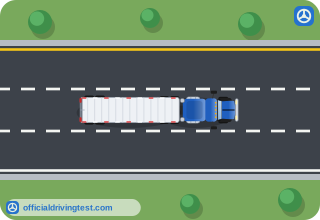
- Only directly behind the vehicle
- Behind the vehicle and on each side of it
- Only on the right side of the vehicle
- Behind the vehicle and on its left side only
Show answer
Correct answer: Behind the vehicle and on each side of it
The manual says there are blind spots behind and on each side of large vehicles.
Source: Idaho Driver's Handbook (July 2026), page 105 · Open this page in the manual (Manual page 105)
-
What should you avoid doing around large vehicles because of their blind spots?
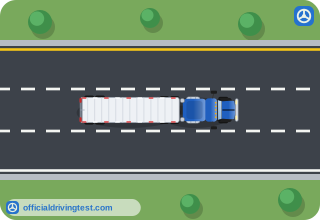
- Following them at any distance
- Passing them on a divided highway
- Passing them only after signaling your intent
- Driving alongside them for prolonged periods
Show answer
Correct answer: Driving alongside them for prolonged periods
The manual says to stay out of blind spots and avoid driving alongside large vehicles for prolonged periods.
Source: Idaho Driver's Handbook (July 2026), page 105 · Open this page in the manual (Manual page 105)
-
A large vehicle ahead blocks your view of the road. What should you do?
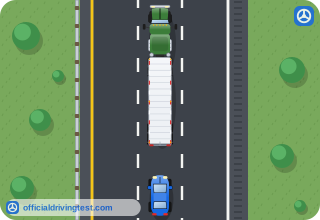
- Adjust your following distance so you can see most of the roadway ahead
- Move as close as possible so the driver can see your headlights
- Follow at the same distance and rely on the vehicle's brake lights
- Drive beside it to keep an eye on the road ahead
Show answer
Correct answer: Adjust your following distance so you can see most of the roadway ahead
The manual says to adjust your following distance when following large vehicles so you can see most of the roadway ahead.
Source: Idaho Driver's Handbook (July 2026), page 105 · Open this page in the manual (Manual page 105)
-
Because it takes longer to pass a large vehicle, what should you do while passing?
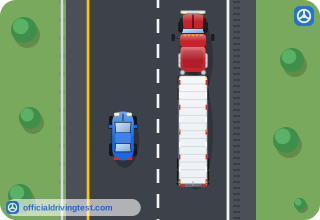
- Speed up sharply, then slow down once you are ahead
- Slow down gradually while you are beside the vehicle
- Keep a steady speed
- Change speed often so the driver notices you
Show answer
Correct answer: Keep a steady speed
The manual says that since passing a large vehicle takes longer, you should keep a steady speed when passing.
Source: Idaho Driver's Handbook (July 2026), page 105 · Open this page in the manual (Manual page 105)
-
Before merging back into the lane after passing a large vehicle, what should you be able to see?
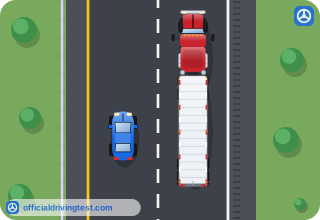
- The trailer's rear bumper in your rear-view mirror
- The cab of the large vehicle in your rear-view mirror
- The large vehicle's headlights in your side mirror
- The driver's face in your side mirror
Show answer
Correct answer: The cab of the large vehicle in your rear-view mirror
The manual says to be sure you can see the cab of the large vehicle in your rear-view mirror before merging back into the lane.
Source: Idaho Driver's Handbook (July 2026), page 105 · Open this page in the manual (Manual page 105)
-
What forces large-vehicle drivers to react with little time or room to spare when you pass?
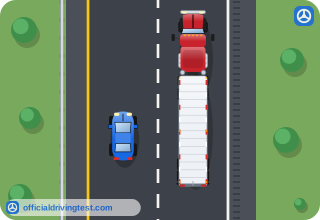
- Cars that pass on the left and then drive at a steady speed
- Cars that stay beside the vehicle after they complete a pass
- Cars that signal for two seconds before returning to the lane
- Cars that cut in too soon after passing and then quickly slow down
Show answer
Correct answer: Cars that cut in too soon after passing and then quickly slow down
The manual says drivers of large vehicles must react with little time or room when cars cut in too soon after passing, then quickly slow down.
Source: Idaho Driver's Handbook (July 2026), page 105 · Open this page in the manual (Manual page 105)
-
A loaded truck with properly adjusted brakes is traveling 55 miles per hour on a dry road. How far does it need to come to a complete stop?
- 450 feet
- 300 feet
- 250 feet
- 600 feet
Show answer
Correct answer: 450 feet
The manual gives 450 feet as the stopping distance of a loaded truck with properly adjusted brakes at 55 miles per hour on a dry road.
Source: Idaho Driver's Handbook (July 2026), page 105 · Open this page in the manual (Manual page 105)
-
When turning right, how may the driver of a large vehicle position the vehicle?
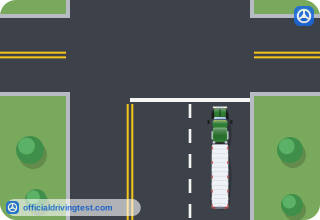
- Move onto the right shoulder first to leave room for the turn
- Stay in the right lane and swing wide only at the end of the turn
- Angle into the left lane to make the turn without running over the curb
- Stop in the intersection and wait until all traffic has cleared
Show answer
Correct answer: Angle into the left lane to make the turn without running over the curb
The manual says large-vehicle drivers may angle into the left lane when turning right so they do not run over the curb or hit something.
Source: Idaho Driver's Handbook (July 2026), page 106 · Open this page in the manual (Manual page 106)
-
When making sharp turns, how much space do large vehicles sometimes require?
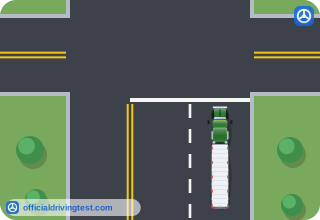
- Less than one full lane
- More than one lane
- Only the lane they started in
- Exactly one lane
Show answer
Correct answer: More than one lane
The manual says large vehicles sometimes require more than one lane to complete a sharp turn.
Source: Idaho Driver's Handbook (July 2026), page 106 · Open this page in the manual (Manual page 106)
-
What is a frequent cause of crashes involving large vehicles that are making a right turn?
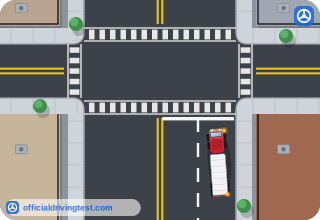
- Leaving extra room for the vehicle to finish its turn
- Waiting behind the vehicle until it completes the turn
- Slowing down to let the vehicle turn ahead of you
- Trying to squeeze by on the right side
Show answer
Correct answer: Trying to squeeze by on the right side
The manual says not to squeeze by on the right side of a large vehicle that is turning, which is a frequent cause of crashes.
Source: Idaho Driver's Handbook (July 2026), page 106 · Open this page in the manual (Manual page 106)
-
How are vehicles carrying hazardous materials identified?
- They have flashing red lights on the cab at all times
- They are painted a color set aside for these loads
- They are placarded to identify what they are carrying
- They are followed by a marked escort vehicle
Show answer
Correct answer: They are placarded to identify what they are carrying
The manual says vehicles carrying hazardous materials are placarded to identify what they are carrying.
Source: Idaho Driver's Handbook (July 2026), page 106 · Open this page in the manual (Manual page 106)
-
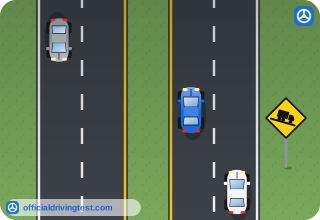
On long, steep grades of four-lane roads, which lane do large vehicles use as they travel slowly?
- The left lane
- The right lane
- The center lane
- The shoulder
Show answer
Correct answer: The right lane
The manual says large vehicles travel slowly on steep grades and use the right lane on four-lane roads.
Source: Idaho Driver's Handbook (July 2026), page 106 · Open this page in the manual (Manual page 106)
-
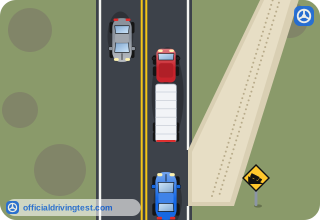
For what should "escape" or "runaway" ramps be used?
- To park large trucks that need to rest a while
- To pass slow vehicles on long steep grades
- To pull off the road and check a heavy load
- Only to stop vehicles whose brakes have failed
Show answer
Correct answer: Only to stop vehicles whose brakes have failed
The manual says these ramps should only be used to stop vehicles whose brakes have failed.
Source: Idaho Driver's Handbook (July 2026), page 106 · Open this page in the manual (Manual page 106)
-
What are trucks with large loads required to have when the loads reach certain dimensions?
- One or more pilot vehicles
- A police officer riding in the cab
- Flashing red lights on the load only
- A second driver on duty
Show answer
Correct answer: One or more pilot vehicles
The manual says trucks with large loads that reach certain dimensions are required to have one or more pilot vehicles.
Source: Idaho Driver's Handbook (July 2026), page 106 · Open this page in the manual (Manual page 106)
-
What lights do pilot vehicles use to warn oncoming and following traffic of a large load?
- Red lights
- Blue lights
- Amber lights
- White lights
Show answer
Correct answer: Amber lights
Pilot vehicles are specially marked vehicles with amber lights that warn oncoming and following traffic of the large load.
Source: Idaho Driver's Handbook (July 2026), page 106 · Open this page in the manual (Manual page 106)
-
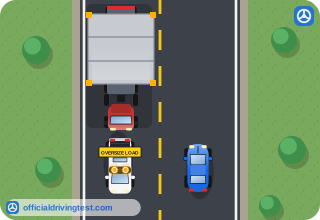
What should you do when you meet an oncoming pilot vehicle?
- Stop in your lane and wait until the whole large load has passed you
- Reduce your speed and position your vehicle as far to the right as possible
- Move to the left side of your lane to give the load more room
- Keep your speed and flash your headlights to warn the pilot driver
Show answer
Correct answer: Reduce your speed and position your vehicle as far to the right as possible
The manual says to reduce speed and position your vehicle as far to the right as possible when you meet an oncoming pilot vehicle.
Source: Idaho Driver's Handbook (July 2026), page 106 · Open this page in the manual (Manual page 106)
-
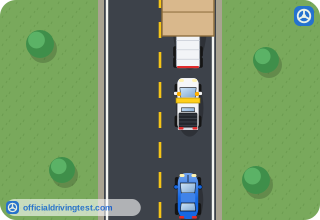
What should you do if you are following a pilot vehicle?
- Stay close behind it to keep the large load in view
- Pass it quickly to get ahead of the large load
- Drive on the shoulder to avoid the large load
- Increase your following distance
Show answer
Correct answer: Increase your following distance
The manual says to increase your following distance if you are following a pilot vehicle.
Source: Idaho Driver's Handbook (July 2026), page 106 · Open this page in the manual (Manual page 106)
-
What should you do when you see a small animal in the road?
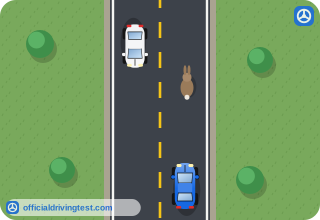
- Swerve around it as quickly as you can, whatever is beside your vehicle
- Think of your own safety and do not dodge it unless you are sure it is safe
- Stop immediately in your lane and wait for the animal to leave
- Speed up so you pass it before it moves into your path
Show answer
Correct answer: Think of your own safety and do not dodge it unless you are sure it is safe
The manual says to think of your own safety and not dodge a small animal unless you are sure it is safe to do so.
Source: Idaho Driver's Handbook (July 2026), page 107 · Open this page in the manual (Manual page 107)
-
What should you do when you see a large animal, such as a moose, elk, or deer, on or near the road?
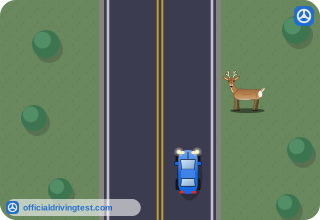
- Speed up to pass it before it moves onto the road ahead
- Swerve onto the shoulder at once to keep well away from it
- Stop and wait in your lane until the animal has left the road
- Slow down and proceed with caution, because others are usually nearby
Show answer
Correct answer: Slow down and proceed with caution, because others are usually nearby
The manual says to slow down and proceed with caution near a large animal, because these are herd animals and others are usually nearby.
Source: Idaho Driver's Handbook (July 2026), page 107 · Open this page in the manual (Manual page 107)
-
An animal moves into your path so quickly that you cannot slow down enough to avoid it. What must you consider the safest alternative?
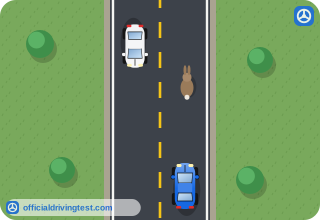
- Running over it
- Swerving into the oncoming lane
- Braking as hard as possible
- Driving onto the shoulder
Show answer
Correct answer: Running over it
The manual says that in this case you must consider running over the animal as the safest alternative.
Source: Idaho Driver's Handbook (July 2026), page 108 · Open this page in the manual (Manual page 108)
-
If a collision with an animal cannot be avoided, what should you concentrate on?
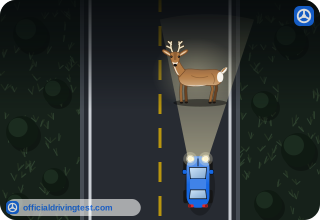
- Stopping the vehicle immediately after the collision to help it
- Steering around any other animals that may be nearby on the road
- Keeping control of the vehicle before, during, and after the collision
- Protecting the vehicle's bumper and hood from any damage
Show answer
Correct answer: Keeping control of the vehicle before, during, and after the collision
The manual says to concentrate on keeping control of the vehicle before, during and after the collision.
Source: Idaho Driver's Handbook (July 2026), page 108 · Open this page in the manual (Manual page 108)
-
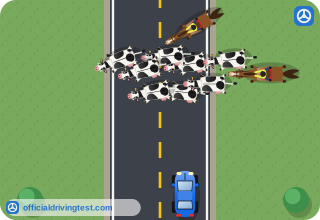
Who has the right-of-way when livestock are under controlled movement over a highway or road in Idaho?
- The nearest driver
- The livestock
- The first vehicle to arrive
- Vehicles traveling uphill
Show answer
Correct answer: The livestock
The manual says livestock under controlled movement over a highway or road have the right-of-way in Idaho.
Source: Idaho Driver's Handbook (July 2026), page 108 · Open this page in the manual (Manual page 108)
-
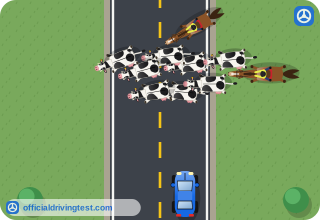
What should you do when you meet or overtake livestock herds?
- Drive through the herd slowly to keep it moving
- Pass at normal speed on the shoulder
- Stop and wait for the herd to leave the road on its own
- Be careful and cooperate with the workers in charge
Show answer
Correct answer: Be careful and cooperate with the workers in charge
The manual says to be careful and cooperate with the workers in charge when you meet or overtake any livestock herd.
Source: Idaho Driver's Handbook (July 2026), page 108 · Open this page in the manual (Manual page 108)
-
What does the term "open range" mean in Idaho?
- Almost all areas outside of city limits and herd districts where livestock roam
- Only fenced pastures that run alongside a state highway or county road
- Only the areas inside a herd district, where livestock are kept
- Any highway that has a wildlife crossing sign posted along it
Show answer
Correct answer: Almost all areas outside of city limits and herd districts where livestock roam
The manual defines open range as almost all areas outside of city limits and herd districts where livestock are grazed or permitted to roam.
Source: Idaho Driver's Handbook (July 2026), page 108 · Open this page in the manual (Manual page 108)
-
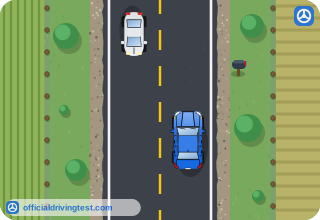
What does the presence of fences along a road mean for animals on the open range?
- Animals are kept off the road and drivers have the right-of-way
- Animals may be present but never have the right-of-way
- It does not necessarily mean animals are absent or lack the right-of-way
- The area is not open range
Show answer
Correct answer: It does not necessarily mean animals are absent or lack the right-of-way
The manual says fences do not necessarily mean animals are not present or do not have the right-of-way.
Source: Idaho Driver's Handbook (July 2026), page 108 · Open this page in the manual (Manual page 108)
-
If you strike livestock on the open range, is the animal’s owner liable for damages to you or your vehicle?
- Yes, always
- Yes, if the range is unfenced
- Yes, if it happens at night
- No, the owner is not liable
Show answer
Correct answer: No, the owner is not liable
The manual says the owner of livestock on the open range or under controlled movement is not liable for damages to you or your vehicle.
Source: Idaho Driver's Handbook (July 2026), page 108 · Open this page in the manual (Manual page 108)
-
When may you be liable for the injuries or death of livestock you strike on the open range?
- Only if you were driving at night
- Only if the animal was inside a fenced pasture
- Every time you strike one, whatever the circumstances
- If you are found to have been negligent
Show answer
Correct answer: If you are found to have been negligent
The manual says you may be liable for the injuries or death of the animal if you are found to have been negligent.
Source: Idaho Driver's Handbook (July 2026), page 108 · Open this page in the manual (Manual page 108)