Idaho: Sharing the road — Part 1 Practice Test
Bicyclists, motorcycles, large vehicles, horseback riders, wildlife and open range, and passing and being passed. — Part 1
Independent educational site · not affiliated with any government agency or DMV
Ready? Test yourself
- Instant feedback with an explanation
- Every answer cites its source in the manual
- Your best score is saved on this device
Questions are original and based on the official manual "Idaho Driver's Handbook" (July 2026), Idaho Transportation Department.
All 31 questions in this practice test
Take the test above first, then use this list to study. Tap “Show answer” to see the correct answer and explanation.
Show the questions and answersHide the questions
-
Where is the Share the Road sign used?
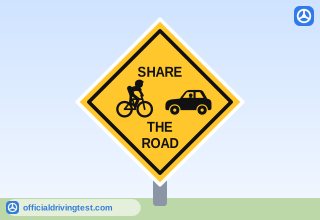
- On highways where bike lanes are provided on both sides
- Only on streets where bicycles are banned
- On highways where bike lanes are not provided
- Only on freeways with a wide paved shoulder
Show answer
Correct answer: On highways where bike lanes are not provided
The Share the Road sign is used on highways where bike lanes are not provided.
Source: Idaho Driver's Handbook (July 2026), page 52 · Open this page in the manual (Manual page 52)
-
Where may Share the Road signs be placed?
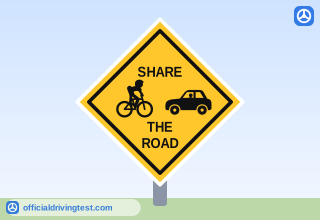
- Only on roads where bicycle riding is prohibited by law
- Where lanes are narrow or traffic volumes or speeds are high
- Only where a school or crosswalk is nearby on the road
- Only where the roadway has a wide lane and a wide shoulder
Show answer
Correct answer: Where lanes are narrow or traffic volumes or speeds are high
The manual says Share the Road signs may be placed where lanes or shoulders are narrow, or traffic volumes or speeds are high.
Source: Idaho Driver's Handbook (July 2026), page 52 · Open this page in the manual (Manual page 52)
-
Which warning sign is placed below a bicycle symbol sign?
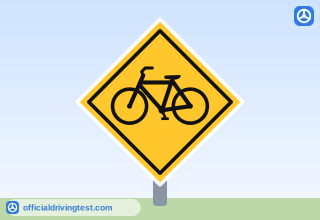
- Hill
- Slippery When Wet
- Low Clearance
- Share the Road
Show answer
Correct answer: Share the Road
The manual says the Share the Road sign is placed below a bicycle symbol sign.
Source: Idaho Driver's Handbook (July 2026), page 52 · Open this page in the manual (Manual page 52)
-
In which direction must bicycles travel in a bicycle lane marked by a solid white line with a bicycle symbol?
- The opposite direction from the adjacent traffic
- Either direction, whichever is safer for the bicyclist
- The direction of the nearest pedestrians
- The same direction as the adjacent traffic
Show answer
Correct answer: The same direction as the adjacent traffic
Bicycles in such a lane must travel in the same direction as the adjacent traffic.
Source: Idaho Driver's Handbook (July 2026), page 59 · Open this page in the manual (Manual page 59)
-
A bike lane line becomes dashed near an intersection. What does this mean for a driver who is turning right?
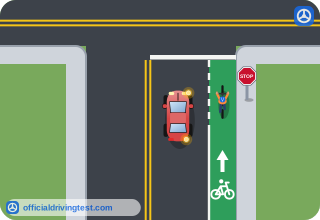
- The driver must stay left of the dashed line
- The driver must stop before the dashed line
- The driver may not turn right
- The driver can merge to the right
Show answer
Correct answer: The driver can merge to the right
Dashed bike lane lines show that right-turning drivers can merge to the right and left-turning bicyclists can merge to the left.
Source: Idaho Driver's Handbook (July 2026), page 59 · Open this page in the manual (Manual page 59)
-
Near a dashed bike lane line, what should a bicyclist who is going straight do to prevent a turning car from colliding with the bicycle?
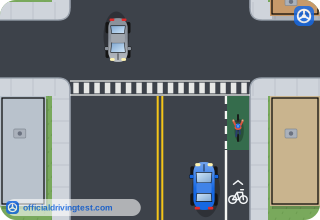
- Stay at the far right edge of the bike lane
- Move left, out of the bike lane
- Stop and wait for the car to turn
- Ride on the sidewalk until the car has passed
Show answer
Correct answer: Move left, out of the bike lane
Bicyclists going straight should move left out of the bike lane where a dashed line shows the area.
Source: Idaho Driver's Handbook (July 2026), page 60 · Open this page in the manual (Manual page 60)
-
You want to turn right where the bike lane line is dashed, and a bicycle is already in that area. What must you do?
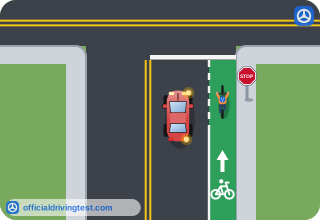
- Turn right ahead of the bicycle
- Sound your horn and then turn
- Yield to the bicycle
- Merge to the right in front of the bicycle
Show answer
Correct answer: Yield to the bicycle
The manual says right-turning drivers must yield if a bike is already in the dashed area.
Source: Idaho Driver's Handbook (July 2026), page 60 · Open this page in the manual (Manual page 60)
-
Where the bike lane line is dashed, a car is already in the area before the bicyclist arrives. What must the bicyclist do?
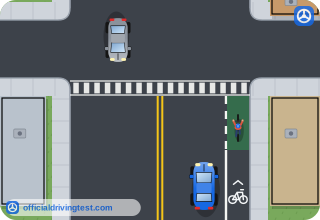
- Move to the left
- Pass the car on its right side
- Stop in the bike lane behind the car
- Speed up to get ahead of the car
Show answer
Correct answer: Move to the left
If a car is already in the area, the bicyclist must move to the left.
Source: Idaho Driver's Handbook (July 2026), page 60 · Open this page in the manual (Manual page 60)
-
On which side of a school bus is the stop arm that is extended while students load or unload?
- The right side
- The front bumper
- The rear door
- The left side
Show answer
Correct answer: The left side
Traffic must stop and remain stopped as long as the red lights near the top of the bus are flashing and/or the stop arm on the left side of the bus is extended.
Source: Idaho Driver's Handbook (July 2026), page 70 · Open this page in the manual (Manual page 70)
-
You stop for a school bus displaying flashing red lights while it picks up or drops off children. How long must you remain stopped?
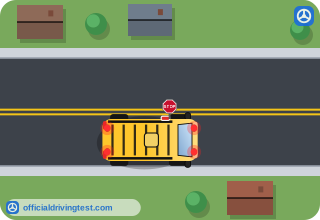
- Until all children are clear of the road and the bus
- Until the bus door has closed
- For 30 seconds, then pass slowly at 10 mph or less
- Until the bus driver waves you around it
Show answer
Correct answer: Until all children are clear of the road and the bus
You must stop when approaching a school bus displaying flashing red lights while stopped for children, and remain stopped until all children are clear of the roadway and the bus.
Source: Idaho Driver's Handbook (July 2026), page 70 · Open this page in the manual (Manual page 70)
-
When do you not have to stop for a school bus with flashing red lights that is traveling in the opposite direction?
- On any two-lane road with a solid yellow center line
- On any road when no children can be seen
- On a highway with four or more lanes, two each way
- On any road with a posted limit of 55 or more
Show answer
Correct answer: On a highway with four or more lanes, two each way
You do not have to stop if you are traveling in the opposite direction on highways with four or more lanes if two lanes are going in each direction.
Source: Idaho Driver's Handbook (July 2026), page 70 · Open this page in the manual (Manual page 70)
-
When making a right turn, from which direction should you watch for bicycles approaching between your vehicle and the curb?
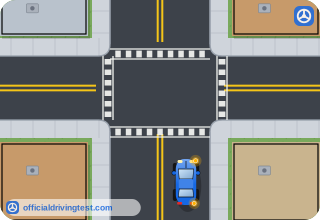
- From the right
- From the left
- From straight ahead only
- From the opposite lane
Show answer
Correct answer: From the right
When turning right, watch for bicycles that are approaching from the right between your vehicle and the curb.
Source: Idaho Driver's Handbook (July 2026), page 73 · Open this page in the manual (Manual page 73)
-
Before returning to your own lane after passing, what should you do?
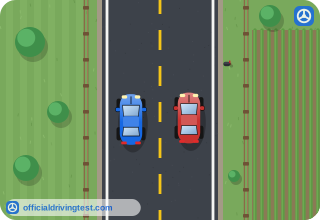
- Sound your horn, then move back into the lane at once
- Signal and wait until you see the vehicle in your mirror
- Slow to the speed of the passed vehicle first
- Flash your brake lights and then move over
Show answer
Correct answer: Signal and wait until you see the vehicle in your mirror
Before returning to your own lane, you signal and wait until you can see the vehicle you’re passing in your rear-view mirror.
Source: Idaho Driver's Handbook (July 2026), page 76 · Open this page in the manual (Manual page 76)
-
If you start to pass but decide you cannot make it, what should you do?
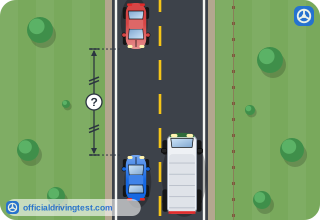
- Speed up and finish the pass anyway
- Stay in the left lane until traffic moves over
- Brake hard and stop in the left lane
- Pull back and wait for another opening
Show answer
Correct answer: Pull back and wait for another opening
If you start to pass but decide you can’t make it, you pull back and wait for another opening.
Source: Idaho Driver's Handbook (July 2026), page 76 · Open this page in the manual (Manual page 76)
-
What can "No Passing" signs and pavement markings tell you?
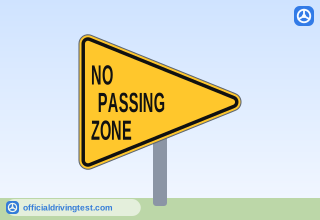
- Where passing is prohibited or unsafe
- Exactly when it is safe to pass
- How fast you may travel while passing
- Which vehicles may pass on the right
Show answer
Correct answer: Where passing is prohibited or unsafe
These signs and markings show where passing is prohibited or unsafe, but only the driver can tell when it is safe.
Source: Idaho Driver's Handbook (July 2026), page 76 · Open this page in the manual (Manual page 76)
-
When is passing prohibited on a two-lane road?
- When the vehicle ahead is traveling below the speed limit
- When the road has a wide paved shoulder on both sides
- When a hill or curve blocks your view of oncoming traffic
- When you are driving in the right lane at night
Show answer
Correct answer: When a hill or curve blocks your view of oncoming traffic
Passing is prohibited at hills, curves, or other obstructions on two-lane roads that prevent you from seeing oncoming vehicles that might pose a hazard.
Source: Idaho Driver's Handbook (July 2026), page 76 · Open this page in the manual (Manual page 76)
-
Within what distance of an intersection is passing prohibited, unless traffic-control devices indicate otherwise?
- 50 feet
- 100 feet
- 200 feet
- 500 feet
Show answer
Correct answer: 100 feet
Passing is prohibited within 100 feet of an intersection unless traffic-control devices indicate otherwise.
Source: Idaho Driver's Handbook (July 2026), page 76 · Open this page in the manual (Manual page 76)
-
When is passing prohibited within 100 feet of a bridge or tunnel?
- When the view is obstructed
- When the bridge surface is wet
- When it is dark and raining
- When traffic is heavy ahead
Show answer
Correct answer: When the view is obstructed
Passing is prohibited within 100 feet of a bridge or tunnel when the view is obstructed.
Source: Idaho Driver's Handbook (July 2026), page 77 · Open this page in the manual (Manual page 77)
-
Passing is prohibited when a school bus is doing which of these?
- Moving slowly in its lane
- Approaching an intersection ahead of you
- Stopped to load or unload passengers
- Driving in the right lane of a multi-lane road
Show answer
Correct answer: Stopped to load or unload passengers
Passing is prohibited when a school bus is stopped to load or unload passengers.
Source: Idaho Driver's Handbook (July 2026), page 77 · Open this page in the manual (Manual page 77)
-
Passing is prohibited when you would have to do which of these?
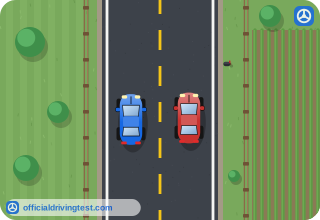
- Move into the left lane
- Use your left turn signal
- Pass a vehicle traveling slower than you
- Go off the pavement or roadway to pass
Show answer
Correct answer: Go off the pavement or roadway to pass
Passing is prohibited when you must go off the pavement or roadway to pass.
Source: Idaho Driver's Handbook (July 2026), page 77 · Open this page in the manual (Manual page 77)
-
On a two-lane, two-way road, when may you pass a vehicle on the right?
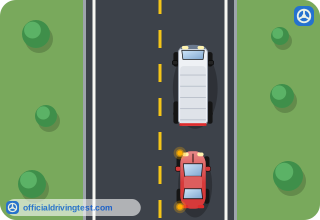
- When the vehicle ahead is signaling to turn left
- When the vehicle ahead is below the speed limit
- When the vehicle ahead is signaling to turn right
- When the shoulder is wide enough
Show answer
Correct answer: When the vehicle ahead is signaling to turn left
Passing on the right is allowed when the vehicle you are overtaking on a two-lane, two-way road is signaling to turn left.
Source: Idaho Driver's Handbook (July 2026), page 77 · Open this page in the manual (Manual page 77)
-
On which kind of street may you pass on the right, if you can do so safely?
- A two-lane road with heavy traffic
- A two-lane road with a paved shoulder
- A street with two or more lanes going your direction
- A two-lane road where the vehicle ahead is moving slowly
Show answer
Correct answer: A street with two or more lanes going your direction
Passing on the right is allowed on a street with two or more lanes going your direction, if you can do so safely.
Source: Idaho Driver's Handbook (July 2026), page 77 · Open this page in the manual (Manual page 77)
-
Which method of passing on the right is prohibited?
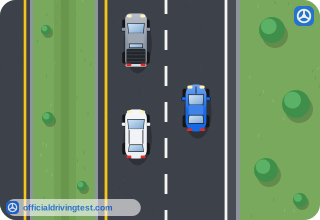
- Using a lane going your direction
- Driving off the roadway
- Signaling first
- Checking your mirrors first
Show answer
Correct answer: Driving off the roadway
The manual states that passing on the right shall not be made by driving off the roadway.
Source: Idaho Driver's Handbook (July 2026), page 77 · Open this page in the manual (Manual page 77)
-
When passing another vehicle, what do you do right after checking your mirrors and blind spots?
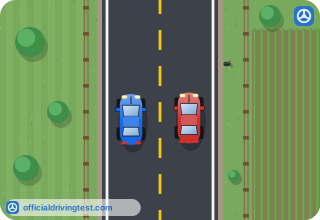
- Sound your horn, then accelerate past the vehicle
- Turn on your right turn signal and move to the right
- Brake gently, then move into the left lane
- Turn on your left signal, then move into the left lane
Show answer
Correct answer: Turn on your left signal, then move into the left lane
You check mirrors and blind spots, turn on your left turn signal, then move into the left lane.
Source: Idaho Driver's Handbook (July 2026), page 77 · Open this page in the manual (Manual page 77)
-
What should you do if the vehicle you are passing begins to drift toward you?
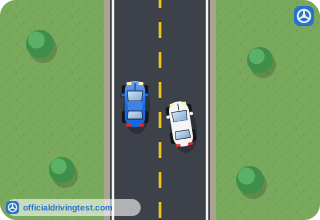
- Use your horn
- Brake hard
- Flash your headlights
- Move onto the shoulder
Show answer
Correct answer: Use your horn
If the vehicle you are passing begins to drift toward you, use your horn.
Source: Idaho Driver's Handbook (July 2026), page 78 · Open this page in the manual (Manual page 78)
-
You should complete a pass before coming within how far of oncoming traffic?
- 100 feet
- 300 feet
- 200 feet
- 500 feet
Show answer
Correct answer: 200 feet
The manual says to complete a pass before coming within 200 feet of oncoming traffic.
Source: Idaho Driver's Handbook (July 2026), page 78 · Open this page in the manual (Manual page 78)
-
When should you complete a pass in relation to a "No Passing" zone?
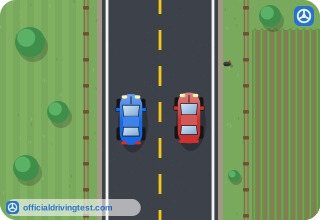
- Just after you enter the zone
- Before you reach the zone
- Only when you are in the middle of the zone
- Any time, if the road ahead looks clear
Show answer
Correct answer: Before you reach the zone
Complete a pass before you reach a "No Passing" zone marked with signs or pavement markings.
Source: Idaho Driver's Handbook (July 2026), page 78 · Open this page in the manual (Manual page 78)
-
How can you help other drivers pass you safely?
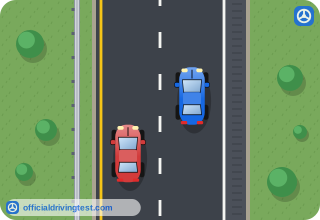
- Speed up slightly
- Move toward the left side of your lane
- Flash your brake lights
- Move to the right side of your lane
Show answer
Correct answer: Move to the right side of your lane
Moving to the right side of your lane gives them more room and a better view of the road ahead.
Source: Idaho Driver's Handbook (July 2026), page 78 · Open this page in the manual (Manual page 78)
-
What should you do with your speed when another driver is passing you?
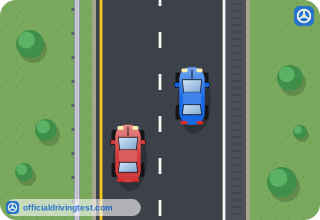
- Maintain a steady speed or slow down
- Speed up to shorten the pass
- Speed up until the other driver is clear
- Slow to half the speed limit
Show answer
Correct answer: Maintain a steady speed or slow down
When being passed, do not speed up; maintain a steady speed or slow down.
Source: Idaho Driver's Handbook (July 2026), page 78 · Open this page in the manual (Manual page 78)
-
When may you drive between or join vehicles in a funeral procession?
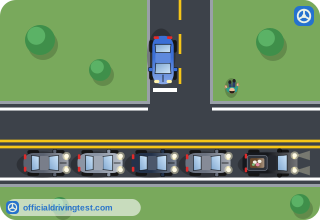
- When the procession moves slowly
- When you flash your headlights
- Only if a police officer authorizes it
- When you have a green light
Show answer
Correct answer: Only if a police officer authorizes it
Do not drive between or join vehicles in a funeral procession unless authorized to do so by a police officer.
Source: Idaho Driver's Handbook (July 2026), page 78 · Open this page in the manual (Manual page 78)
-
On a multi-lane highway, when may you pass a funeral procession in the right lane?
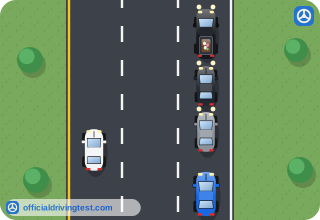
- Whenever the procession is slower than traffic
- Only when the procession is in the farthest left lane
- Only when you flash your headlights
- Never, under any condition
Show answer
Correct answer: Only when the procession is in the farthest left lane
Do not pass the procession in the right lane on a multi-lane highway unless the procession is in the farthest left lane.
Source: Idaho Driver's Handbook (July 2026), page 78 · Open this page in the manual (Manual page 78)