Idaho: Railroad crossings Practice Test
Railroad signs and signals and when you must stop before the tracks.
Independent educational site · not affiliated with any government agency or DMV
Ready? Test yourself
- Instant feedback with an explanation
- Every answer cites its source in the manual
- Your best score is saved on this device
Questions are original and based on the official manual "Idaho Driver's Handbook" (July 2026), Idaho Transportation Department.
All 18 questions in this practice test
Take the test above first, then use this list to study. Tap “Show answer” to see the correct answer and explanation.
Show the questions and answersHide the questions
-
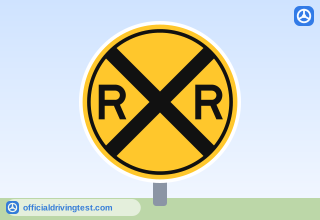
A round yellow sign shows an X with the letters R R. What should you be prepared to do?
- Shift to a lower gear and keep your speed on the tracks
- Stop before the tracks if a train is approaching
- Change lanes to get away from the tracks
- Cross the tracks quickly before a train arrives
Show answer
Correct answer: Stop before the tracks if a train is approaching
The railroad crossing sign gives early warning, and you must be ready to stop before the tracks if a train is approaching.
Source: Idaho Driver's Handbook (July 2026), page 52 · Open this page in the manual (Manual page 52)
-
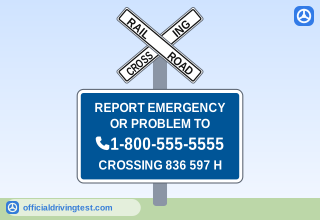
What does the Emergency Notification System sign list besides the railroad's phone number?
- The location specific crossing number
- The time of the next scheduled train
- The speed limit for trains at the crossing
- The number of tracks beyond the crossing
Show answer
Correct answer: The location specific crossing number
The sign lists the railroad's phone number along with the location specific crossing number.
Source: Idaho Driver's Handbook (July 2026), page 53 · Open this page in the manual (Manual page 53)
-
Why is the Emergency Notification System sign posted at or near a railroad crossing?
- It tells drivers the schedule of trains that use the crossing each day
- It warns drivers that a gate will lower soon
- It identifies the owner of the land beside the tracks
- It shows how to notify the railroad of an emergency or a malfunction
Show answer
Correct answer: It shows how to notify the railroad of an emergency or a malfunction
The sign displays information needed to notify the railroad of an emergency situation or of a warning device malfunction.
Source: Idaho Driver's Handbook (July 2026), page 53 · Open this page in the manual (Manual page 53)
-
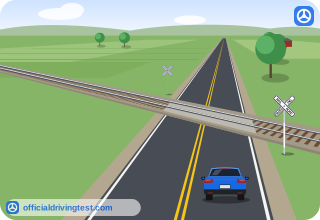
How should a driver regard railroad crossings?
- As dangerous only when a signal is flashing
- As dangerous only when a gate is present
- As always dangerous
- As dangerous only at night or in bad weather
Show answer
Correct answer: As always dangerous
The manual says railroad crossings should always be considered dangerous.
Source: Idaho Driver's Handbook (July 2026), page 60 · Open this page in the manual (Manual page 60)
-
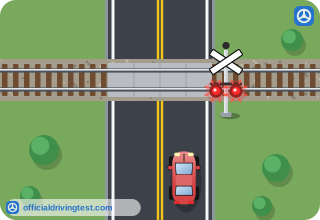
When you are required to stop at a railroad crossing, how far from the nearest rail should you stop?
- Within 100 feet but no less than 50 feet
- Within 50 feet but no less than 15 feet
- Within 20 feet but no less than 15 feet
- Within 100 feet but no less than 15 feet
Show answer
Correct answer: Within 50 feet but no less than 15 feet
The stopping zone is within 50 feet but no less than 15 feet from the nearest rail.
Source: Idaho Driver's Handbook (July 2026), page 60 · Open this page in the manual (Manual page 60)
-
What is often painted on the pavement in advance of a railroad crossing?
- A zigzag line and the word TRAIN
- Two white stripes and the word STOP
- A yellow circle with a bar across it
- An X and the letters RR
Show answer
Correct answer: An X and the letters RR
Pavements are often marked in advance of a crossing with an X and the letters RR.
Source: Idaho Driver's Handbook (July 2026), page 61 · Open this page in the manual (Manual page 61)
-
What must you do when the flashing-light signals at a railroad crossing are actively flashing?
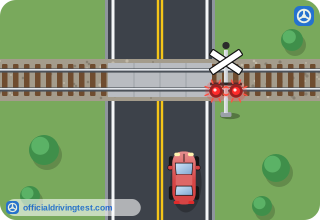
- Slow down and cross if no train is in sight
- Stop only if you can see a train approaching
- Stop, and proceed only when you can do so safely
- Cross quickly before the gate comes down
Show answer
Correct answer: Stop, and proceed only when you can do so safely
Drivers must stop when the lights are actively flashing and may proceed only when it is safe.
Source: Idaho Driver's Handbook (July 2026), page 61 · Open this page in the manual (Manual page 61)
-
What must you never do at a railroad crossing gate that is lowered or being lowered?
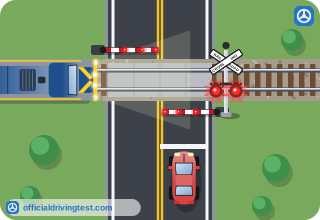
- Drive through, under or around it
- Stop and wait until it is raised
- Look both ways for an approaching train
- Turn on your hazard lights
Show answer
Correct answer: Drive through, under or around it
You must never drive through, under or around a crossing gate that is lowered or being lowered.
Source: Idaho Driver's Handbook (July 2026), page 61 · Open this page in the manual (Manual page 61)
-
Where must you never stop your vehicle at a railroad crossing?
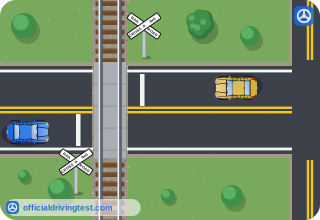
- At least 15 feet back from the nearest rail
- Behind a vehicle that is waiting at the crossing
- Beside a railroad cross buck sign
- Anywhere that part of your vehicle is on the track
Show answer
Correct answer: Anywhere that part of your vehicle is on the track
The manual says never stop your vehicle when any part of it is on the track.
Source: Idaho Driver's Handbook (July 2026), page 61 · Open this page in the manual (Manual page 61)
-
When in traffic, when may you proceed across railroad tracks?
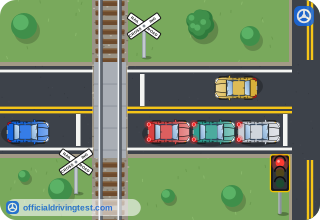
- Only when the vehicle ahead of you has started to cross
- Only when there is adequate room for the full length of your vehicle
- Only when the cross buck sign is clear of traffic
- Only when there is room for the front half of your vehicle
Show answer
Correct answer: Only when there is adequate room for the full length of your vehicle
In traffic, never cross the tracks unless there is room for the full length of your vehicle.
Source: Idaho Driver's Handbook (July 2026), page 61 · Open this page in the manual (Manual page 61)
-
Why should you never shift gears while driving through a railroad crossing?
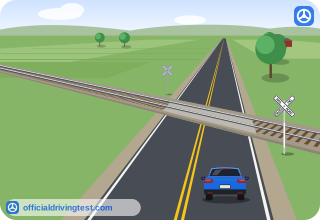
- It may trigger the crossing warning signals
- It may cause your vehicle to stall on the tracks
- It may damage the rails of the crossing
- It may cause the crossing gate to lower early
Show answer
Correct answer: It may cause your vehicle to stall on the tracks
Shifting gears in a crossing may cause the vehicle to stall on the tracks.
Source: Idaho Driver's Handbook (July 2026), page 61 · Open this page in the manual (Manual page 61)
-
What should you never do when you see a train approaching a railroad crossing?
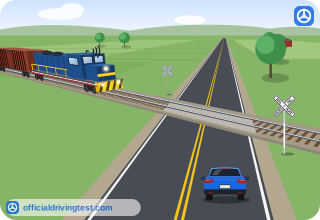
- Look both ways
- Expect another train
- Stop within the required distance of the nearest rail
- Race the train to the crossing
Show answer
Correct answer: Race the train to the crossing
The manual lists never racing a train to a crossing as a safety tip.
Source: Idaho Driver's Handbook (July 2026), page 61 · Open this page in the manual (Manual page 61)
-
A train has just passed a crossing. What should you do before you cross?
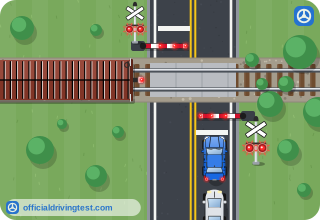
- Be sure no train is approaching on another track
- Cross at once, since the danger has passed
- Wait for the gate to be raised, then drive fast
- Shift to a lower gear first
Show answer
Correct answer: Be sure no train is approaching on another track
Watch for a second train and do not proceed until you are sure no train is coming on another track.
Source: Idaho Driver's Handbook (July 2026), page 61 · Open this page in the manual (Manual page 61)
-
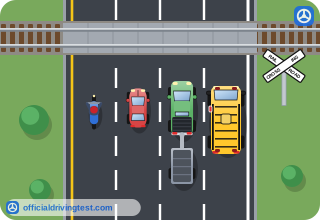
Which vehicles are required to stop at all railroad crossings?
- Passenger cars towing a trailer
- All motorcycles and mopeds
- Some buses and trucks
- Passenger cars carrying more than four people
Show answer
Correct answer: Some buses and trucks
The manual warns that some buses and trucks are required to stop at all railroad crossings.
Source: Idaho Driver's Handbook (July 2026), page 61 · Open this page in the manual (Manual page 61)
-
What should you do when you approach a railroad crossing where the flashing-light signal is not working?
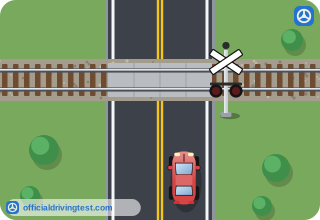
- Cross without stopping, because no train is coming
- Wait for the signal to start flashing
- Follow the vehicle ahead without looking
- Look both ways
Show answer
Correct answer: Look both ways
You should look both ways as you approach a crossing, even if the flashing-light signal is not functioning.
Source: Idaho Driver's Handbook (July 2026), page 61 · Open this page in the manual (Manual page 61)
-
Besides a train coming, which of these requires you to stop at a railway crossing because it indicates a train is approaching?
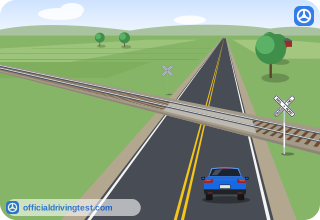
- Wigwag signals, gates, or a watchman
- An X and RR painted on the pavement
- An advance warning sign before it
- A sign listing the railroad's phone number
Show answer
Correct answer: Wigwag signals, gates, or a watchman
You must stop at a railway crossing when a train is coming or when wigwag or flashing signals, gates, or a watchman indicate the approach of a train.
Source: Idaho Driver's Handbook (July 2026), page 70 · Open this page in the manual (Manual page 70)
-
Passing is prohibited within 100 feet of which of these, unless traffic-control devices indicate otherwise?
- A driveway
- A parked vehicle
- An exit ramp
- A railroad crossing
Show answer
Correct answer: A railroad crossing
Passing is prohibited within 100 feet of a railroad crossing unless traffic-control devices indicate otherwise.
Source: Idaho Driver's Handbook (July 2026), page 76 · Open this page in the manual (Manual page 76)
-
What must all vehicles carrying hazardous materials do at railroad crossings?
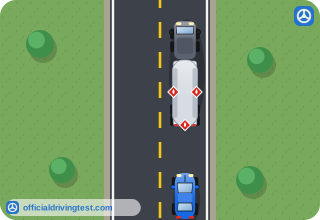
- Stop at all railroad crossings
- Slow down and cross if no train is visible
- Stop only when the gates are lowered
- Stop only when the warning lights are flashing
Show answer
Correct answer: Stop at all railroad crossings
The manual says all vehicles carrying hazardous materials must stop at all railroad crossings, so be ready to stop if you follow one.
Source: Idaho Driver's Handbook (July 2026), page 106 · Open this page in the manual (Manual page 106)