Idaho: Parking rules Practice Test
Parking on hills, handicapped parking, backing, and the places where you may not park.
Independent educational site · not affiliated with any government agency or DMV
Ready? Test yourself
- Instant feedback with an explanation
- Every answer cites its source in the manual
- Your best score is saved on this device
Questions are original and based on the official manual "Idaho Driver's Handbook" (July 2026), Idaho Transportation Department.
All 29 questions in this practice test
Take the test above first, then use this list to study. Tap “Show answer” to see the correct answer and explanation.
Show the questions and answersHide the questions
-
When parking on a public road, how close to the curb or edge of the roadway must you park?
- Parallel to it and within 18 inches
- Parallel to it and within 6 inches
- Parallel to it and within 12 inches
- Parallel to it and within 24 inches
Show answer
Correct answer: Parallel to it and within 18 inches
The manual requires parking parallel to and within 18 inches of the curb or edge of the roadway.
Source: Idaho Driver's Handbook (July 2026), page 80 · Open this page in the manual (Manual page 80)
-
When you park on a public road, which way must your vehicle face?
- Toward oncoming traffic on the opposite side
- Toward the nearest intersection or driveway
- In the same direction as traffic on your side of the road
- In whichever direction makes it easier to leave later
Show answer
Correct answer: In the same direction as traffic on your side of the road
The vehicle must face in the same direction as traffic on your side of the road.
Source: Idaho Driver's Handbook (July 2026), page 80 · Open this page in the manual (Manual page 80)
-
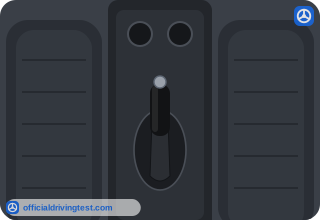
When is the parking brake to be set when you park on a public road, according to the manual?
- Only if you park facing uphill
- Only if the car is left running
- Only if the car has a manual transmission
- Only if you park next to a curb
Show answer
Correct answer: Only if the car is left running
The manual says to set the parking brake only if the car is left running.
Source: Idaho Driver's Handbook (July 2026), page 80 · Open this page in the manual (Manual page 80)
-
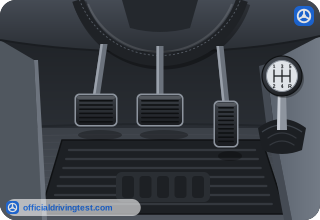
What should you do with the gear selector of a car with a manual transmission when you park it?
- Shift to neutral
- Shift to park
- Shift to the highest gear
- Leave the car in gear
Show answer
Correct answer: Leave the car in gear
With a manual transmission, the car is left in gear when parked.
Source: Idaho Driver's Handbook (July 2026), page 80 · Open this page in the manual (Manual page 80)
-
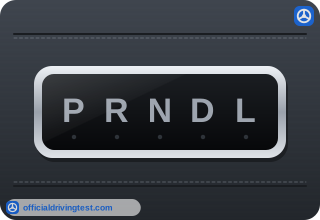
When you park a car that has an automatic transmission, what should you do with the gear selector?
- Shift to park
- Shift to neutral
- Shift to low
- Leave it in drive
Show answer
Correct answer: Shift to park
For an automatic transmission the manual says to shift to park.
Source: Idaho Driver's Handbook (July 2026), page 80 · Open this page in the manual (Manual page 80)
-
After you park on a public road, what should you do with the keys?
- Leave them in the ignition if you will be right back
- Leave them in the ignition with the engine off
- Remove them and secure your car
- Hide them under the driver's seat
Show answer
Correct answer: Remove them and secure your car
The manual says to remove the keys and secure your car.
Source: Idaho Driver's Handbook (July 2026), page 80 · Open this page in the manual (Manual page 80)
-
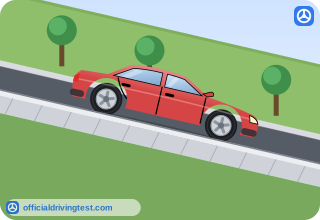
You are parked facing downhill next to a curb. Which way should you turn your front wheels?
- Sharply away from the curb, toward the road
- Sharply toward and against the curb
- Straight ahead
- Slightly away from the curb and the road
Show answer
Correct answer: Sharply toward and against the curb
Facing downhill, the front wheels are turned sharply toward and against the curb so the vehicle cannot roll into traffic.
Source: Idaho Driver's Handbook (July 2026), page 81 · Open this page in the manual (Manual page 81)
-
You are parked facing uphill next to a curb. Which way should you turn your wheels?
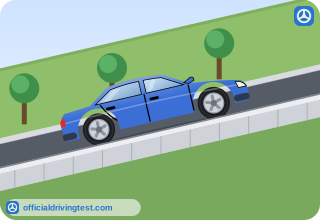
- Sharply toward the curb and against it
- Straight ahead with the wheels centered
- Slightly toward the curb
- Sharply away from the curb
Show answer
Correct answer: Sharply away from the curb
Facing uphill, the wheels are turned sharply away and against the curb.
Source: Idaho Driver's Handbook (July 2026), page 81 · Open this page in the manual (Manual page 81)
-
You are parked on a hill where there is no curb. Which way should you turn your wheels?
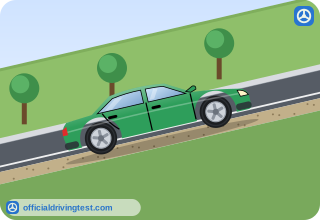
- Sharply toward the edge of the road
- Sharply toward the center of the road
- Straight ahead
- Away from the edge of the road
Show answer
Correct answer: Sharply toward the edge of the road
With no curb, the wheels are turned sharply toward the edge of the road, uphill or downhill.
Source: Idaho Driver's Handbook (July 2026), page 81 · Open this page in the manual (Manual page 81)
-
How close to a fire hydrant is parking not allowed?
- Within 5 feet
- Within 10 feet
- Within 15 feet
- Within 25 feet
Show answer
Correct answer: Within 15 feet
Parking is not allowed within 15 feet of a fire hydrant.
Source: Idaho Driver's Handbook (July 2026), page 81 · Open this page in the manual (Manual page 81)
-
How close to a crosswalk is parking not allowed?
- Within 5 feet
- Within 20 feet
- Within 10 feet
- Within 40 feet
Show answer
Correct answer: Within 20 feet
Parking is not allowed within 20 feet of a crosswalk.
Source: Idaho Driver's Handbook (July 2026), page 81 · Open this page in the manual (Manual page 81)
-
How close to a stop sign, yield sign, or traffic signal is parking not allowed?
- Within 10 feet
- Within 15 feet
- Within 100 feet
- Within 30 feet
Show answer
Correct answer: Within 30 feet
Parking is not allowed within 30 feet of a stop sign, yield sign, or traffic signal.
Source: Idaho Driver's Handbook (July 2026), page 81 · Open this page in the manual (Manual page 81)
-
How close to railroad tracks is parking not allowed?
- Within 50 feet
- Within 10 feet
- Within 25 feet
- Within 200 feet
Show answer
Correct answer: Within 50 feet
Parking is not allowed within 50 feet of railroad tracks.
Source: Idaho Driver's Handbook (July 2026), page 81 · Open this page in the manual (Manual page 81)
-
How close to a fire station driveway is parking not allowed?
- Within 5 feet
- Within 10 feet
- Within 20 feet
- Within 40 feet
Show answer
Correct answer: Within 20 feet
Parking is not allowed within 20 feet of a fire station driveway.
Source: Idaho Driver's Handbook (July 2026), page 81 · Open this page in the manual (Manual page 81)
-
What is it called when you park on the street side of a vehicle that is already parked, and is it allowed?
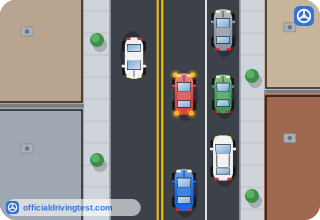
- Double parking, which is allowed for short stops
- Double parking, which is not allowed
- Angle parking, which is not allowed
- Parallel parking, which is allowed
Show answer
Correct answer: Double parking, which is not allowed
Parking on the street side of any parked vehicle is called double parking and is not allowed.
Source: Idaho Driver's Handbook (July 2026), page 81 · Open this page in the manual (Manual page 81)
-
What does a red-painted curb mean for parking?
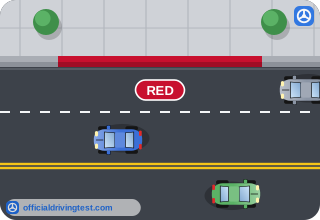
- Parking is allowed for loading only
- Parking is allowed for up to two hours
- Parking is allowed for disabled persons only
- Parking is not allowed there
Show answer
Correct answer: Parking is not allowed there
Parking is not allowed where prohibited by signs or a red-painted curb.
Source: Idaho Driver's Handbook (July 2026), page 81 · Open this page in the manual (Manual page 81)
-
What does a blue rectangular sign with a white wheelchair symbol and the words PARKING ONLY indicate?
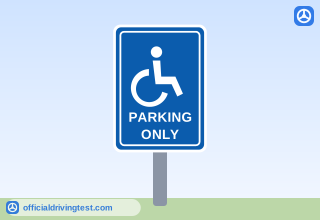
- Parking spaces reserved for handicapped persons
- A loading zone for delivery vehicles
- Parking reserved for emergency vehicles
- A zone where parking is free for all drivers
Show answer
Correct answer: Parking spaces reserved for handicapped persons
The manual says this symbol indicates parking spaces reserved for handicapped persons.
Source: Idaho Driver's Handbook (July 2026), page 82 · Open this page in the manual (Manual page 82)
-
Which vehicles may park in spaces reserved for handicapped persons?
- Any vehicle whose driver stays inside it
- Any vehicle parked there for less than fifteen minutes at a time
- Those displaying the handicapped symbol on a plate or special card
- Only emergency vehicles and delivery vehicles
Show answer
Correct answer: Those displaying the handicapped symbol on a plate or special card
Only vehicles displaying the symbol on a license plate or a special card may park in these spaces.
Source: Idaho Driver's Handbook (July 2026), page 82 · Open this page in the manual (Manual page 82)
-
What may happen to a non-handicapped driver who parks in a space reserved for handicapped persons?
- Nothing, if the other spaces are all taken
- The driver may be fined
- The driver may only be asked to move the vehicle
- The driver is given a written warning only
Show answer
Correct answer: The driver may be fined
Non-handicapped drivers are prohibited from parking in such spaces and may be fined for violations.
Source: Idaho Driver's Handbook (July 2026), page 82 · Open this page in the manual (Manual page 82)
-
How may a handicapped person park an automobile displaying the handicapped symbol in reserved parking spaces?
- Without paying but for no more than 24 hours
- Only after paying and for a limited time
- Without paying but for no more than two hours
- Without paying and for unlimited time
Show answer
Correct answer: Without paying and for unlimited time
The manual says a handicapped person may park in reserved spaces without paying and for unlimited time.
Source: Idaho Driver's Handbook (July 2026), page 82 · Open this page in the manual (Manual page 82)
-
Why does backing require extra caution?
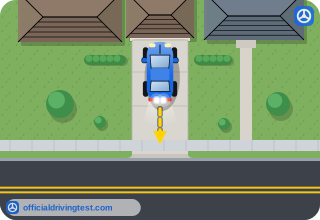
- It is difficult to see behind the vehicle
- Brakes work less well in reverse
- Other drivers expect you to back up quickly
- Reverse gear limits you to a very low speed
Show answer
Correct answer: It is difficult to see behind the vehicle
The manual says backing is difficult because drivers cannot see well behind their vehicles.
Source: Idaho Driver's Handbook (July 2026), page 82 · Open this page in the manual (Manual page 82)
-
Before you get into your vehicle to back up, what should you do?
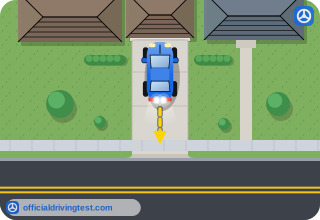
- Check only the mirrors after you are seated
- Sound the horn
- Check behind the vehicle
- Let the engine warm up
Show answer
Correct answer: Check behind the vehicle
Children or small objects are hard to see from the driver's seat, so you should check behind the vehicle before you get in.
Source: Idaho Driver's Handbook (July 2026), page 82 · Open this page in the manual (Manual page 82)
-
How should you look when backing up?
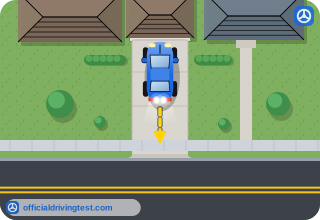
- Mainly in the rearview and side mirrors
- Over your shoulder directly through the rear window
- Only in the side mirror on the passenger side
- Straight ahead while a passenger watches behind
Show answer
Correct answer: Over your shoulder directly through the rear window
The manual says to look over your shoulder directly through the rear window and not to rely on your mirrors.
Source: Idaho Driver's Handbook (July 2026), page 82 · Open this page in the manual (Manual page 82)
-
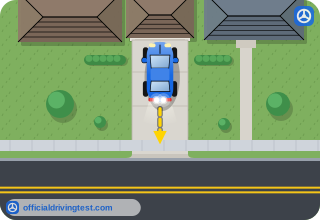
How long should you continue looking back while you back up?
- Until the vehicle starts moving
- Until you have backed up ten feet
- Until your rear wheels clear the curb
- Until you come to a complete stop
Show answer
Correct answer: Until you come to a complete stop
The manual says to continue looking back until you come to a complete stop.
Source: Idaho Driver's Handbook (July 2026), page 82 · Open this page in the manual (Manual page 82)
-
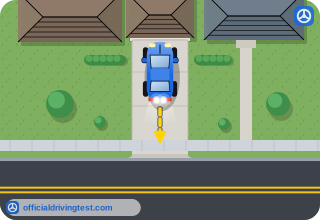
On roads other than freeways and other controlled-access highways, when is backing allowed?
- Only when you have a passenger to help you
- Only when it can be done safely and without interfering with other traffic
- Only on roads with a posted speed limit of 25 miles per hour or less
- Only after you sound your horn
Show answer
Correct answer: Only when it can be done safely and without interfering with other traffic
Elsewhere, backing is prohibited unless it can be done safely and without interfering with other traffic.
Source: Idaho Driver's Handbook (July 2026), page 82 · Open this page in the manual (Manual page 82)
-
What can happen to an unattended vehicle on the traveled portion of a highway?
- It is allowed to stay for 24 hours
- It is subject to removal only after midnight
- It is subject to removal only at the owner's request
- It is subject to immediate removal (towing)
Show answer
Correct answer: It is subject to immediate removal (towing)
Unattended vehicles on the traveled portion of a highway are a danger to public safety and subject to immediate removal (towing).
Source: Idaho Driver's Handbook (July 2026), page 93 · Open this page in the manual (Manual page 93)
-
When must a vehicle left unattended on the paved portion of a highway, off the traveled portion, be removed?
- Prior to darkness
- Within one hour of being left
- Before the next business day
- Only when a police officer requests it
Show answer
Correct answer: Prior to darkness
Vehicles left unattended must be removed prior to darkness or be subject to towing at the owner’s expense.
Source: Idaho Driver's Handbook (July 2026), page 93 · Open this page in the manual (Manual page 93)
-
Who pays for towing a vehicle that is left unattended and not removed prior to darkness?
- The county
- The nearest property owner
- The owner of the vehicle
- The driver who reports it
Show answer
Correct answer: The owner of the vehicle
A vehicle not removed prior to darkness is subject to towing at the owner’s expense.
Source: Idaho Driver's Handbook (July 2026), page 93 · Open this page in the manual (Manual page 93)
-
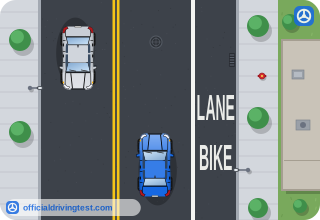
May you park in a bike lane?
- Yes, but only for a short time while waiting
- Yes, if no bicyclist is in sight at the time
- No, parking in bike lanes is not allowed
- Yes, if your hazard lights are turned on
Show answer
Correct answer: No, parking in bike lanes is not allowed
Bike lanes are designated travel lanes for bicyclists and should not be blocked, so parking in them is not allowed.
Source: Idaho Driver's Handbook (July 2026), page 101 · Open this page in the manual (Manual page 101)