Idaho: Freeway driving — Part 2 Practice Test
Questions in this part include: “What should you do if you cannot or do not want to drive at the posted speed on a freeway?” · “How long should you signal before making a lane change or exiting a freeway?”
Independent educational site · not affiliated with any government agency or DMV
Ready? Test yourself
- Instant feedback with an explanation
- Every answer cites its source in the manual
- Your best score is saved on this device
Questions are original and based on the official manual "Idaho Driver's Handbook" (July 2026), Idaho Transportation Department.
All 20 questions in this practice test
Take the test above first, then use this list to study. Tap “Show answer” to see the correct answer and explanation.
Show the questions and answersHide the questions
-
If you enter a freeway by the wrong entrance by mistake, what must you never try to do?
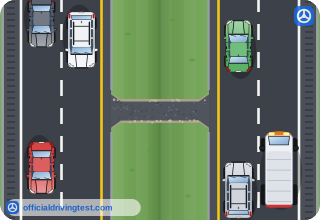
- Back up or turn around
- Wait until the next exit
- Check traffic around you
- Signal before changing lanes
Show answer
Correct answer: Back up or turn around
The manual says never to back up or turn around through the median if you enter the wrong entrance.
Source: Idaho Driver's Handbook (July 2026), page 84 · Open this page in the manual (Manual page 84)
-
If you need to get off the freeway or change directions, when should you do so?
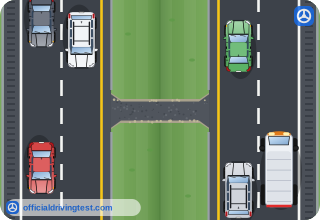
- At the nearest median crossover
- On the shoulder, when no traffic is near
- At the next exit
- At the next break in the median
Show answer
Correct answer: At the next exit
The manual says to wait until the next exit to get off the freeway or change directions.
Source: Idaho Driver's Handbook (July 2026), page 84 · Open this page in the manual (Manual page 84)
-
Once on the entrance ramp, over which shoulder do you begin looking for a gap in freeway traffic?
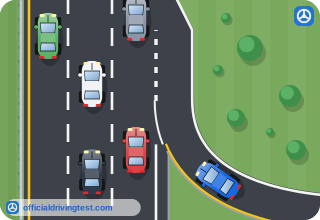
- Your right shoulder
- Your left shoulder
- Neither, you should rely only on your mirrors
- Whichever is closer to the lane you want
Show answer
Correct answer: Your left shoulder
The manual says to signal and begin looking over your left shoulder for a gap in the traffic.
Source: Idaho Driver's Handbook (July 2026), page 84 · Open this page in the manual (Manual page 84)
-
When merging onto a freeway, who must yield?
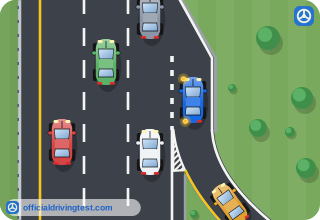
- Traffic already on the highway must yield to you
- The vehicle that is going faster must yield
- The vehicle in the left lane must yield
- You must yield to the traffic already on the highway
Show answer
Correct answer: You must yield to the traffic already on the highway
The manual reminds drivers entering that they must yield to the traffic already on the highway.
Source: Idaho Driver's Handbook (July 2026), page 84 · Open this page in the manual (Manual page 84)
-
When can you make a simple lane change, merge with the flow of vehicles, and turn off your turn signal after entering a freeway?
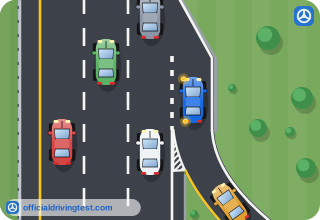
- Once you are traveling at the speed of traffic
- As soon as you enter the ramp
- As soon as you reach the acceleration lane
- After you have passed the first exit
Show answer
Correct answer: Once you are traveling at the speed of traffic
The manual says you can do so once you are traveling at the speed of traffic.
Source: Idaho Driver's Handbook (July 2026), page 84 · Open this page in the manual (Manual page 84)
-
In heavy traffic on a freeway entrance, what might you have to do if there is no opening?
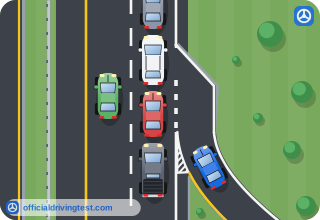
- Speed up and force your way in ahead of traffic
- Stop on the entrance ramp and back up
- Slow down before the end of the acceleration lane
- Drive on the shoulder to pass the traffic
Show answer
Correct answer: Slow down before the end of the acceleration lane
If there is no opening, the manual says you may have to slow down before reaching the end of the acceleration lane.
Source: Idaho Driver's Handbook (July 2026), page 84 · Open this page in the manual (Manual page 84)
-
If a short acceleration lane and heavy traffic force you to stop, what should you be sure to leave?
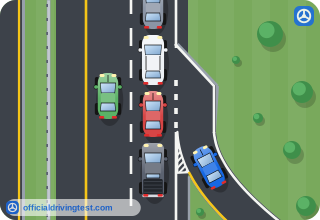
- Enough room behind to back up if needed
- Enough room ahead to accelerate to freeway speed
- A gap of at least one full lane on your right
- Room for the next car to pull alongside
Show answer
Correct answer: Enough room ahead to accelerate to freeway speed
The manual says to leave enough room ahead so you can accelerate up to the speed of freeway traffic as you merge.
Source: Idaho Driver's Handbook (July 2026), page 84 · Open this page in the manual (Manual page 84)
-
After you are forced to stop on a short acceleration lane, what should you do once there is a gap large enough?
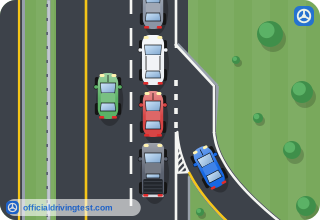
- Merge slowly at the speed you are going
- Accelerate gently without signaling
- Wait for a second gap before entering
- Signal and accelerate as rapidly as you can
Show answer
Correct answer: Signal and accelerate as rapidly as you can
The manual says to signal your entrance and accelerate as rapidly as you can to blend in with the traffic flow.
Source: Idaho Driver's Handbook (July 2026), page 85 · Open this page in the manual (Manual page 85)
-
Once on the freeway, what speed should you maintain?
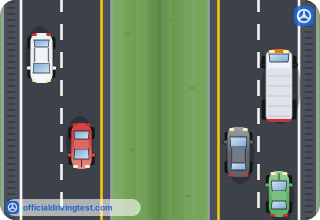
- A steady speed that keeps up with traffic flow
- A speed below the flow of traffic to be safe
- A speed that changes with each lane
- The slowest speed that keeps you in the lane
Show answer
Correct answer: A steady speed that keeps up with traffic flow
The manual says to maintain a steady speed and keep up with the flow of traffic.
Source: Idaho Driver's Handbook (July 2026), page 85 · Open this page in the manual (Manual page 85)
-
What should you do if you cannot or do not want to drive at the posted speed on a freeway?
- Drive in the left lane at a lower speed
- Drive on the shoulder
- Choose another kind of road to travel
- Turn on your hazard lights and drive slowly
Show answer
Correct answer: Choose another kind of road to travel
The manual says to choose another kind of road if you can't or don't want to drive at the posted speed on a freeway.
Source: Idaho Driver's Handbook (July 2026), page 85 · Open this page in the manual (Manual page 85)
-
On a freeway, which lane is for higher-speed traffic and passing?
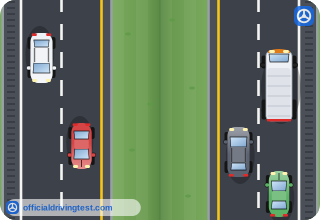
- The far right lane
- The left lane
- The center lane
- The entrance lane
Show answer
Correct answer: The left lane
The manual says the left lane is for higher-speed traffic and passing.
Source: Idaho Driver's Handbook (July 2026), page 85 · Open this page in the manual (Manual page 85)
-
Most of the time, which lane or lanes should you drive in on a freeway?
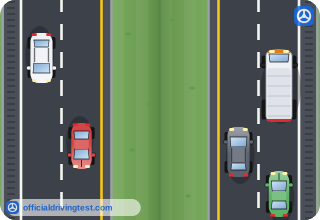
- The far left lane
- The left lane or the shoulder
- The lane with the fastest traffic
- The far right or center lane
Show answer
Correct answer: The far right or center lane
The manual says most of the time you should drive in the far right or center lane.
Source: Idaho Driver's Handbook (July 2026), page 85 · Open this page in the manual (Manual page 85)
-
During rush hours, which freeway lane should you avoid?
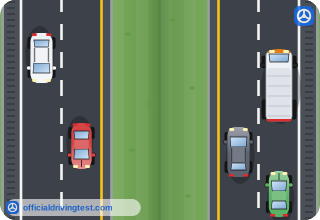
- The right lane
- The left lane
- The center lane
- Every lane except the shoulder
Show answer
Correct answer: The right lane
The manual says to avoid the right lane during rush hours to leave room for drivers entering the freeway.
Source: Idaho Driver's Handbook (July 2026), page 85 · Open this page in the manual (Manual page 85)
-
How long should you signal before making a lane change or exiting a freeway?
- At least two seconds
- At least three seconds
- At least five seconds
- At least one second
Show answer
Correct answer: At least five seconds
The manual says to always signal for at least five seconds before a lane change or exit.
Source: Idaho Driver's Handbook (July 2026), page 85 · Open this page in the manual (Manual page 85)
-
Driving across a barrier or unpaved strip that separates the two halves of a roadway is illegal except where?
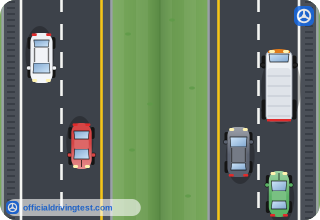
- At any place where there is no oncoming traffic
- At an authorized opening or crossover
- At any place where the strip is narrow
- At any exit ramp
Show answer
Correct answer: At an authorized opening or crossover
The manual says it is illegal except at an authorized opening or crossover. On interstate highways (freeways), this is not allowed.
Source: Idaho Driver's Handbook (July 2026), page 85 · Open this page in the manual (Manual page 85)
-
What makes getting off a freeway a simple maneuver?
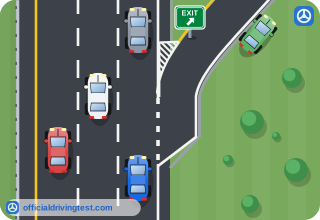
- Slowing down on the freeway before reaching the exit
- Stopping at the end of the exit lane to check traffic
- Taking the first exit you see
- Knowing which exit to take and following the lane signs
Show answer
Correct answer: Knowing which exit to take and following the lane signs
The manual says exiting is simple if you know which exit to take and follow the signs marking the lane for that exit.
Source: Idaho Driver's Handbook (July 2026), page 85 · Open this page in the manual (Manual page 85)
-
About how far before your freeway exit should you signal and move into the lane nearest the exit if you are not already in it?
- About a half mile
- About 100 feet
- About one mile
- About a quarter mile
Show answer
Correct answer: About a half mile
The manual says to signal and move into the lane nearest the exit about a half mile before the exit.
Source: Idaho Driver's Handbook (July 2026), page 86 · Open this page in the manual (Manual page 86)
-
What is the deceleration lane on a freeway exit provided for?
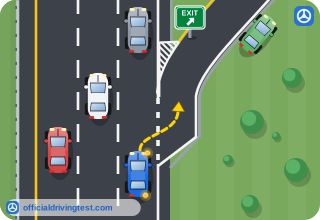
- To let you pass slower vehicles on the ramp
- To let you stop and check your mirrors
- To slow down without interrupting traffic flow
- To let trucks park before the ramp
Show answer
Correct answer: To slow down without interrupting traffic flow
The deceleration lane lets you slow down without interrupting the flow of traffic.
Source: Idaho Driver's Handbook (July 2026), page 86 · Open this page in the manual (Manual page 86)
-
What should you do when an exit speed is posted on a freeway ramp?
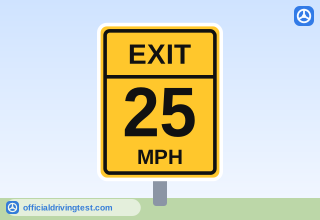
- Keep the freeway speed until the end of the ramp
- Adjust your speed accordingly as you drive through the ramp
- Stop at the start of the ramp before entering it
- Drive at the speed of the vehicle ahead whatever the sign says
Show answer
Correct answer: Adjust your speed accordingly as you drive through the ramp
The manual tells drivers to adjust their speed to the posted exit speed through the ramp.
Source: Idaho Driver's Handbook (July 2026), page 86 · Open this page in the manual (Manual page 86)
-
When you leave a freeway ramp and enter another thoroughfare, what should you expect?
- Lighter traffic and faster speeds than on the freeway
- The same traffic conditions as on the freeway
- Traffic that always yields to you
- More complicated, dangerous traffic and slower speeds
Show answer
Correct answer: More complicated, dangerous traffic and slower speeds
You may be driving in more complicated, dangerous traffic than on the freeway, so you must be alert and adjust to the new conditions and slower speeds.
Source: Idaho Driver's Handbook (July 2026), page 86 · Open this page in the manual (Manual page 86)