Idaho: Exam Simulator
40 random questions from every topic, like a mini exam.
Independent educational site · not affiliated with any government agency or DMV
Ready? Test yourself
Like the real test: 40 questions; pass with 34 correct.
- Instant feedback with an explanation
- Every answer cites its source in the manual
- Your best score is saved on this device
Questions are original and based on the official manual "Idaho Driver's Handbook" (July 2026), Idaho Transportation Department.
Sample questions
The exam simulator picks 40 random questions from every topic each time you start. Here are a few examples.
Show the questions and answersHide the questions
-
At what age can you first be licensed in Idaho?
- 15 years of age
- 14 1/2 years of age
- 16 years of age
- 17 years of age
Show answer
Correct answer: 15 years of age
The manual states that you can be licensed in Idaho when you are 15 years of age.
Source: Idaho Driver's Handbook (July 2026), page 3 · Open this page in the manual (Manual page 3)
-
What is the minimum tire tread depth the examiner requires on the skills test vehicle?
- At least 4/32 of an inch
- At least 6/32 of an inch
- At least 1/32 of an inch
- At least 2/32 of an inch
Show answer
Correct answer: At least 2/32 of an inch
Tires must have at least 2/32 of an inch or more of tread.
Source: Idaho Driver's Handbook (July 2026), page 36 · Open this page in the manual (Manual page 36)
-
What does a single dashed yellow line between two lanes of traffic mean?
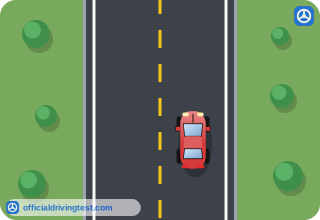
- Vehicles in either lane can cross the line if it is safe to do so
- Only vehicles in the lane nearest the line can cross it
- No vehicle may cross the line unless it is turning left
- Vehicles may cross the line only to pass a slower vehicle
Show answer
Correct answer: Vehicles in either lane can cross the line if it is safe to do so
Per the manual, a dashed yellow line allows vehicles in either lane to cross it when it is safe.
Source: Idaho Driver's Handbook (July 2026), page 58 · Open this page in the manual (Manual page 58)
-
What gives a single point urban interchange (SPUI) its name?
- The single lane that serves all of the exit ramps
- The single bridge that carries the highway over the cross street
- The single stop line used by all traffic
- The traffic signals that control turns from a single point at the center
Show answer
Correct answer: The traffic signals that control turns from a single point at the center
A SPUI is named for the traffic signals that control turns from a single point at its center.
Source: Idaho Driver's Handbook (July 2026), page 64 · Open this page in the manual (Manual page 64)
-
When parking on a public road, how close to the curb or edge of the roadway must you park?
- Parallel to it and within 18 inches
- Parallel to it and within 6 inches
- Parallel to it and within 12 inches
- Parallel to it and within 24 inches
Show answer
Correct answer: Parallel to it and within 18 inches
The manual requires parking parallel to and within 18 inches of the curb or edge of the roadway.
Source: Idaho Driver's Handbook (July 2026), page 80 · Open this page in the manual (Manual page 80)
-
How does the manual say you should learn to recognize traffic signs?
- By their size and the height at which they are mounted
- By the order in which they appear along the road
- By color and shape as well as the messages or symbols they carry
- By the lettering style used on each sign
Show answer
Correct answer: By color and shape as well as the messages or symbols they carry
The manual says to learn to recognize signs by color and shape as well as the messages or symbols they carry.
Source: Idaho Driver's Handbook (July 2026), page 44 · Open this page in the manual (Manual page 44)
-
Besides traffic signals, signs and pavement markings, who else may provide traffic control that you must obey?
- Law enforcement officers, highway personnel, or school crossing guards
- Only law enforcement officers and emergency medical technicians
- Only taxi drivers, bus drivers, and tow truck operators
- Any pedestrian who is standing in the roadway
Show answer
Correct answer: Law enforcement officers, highway personnel, or school crossing guards
Traffic control may also be provided by law enforcement officers, highway personnel, or school crossing guards, and you must obey these directions.
Source: Idaho Driver's Handbook (July 2026), page 44 · Open this page in the manual (Manual page 44)
-
Where is the red light on a vertical traffic light?
- In the middle
- At the bottom
- On the far right
- At the top
Show answer
Correct answer: At the top
Vertical traffic lights have a red light at the top, a yellow light in the middle, and a green light at the bottom.
Source: Idaho Driver's Handbook (July 2026), page 55 · Open this page in the manual (Manual page 55)
-
What must you do when you approach a yield sign?
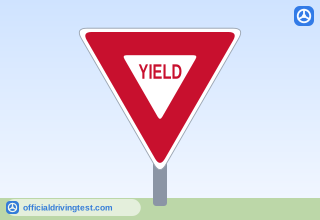
- Stop completely every time, then proceed when the way is clear
- Slow down and yield to other vehicles and pedestrians, stopping if necessary
- Keep your speed and let other vehicles yield to you
- Slow down and yield only to vehicles, since pedestrians must wait
Show answer
Correct answer: Slow down and yield to other vehicles and pedestrians, stopping if necessary
You must slow down and yield the right-of-way to other vehicles and pedestrians, and stop if necessary.
Source: Idaho Driver's Handbook (July 2026), page 44 · Open this page in the manual (Manual page 44)
-
A round yellow sign shows an X with the letters R R. What should you be prepared to do?
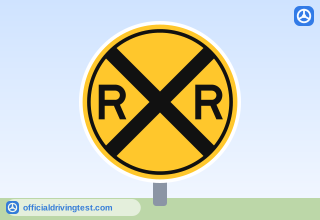
- Shift to a lower gear and keep your speed on the tracks
- Stop before the tracks if a train is approaching
- Change lanes to get away from the tracks
- Cross the tracks quickly before a train arrives
Show answer
Correct answer: Stop before the tracks if a train is approaching
The railroad crossing sign gives early warning, and you must be ready to stop before the tracks if a train is approaching.
Source: Idaho Driver's Handbook (July 2026), page 52 · Open this page in the manual (Manual page 52)