Idaho: Emergency vehicles and work zones — Part 2 Practice Test
Questions in this part include: “You must stop for emergency or police vehicles that are sounding a siren or flashing which lights?” · “How far behind a snowplow truck should you stay?”
Independent educational site · not affiliated with any government agency or DMV
Ready? Test yourself
- Instant feedback with an explanation
- Every answer cites its source in the manual
- Your best score is saved on this device
Questions are original and based on the official manual "Idaho Driver's Handbook" (July 2026), Idaho Transportation Department.
All 23 questions in this practice test
Take the test above first, then use this list to study. Tap “Show answer” to see the correct answer and explanation.
Show the questions and answersHide the questions
-
You must stop for emergency or police vehicles that are sounding a siren or flashing which lights?
- Amber or yellow lights
- Green or white lights
- White headlights only
- Red or blue lights
Show answer
Correct answer: Red or blue lights
Idaho law requires you to stop for emergency or police vehicles sounding a siren or flashing red or blue lights.
Source: Idaho Driver's Handbook (July 2026), page 70 · Open this page in the manual (Manual page 70)
-
An emergency vehicle sounding a siren is approaching. Where should you pull over and stop?
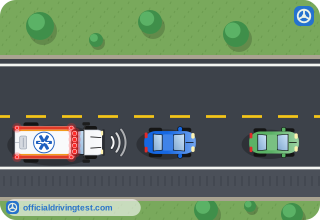
- At the nearest right edge or curb, clear of any intersection
- At the nearest left edge, clear of any intersection
- In the middle of the nearest intersection
- In the left lane, keeping up with traffic
Show answer
Correct answer: At the nearest right edge or curb, clear of any intersection
Pull over to the nearest edge or curb on the right side of the highway and clear of any intersection, and remain stopped.
Source: Idaho Driver's Handbook (July 2026), page 70 · Open this page in the manual (Manual page 70)
-
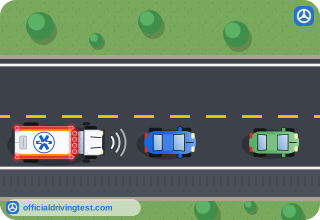
After pulling over for an emergency vehicle, how long must you remain stopped?
- For at least 10 seconds after the siren starts
- Until you can no longer hear the siren
- Until it has passed or an officer says to go
- Until the vehicle stops somewhere ahead
Show answer
Correct answer: Until it has passed or an officer says to go
You remain stopped until the emergency vehicle has passed, or the police officer has indicated you may proceed.
Source: Idaho Driver's Handbook (July 2026), page 70 · Open this page in the manual (Manual page 70)
-
In a work zone, what must you yield to?
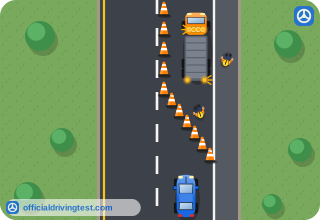
- Vehicles or pedestrians working on the project
- Only workers who are standing in the roadway
- Only flaggers and law enforcement vehicles
- Only equipment with flashing lights
Show answer
Correct answer: Vehicles or pedestrians working on the project
In work zones you must yield to all vehicles or pedestrians working on a highway construction project.
Source: Idaho Driver's Handbook (July 2026), page 76 · Open this page in the manual (Manual page 76)
-
An emergency or police vehicle sounding a siren or flashing red or blue lights is approaching you. What must you do?
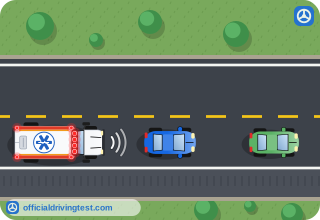
- Pull to the nearest curb or right edge and stop
- Slow down and keep driving in your own lane until it passes
- Pull to the left edge of the roadway and stop
- Speed up to clear the road ahead of the vehicle
Show answer
Correct answer: Pull to the nearest curb or right edge and stop
You must pull to the nearest curb or the edge on the right side of the roadway and stop.
Source: Idaho Driver's Handbook (July 2026), page 95 · Open this page in the manual (Manual page 95)
-
After you pull over for an approaching emergency vehicle, how long must you remain stopped?
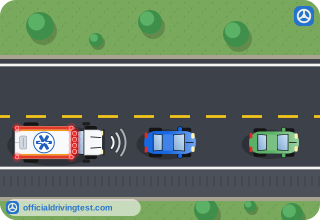
- Until you can no longer hear its siren
- Until the traffic behind you starts moving
- Until the emergency vehicle has passed ahead of you
- For at least one minute after its lights go out
Show answer
Correct answer: Until the emergency vehicle has passed ahead of you
The manual says to remain stopped until the emergency vehicle has passed ahead of you.
Source: Idaho Driver's Handbook (July 2026), page 95 · Open this page in the manual (Manual page 95)
-
You are approaching a stopped emergency or police vehicle with its lights flashing. What are you required to do?
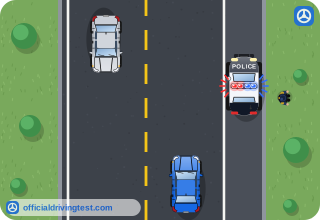
- Come to a complete stop and wait until it leaves the scene
- Reduce your speed below the posted limit and proceed with caution
- Keep your speed and sound your horn as you pass by
- Slow to exactly the posted speed limit but no lower
Show answer
Correct answer: Reduce your speed below the posted limit and proceed with caution
You are required to immediately reduce your speed below the posted limit and proceed with caution.
Source: Idaho Driver's Handbook (July 2026), page 95 · Open this page in the manual (Manual page 95)
-
A tow truck or incident response vehicle is stopped ahead with its lights flashing. What are you required to do as you approach it?
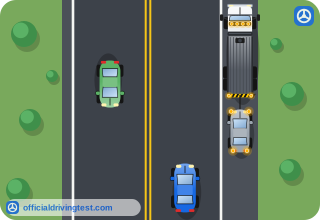
- Stop and wait for a signal from the driver to go
- Maintain the posted speed limit if your lane is clear
- Pass quickly to clear the area as soon as possible
- Slow below the posted limit and proceed with caution
Show answer
Correct answer: Slow below the posted limit and proceed with caution
The requirement to slow below the posted limit applies to a tow truck or incident response vehicle as well as to emergency and police vehicles.
Source: Idaho Driver's Handbook (July 2026), page 95 · Open this page in the manual (Manual page 95)
-
You approach a stopped emergency vehicle with lights flashing on a road with two or more lanes in your direction. What else must you do?
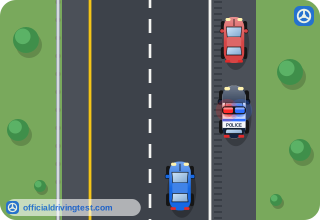
- Stay in the lane next to it and come to a stop
- Move into the lane right beside it in order to pass
- Move to a lane not adjacent to it as soon as safely possible
- Change lanes only if a police officer directs you to
Show answer
Correct answer: Move to a lane not adjacent to it as soon as safely possible
On a road with two or more lanes in your direction, you must also move to a lane not adjacent to the emergency vehicle, as soon as possible if safe.
Source: Idaho Driver's Handbook (July 2026), page 95 · Open this page in the manual (Manual page 95)
-
Why should you use extra caution when you encounter snow removal equipment?
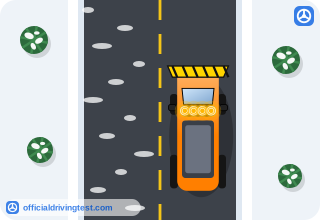
- Snowplows are required to stop at every intersection along the entire road they clear
- Their blades force snow up and off the road, reducing visibility for drivers following too closely
- Snowplows cannot be seen from behind during a storm because they carry no warning lights
- Snowplow drivers may ask the drivers who are following them to pass them on the right
Show answer
Correct answer: Their blades force snow up and off the road, reducing visibility for drivers following too closely
Snowplow blades force snow up and off the road, potentially causing blizzard-like conditions and reduced visibility for drivers following too closely.
Source: Idaho Driver's Handbook (July 2026), page 109 · Open this page in the manual (Manual page 109)
-
How far behind a snowplow truck should you stay?
- Two car lengths for every 10 miles per hour you drive
- One car length for every 10 miles per hour you drive
- Four car lengths no matter how fast you drive
- Two car lengths for every 20 miles per hour you drive
Show answer
Correct answer: Two car lengths for every 10 miles per hour you drive
The handbook says to remain two car lengths behind snowplow trucks for every 10 miles per hour you drive.
Source: Idaho Driver's Handbook (July 2026), page 110 · Open this page in the manual (Manual page 110)
-
What does the handbook say about passing a snowplow?
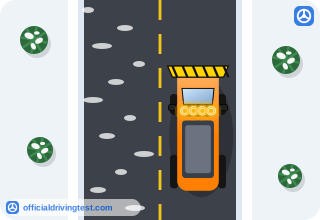
- Pass it as soon as the lane ahead looks clear
- Pass it whenever you are in a hurry to get ahead
- Do not pass it unless it is absolutely necessary
- Pass it only when its blade is raised
Show answer
Correct answer: Do not pass it unless it is absolutely necessary
Drivers should not pass a snowplow unless it is absolutely necessary.
Source: Idaho Driver's Handbook (July 2026), page 110 · Open this page in the manual (Manual page 110)
-
If you must pass a snowplow, which side should you NOT pass on?
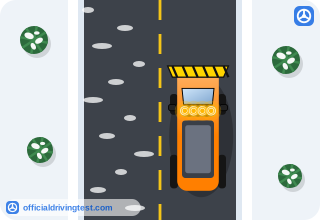
- The side with the wider shoulder
- The side where the plow is spraying snow
- The side with the most open road ahead
- The side farthest from the sprayed snow
Show answer
Correct answer: The side where the plow is spraying snow
The force of the sprayed snow can knock your car out of control.
Source: Idaho Driver's Handbook (July 2026), page 110 · Open this page in the manual (Manual page 110)
-
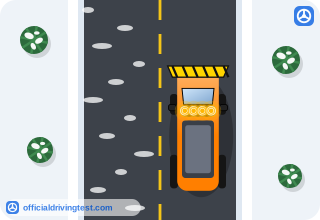
Why should you not cut back in front of a snowplow truck right after passing it?
- Its driver cannot sound the horn in snow
- Its blades extend into every lane at night
- Its sand spreader can only be switched off by stopping
- Its plow blades are often covered with snow and hard to see
Show answer
Correct answer: Its plow blades are often covered with snow and hard to see
The plow blades are often covered with snow and can be difficult to see.
Source: Idaho Driver's Handbook (July 2026), page 110 · Open this page in the manual (Manual page 110)
-
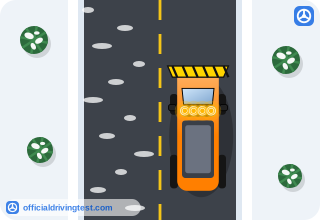
Why should you not brake suddenly while traveling in front of a snowplow?
- The plow driver is not allowed to use the brakes in snow
- The plow blade would scrape your rear bumper
- Sudden braking makes the plow spread more sand
- The heavy vehicle cannot stop as quickly as your automobile
Show answer
Correct answer: The heavy vehicle cannot stop as quickly as your automobile
A snowplow is heavy and cannot stop as quickly as a car.
Source: Idaho Driver's Handbook (July 2026), page 110 · Open this page in the manual (Manual page 110)
-
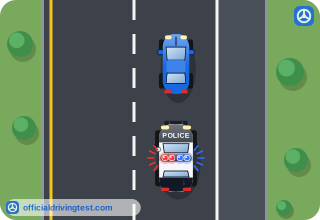
When law enforcement stops you, what should you do with your turn signal and position?
- Turn on your hazard lights and stop in the traffic lane to wait for the officer
- Keep driving at a slow speed until you reach a parking lot nearby
- Stop where you are and turn on your headlights to show you saw them
- Activate your turn signal and pull off or to the side as soon and safely as possible
Show answer
Correct answer: Activate your turn signal and pull off or to the side as soon and safely as possible
The handbook says to stay calm, activate your turn signal, and pull off or to the side of the roadway as soon and safely as possible.
Source: Idaho Driver's Handbook (July 2026), page 132 · Open this page in the manual (Manual page 132)
-
After you pull over for a law enforcement officer, what should you do?
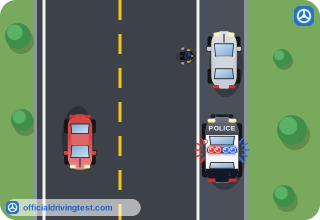
- Turn off the ignition and radio, and stay in your vehicle unless told to exit
- Leave the engine running and step out to meet the officer
- Turn the radio up so you can hear the officer's instructions clearly
- Step out and wait beside the car with your documents ready
Show answer
Correct answer: Turn off the ignition and radio, and stay in your vehicle unless told to exit
The handbook says to turn off the ignition and radio and stay in your vehicle unless directed by the officer to exit.
Source: Idaho Driver's Handbook (July 2026), page 132 · Open this page in the manual (Manual page 132)
-
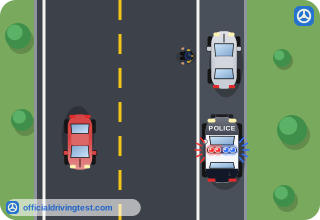
During a traffic stop, where should you keep your hands?
- On the dashboard
- Out of the open window
- On the steering wheel
- Behind your head
Show answer
Correct answer: On the steering wheel
The handbook says to keep your hands on the steering wheel so they are easily observable.
Source: Idaho Driver's Handbook (July 2026), page 132 · Open this page in the manual (Manual page 132)
-
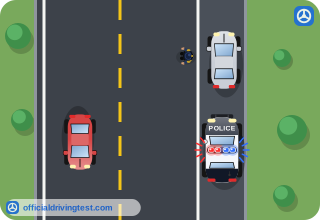
During a traffic stop, who should not use cell phones and mobile devices?
- Only you, the driver
- You and any of your passengers
- Only your passengers
- No one, unless the officer is slow
Show answer
Correct answer: You and any of your passengers
Cell phones and mobile devices should not be used by you or any of your passengers.
Source: Idaho Driver's Handbook (July 2026), page 132 · Open this page in the manual (Manual page 132)
-
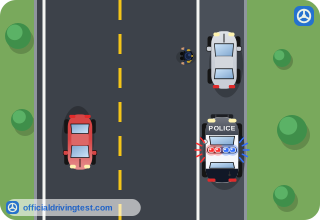
During a traffic stop, what should you do instead of searching for your license or vehicle documents?
- Hand all your documents out the window right away
- Search quickly so the documents are ready on arrival
- Place the documents on the dashboard before the officer comes
- Wait for the officer to give you instructions
Show answer
Correct answer: Wait for the officer to give you instructions
The handbook says not to make sudden moves or search for documents, but to wait for the officer to give you instructions.
Source: Idaho Driver's Handbook (July 2026), page 133 · Open this page in the manual (Manual page 133)
-
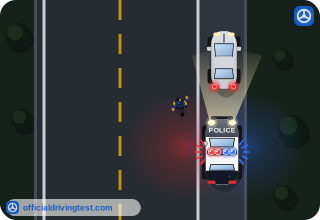
If you have a weapon in the vehicle during a traffic stop, when should you inform the officer?
- Upon first contact
- Only if the officer asks
- After handing over your documents
- Only if the weapon is loaded
Show answer
Correct answer: Upon first contact
The handbook says to inform the officer of a weapon in the vehicle upon first contact.
Source: Idaho Driver's Handbook (July 2026), page 133 · Open this page in the manual (Manual page 133)
-
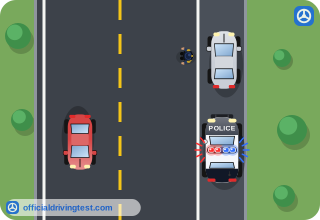
During a traffic stop, your documents are out of your reach. What should you do?
- Reach for them quickly so the officer can see you doing it
- Reach slowly and hold them up in the window
- Tell the officer where they are before you reach for them
- Ask a passenger to search for them first
Show answer
Correct answer: Tell the officer where they are before you reach for them
If the documents are out of your reach, tell the officer where they are before you reach for them.
Source: Idaho Driver's Handbook (July 2026), page 133 · Open this page in the manual (Manual page 133)
-
If the officer asks you to exit the vehicle during a traffic stop, what should you do?
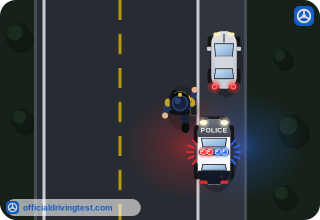
- Stand behind your vehicle in the traffic lane with your hands down
- Stay safely away from traffic and keep your hands in plain view
- Walk to the officer's vehicle with your documents in hand
- Stay near your door and reach inside to find your documents
Show answer
Correct answer: Stay safely away from traffic and keep your hands in plain view
The handbook says to stay safely away from traffic and keep your hands in plain view.
Source: Idaho Driver's Handbook (July 2026), page 133 · Open this page in the manual (Manual page 133)