Idaho: Emergencies — Part 5 Practice Test
Questions in this part include: “What does Idaho’s Good Samaritan Law protect you from if you help an injured person in good faith?” · “At the scene of a crash, what information must you get about any witnesses?”
Independent educational site · not affiliated with any government agency or DMV
Ready? Test yourself
- Instant feedback with an explanation
- Every answer cites its source in the manual
- Your best score is saved on this device
Questions are original and based on the official manual "Idaho Driver's Handbook" (July 2026), Idaho Transportation Department.
All 17 questions in this practice test
Take the test above first, then use this list to study. Tap “Show answer” to see the correct answer and explanation.
Show the questions and answersHide the questions
-
If the wheels drop off the pavement, what should you do with the steering wheel?
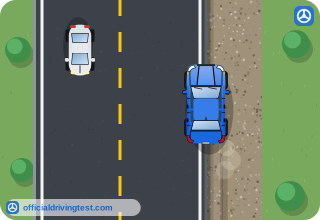
- Turn it sharply back toward the pavement
- Grip it tightly and steer straight ahead
- Let it turn freely
- Turn it away from the road
Show answer
Correct answer: Grip it tightly and steer straight ahead
The manual says to grip the wheel tightly, steer straight ahead, and stay on the shoulder if there are no immediate obstacles.
Source: Idaho Driver's Handbook (July 2026), page 120 · Open this page in the manual (Manual page 120)
-
If the wheels drop off the pavement, what should you do with the pedals?
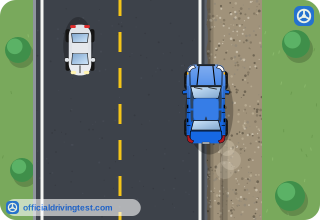
- Press the accelerator to climb back onto the pavement
- Apply the brakes hard to stop as fast as you can
- Take your foot off the accelerator and apply the brakes gently
- Press the clutch and coast without using the brakes
Show answer
Correct answer: Take your foot off the accelerator and apply the brakes gently
You take your foot off the accelerator and apply the brakes gently.
Source: Idaho Driver's Handbook (July 2026), page 120 · Open this page in the manual (Manual page 120)
-
When you steer back onto the pavement after running off the road, what should you be careful not to do?
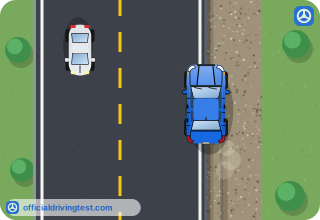
- Oversteer and drive across the center line
- Use your turn signal before you move over
- Check traffic for an opening before you steer
- Slow down below the speed limit before you steer
Show answer
Correct answer: Oversteer and drive across the center line
After checking traffic and when it is safe, steer onto the pavement carefully so you do not oversteer across the center line.
Source: Idaho Driver's Handbook (July 2026), page 120 · Open this page in the manual (Manual page 120)
-
What should you do if you come upon a traffic crash where police or medical help is already there?
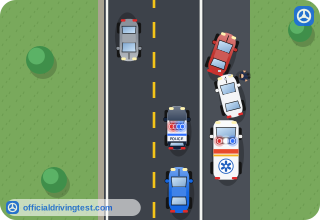
- Do not stop; move on as officers direct
- Stop and help the injured
- Stop and take photographs
- Slow down and watch from the road
Show answer
Correct answer: Do not stop; move on as officers direct
If help is already there, you do not stop and you move on as officers direct.
Source: Idaho Driver's Handbook (July 2026), page 120 · Open this page in the manual (Manual page 120)
-
If you are the first to arrive at a crash with serious injuries, what should you do?
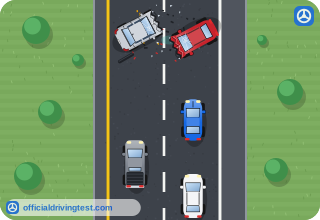
- Drive on and tell the next officer you see
- Stop and move all injured people to the roadside
- Stop, call 911, and assist if you are able
- Wait for another driver to stop
Show answer
Correct answer: Stop, call 911, and assist if you are able
The first person to arrive should stop and call 911 and assist if able.
Source: Idaho Driver's Handbook (July 2026), page 120 · Open this page in the manual (Manual page 120)
-
If you are involved in a crash, how must you stop?
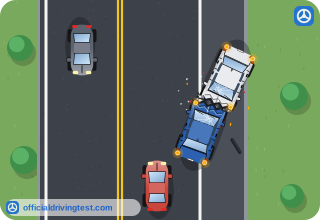
- Immediately, in the lane where the crash happened
- As near to the scene as possible without blocking traffic
- Only after you have reached the next exit ramp
- At least one mile away from the scene of the crash
Show answer
Correct answer: As near to the scene as possible without blocking traffic
You must stop as near to the scene as possible without blocking traffic.
Source: Idaho Driver's Handbook (July 2026), page 121 · Open this page in the manual (Manual page 121)
-
What may you do with vehicles that pose a traffic hazard after a crash, before the police arrive?
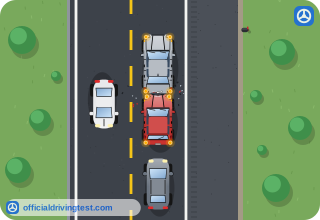
- Leave them exactly where they stopped
- Tow them yourself
- Cover them with a tarp
- Move them
Show answer
Correct answer: Move them
The manual says you may move vehicles that pose a traffic hazard before the police arrive.
Source: Idaho Driver's Handbook (July 2026), page 121 · Open this page in the manual (Manual page 121)
-
What does Idaho’s Quick Clearance law require after a crash on an interstate or major divided highway that causes no death or injury?
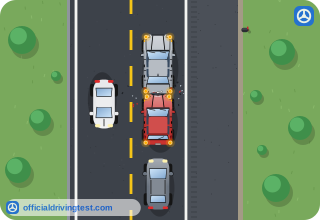
- Leave the vehicles exactly in place until the police arrive
- Move the vehicle onto the nearest city street, off the highway
- Safely move the vehicle to a shoulder, median, or emergency lane
- Turn off the engine and wait in the traffic lane
Show answer
Correct answer: Safely move the vehicle to a shoulder, median, or emergency lane
The law requires anyone involved in such a crash to safely move the vehicle to a shoulder, median, or emergency lane.
Source: Idaho Driver's Handbook (July 2026), page 121 · Open this page in the manual (Manual page 121)
-
What does Idaho’s Good Samaritan Law protect you from if you help an injured person in good faith?
- Civil liability
- Paying for your own vehicle repairs
- A speeding citation on the way
- Having to report the crash
Show answer
Correct answer: Civil liability
The manual says the Good Samaritan Law protects you from civil liability if you act in good faith.
Source: Idaho Driver's Handbook (July 2026), page 121 · Open this page in the manual (Manual page 121)
-
When may you try to move an injured person from a wrecked vehicle?
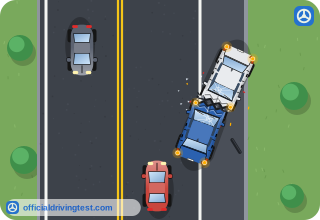
- Only if the injured person asks you to move him or her right away
- Only if the police have not arrived within a few minutes of the crash
- Only if the wrecked vehicle is blocking a lane of traffic ahead
- Only if you have medical training or there is immediate danger, such as fire
Show answer
Correct answer: Only if you have medical training or there is immediate danger, such as fire
The manual says not to move an injured person unless you have the necessary medical training or there is immediate danger such as fire.
Source: Idaho Driver's Handbook (July 2026), page 121 · Open this page in the manual (Manual page 121)
-
After a crash, what should you do about police and medical help?
- Wait one hour before calling
- Call for them as soon as possible
- Call only if the other driver agrees
- Call only if a vehicle cannot be driven
Show answer
Correct answer: Call for them as soon as possible
You are required to call for police and medical help as soon as possible.
Source: Idaho Driver's Handbook (July 2026), page 121 · Open this page in the manual (Manual page 121)
-
You must report to police any crash in which someone is injured or property damage is more than what amount?
- $500
- $1,500
- $1,000
- $2,500
Show answer
Correct answer: $1,500
The manual requires a police report for injury or damage of more than $1,500.
Source: Idaho Driver's Handbook (July 2026), page 121 · Open this page in the manual (Manual page 121)
-
At the scene of a crash, which information must you exchange about the injured?
- Names, addresses, and Social Security numbers
- Names, employers, and telephone numbers
- Addresses, ages, and insurance policy numbers
- Names, addresses, and driver’s license numbers
Show answer
Correct answer: Names, addresses, and driver’s license numbers
The manual lists names, addresses, and driver’s license numbers of the injured.
Source: Idaho Driver's Handbook (July 2026), page 121 · Open this page in the manual (Manual page 121)
-
At the scene of a crash, what information must you get about any witnesses?
- Their names and addresses
- Their insurance policy numbers
- Their driver’s license numbers only
- Their vehicle registration numbers
Show answer
Correct answer: Their names and addresses
The manual lists names and addresses of any witnesses.
Source: Idaho Driver's Handbook (July 2026), page 121 · Open this page in the manual (Manual page 121)
-
At the scene of a crash, which of these must you exchange with the other vehicle owners?
- Names, employers, and Social Security numbers
- Addresses, ages, and vehicle purchase prices
- Names, addresses, and insurance policy numbers
- Names, addresses, and insurance premium amounts
Show answer
Correct answer: Names, addresses, and insurance policy numbers
The manual lists names, addresses, and insurance policy numbers of the other vehicle owners.
Source: Idaho Driver's Handbook (July 2026), page 121 · Open this page in the manual (Manual page 121)
-
What may happen if you provide false information when exchanging information after a crash?
- Nothing, if the other driver is not hurt
- You will only be asked to sign a new form
- Your vehicle will be towed on the spot
- You may be guilty of a misdemeanor
Show answer
Correct answer: You may be guilty of a misdemeanor
The manual says that giving false information may make you guilty of a misdemeanor.
Source: Idaho Driver's Handbook (July 2026), page 121 · Open this page in the manual (Manual page 121)
-
Who will help you exchange information with the other drivers after a crash, when present?
- Your insurance agent
- A police officer
- A tow truck driver
- The county clerk
Show answer
Correct answer: A police officer
The manual says a police officer, when present, will help you exchange information with the other drivers.
Source: Idaho Driver's Handbook (July 2026), page 121 · Open this page in the manual (Manual page 121)