Idaho: Emergencies — Part 2 Practice Test
Questions in this part include: “How little fast-moving water can knock you off your feet?” · “Which of these does the handbook list for an emergency winter driving kit?”
Independent educational site · not affiliated with any government agency or DMV
Ready? Test yourself
- Instant feedback with an explanation
- Every answer cites its source in the manual
- Your best score is saved on this device
Questions are original and based on the official manual "Idaho Driver's Handbook" (July 2026), Idaho Transportation Department.
All 17 questions in this practice test
Take the test above first, then use this list to study. Tap “Show answer” to see the correct answer and explanation.
Show the questions and answersHide the questions
-
When do flash floods generally occur in Idaho?
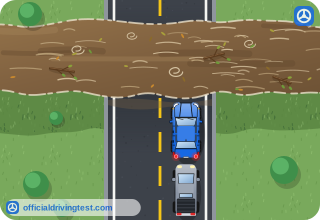
- During or right after a severe thunderstorm
- Only during the spring snow melt
- Only after several days of light rain
- Mostly during the coldest winter weeks
Show answer
Correct answer: During or right after a severe thunderstorm
Flash floods generally occur during or right after a severe thunderstorm.
Source: Idaho Driver's Handbook (July 2026), page 112 · Open this page in the manual (Manual page 112)
-
How little fast-moving water can knock you off your feet?
- Six inches
- Two inches
- Twelve inches
- Two feet
Show answer
Correct answer: Six inches
As little as six inches of fast moving water can knock you off your feet.
Source: Idaho Driver's Handbook (July 2026), page 112 · Open this page in the manual (Manual page 112)
-
Fast-moving water of what depth can wash away a vehicle?
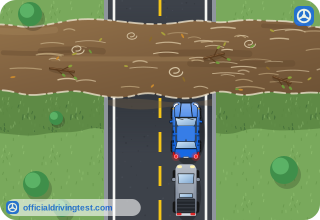
- Six inches
- Twelve inches
- Two feet
- Three inches
Show answer
Correct answer: Two feet
Fast-moving water two feet deep can wash away a vehicle.
Source: Idaho Driver's Handbook (July 2026), page 112 · Open this page in the manual (Manual page 112)
-
What should you do if the National Weather Service issues a Flash Flood Warning or you see water rising quickly?
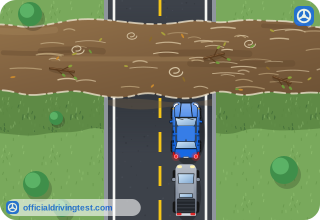
- Wait for a second warning before moving
- Take action immediately
- Continue your trip but drive slowly
- Wait until the water reaches the road
Show answer
Correct answer: Take action immediately
The handbook says to take action immediately in either case.
Source: Idaho Driver's Handbook (July 2026), page 112 · Open this page in the manual (Manual page 112)
-
What should you do if you see a flooded roadway ahead?
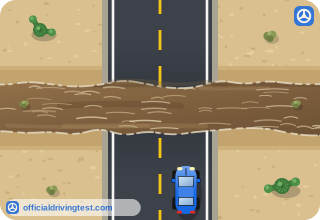
- Drive through slowly in a low gear
- Follow a vehicle that is crossing it
- Cross where the water looks shallowest
- Turn around and find another route
Show answer
Correct answer: Turn around and find another route
The handbook says never to drive through flooded areas; turn around and find another route.
Source: Idaho Driver's Handbook (July 2026), page 112 · Open this page in the manual (Manual page 112)
-
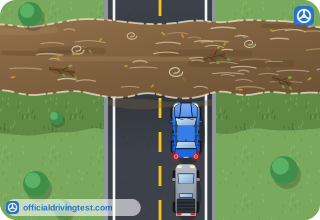
Why should you never drive through a flooded roadway?
- Flood water always stalls the engine at once
- Underwater roads are closed to traffic by law
- Traffic signals do not work in flood water
- Roads that are underwater may no longer be intact
Show answer
Correct answer: Roads that are underwater may no longer be intact
Roads that are underwater may no longer be intact.
Source: Idaho Driver's Handbook (July 2026), page 112 · Open this page in the manual (Manual page 112)
-
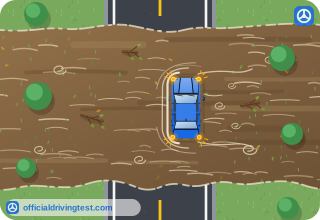
If your vehicle stalls in a flooded area, what should you do?
- Stay inside until the water stops rising
- Leave it immediately and seek higher ground
- Keep restarting the engine
- Close the windows and wait for the water to go down
Show answer
Correct answer: Leave it immediately and seek higher ground
Rapidly rising water may engulf the vehicle and sweep it away, so you should leave it immediately and seek higher ground.
Source: Idaho Driver's Handbook (July 2026), page 112 · Open this page in the manual (Manual page 112)
-
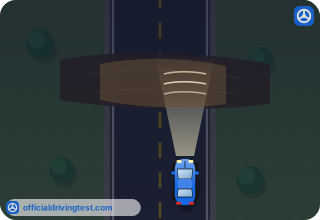
Why should you be very careful near flood-prone areas at night?
- Flood water is deeper at night
- Flash flood warnings are not issued at night
- It is harder to see flood dangers
- Rain always falls harder at night
Show answer
Correct answer: It is harder to see flood dangers
The handbook says to be very careful at night when it is harder to see flood dangers.
Source: Idaho Driver's Handbook (July 2026), page 112 · Open this page in the manual (Manual page 112)
-
During threatening weather, where should you not park your vehicle or camp?
- Along streams or dry stream beds
- On a hillside above any stream
- On high, safe ground
- Near a ridge top
Show answer
Correct answer: Along streams or dry stream beds
The handbook says not to park or camp along streams or dry stream beds during threatening conditions.
Source: Idaho Driver's Handbook (July 2026), page 112 · Open this page in the manual (Manual page 112)
-
What is a small sack of sand or cat litter for in an emergency winter driving kit?

- Absorbing fuel spilled in the trunk
- Melting ice on the windshield
- Generating traction under the wheels
- Keeping the engine warm
Show answer
Correct answer: Generating traction under the wheels
The handbook lists a small sack of sand or cat litter for generating traction under the wheels.
Source: Idaho Driver's Handbook (July 2026), page 114 · Open this page in the manual (Manual page 114)
-
What is the brightly-colored scarf in an emergency winter driving kit for?

- To cover the exhaust pipe
- To attract attention in case of an emergency
- To wipe condensation from the windows
- To keep the battery warm
Show answer
Correct answer: To attract attention in case of an emergency
The kit includes a brightly-colored scarf to attract attention in case of an emergency.
Source: Idaho Driver's Handbook (July 2026), page 114 · Open this page in the manual (Manual page 114)
-
If you run your car for heat while stranded in snow, what must you make sure of?

- That the windows are fully closed
- That the headlights are on high beam
- That the hood is covered with a blanket
- That the exhaust pipe is clear of snow
Show answer
Correct answer: That the exhaust pipe is clear of snow
The handbook says to make sure your exhaust pipe is clear of snow if you run your car for heat.
Source: Idaho Driver's Handbook (July 2026), page 114 · Open this page in the manual (Manual page 114)
-
If available, what should you tie on the car antenna when stranded in snow?

- A reflective triangle
- A flashlight
- A small flag
- A scarf or bright cloth
Show answer
Correct answer: A scarf or bright cloth
The handbook says to tie a scarf or bright cloth on the antenna for snow crews to see.
Source: Idaho Driver's Handbook (July 2026), page 114 · Open this page in the manual (Manual page 114)
-
Which of these does the handbook list for an emergency winter driving kit?
- A tow chain
- Booster cables
- A portable stove
- A spare battery
Show answer
Correct answer: Booster cables
Booster cables are on the handbook list of items for an emergency winter driving kit.
Source: Idaho Driver's Handbook (July 2026), page 114 · Open this page in the manual (Manual page 114)
-
What should you tell someone before a winter trip?
- Your destination and the type of vehicle you drive
- Your license number, the vehicle registration and your insurance company
- Your route, estimated departure and arrival times, and where you will stay
- Your insurance company and policy number
Show answer
Correct answer: Your route, estimated departure and arrival times, and where you will stay
The handbook says to let someone know your travel plans, including estimated departure and arrival times, route, and where you will stay.
Source: Idaho Driver's Handbook (July 2026), page 115 · Open this page in the manual (Manual page 115)
-
If you get stranded while heavy snow is falling, what should you do?

- Stay with your vehicle
- Leave the car and walk for help
- Leave the car and look for a shelter
- Walk along the road toward the nearest town
Show answer
Correct answer: Stay with your vehicle
The handbook says to stay with your vehicle if heavy snow is falling, because most deaths occur when people leave their car, get lost, and freeze.
Source: Idaho Driver's Handbook (July 2026), page 115 · Open this page in the manual (Manual page 115)
-
Whom should you call in a medical emergency in an area where the roads have not been plowed?
- The local or state police
- A tow truck company
- The county driver license office
- The National Weather Service
Show answer
Correct answer: The local or state police
The handbook says to call the local or state police, who work with search and rescue personnel and the Idaho Transportation Department.
Source: Idaho Driver's Handbook (July 2026), page 115 · Open this page in the manual (Manual page 115)