Idaho: Emergencies — Part 1 Practice Test
Questions in this part include: “In the crash prevention formula, what does the manual say to avoid when scanning?” · “What does the manual say is the key to defensive driving?”
Independent educational site · not affiliated with any government agency or DMV
Ready? Test yourself
- Instant feedback with an explanation
- Every answer cites its source in the manual
- Your best score is saved on this device
Questions are original and based on the official manual "Idaho Driver's Handbook" (July 2026), Idaho Transportation Department.
All 18 questions in this practice test
Take the test above first, then use this list to study. Tap “Show answer” to see the correct answer and explanation.
Show the questions and answersHide the questions
-
What does Idaho law require you to do when you are involved in a crash?
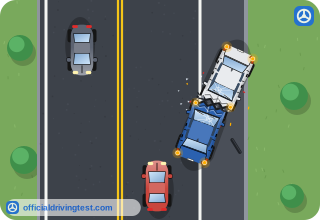
- Leave if the damage looks minor
- Stop
- Drive to the nearest county office first
- Keep driving and report it later
Show answer
Correct answer: Stop
Idaho law requires you to stop when you are involved in a crash.
Source: Idaho Driver's Handbook (July 2026), page 70 · Open this page in the manual (Manual page 70)
-
In the crash prevention formula, what does the manual say to avoid when scanning?
- Moving your eyes from side to side
- Reading the road ahead
- Checking traffic behind you
- A fixed, straight-ahead stare
Show answer
Correct answer: A fixed, straight-ahead stare
Scanning means keeping your eyes moving and learning to read the road, not staring straight ahead.
Source: Idaho Driver's Handbook (July 2026), page 89 · Open this page in the manual (Manual page 89)
-
In the crash prevention formula, what does the "Identify" step mean?
- Name each traffic sign you pass
- Check your vehicle for mechanical problems
- Read the license plates of vehicles ahead
- Scan ahead for potential hazards
Show answer
Correct answer: Scan ahead for potential hazards
Identify means scanning ahead for potential hazards such as a vehicle, pedestrian, animal or situation.
Source: Idaho Driver's Handbook (July 2026), page 90 · Open this page in the manual (Manual page 90)
-
After spotting a potential hazard, what does the manual say it is safest to do in the "Predict" step?
- Predict that nothing will happen
- Predict that the hazard will go away
- Predict the worst
- Predict what other drivers want you to do
Show answer
Correct answer: Predict the worst
After spotting a hazard, you predict what will happen, and it is safest to predict the worst.
Source: Idaho Driver's Handbook (July 2026), page 90 · Open this page in the manual (Manual page 90)
-
What does the manual say is the key to defensive driving?
- Making a sound decision ahead of time
- Driving faster than other traffic
- Relying on other drivers' signals
- Using the horn to warn others
Show answer
Correct answer: Making a sound decision ahead of time
The key to defensive driving is making a sound decision ahead of time rather than reacting at the last second.
Source: Idaho Driver's Handbook (July 2026), page 90 · Open this page in the manual (Manual page 90)
-
What is the final step of the crash prevention formula?
- Scan the road for the next potential hazard
- Look behind you for tailgating vehicles
- Predict the worst outcome of the hazard
- Execute your decision smoothly and predictably
Show answer
Correct answer: Execute your decision smoothly and predictably
The final step is to execute your decision in a smooth, predictable manner in time to avoid a crash.
Source: Idaho Driver's Handbook (July 2026), page 90 · Open this page in the manual (Manual page 90)
-
What number do you dial for Idaho travel information?
- 511
- 411
- 211
- 311
Show answer
Correct answer: 511
The manual says to dial 511 for up-to-date travel information.
Source: Idaho Driver's Handbook (July 2026), page 107 · Open this page in the manual (Manual page 107)
-
Which information is available through Idaho's 511 traveler services?
- Vehicle registration renewal status
- Driver's license test appointments
- Weather-related road conditions
- Insurance verification for your vehicle
Show answer
Correct answer: Weather-related road conditions
The 511 service gives up-to-date information on emergency road closures, roadwork projects, tourism, traffic incidents and delays, and weather-related road conditions.
Source: Idaho Driver's Handbook (July 2026), page 107 · Open this page in the manual (Manual page 107)
-
If you must park on a highway shoulder at night, what should you turn on?
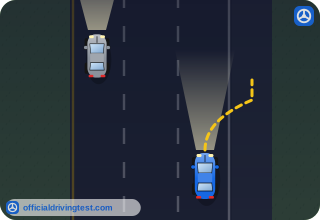
- Your high beams and your fog lights together
- Your low beams and nothing else
- Your emergency flashers or parking lights
- Your interior dome light and radio
Show answer
Correct answer: Your emergency flashers or parking lights
The manual says to turn on your emergency flashers or parking lights if you must park on a highway shoulder at night.
Source: Idaho Driver's Handbook (July 2026), page 109 · Open this page in the manual (Manual page 109)
-
If you must abandon your car in winter conditions, where should you leave it?
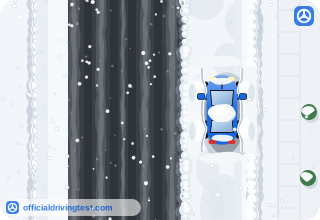
- Right at the edge of the traffic lane so it is easy to see
- As far off the road as possible
- In the lane with the emergency flashers on
- Under a bridge or overpass out of the snow
Show answer
Correct answer: As far off the road as possible
Abandoned cars can interfere with road clearing and endanger snow removal equipment and its operators if they are hidden or buried by snow.
Source: Idaho Driver's Handbook (July 2026), page 110 · Open this page in the manual (Manual page 110)
-
In fog, smoke, dust or rain, what should you do if conditions get too bad to drive?
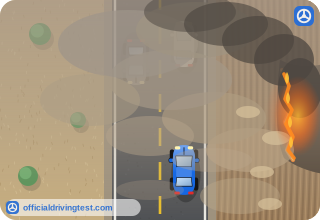
- Creep along with your emergency flashers on
- Keep following the taillights ahead
- Stay in your lane and slow to a crawl
- Pull off the road and stop
Show answer
Correct answer: Pull off the road and stop
If conditions get too bad, pull off the road and stop; do not creep along.
Source: Idaho Driver's Handbook (July 2026), page 111 · Open this page in the manual (Manual page 111)
-
At about what speed may tires lose all contact with a wet road and hydroplane?
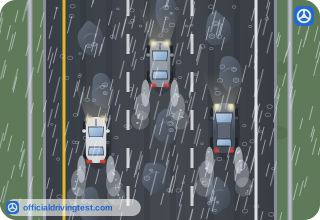
- 55 miles per hour
- 35 miles per hour
- 25 miles per hour
- 45 miles per hour
Show answer
Correct answer: 55 miles per hour
At 55 miles per hour, the tires may lose all contact with the road and begin to hydroplane.
Source: Idaho Driver's Handbook (July 2026), page 111 · Open this page in the manual (Manual page 111)
-
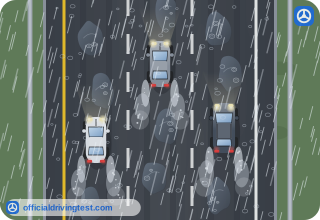
What happens when tires hydroplane?
- The tires lock up and the engine stalls until you slow down
- Only the steering is lost; braking works normally
- They ride on a film of water and you cannot brake, accelerate or turn
- The brakes work better because the water cools them
Show answer
Correct answer: They ride on a film of water and you cannot brake, accelerate or turn
When tires ride on a film of water like water skis, you cannot brake, accelerate or turn.
Source: Idaho Driver's Handbook (July 2026), page 111 · Open this page in the manual (Manual page 111)
-
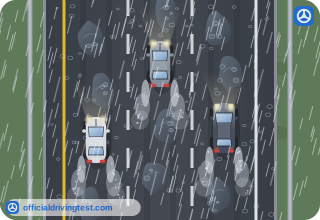
Which action helps reduce the chances of hydroplaning?
- Speeding up through standing water
- Keeping your tires properly inflated
- Lowering tire pressure for more grip
- Keeping worn tires until the next service
Show answer
Correct answer: Keeping your tires properly inflated
The handbook lists keeping tires properly inflated as a way to reduce the chances of hydroplaning.
Source: Idaho Driver's Handbook (July 2026), page 111 · Open this page in the manual (Manual page 111)
-
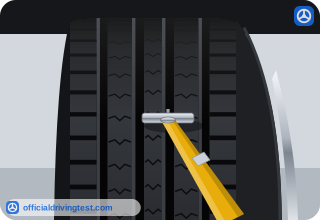
When should you replace worn tires to reduce the chances of hydroplaning?
- Only when they go flat
- Once a year in the fall
- Only after a hydroplaning skid
- As soon as they become worn
Show answer
Correct answer: As soon as they become worn
The handbook says to replace tires as soon as they become worn.
Source: Idaho Driver's Handbook (July 2026), page 111 · Open this page in the manual (Manual page 111)
-
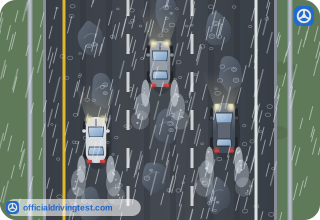
You think your car has started to hydroplane. What should you do?
- Brake hard and turn toward the shoulder to regain grip
- Press the gas pedal firmly to get through the water
- Steer sharply back and forth to regain grip
- Keep a steady speed straight ahead and slowly ease off the gas
Show answer
Correct answer: Keep a steady speed straight ahead and slowly ease off the gas
The handbook says to maintain a steady speed, keep moving straight, and slowly take your foot off the gas pedal.
Source: Idaho Driver's Handbook (July 2026), page 111 · Open this page in the manual (Manual page 111)
-
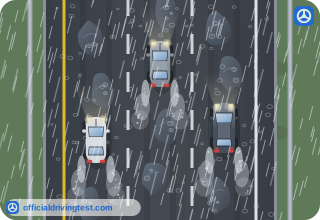
You must use the brakes while hydroplaning and your car has no anti-lock brakes. How should you brake?
- Press hard and hold the pedal down
- Pump them gently
- Stomp on the pedal once
- Use only the parking brake
Show answer
Correct answer: Pump them gently
If you must brake, pump the brakes gently unless your car has an anti-lock braking system.
Source: Idaho Driver's Handbook (July 2026), page 111 · Open this page in the manual (Manual page 111)
-
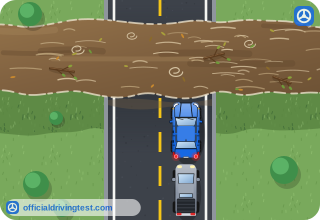
What causes flash floods?
- Slow, light rain that falls for several days
- Melting snow on the mountains only
- Intense rain that falls in a short amount of time
- Strong winds that blow across rivers
Show answer
Correct answer: Intense rain that falls in a short amount of time
Flash floods are caused by intense rain that falls in a short amount of time.
Source: Idaho Driver's Handbook (July 2026), page 112 · Open this page in the manual (Manual page 112)