Hawaii: Speed and following distance — Part 3 Practice Test
Questions in this part include: “At what speed may partial hydroplaning start?” · “Where may ice accumulate even when the rest of the road is clear?”
Independent educational site · not affiliated with any government agency or DMV
Ready? Test yourself
- Instant feedback with an explanation
- Every answer cites its source in the manual
- Your best score is saved on this device
Questions are original and based on the official manual "Hawaii Driver's Manual" (2023), Hawaii Department of Transportation.
All 19 questions in this practice test
Take the test above first, then use this list to study. Tap “Show answer” to see the correct answer and explanation.
Show the questions and answersHide the questions
-
What is it called when tires ride up on a layer of water on the road like a surfboard?
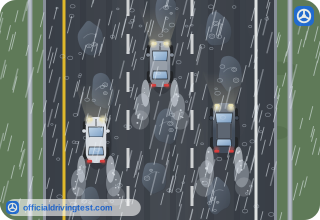
- Hydroplaning
- Skidding
- Fishtailing
- Brake fade
Show answer
Correct answer: Hydroplaning
The manual calls tires riding up on the layer of water “hydroplaning”.
Source: Hawaii Driver's Manual (2023), page 75 · Open this page in the manual (Manual page 75)
-
At what speed may partial hydroplaning start?
- 15 miles per hour (24 km/h)
- 25 miles per hour (40 km/h)
- 45 miles per hour (72 km/h)
- 35 miles per hour (56 km/h)
Show answer
Correct answer: 35 miles per hour (56 km/h)
Partial hydroplaning may start at 35 miles per hour (56 km/h) and increases with speed and the amount of water.
Source: Hawaii Driver's Manual (2023), page 75 · Open this page in the manual (Manual page 75)
-
At about what speed in a heavy rain may tires lose all contact with the pavement?
- 15 miles per hour (24 km/h)
- 55 miles per hour (89 km/h)
- 25 miles per hour (40 km/h)
- 40 miles per hour (64 km/h)
Show answer
Correct answer: 55 miles per hour (89 km/h)
At 55 miles per hour in a heavy rain the tires may lose all contact with the pavement.
Source: Hawaii Driver's Manual (2023), page 75 · Open this page in the manual (Manual page 75)
-
What happens when hydroplaning makes the tires lose all contact with the pavement?
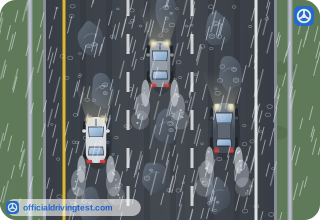
- You can still brake, but you cannot steer
- You cannot brake, accelerate or turn
- You can still steer, but you cannot accelerate
- Gentle braking restores control
Show answer
Correct answer: You cannot brake, accelerate or turn
The manual says you cannot brake, accelerate or turn and have no control over your vehicle.
Source: Hawaii Driver's Manual (2023), page 75 · Open this page in the manual (Manual page 75)
-
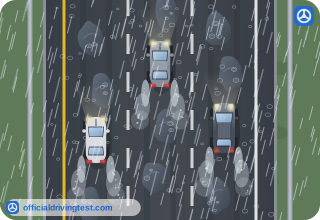
Compared with tires that have good tread, at what speeds will worn or bald tires hydroplane?
- Higher speeds
- The same speeds
- Speeds above 55 mph only
- Lower speeds
Show answer
Correct answer: Lower speeds
Worn or bald tires will hydroplane at lower speeds.
Source: Hawaii Driver's Manual (2023), page 76 · Open this page in the manual (Manual page 76)
-
To help prevent hydroplaning, how should the tires be inflated?
- To the proper pressure
- Slightly above the proper pressure
- Slightly below the proper pressure
- Pressure does not matter if the tread is good
Show answer
Correct answer: To the proper pressure
The manual says to insure that the tires are inflated to the proper pressure, because under-inflated tires hydroplane at lower speeds.
Source: Hawaii Driver's Manual (2023), page 76 · Open this page in the manual (Manual page 76)
-
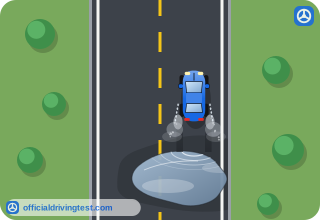
What should you do when your brakes are wet after driving through deep water?
- Apply the brakes firmly and repeatedly while keeping your normal speed
- Shift to neutral and coast until they dry
- Reduce speed and apply gentle brake pressure until they work properly again
- Turn on the hazard warning signals and keep your speed
Show answer
Correct answer: Reduce speed and apply gentle brake pressure until they work properly again
The manual says wet brakes may pull to one side or not hold, so reduce speed and apply gentle pressure on the brake pedal until they work again.
Source: Hawaii Driver's Manual (2023), page 76 · Open this page in the manual (Manual page 76)
-
Where may fog be encountered on Hawaii roads?

- At higher elevations where low-lying clouds meet the ground
- Mostly at lower elevations along the coast and beaches
- Mostly on freeways at sea level
- Only along rivers at dawn
Show answer
Correct answer: At higher elevations where low-lying clouds meet the ground
In Hawaii fog almost never occurs at lower elevations; it may be met at higher elevations where low-lying clouds meet the ground.
Source: Hawaii Driver's Manual (2023), page 76 · Open this page in the manual (Manual page 76)
-
Why are patches of fog particularly hazardous?

- They always last for several hours after heavy rain has stopped
- They make the road surface icy
- They stop head lamps from working
- You may encounter them suddenly without being aware of their presence
Show answer
Correct answer: You may encounter them suddenly without being aware of their presence
Patches of fog are particularly hazardous because you may encounter them suddenly without being aware of their presence.
Source: Hawaii Driver's Manual (2023), page 76 · Open this page in the manual (Manual page 76)
-
If you plan to drive under winter conditions in other areas, how should you equip your car?

- With snowtread tires
- With worn tires that have little tread
- With under-inflated tires for extra grip
- With the same highway tires used in Hawaii
Show answer
Correct answer: With snowtread tires
One winter driving suggestion is to equip your car with snowtread tires.
Source: Hawaii Driver's Manual (2023), page 76 · Open this page in the manual (Manual page 76)
-
Where may ice accumulate even when the rest of the road is clear?
- On wide, straight road sections
- In places that get direct sun
- On or under bridges
- On the clear, dry portions of the road
Show answer
Correct answer: On or under bridges
The manual warns that ice may accumulate on or under bridges even when the rest of the road is clear.
Source: Hawaii Driver's Manual (2023), page 77 · Open this page in the manual (Manual page 77)
-
Where do snow and ice melt more slowly?
- In areas exposed to full sun
- In shady areas
- On the clear, dry portions of the road
- Near the center line
Show answer
Correct answer: In shady areas
The manual says snow and ice melt more slowly in shady areas.
Source: Hawaii Driver's Manual (2023), page 77 · Open this page in the manual (Manual page 77)
-
How should you use your brakes if you must stop on packed snow or ice?

- Firmly and continuously
- With one hard application and hold it
- Only when going downhill
- Very cautiously and intermittently
Show answer
Correct answer: Very cautiously and intermittently
The manual says to use brakes very cautiously and intermittently, because locked wheels mean you lose control.
Source: Hawaii Driver's Manual (2023), page 77 · Open this page in the manual (Manual page 77)
-
When is the lack of light before sunrise and after sunset worse?
- When the sky is clear
- When the road is dry
- When the sun is directly overhead
- When the sky is cloudy
Show answer
Correct answer: When the sky is cloudy
The manual says this condition is worse when the sky is cloudy.
Source: Hawaii Driver's Manual (2023), page 77 · Open this page in the manual (Manual page 77)
-
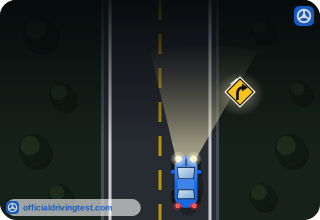
At night, how should you adjust your speed?
- So that you match the speed of the vehicle ahead
- So that you can stop within the distance you can see ahead
- So that you travel at the posted limit at all times
- So that you keep pace with the fastest traffic
Show answer
Correct answer: So that you can stop within the distance you can see ahead
The manual says to reduce your speed so that you can stop within the distance you can see ahead.
Source: Hawaii Driver's Manual (2023), page 77 · Open this page in the manual (Manual page 77)
-
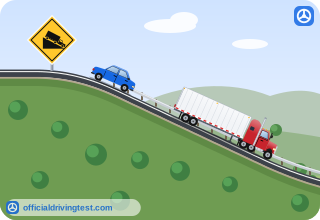
What should drivers of large vehicles do before descending a steep hill?
- Shift to a higher gear to save fuel
- Keep the brakes applied continuously
- Shift to an appropriate lower gear
- Shift into neutral to coast down
Show answer
Correct answer: Shift to an appropriate lower gear
They should shift to an appropriate lower gear before descending a steep hill to minimize the possibility of overheating the brakes.
Source: Hawaii Driver's Manual (2023), page 86 · Open this page in the manual (Manual page 86)
-
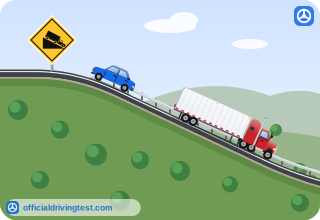
What happens when brakes are applied continuously to control speed on a downgrade?
- The brakes grip harder
- The brakes become ineffective
- The vehicle slows more safely
- The engine overheats
Show answer
Correct answer: The brakes become ineffective
The continuous application of brakes on downgrades causes the brakes to become ineffective, which is more dangerous with large vehicles.
Source: Hawaii Driver's Manual (2023), page 86 · Open this page in the manual (Manual page 86)
-
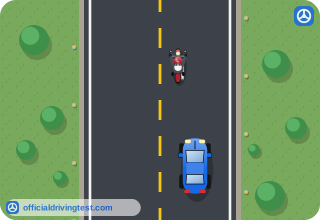
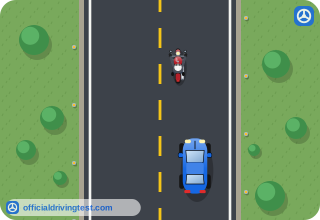
What is the minimum following distance when driving behind a motorcycle?
- 1 second
- 2 seconds
- 4 seconds
- 6 seconds
Show answer
Correct answer: 2 seconds
The manual says to allow at least a 2-second following distance behind a motorcycle.
Source: Hawaii Driver's Manual (2023), page 93 · Open this page in the manual (Manual page 93)
-
Because it is hard to judge a motorcycle’s speed and distance, what should you do with the space between you and the motorcycle?
- Decrease it so the rider can see you
- Keep it the same as when following a car
- Keep it as small as the traffic allows
- Increase it, to avoid sudden braking
Show answer
Correct answer: Increase it, to avoid sudden braking
The space between the two vehicles should be increased to avoid sudden braking.
Source: Hawaii Driver's Manual (2023), page 93 · Open this page in the manual (Manual page 93)