Pavement markings in Georgia
The Georgia Driver's Manual shows or names everything on this page: 17 in all, on pages 36–37, 40.
Independent educational site · not affiliated with any government agency or DMV
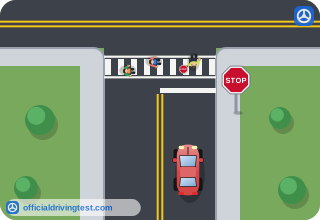
Stop Line
Stop lines are white lines painted across the pavement at intersections indicating the point beyond which your vehicle should not cross if you are stopping for a traffic control device. In urban areas, the line is usually located about four feet before the crosswalk. Drivers must come to a complete stop at the stop line, when present, not at the actual stop sign or traffic signal.
Manual page 36
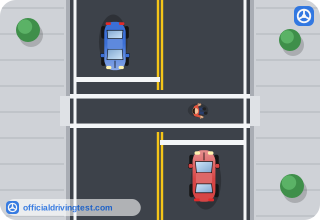
Crosswalk Lines
These white lines are painted across, or partially across the pavement. Sometimes they will be painted in a ladder pattern. When pedestrians are in the crosswalks, they have the right-of-way over motor vehicles. Crosswalks are sometimes in the middle of a block in residential areas, and in some cases, a pedestrian crossing signal is located at the white line.
Manual page 36
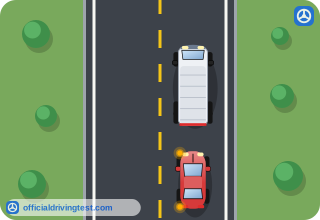
Broken Yellow Center Line
These are used to separate traffic moving in opposite directions on paved roadways. Broken yellow lines are used when there are only two lanes and it is safe to pass in either direction.
Manual page 36
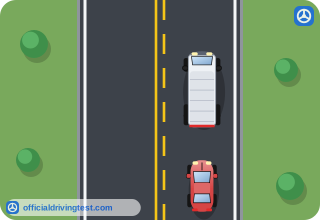
Solid and Broken Yellow Center Line
These single, solid yellow lines on two-lane roads indicate zones where passing is prohibited. They will be located on the right of the broken yellow line when they apply to the lane in which you are traveling.
Manual page 36
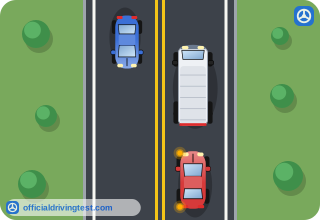
Double Solid Yellow Center Line
In some instances, both yellow lines will be solid, indicating it is not safe for passing in either direction.
Manual page 36
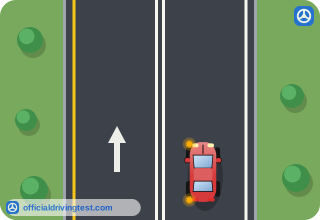
Double White Lines
These are double white line (dashed or solid) pavement markings on roadways that indicate where vehicles can or cannot cross to access the adjacent lane. When the double white lines are dashed, vehicles are allowed to cross over to the adjacent lane. When the double white lines are solid, lane changes are prohibited.
Manual page 36
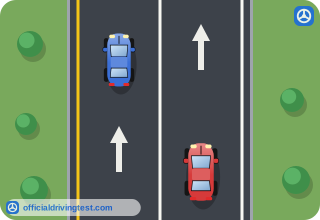
Solid White Edge Line
These are the solid white lines along the side of the pavement. They serve as safety guides, especially at night when it is difficult to see the edge of the road.
Manual page 36
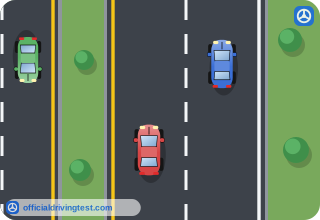
Yellow Left Edge Line
A yellow edge line may be used on the left side to warn of narrow or raised medians.
Manual page 36
Lane Lines on a Divided Road
These are the white dashes that mark the individual lanes of travel on streets and highways having more than one lane for traffic moving in the same direction.
Manual page 36
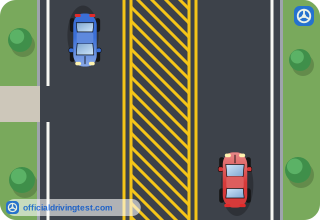
Diagonal Yellow Hatching (Median Nose)
These markings, created by diagonal yellow lines, are on streets and highways indicating that the road is narrowing or there is an obstruction on the roadway. The area is similar to a triangle with solid yellow diagonal lines within the outside lines. Always keep to the right of these markings.
Manual page 36
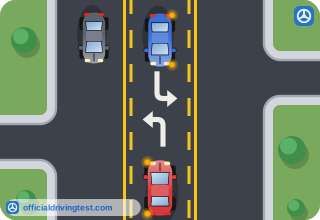
Left-Turn Lane at a Median Opening
These lanes, bordered by solid yellow and/or broken yellow lines, is in the center of many streets and highways to make left turns. A motorist desiring to turn left should proceed to the turn lane just prior to making a left turn. Georgia law prohibits the use of this lane for any purpose other than making a left turn. You may enter this lane no more than 300 feet from the location of the left turn.
Manual page 37
Two-Way Center Turn Lane
When a turning lane is provided for vehicles traveling in both directions, you should use extreme caution before entering the turning lane to make a left turn. There may be a vehicle traveling in the opposite direction also entering the turning lane to make a left turn.
Manual page 37
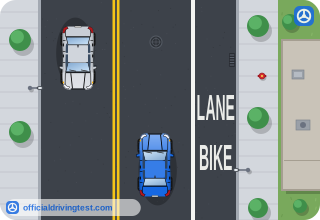
Bicycle Lane (Solid White Line)
These are solid white lines typically located between the farthest right traffic lane and the curb or edge of the roadway. If there is a right-turn-only lane present, the bicycle lane will be located to the left of the right-turn-only lane in order to safely accommodate bicycles traveling straight through the intersection. Bicycle lanes may also be marked with painted symbols of a bicycle. Drivers of motor vehicles are prohibited from driving or parking in the bicycle lane, except to cross over it to make a turn.
Manual page 37
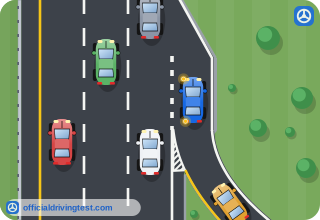
Gore Area
The gore is the area bounded by solid white lines between the acceleration lane and the adjacent travel lane. Drivers entering the controlled access highway are prohibited by law from crossing this solid white line, and are required to continue traveling in the acceleration lane until the solid white line disappears.
Manual page 40
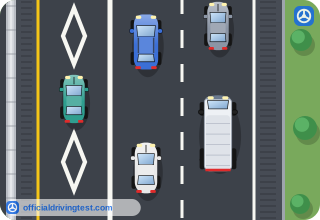
HOV Diamond Marking
The lanes are marked with a diamond symbol and the hours of restriction are posted.
Manual page 40
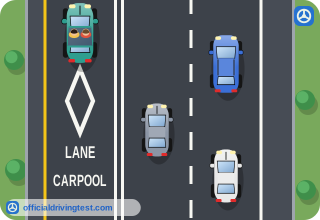
HOV Lane: Double White Lines (No Entry)
The manual does not state it
Manual page 40
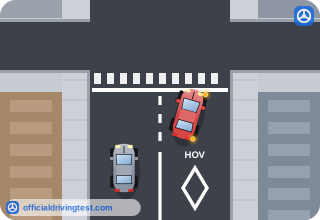
HOV Lane: Dashed White Line (May Enter)
The manual does not state it
Manual page 40