Georgia: Pavement markings Practice Test
White and yellow lines, lane markings and what each marking tells you.
Independent educational site · not affiliated with any government agency or DMV
Ready? Test yourself
- Instant feedback with an explanation
- Every answer cites its source in the manual
- Your best score is saved on this device
Questions are original and based on the official manual "Georgia Driver's Manual" (2023-2024), Georgia Department of Driver Services (DDS).
All 27 questions in this practice test
Take the test above first, then use this list to study. Tap “Show answer” to see the correct answer and explanation.
Show the questions and answersHide the questions
-
How is a passing zone indicated on a two-lane road?
- By a solid line nearest your vehicle
- By striped lines to the right of the center line
- By a solid white line along the edge of the road
- By a yellow diamond-shaped warning sign
Show answer
Correct answer: By striped lines to the right of the center line
The manual says a passing zone is indicated by striped lines to the right of the center line of the roadway.
Source: Georgia Driver's Manual (2023-2024), page 18
-
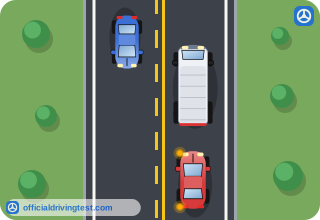
On a two-lane road, what does it mean if the line nearest your vehicle is solid?
- You may pass if the road ahead is clear
- You may pass only with your turn signal on
- You may pass only at a slow speed
- You are not in a passing zone
Show answer
Correct answer: You are not in a passing zone
A solid line nearest your vehicle means you are not in a passing zone.
Source: Georgia Driver's Manual (2023-2024), page 18
-
What are pavement markings used for, like highway signs?
- To direct drivers only, not to warn or regulate
- To show drivers where local businesses are located
- To warn and direct drivers and to regulate traffic
- To tell drivers the legal speed on each road
Show answer
Correct answer: To warn and direct drivers and to regulate traffic
Pavement markings, like highway signs, are used to warn and direct drivers and to regulate traffic.
Source: Georgia Driver's Manual (2023-2024), page 36
-
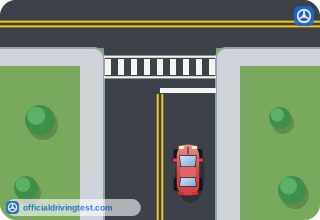
What do stop lines indicate?
- The point where you must begin to slow down as you get close to the intersection ahead
- The point beyond which your vehicle should not cross when stopping for a traffic control device
- The lane from which vehicles are allowed to make left turns at the intersection ahead
- The place where the crosswalk begins for pedestrians who are crossing at the intersection
Show answer
Correct answer: The point beyond which your vehicle should not cross when stopping for a traffic control device
Stop lines are white lines showing the point beyond which your vehicle should not cross if stopping for a traffic control device.
Source: Georgia Driver's Manual (2023-2024), page 36
-
In urban areas, where is the stop line usually located?
- About ten feet before the crosswalk
- About four feet after the crosswalk
- In the middle of the crosswalk
- About four feet before the crosswalk
Show answer
Correct answer: About four feet before the crosswalk
In urban areas, the stop line is usually about four feet before the crosswalk.
Source: Georgia Driver's Manual (2023-2024), page 36
-
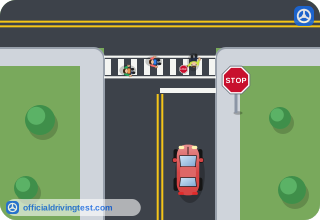
Where must drivers come to a complete stop when a stop line is present?
- At the stop sign or traffic signal, not at the stop line
- At the stop line, not at the actual stop sign or traffic signal
- In the crosswalk, so you can see the cross traffic
- Just past the stop line, at the edge of the intersection
Show answer
Correct answer: At the stop line, not at the actual stop sign or traffic signal
Drivers must stop at the stop line, when present, not at the actual stop sign or traffic signal.
Source: Georgia Driver's Manual (2023-2024), page 36
-
What color are crosswalk lines?
- White
- Yellow
- Orange
- Red
Show answer
Correct answer: White
Crosswalk lines are white lines painted across, or partially across, the pavement.
Source: Georgia Driver's Manual (2023-2024), page 36
-
Where are crosswalks sometimes located in residential areas?
- Only at corners with traffic signals
- Only next to school buildings
- In the middle of a block
- Only beside railroad crossings
Show answer
Correct answer: In the middle of a block
Crosswalks are sometimes in the middle of a block in residential areas.
Source: Georgia Driver's Manual (2023-2024), page 36
-
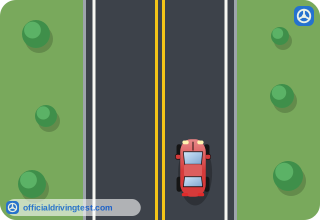
What are center lines used for?
- To separate lanes of traffic moving in the same direction
- To separate traffic moving in opposite directions on paved roadways
- To mark the edge of the paved roadway
- To show the places where parking is not allowed
Show answer
Correct answer: To separate traffic moving in opposite directions on paved roadways
Center lines separate traffic moving in opposite directions on paved roadways.
Source: Georgia Driver's Manual (2023-2024), page 36
-
When are broken yellow center lines used?
- When there are only two lanes and it is safe to pass in either direction
- When there are four lanes and passing is not allowed in either direction
- When the road is narrowing and traffic from two lanes must merge
- When the center lane is reserved for vehicles that are turning left
Show answer
Correct answer: When there are only two lanes and it is safe to pass in either direction
Broken yellow lines are used when there are only two lanes and it is safe to pass in either direction.
Source: Georgia Driver's Manual (2023-2024), page 36
-
What do single, solid yellow lines on two-lane roads indicate?
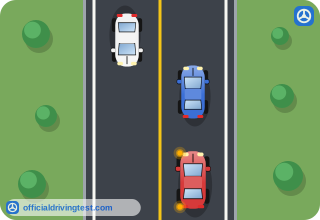
- Zones where passing is allowed in either direction
- Zones where the road is narrowing ahead
- Zones where only slow vehicles may pass
- Zones where passing is prohibited
Show answer
Correct answer: Zones where passing is prohibited
Single, solid yellow lines on two-lane roads indicate zones where passing is prohibited.
Source: Georgia Driver's Manual (2023-2024), page 36
-
Where is a solid yellow no-passing line located when it applies to the lane in which you are traveling?
- On the left of the broken yellow line
- On the edge of the roadway
- On the right of the broken yellow line
- Between two broken white lines
Show answer
Correct answer: On the right of the broken yellow line
The solid yellow line is located on the right of the broken yellow line when it applies to your lane.
Source: Georgia Driver's Manual (2023-2024), page 36
-
What does it mean when both yellow center lines on a two-lane road are solid?
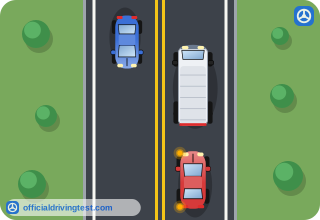
- It is not safe to pass in either direction
- It is safe to pass in either direction
- Passing is allowed only on the right side
- Passing is allowed after slowing down
Show answer
Correct answer: It is not safe to pass in either direction
When both yellow lines are solid it is not safe for passing in either direction.
Source: Georgia Driver's Manual (2023-2024), page 36
-
What may vehicles do when double white lines are dashed?
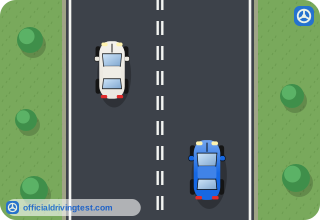
- Not change lanes at any time
- Only pass on the right shoulder
- Cross over to the adjacent lane
- Park along the side of the lane
Show answer
Correct answer: Cross over to the adjacent lane
When the double white lines are dashed, vehicles are allowed to cross over to the adjacent lane.
Source: Georgia Driver's Manual (2023-2024), page 36
-
What do solid double white lines mean?
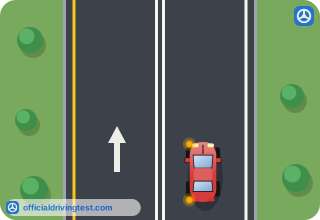
- Lane changes are allowed if the way is clear
- Lane changes are prohibited
- Passing is allowed in either direction
- Traffic flows in opposite directions
Show answer
Correct answer: Lane changes are prohibited
When the double white lines are solid, lane changes are prohibited.
Source: Georgia Driver's Manual (2023-2024), page 36
-
What are the solid white lines along the side of the pavement called?
- Lane lines
- Stop lines
- Center lines
- Edge lines
Show answer
Correct answer: Edge lines
Edge lines are the solid white lines along the side of the pavement.
Source: Georgia Driver's Manual (2023-2024), page 36
-
When are edge lines especially useful as safety guides?
- In heavy rain, when water covers parts of the road
- At night, when it is difficult to see the edge of the road
- During rush hour, when traffic is moving very slowly
- On icy roads, when vehicles tend to slide sideways
Show answer
Correct answer: At night, when it is difficult to see the edge of the road
Edge lines serve as safety guides, especially at night when it is difficult to see the edge of the road.
Source: Georgia Driver's Manual (2023-2024), page 36
-
What may a yellow edge line on the left side of the road warn of?
- Narrow or raised medians
- A railroad crossing ahead
- A school zone ahead
- A sharp curve ahead
Show answer
Correct answer: Narrow or raised medians
A yellow edge line may be used on the left side to warn of narrow or raised medians.
Source: Georgia Driver's Manual (2023-2024), page 36
-
What marks the individual lanes of travel on roads with more than one lane for traffic moving in the same direction?
- Solid yellow lines
- Solid white lines
- Double white lines
- White dashes
Show answer
Correct answer: White dashes
Lane lines are the white dashes that mark the individual lanes of travel.
Source: Georgia Driver's Manual (2023-2024), page 36
-
What marks the center of a roadway with four or more lanes and traffic moving in opposite directions?
- One broken yellow line
- Two broken white lines
- Two solid yellow lines
- One solid white line
Show answer
Correct answer: Two solid yellow lines
With four or more lanes, two solid yellow lines mark the center of the roadway.
Source: Georgia Driver's Manual (2023-2024), page 36
-
When may you cross the two solid yellow lines marking the center of a roadway?
- Only to make a left turn into or from an alley, private road, driveway, or another street
- To pass a slow vehicle when there is no oncoming traffic within sight of you
- Only to avoid an obstruction that is blocking part of the roadway ahead of you
- Only to turn around when the road is clear of all traffic in both directions
Show answer
Correct answer: Only to make a left turn into or from an alley, private road, driveway, or another street
You may cross these lines only to make a left turn into or from an alley, private road, driveway, or another street.
Source: Georgia Driver's Manual (2023-2024), page 36
-
On a multi-lane road, which lane should you stay in except to pass other vehicles going the same direction?
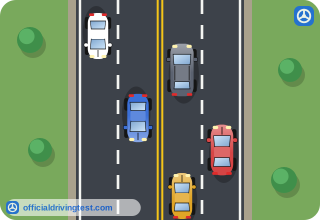
- The left lane
- The center lane
- The right lane
- The fastest-moving lane
Show answer
Correct answer: The right lane
When traveling on a multi-lane road, stay in the right lane except to pass other vehicles.
Source: Georgia Driver's Manual (2023-2024), page 36
-
What do diagonal yellow lines (traffic striping) on streets and highways indicate?
- That a school zone is ahead and all drivers must slow down
- That the road is narrowing or there is an obstruction on the roadway
- That passing is allowed on the left side of the striping
- That a pedestrian crossing is just ahead and you must stop
Show answer
Correct answer: That the road is narrowing or there is an obstruction on the roadway
Traffic striping made of diagonal yellow lines indicates the road is narrowing or there is an obstruction on the roadway.
Source: Georgia Driver's Manual (2023-2024), page 36
-
How should you travel in relation to traffic striping made of diagonal yellow lines?
- Always keep to the left of these markings
- Drive over the markings when the road is clear
- Choose either side of these markings
- Always keep to the right of these markings
Show answer
Correct answer: Always keep to the right of these markings
The manual says to always keep to the right of these markings.
Source: Georgia Driver's Manual (2023-2024), page 36
-
What borders a center turn lane used for making left turns?
- Solid white lines only
- Solid yellow and/or broken yellow lines
- Double solid white lines
- A solid yellow and a solid white line
Show answer
Correct answer: Solid yellow and/or broken yellow lines
Turn lanes are bordered by solid yellow and/or broken yellow lines.
Source: Georgia Driver's Manual (2023-2024), page 37
-
According to the manual's HOV lane caption, what do double white lines mean?
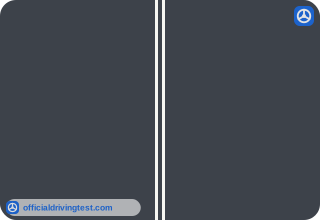
- No entry
- You may enter
- Merge only
- Exit only
Show answer
Correct answer: No entry
The caption states that double white lines mean no entry.
Source: Georgia Driver's Manual (2023-2024), page 40
-
According to the manual's HOV lane caption, what does a dashed white line mean?
- No entry
- The HOV lane ends ahead
- Buses only
- You may enter
Show answer
Correct answer: You may enter
The caption states that a dashed white line means you may enter.
Source: Georgia Driver's Manual (2023-2024), page 40