Georgia: Right of way & turning
Intersections, turning, roundabouts, passing and yielding. Split into 4 shorter tests so you're not stuck in one long quiz.
Independent educational site · not affiliated with any government agency or DMV
Choose a part
Right of way & turning — Part 1
Questions in this part include: “On the driving test, to whom must you always yield right-of-way when they move into the intersection before you?”
StartRight of way & turning — Part 2
Questions in this part include: “Passing on a two-lane road is prohibited in an area marked by which of these?”
StartRight of way & turning — Part 3
Questions in this part include: “Where should you not make a U-turn?”
StartRight of way & turning — Part 4
Questions in this part include: “How far from the location of the left turn may you enter the center turn lane?”
StartAll 69 Right of way & turning questions with answers
Choose a part above to take a practice test, or study every question and answer here.
Show the questions and answersHide the questions
-
When approaching intersections and corners on the driving test, what must you do?
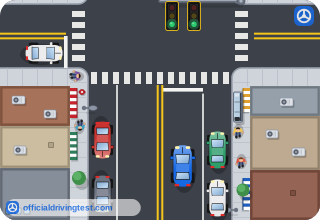
- Be in the proper lane and look in both directions
- Stop at every corner and wait for the examiner to speak
- Stay in the far left lane and watch only oncoming traffic
- Sound the horn and look straight ahead
Show answer
Correct answer: Be in the proper lane and look in both directions
You must be in the proper lane and look in both directions when approaching intersections and corners.
Source: Georgia Driver's Manual (2023-2024), page 12
-
On the driving test, to whom must you always yield right-of-way when they move into the intersection before you?
- Only vehicle operators
- Only pedestrians
- Pedestrians, vehicle operators, and bicyclists
- Pedestrians and vehicle operators, but not bicyclists
Show answer
Correct answer: Pedestrians, vehicle operators, and bicyclists
You must yield to pedestrians, vehicle operators and bicyclists who move into the intersection before you.
Source: Georgia Driver's Manual (2023-2024), page 12
-
For the turning part of the driving test, what must you do?
- Signal only after you have begun turning into the intersection
- Move into the proper lane and signal an adequate distance before the turn
- Turn from the center of the road and signal when you reach the corner
- Stay in your current lane and signal with your horn
Show answer
Correct answer: Move into the proper lane and signal an adequate distance before the turn
Turning requires moving into the proper lane and signaling an adequate distance before the turn.
Source: Georgia Driver's Manual (2023-2024), page 12
-
What does the manual say about right-of-way?
- It belongs to the driver who is traveling faster
- It belongs to the driver in the larger vehicle
- It is decided by each driver on the spot
- It is something to be given, not taken
Show answer
Correct answer: It is something to be given, not taken
The manual tells drivers and pedestrians to remember that right-of-way is something to be given, not taken.
Source: Georgia Driver's Manual (2023-2024), page 17
-
Right-of-way describes who has the lawful authority to do which of these?
- Enter a roadway, turn, or travel through an intersection
- Set the legal speed limit for a section of roadway
- Park a vehicle in front of a large public building
- Pass another vehicle on a two-lane road at night
Show answer
Correct answer: Enter a roadway, turn, or travel through an intersection
The manual defines right-of-way as the lawful authority to enter a roadway, change lanes, turn, travel through an intersection, or make any other traffic related movement.
Source: Georgia Driver's Manual (2023-2024), page 17
-
You have the legal right-of-way, but another person does not realize it and is not obeying the rules of the road. What does the manual say you should do?
- Keep going because the law is on your side
- Sound your horn and proceed at the same speed
- Yield the right-of-way in order to prevent a crash
- Stop and wait for a law enforcement officer to arrive
Show answer
Correct answer: Yield the right-of-way in order to prevent a crash
The manual says that even when you have the legal right-of-way, it should be yielded to prevent a crash.
Source: Georgia Driver's Manual (2023-2024), page 17
-
You face a stop sign, but the other traffic on the intersecting roadway does not. When may you proceed?
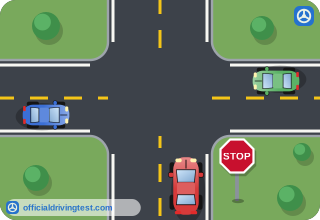
- After slowing down and confirming that the intersection looks clear to you
- After stopping and yielding to any vehicle or pedestrian in or near the intersection
- As soon as the driver on the cross street signals you to go ahead of them
- After sounding your horn to warn anyone already in the intersection
Show answer
Correct answer: After stopping and yielding to any vehicle or pedestrian in or near the intersection
A driver facing a stop sign may proceed only after stopping and yielding to any vehicle or pedestrian in or dangerously close to the intersection.
Source: Georgia Driver's Manual (2023-2024), page 17
-
At an intersection with no stop signs, yield signs or other traffic signals, two vehicles arrive at the same time. Which driver must yield?
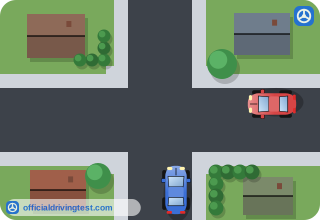
- The driver of the vehicle on the right must yield to the driver on the left
- The driver of the larger vehicle must yield to the driver of the smaller one
- The driver traveling at the higher speed must yield to the slower driver
- The driver of the vehicle on the left must yield to the driver on the right
Show answer
Correct answer: The driver of the vehicle on the left must yield to the driver on the right
When two vehicles reach an uncontrolled intersection at the same time, the driver on the left yields to the driver on the right.
Source: Georgia Driver's Manual (2023-2024), page 17
-
At a four-way intersection where all drivers face stop signs, all drivers must yield to whom?
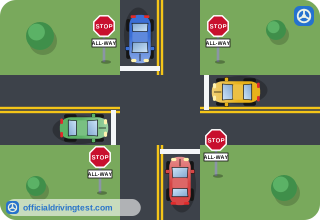
- Pedestrians
- Vehicles turning left
- Buses and trucks
- Bicycles only
Show answer
Correct answer: Pedestrians
At an all-way stop, all drivers must yield to pedestrians, and the vehicles then go in the order they arrived.
Source: Georgia Driver's Manual (2023-2024), page 17
-
At a four-way intersection where all drivers face stop signs, two vehicles reach the intersection at approximately the same time. Which vehicles should you yield to?
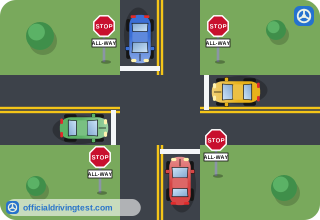
- Vehicles on your left
- Vehicles going straight
- Vehicles on your right
- Vehicles that are larger than yours
Show answer
Correct answer: Vehicles on your right
The manual says that if two vehicles reach an all-way stop at about the same time, you yield to any vehicles on your right.
Source: Georgia Driver's Manual (2023-2024), page 17
-
Another driver tries to take your turn, even though you have the right-of-way. What should you do?
- Sound your horn and proceed
- Let the other driver proceed
- Proceed to keep traffic moving
- Flash your headlights and hold your position
Show answer
Correct answer: Let the other driver proceed
The manual says to let the other driver proceed, because it might prevent a traffic crash.
Source: Georgia Driver's Manual (2023-2024), page 17
-
When making a left turn at an intersection, or into an alley or driveway, to whom must you yield the right-of-way?
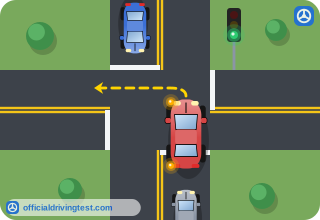
- Only vehicles that are traveling at the speed limit
- Only vehicles that are less than a block away
- Only vehicles that have their turn signals on
- All traffic coming from the opposite direction
Show answer
Correct answer: All traffic coming from the opposite direction
A driver turning left at an intersection, alley or driveway must yield to all traffic coming from the opposite direction.
Source: Georgia Driver's Manual (2023-2024), page 17
-
What should you do when approaching a yield sign?
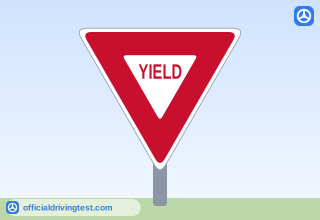
- Slow down to a safe speed and be prepared to stop
- Come to a complete stop every time
- Keep your speed if no traffic is in sight
- Speed up to get ahead of other traffic
Show answer
Correct answer: Slow down to a safe speed and be prepared to stop
At a yield sign you slow to a safe speed and be prepared to stop, stopping if necessary and proceeding only when it is safe.
Source: Georgia Driver's Manual (2023-2024), page 17
-
Traffic from another roadway is merging into the roadway you are traveling on. What should you do first, if possible?
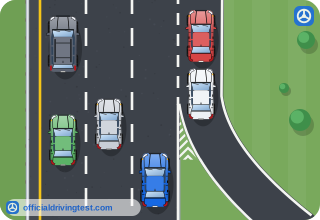
- Speed up to stay ahead of the merging traffic
- Stay in your lane and sound your horn
- Safely change lanes away from the merging traffic
- Slow down and stop until the merging traffic has gone by
Show answer
Correct answer: Safely change lanes away from the merging traffic
If traffic is merging into your roadway, you should safely change lanes away from it if possible, and otherwise adjust your speed and position.
Source: Georgia Driver's Manual (2023-2024), page 17
-
The roadway you are traveling on is merging into other traffic without stopping. What must you do?
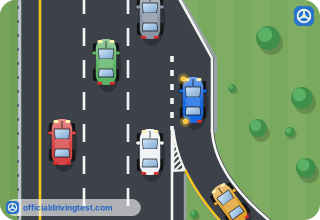
- Stop at the end of the merging lane and wait for a gap
- Adjust your speed and position to merge safely
- Keep the same speed and let the other drivers move over
- Move onto the shoulder and let the other traffic pass first
Show answer
Correct answer: Adjust your speed and position to merge safely
When your roadway merges into other traffic without stopping, you adjust your speed and position so you can merge safely.
Source: Georgia Driver's Manual (2023-2024), page 17
-
You are about to enter or cross a highway from an alley or a private road. What must you do?
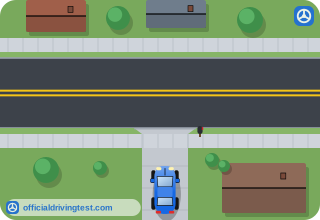
- Stop and yield to all pedestrians and vehicles already on the road
- Slow down and yield only to vehicles already on the roadway
- Stop only if other vehicles are in sight on the roadway
- Proceed first if you sound your horn as a warning
Show answer
Correct answer: Stop and yield to all pedestrians and vehicles already on the road
Entering or crossing a highway from an alley or private road requires a stop and yielding to all pedestrians and vehicles already on the roadway or sidewalk.
Source: Georgia Driver's Manual (2023-2024), page 17
-
Unless a sign prohibits it, what must you do before making a right turn on red at a traffic control light?
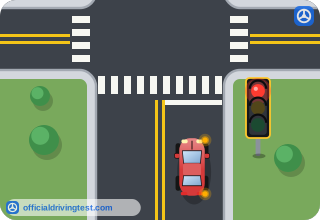
- Slow down, look left for oncoming traffic, and turn if nothing is coming
- Wait until the light turns yellow, then turn when the road is clear
- Stop completely, yield to all traffic and pedestrians, and confirm it is safe
- Sound your horn to warn cross traffic and then turn without stopping
Show answer
Correct answer: Stop completely, yield to all traffic and pedestrians, and confirm it is safe
A right turn on red is allowed only after a complete stop, yielding to all traffic and pedestrians, and determining that you can complete the turn safely.
Source: Georgia Driver's Manual (2023-2024), page 18
-
Unless a sign prohibits it, you may turn left on red from the left lane of a one-way street onto which kind of street?
- Any two-way street
- A one-way street on which traffic moves toward your left
- A one-way street on which traffic moves toward your right
- Any street that has a center turn lane
Show answer
Correct answer: A one-way street on which traffic moves toward your left
A left turn on red is allowed from the left lane of a one-way street onto a one-way street on which traffic moves to the driver's left.
Source: Georgia Driver's Manual (2023-2024), page 18
-
When passing on a two-lane road, you must return completely to the right lane before oncoming traffic is within how many feet of your vehicle?
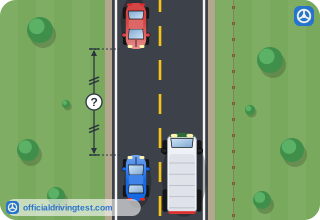
- 200 feet
- 100 feet
- 300 feet
- 500 feet
Show answer
Correct answer: 200 feet
You must have enough time and space to return completely to the right lane before oncoming traffic is within 200 feet of your vehicle.
Source: Georgia Driver's Manual (2023-2024), page 18
-
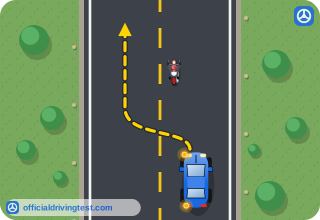
What should you do before leaving your lane to begin passing?
- Check only your rear view mirror and then pull out
- Sound your horn to warn the vehicle ahead of you
- Check mirrors and turn your head to check your blind spot
- Flash your headlights at the vehicle ahead of you
Show answer
Correct answer: Check mirrors and turn your head to check your blind spot
Before passing, you check your rear view and side mirrors and turn your head to check your blind spot.
Source: Georgia Driver's Manual (2023-2024), page 18
-
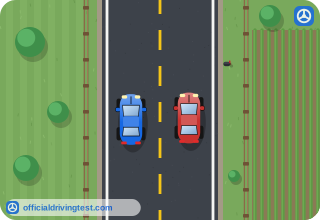
After passing on the left, when should you return to the right lane?
- As soon as your front bumper is ahead of the other vehicle's bumper
- When the driver you passed flashes their headlights at you
- After you have driven at least a quarter mile past the other vehicle
- When you can see the car you just passed in your rear view mirror
Show answer
Correct answer: When you can see the car you just passed in your rear view mirror
Do not return to the right lane until your vehicle is safely clear of the overtaken vehicle, meaning you can see it in your rear view mirror.
Source: Georgia Driver's Manual (2023-2024), page 18
-
Passing on a two-lane road is prohibited in an area marked by which of these?
- A broken yellow line nearest your vehicle
- Double yellow lines
- A solid white line along the shoulder
- A yellow diamond-shaped warning sign
Show answer
Correct answer: Double yellow lines
Passing is prohibited in an area marked by a solid yellow line on the right of the center line, a "Do Not Pass" sign, or double yellow lines.
Source: Georgia Driver's Manual (2023-2024), page 18
-
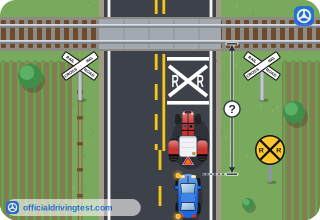
Within how many feet of a railroad crossing is passing prohibited on a two-lane road?
- 50 feet
- 150 feet
- 200 feet
- 100 feet
Show answer
Correct answer: 100 feet
Passing on two-lane roads is prohibited within 100 feet of a railroad crossing.
Source: Georgia Driver's Manual (2023-2024), page 18
-
On a two-lane road, passing is prohibited within 100 feet of which of these?
- A bridge, viaduct or tunnel
- A traffic signal at an intersection
- A private driveway or alley
- A bus stop or school zone
Show answer
Correct answer: A bridge, viaduct or tunnel
Passing on two-lane roads is prohibited within 100 feet of a bridge, viaduct or tunnel.
Source: Georgia Driver's Manual (2023-2024), page 18
-
Where is passing prohibited on a two-lane road?
- On any road that has a paved shoulder beside it
- On any straight road that has a posted speed limit
- On a hill or curve where you cannot see oncoming vehicles
- On any road where the vehicle ahead is moving slowly
Show answer
Correct answer: On a hill or curve where you cannot see oncoming vehicles
Passing is prohibited on a hill or curve where you cannot see oncoming vehicles that might be a hazard.
Source: Georgia Driver's Manual (2023-2024), page 19
-
Which statement about passing on the shoulder of the road is correct?
- It is allowed when the lane ahead is blocked
- Passing on the shoulder of the road is prohibited
- It is allowed when the vehicle ahead is turning left
- It is allowed when the vehicle ahead is moving slowly
Show answer
Correct answer: Passing on the shoulder of the road is prohibited
The manual lists the shoulder of the road among the places where passing is prohibited on two-lane roads.
Source: Georgia Driver's Manual (2023-2024), page 19
-
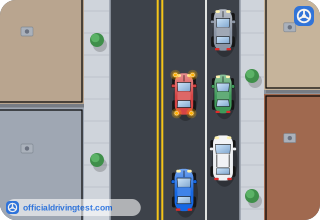
When an obstruction makes it necessary to drive to the left of the center line, what must you do first?
- Sound your horn
- Speed up
- Flash your headlights
- Yield to oncoming traffic
Show answer
Correct answer: Yield to oncoming traffic
Passing to the left of the center line because of an obstruction is permitted only after yielding to oncoming traffic.
Source: Georgia Driver's Manual (2023-2024), page 19
-
Passing is permitted on a roadway that includes which of these?
- Two or more marked lanes in the same direction
- A solid yellow line on the right of the center line
- A railroad crossing within the next 100 feet
- A hill crest that blocks the view of oncoming cars
Show answer
Correct answer: Two or more marked lanes in the same direction
The manual lists a roadway with two or more marked lanes in the same direction as a situation in which passing is permitted.
Source: Georgia Driver's Manual (2023-2024), page 19
-
On a multi-lane, two-way highway, when may you drive to the left of the center line?
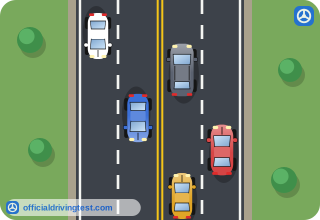
- Whenever the lane to your right is blocked by slow-moving traffic
- Only when you are passing a vehicle that is stopped in the road
- When making a left turn into an alley, private road, or driveway
- Whenever no vehicles are approaching from the opposite direction
Show answer
Correct answer: When making a left turn into an alley, private road, or driveway
On a multi-lane, two-way highway you must never drive left of the center line except when making a left turn into an alley, private road or driveway.
Source: Georgia Driver's Manual (2023-2024), page 19
-
When making a right turn, in which lane should you approach the intersection?
- The center lane, so that you have room on both sides
- The left lane, so that you can swing wide and turn sharply
- The right lane, close to the curb or edge of the roadway
- Any lane that has the least traffic in it
Show answer
Correct answer: The right lane, close to the curb or edge of the roadway
You approach a right turn in the right lane, staying as close as practicable to the curb or edge of the roadway.
Source: Georgia Driver's Manual (2023-2024), page 19
-
There is a bicycle lane on the road you are traveling on, and you want to make a right turn. What must you do?
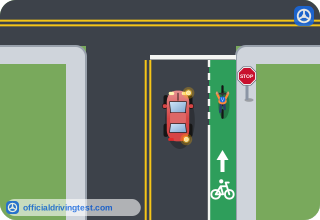
- Turn first, because bicyclists must yield to turning vehicles
- Yield to bicyclists traveling straight through the intersection
- Sound your horn and turn before the bicyclists arrive
- Stop and wave the bicyclists to the left of your vehicle
Show answer
Correct answer: Yield to bicyclists traveling straight through the intersection
With a bicycle lane present, you must yield to bicyclists traveling straight through the intersection before making a right turn.
Source: Georgia Driver's Manual (2023-2024), page 19
-
After you make a right turn, which lane should your vehicle end up in?
- The lane closest to the center line
- The lane that has the least traffic
- The left lane of the street you turned into
- The right lane of the street you turned into
Show answer
Correct answer: The right lane of the street you turned into
A right turn should end in the right lane of the street you turn into, without entering any other lane of traffic.
Source: Georgia Driver's Manual (2023-2024), page 19
-
There are multiple turning lanes on the street you are turning from. Where should your vehicle end up after the turn?
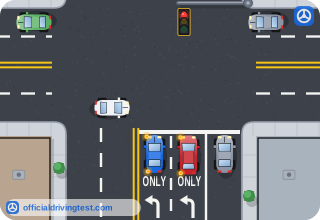
- In the corresponding lane on the street you are turning onto
- In the lane closest to the curb on the new street
- In the lane that has the least traffic on the new street
- In the far left lane of the new street
Show answer
Correct answer: In the corresponding lane on the street you are turning onto
With multiple turning lanes, you complete the turn so your vehicle ends up in the corresponding lane on the street you are turning onto.
Source: Georgia Driver's Manual (2023-2024), page 19
-
Which lane should you move into before making a left turn?
- The center lane of your direction of travel, to leave room
- The right lane, and then turn across all the other lanes
- The far left lane, or the turning lane if one is provided
- Any lane in your direction that has the fewest vehicles
Show answer
Correct answer: The far left lane, or the turning lane if one is provided
For a left turn you move into the far left lane of your direction of travel, or the turning lane if there is one.
Source: Georgia Driver's Manual (2023-2024), page 19
-
Until you begin making a left turn, how should you keep your wheels?
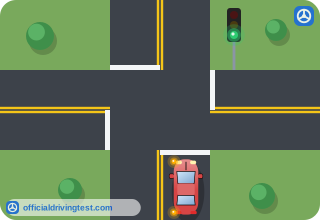
- Turned slightly to the left
- Straight
- Turned slightly to the right
- Turned toward the curb
Show answer
Correct answer: Straight
The manual says to keep your wheels straight until you begin making the turn.
Source: Georgia Driver's Manual (2023-2024), page 19
-
After a left turn, which lane should your vehicle end up in?
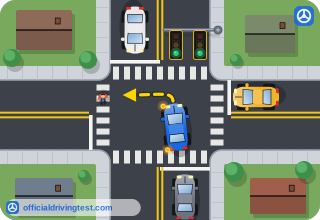
- The lane that is closest to the curb on the street you turned onto
- The right lane of the street that you have just turned onto
- The lane that is farthest away from the oncoming traffic
- The lane closest to the center lane(s), or to the center line if there is none
Show answer
Correct answer: The lane closest to the center lane(s), or to the center line if there is none
A left turn should end in the lane closest to the center lane(s) in your direction, or closest to the center line if there is no center lane.
Source: Georgia Driver's Manual (2023-2024), page 19
-
Once you have entered an intersection to make a left turn, what are you not allowed to do?
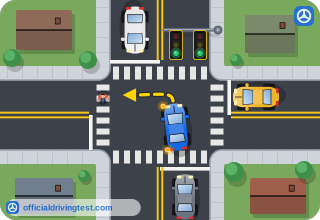
- Change lanes in the intersection
- Slow down before completing the turn
- Yield to pedestrians in the crosswalk
- Use your left turn signal
Show answer
Correct answer: Change lanes in the intersection
Once you are in the intersection for a left turn, you cannot change lanes there.
Source: Georgia Driver's Manual (2023-2024), page 19
-
Where should you not make a U-turn?
- On any street that has more than two lanes of traffic
- At any intersection that is controlled by a traffic signal
- On any road where a posted speed limit is displayed
- On a curve or near a hilltop where other drivers cannot see you
Show answer
Correct answer: On a curve or near a hilltop where other drivers cannot see you
Do not make a U-turn on a curve or near the top of a hill if you cannot be seen by other drivers approaching from either direction.
Source: Georgia Driver's Manual (2023-2024), page 20
-
What must you always do when making a left turn on a multi-lane, two-way highway?
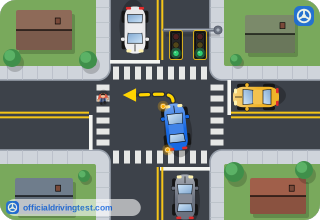
- Yield to oncoming traffic and wait for pedestrians to clear
- Yield only to pedestrians and go ahead of oncoming traffic
- Turn ahead of oncoming traffic once you have signaled
- Proceed if oncoming traffic is slowing down for you
Show answer
Correct answer: Yield to oncoming traffic and wait for pedestrians to clear
Left turns require you to always yield to oncoming traffic and wait for pedestrians to clear the lanes, driveway, sidewalk or alley you are turning into.
Source: Georgia Driver's Manual (2023-2024), page 20
-
Passing is permitted on a roadway that has more than one lane and is restricted to which kind of traffic?
- Two-way traffic only
- Commercial traffic only
- Bicycle traffic only
- One-way traffic
Show answer
Correct answer: One-way traffic
The manual lists a roadway with more than one lane that is restricted to one-way traffic as a situation in which passing is permitted.
Source: Georgia Driver's Manual (2023-2024), page 19
-
Where may you drive across a dividing section, barrier, or unpaved strip that separates two roadways?
- Only at an authorized opening or crossover
- Anywhere, if no traffic is approaching
- Anywhere, if you use your turn signal
- Anywhere on a rural road
Show answer
Correct answer: Only at an authorized opening or crossover
It is unlawful to cross a median at any point other than an authorized opening or crossover.
Source: Georgia Driver's Manual (2023-2024), page 23
-
Which vehicles may drive contrary to the direction posted on a one-way street when they find it necessary?
- Delivery trucks making a stop
- Any vehicle with its hazard lights on
- Vehicles carrying more than two passengers
- Police vehicles and authorized emergency vehicles
Show answer
Correct answer: Police vehicles and authorized emergency vehicles
The manual allows police vehicles or authorized emergency vehicles to drive against the posted direction when necessary.
Source: Georgia Driver's Manual (2023-2024), page 23
-
Who can direct a driver to go contrary to the posted direction on a one-way street?
- Any pedestrian who is standing on the sidewalk beside the one-way street
- A traffic control device, authorized emergency personnel, or construction workers
- Any other driver who is stopped on the same one-way street ahead of you
- A passenger riding in your vehicle who holds a valid driver's license
Show answer
Correct answer: A traffic control device, authorized emergency personnel, or construction workers
Unless directed by a traffic control device, authorized emergency personnel or construction workers, driving against a one-way street is unlawful.
Source: Georgia Driver's Manual (2023-2024), page 23
-
A driver behind you is overtaking your vehicle. What is considered courteous?
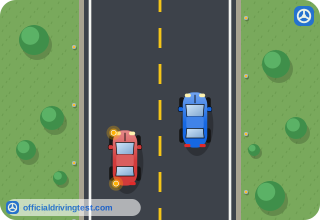
- Reducing your speed slightly to make it easier for the other vehicle to pass
- Moving onto the shoulder and stopping until the other vehicle has passed
- Flashing your turn signal to tell the other driver it is safe to pass
- Keeping your speed exactly the same and ignoring the other driver
Show answer
Correct answer: Reducing your speed slightly to make it easier for the other vehicle to pass
The manual says it is courteous to reduce your speed slightly so the other vehicle can pass more easily.
Source: Georgia Driver's Manual (2023-2024), page 19
-
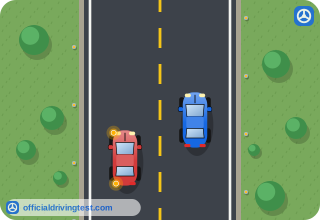
When an overtaking vehicle is passing you, it is unlawful to increase your speed until when?
- The overtaking vehicle has signaled its intent to pass
- The overtaking vehicle is beside your front bumper
- You have been passed completely by the overtaking vehicle
- The overtaking vehicle has moved half a lane ahead of you
Show answer
Correct answer: You have been passed completely by the overtaking vehicle
The manual says it is unlawful to increase your speed before you have been passed completely by the overtaking vehicle.
Source: Georgia Driver's Manual (2023-2024), page 19
-
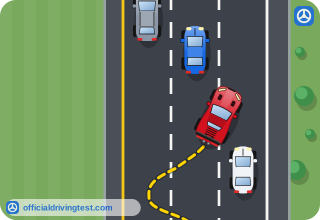
What does the manual say about weaving from one lane of traffic to another?
- It is unlawful only on highways with three or more lanes
- It is unlawful when done to move faster than the flow of traffic
- It is lawful on any multi-lane highway when you signal first
- It is lawful when traffic ahead of you is moving slowly
Show answer
Correct answer: It is unlawful when done to move faster than the flow of traffic
The manual says it is unlawful to weave from one lane to another in order to move faster than the flow of traffic.
Source: Georgia Driver's Manual (2023-2024), page 19
-
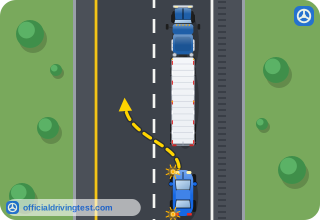
When may a motorist change lanes on a multi-lane highway and pass slower moving vehicles?
- Only when it is safe to do so
- Whenever traffic in your lane is moving slowly
- Whenever you have signaled for at least three seconds
- Only when the vehicle ahead is below the speed limit
Show answer
Correct answer: Only when it is safe to do so
The manual says a motorist may change lanes and pass slower vehicles only when it is safe to do so.
Source: Georgia Driver's Manual (2023-2024), page 19
-
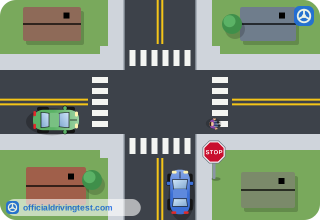
At a stop sign with no marked stop line, where must you stop?
- In the center of the intersection
- Past the crosswalk so you can see traffic
- Past the crosswalk, at the edge of the cross street lane
- Before the crosswalk on your side of the intersection
Show answer
Correct answer: Before the crosswalk on your side of the intersection
With no stop line, you stop before the crosswalk on your side of the intersection.
Source: Georgia Driver's Manual (2023-2024), page 28
-
At a stop sign with no stop line and no crosswalk, where must you stop?
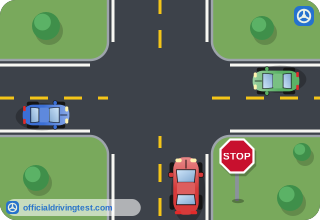
- Exactly at the edge of the intersection
- At a point from which you can best see oncoming traffic
- Wherever the driver behind you can see you clearly
- In the middle of the intersection
Show answer
Correct answer: At a point from which you can best see oncoming traffic
With no stop line or crosswalk, you stop at a point from which you can best see oncoming traffic.
Source: Georgia Driver's Manual (2023-2024), page 28
-
After stopping at a stop sign, you must not start again until all pedestrians have finished crossing where?
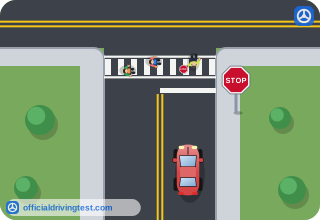
- On both sides of the roadway at the intersection
- On the side of the roadway you are traveling on
- Anywhere within the intersection
- On the cross street only
Show answer
Correct answer: On the side of the roadway you are traveling on
You must wait until pedestrians have finished crossing on the side of the roadway you are traveling on.
Source: Georgia Driver's Manual (2023-2024), page 28
-
After stopping at a stop sign, you must yield the right-of-way to which traffic before starting again?
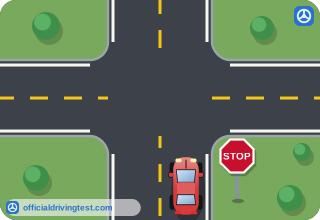
- Only vehicles that are turning left
- Only vehicles that have a green light
- Only bicyclists and pedestrians
- Closely approaching traffic
Show answer
Correct answer: Closely approaching traffic
After a complete stop you must also yield the right-of-way to closely approaching traffic.
Source: Georgia Driver's Manual (2023-2024), page 28
-
When you come to a yield sign, what must you do?
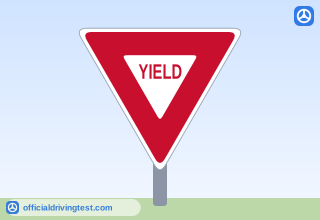
- Come to a complete stop every time before proceeding
- Keep your speed and change lanes to avoid traffic
- Slow down to a reasonable speed and stop if necessary
- Flash your headlights and proceed with caution
Show answer
Correct answer: Slow down to a reasonable speed and stop if necessary
At a yield sign you slow to a speed that is reasonable for existing conditions and stop if necessary.
Source: Georgia Driver's Manual (2023-2024), page 28
-
If you must stop at a yield sign, where do you stop?
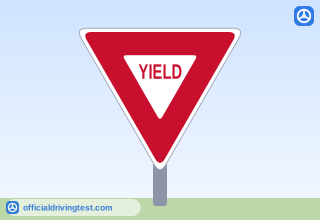
- In the center of the intersection
- Past the crosswalk so you can see traffic
- Beside the sign, even if you block the crosswalk
- At a marked stop line, if it exists
Show answer
Correct answer: At a marked stop line, if it exists
If you must stop at a yield sign, do so at a marked stop line, if one exists.
Source: Georgia Driver's Manual (2023-2024), page 28
-
After slowing or stopping at a yield sign, you must yield the right-of-way to which vehicles?
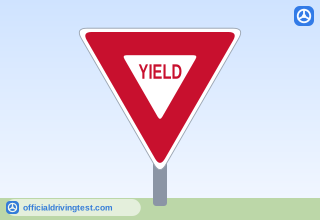
- Only vehicles that are already stopped there
- Vehicles in the intersection or approaching closely
- Only vehicles traveling above the speed limit
- Only vehicles that are turning in front of you
Show answer
Correct answer: Vehicles in the intersection or approaching closely
You must yield to other vehicles in the intersection or approaching closely on another roadway or auxiliary road.
Source: Georgia Driver's Manual (2023-2024), page 28
-
What does Georgia law say about using the center turn lane?
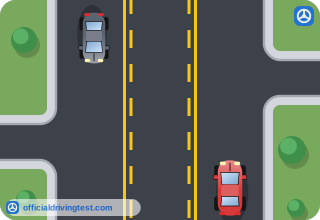
- It may not be used for any purpose other than making a left turn
- It may be used as a passing lane when no traffic is coming
- It may be used by slow vehicles to let other traffic pass
- It may be used to merge into traffic from a driveway
Show answer
Correct answer: It may not be used for any purpose other than making a left turn
Georgia law prohibits the use of this lane for any purpose other than making a left turn.
Source: Georgia Driver's Manual (2023-2024), page 37
-
How far from the location of the left turn may you enter the center turn lane?
- No more than 100 feet
- No more than 500 feet
- No more than 1,000 feet
- No more than 300 feet
Show answer
Correct answer: No more than 300 feet
You may enter this lane no more than 300 feet from the location of the left turn.
Source: Georgia Driver's Manual (2023-2024), page 37
-
When should a motorist who wants to turn left move into the turn lane?
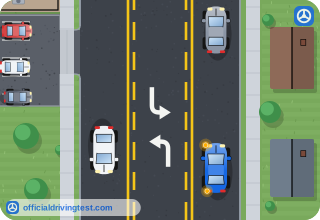
- As early as possible, well before the turn
- Right after passing the previous intersection
- Just prior to making the left turn
- Only after stopping at the far end of the lane
Show answer
Correct answer: Just prior to making the left turn
A motorist desiring to turn left should proceed to the turn lane just prior to making a left turn.
Source: Georgia Driver's Manual (2023-2024), page 37
-
What should you do before entering a turning lane that is provided for vehicles traveling in both directions?
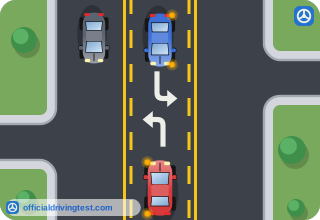
- Use extreme caution, because a vehicle from the opposite direction may be entering the lane too
- Speed up so that you enter the lane before any oncoming vehicle can also enter it
- Sound your horn to warn any oncoming driver that you are entering the turning lane
- Use the lane only to pass slower traffic on your side, when no vehicle is coming
Show answer
Correct answer: Use extreme caution, because a vehicle from the opposite direction may be entering the lane too
You should use extreme caution because a vehicle traveling in the opposite direction may also be entering the turning lane to make a left turn.
Source: Georgia Driver's Manual (2023-2024), page 37
-
Roundabouts are sometimes used at intersections instead of what?
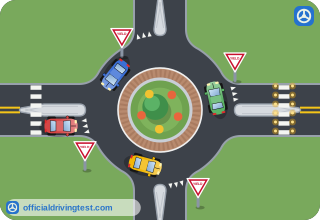
- Railroad crossings
- Yield signs
- Pedestrian bridges
- Stop signs
Show answer
Correct answer: Stop signs
Roundabouts are sometimes used at intersections instead of stop signs.
Source: Georgia Driver's Manual (2023-2024), page 37
-
What is the purpose of a roundabout?
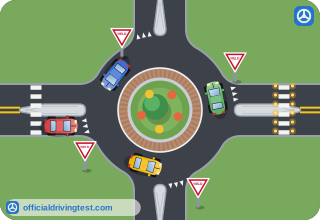
- To let drivers reverse direction without stopping at a signal or a stop sign
- To slow traffic so much that pedestrians never need to stop for any vehicles
- To let the intersection handle heavier traffic flow without a signal or a four-way stop
- To keep vehicles of different sizes in separate lanes through the intersection
Show answer
Correct answer: To let the intersection handle heavier traffic flow without a signal or a four-way stop
A roundabout lets the intersection handle heavier traffic flow without the need for a signal or a four-way stop.
Source: Georgia Driver's Manual (2023-2024), page 37
-
When entering a roundabout, to whom must you yield?
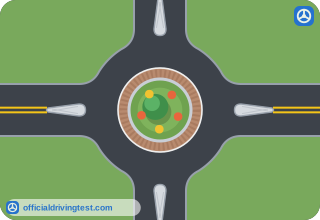
- Other traffic that is already in the roundabout
- Traffic waiting to enter from your right
- Only vehicles in the lane closest to you
- Only vehicles that are larger than yours
Show answer
Correct answer: Other traffic that is already in the roundabout
Right-of-way laws still apply, so you must yield to other traffic already in the roundabout.
Source: Georgia Driver's Manual (2023-2024), page 37
-
Which way do you enter and exit a roundabout?
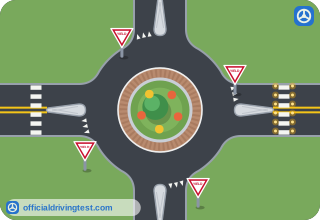
- You always enter to the left and always exit to the right
- You always enter to the right and always exit to the left
- You always enter to the right and always exit to the right
- You always enter to the left and always exit to the left
Show answer
Correct answer: You always enter to the right and always exit to the right
You will always enter a roundabout to the right and always exit to the right.
Source: Georgia Driver's Manual (2023-2024), page 37
-
In which direction does traffic in a roundabout always circulate?
- Clockwise
- Counterclockwise
- Clockwise on two-lane roundabouts
- Either way
Show answer
Correct answer: Counterclockwise
Traffic in a roundabout always circulates counterclockwise.
Source: Georgia Driver's Manual (2023-2024), page 37
-
What should you do with your speed when approaching a single lane roundabout?
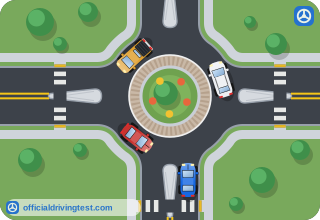
- Keep the speed limit of the road until you reach the entrance
- Slow down to 15 miles per hour
- Stop completely before every entrance
- Slow down to the posted advisory speed
Show answer
Correct answer: Slow down to the posted advisory speed
When approaching, slow down to the posted advisory speed.
Source: Georgia Driver's Manual (2023-2024), page 37
-
Once you are inside a roundabout, what should you do until you reach the roadway onto which you want to turn?
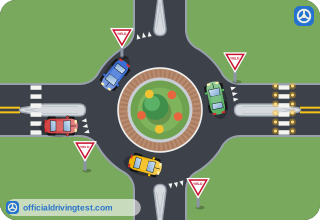
- Continue circling through the roundabout
- Stop at the next crosswalk to check for traffic
- Pull into the center island and wait there
- Change lanes to get around slower traffic
Show answer
Correct answer: Continue circling through the roundabout
You continue circling through the roundabout until you reach the roadway onto which you want to turn.
Source: Georgia Driver's Manual (2023-2024), page 37
-
How should you exit a roundabout?
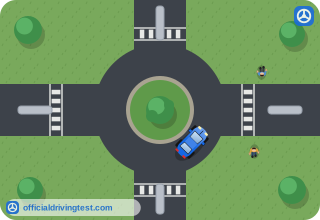
- Bear left without signaling, then yield to the pedestrians
- Signal, then bear left and continue on past the crosswalk
- Bear right without signaling, then speed up past the crosswalk
- Signal, then bear right, and stop for pedestrians in the crosswalk
Show answer
Correct answer: Signal, then bear right, and stop for pedestrians in the crosswalk
To exit, signal, then bear right, and stop for pedestrians in the crosswalk.
Source: Georgia Driver's Manual (2023-2024), page 37
-
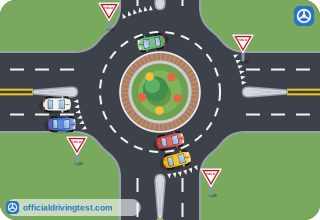
What should you do when approaching a multilane roundabout?
- Follow the car ahead of you and choose the left lane whenever that lane happens to be open
- Enter in any lane you like and change lanes inside the roundabout as needed to reach your exit
- Follow the lane use signs and pavement marking arrows and get into the correct lane before entering
- Use the lane closest to the center island so that you can go faster through the circle
Show answer
Correct answer: Follow the lane use signs and pavement marking arrows and get into the correct lane before entering
In a multilane roundabout, follow the lane use signs and pavement marking arrows and get into the correct lane before entering.
Source: Georgia Driver's Manual (2023-2024), page 37
-
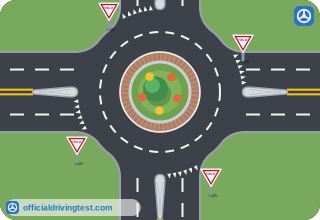
When entering a multilane roundabout, to which vehicles must you yield?
- All circulating vehicles in both lanes
- Only vehicles in the lane you are entering
- Only vehicles in the inside lane
- Only vehicles that are already in the crosswalk
Show answer
Correct answer: All circulating vehicles in both lanes
You must yield to all circulating vehicles in both lanes.
Source: Georgia Driver's Manual (2023-2024), page 37
-
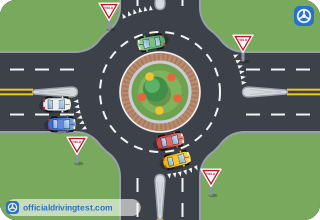
What should you not do while inside a multilane roundabout?
- Keep circling
- Signal to exit
- Change lanes
- Stop for pedestrians
Show answer
Correct answer: Change lanes
The manual says not to change lanes in the roundabout.
Source: Georgia Driver's Manual (2023-2024), page 37