Georgia: Right of way & turning — Part 3 Practice Test
Questions in this part include: “Where should you not make a U-turn?” · “Where may you drive across a dividing section, barrier, or unpaved strip that separates two roadways?”
Independent educational site · not affiliated with any government agency or DMV
Ready? Test yourself
- Instant feedback with an explanation
- Every answer cites its source in the manual
- Your best score is saved on this device
Questions are original and based on the official manual "Georgia Driver's Manual" (2023-2024), Georgia Department of Driver Services (DDS).
All 17 questions in this practice test
Take the test above first, then use this list to study. Tap “Show answer” to see the correct answer and explanation.
Show the questions and answersHide the questions
-
After a left turn, which lane should your vehicle end up in?
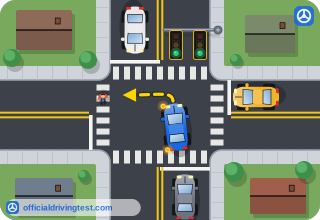
- The lane that is closest to the curb on the street you turned onto
- The right lane of the street that you have just turned onto
- The lane that is farthest away from the oncoming traffic
- The lane closest to the center lane(s), or to the center line if there is none
Show answer
Correct answer: The lane closest to the center lane(s), or to the center line if there is none
A left turn should end in the lane closest to the center lane(s) in your direction, or closest to the center line if there is no center lane.
Source: Georgia Driver's Manual (2023-2024), page 19
-
Once you have entered an intersection to make a left turn, what are you not allowed to do?
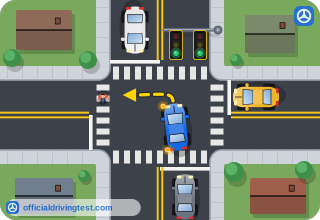
- Change lanes in the intersection
- Slow down before completing the turn
- Yield to pedestrians in the crosswalk
- Use your left turn signal
Show answer
Correct answer: Change lanes in the intersection
Once you are in the intersection for a left turn, you cannot change lanes there.
Source: Georgia Driver's Manual (2023-2024), page 19
-
Where should you not make a U-turn?
- On any street that has more than two lanes of traffic
- At any intersection that is controlled by a traffic signal
- On any road where a posted speed limit is displayed
- On a curve or near a hilltop where other drivers cannot see you
Show answer
Correct answer: On a curve or near a hilltop where other drivers cannot see you
Do not make a U-turn on a curve or near the top of a hill if you cannot be seen by other drivers approaching from either direction.
Source: Georgia Driver's Manual (2023-2024), page 20
-
What must you always do when making a left turn on a multi-lane, two-way highway?
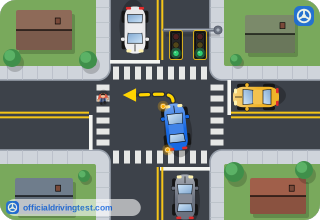
- Yield to oncoming traffic and wait for pedestrians to clear
- Yield only to pedestrians and go ahead of oncoming traffic
- Turn ahead of oncoming traffic once you have signaled
- Proceed if oncoming traffic is slowing down for you
Show answer
Correct answer: Yield to oncoming traffic and wait for pedestrians to clear
Left turns require you to always yield to oncoming traffic and wait for pedestrians to clear the lanes, driveway, sidewalk or alley you are turning into.
Source: Georgia Driver's Manual (2023-2024), page 20
-
Passing is permitted on a roadway that has more than one lane and is restricted to which kind of traffic?
- Two-way traffic only
- Commercial traffic only
- Bicycle traffic only
- One-way traffic
Show answer
Correct answer: One-way traffic
The manual lists a roadway with more than one lane that is restricted to one-way traffic as a situation in which passing is permitted.
Source: Georgia Driver's Manual (2023-2024), page 19
-
Where may you drive across a dividing section, barrier, or unpaved strip that separates two roadways?
- Only at an authorized opening or crossover
- Anywhere, if no traffic is approaching
- Anywhere, if you use your turn signal
- Anywhere on a rural road
Show answer
Correct answer: Only at an authorized opening or crossover
It is unlawful to cross a median at any point other than an authorized opening or crossover.
Source: Georgia Driver's Manual (2023-2024), page 23
-
Which vehicles may drive contrary to the direction posted on a one-way street when they find it necessary?
- Delivery trucks making a stop
- Any vehicle with its hazard lights on
- Vehicles carrying more than two passengers
- Police vehicles and authorized emergency vehicles
Show answer
Correct answer: Police vehicles and authorized emergency vehicles
The manual allows police vehicles or authorized emergency vehicles to drive against the posted direction when necessary.
Source: Georgia Driver's Manual (2023-2024), page 23
-
Who can direct a driver to go contrary to the posted direction on a one-way street?
- Any pedestrian who is standing on the sidewalk beside the one-way street
- A traffic control device, authorized emergency personnel, or construction workers
- Any other driver who is stopped on the same one-way street ahead of you
- A passenger riding in your vehicle who holds a valid driver's license
Show answer
Correct answer: A traffic control device, authorized emergency personnel, or construction workers
Unless directed by a traffic control device, authorized emergency personnel or construction workers, driving against a one-way street is unlawful.
Source: Georgia Driver's Manual (2023-2024), page 23
-
A driver behind you is overtaking your vehicle. What is considered courteous?
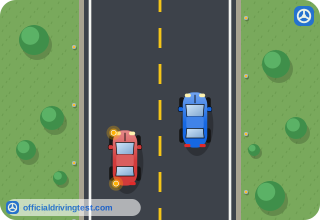
- Reducing your speed slightly to make it easier for the other vehicle to pass
- Moving onto the shoulder and stopping until the other vehicle has passed
- Flashing your turn signal to tell the other driver it is safe to pass
- Keeping your speed exactly the same and ignoring the other driver
Show answer
Correct answer: Reducing your speed slightly to make it easier for the other vehicle to pass
The manual says it is courteous to reduce your speed slightly so the other vehicle can pass more easily.
Source: Georgia Driver's Manual (2023-2024), page 19
-
When an overtaking vehicle is passing you, it is unlawful to increase your speed until when?
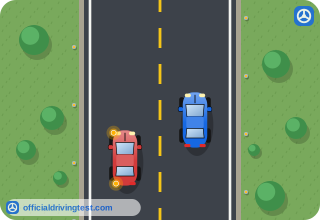
- The overtaking vehicle has signaled its intent to pass
- The overtaking vehicle is beside your front bumper
- You have been passed completely by the overtaking vehicle
- The overtaking vehicle has moved half a lane ahead of you
Show answer
Correct answer: You have been passed completely by the overtaking vehicle
The manual says it is unlawful to increase your speed before you have been passed completely by the overtaking vehicle.
Source: Georgia Driver's Manual (2023-2024), page 19
-
What does the manual say about weaving from one lane of traffic to another?
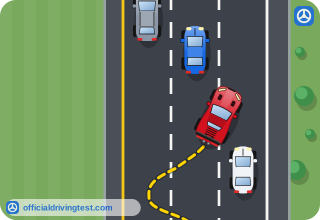
- It is unlawful only on highways with three or more lanes
- It is unlawful when done to move faster than the flow of traffic
- It is lawful on any multi-lane highway when you signal first
- It is lawful when traffic ahead of you is moving slowly
Show answer
Correct answer: It is unlawful when done to move faster than the flow of traffic
The manual says it is unlawful to weave from one lane to another in order to move faster than the flow of traffic.
Source: Georgia Driver's Manual (2023-2024), page 19
-
When may a motorist change lanes on a multi-lane highway and pass slower moving vehicles?
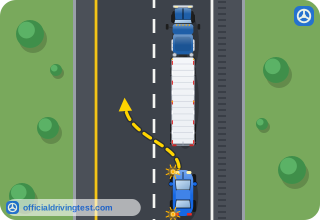
- Only when it is safe to do so
- Whenever traffic in your lane is moving slowly
- Whenever you have signaled for at least three seconds
- Only when the vehicle ahead is below the speed limit
Show answer
Correct answer: Only when it is safe to do so
The manual says a motorist may change lanes and pass slower vehicles only when it is safe to do so.
Source: Georgia Driver's Manual (2023-2024), page 19
-
At a stop sign with no marked stop line, where must you stop?
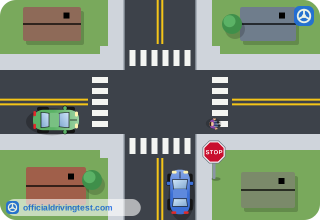
- In the center of the intersection
- Past the crosswalk so you can see traffic
- Past the crosswalk, at the edge of the cross street lane
- Before the crosswalk on your side of the intersection
Show answer
Correct answer: Before the crosswalk on your side of the intersection
With no stop line, you stop before the crosswalk on your side of the intersection.
Source: Georgia Driver's Manual (2023-2024), page 28
-
At a stop sign with no stop line and no crosswalk, where must you stop?
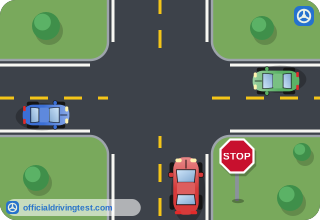
- Exactly at the edge of the intersection
- At a point from which you can best see oncoming traffic
- Wherever the driver behind you can see you clearly
- In the middle of the intersection
Show answer
Correct answer: At a point from which you can best see oncoming traffic
With no stop line or crosswalk, you stop at a point from which you can best see oncoming traffic.
Source: Georgia Driver's Manual (2023-2024), page 28
-
After stopping at a stop sign, you must not start again until all pedestrians have finished crossing where?
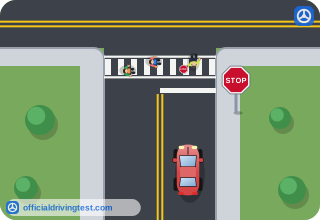
- On both sides of the roadway at the intersection
- On the side of the roadway you are traveling on
- Anywhere within the intersection
- On the cross street only
Show answer
Correct answer: On the side of the roadway you are traveling on
You must wait until pedestrians have finished crossing on the side of the roadway you are traveling on.
Source: Georgia Driver's Manual (2023-2024), page 28
-
After stopping at a stop sign, you must yield the right-of-way to which traffic before starting again?
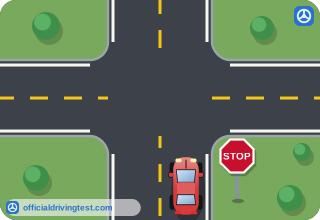
- Only vehicles that are turning left
- Only vehicles that have a green light
- Only bicyclists and pedestrians
- Closely approaching traffic
Show answer
Correct answer: Closely approaching traffic
After a complete stop you must also yield the right-of-way to closely approaching traffic.
Source: Georgia Driver's Manual (2023-2024), page 28
-
When you come to a yield sign, what must you do?
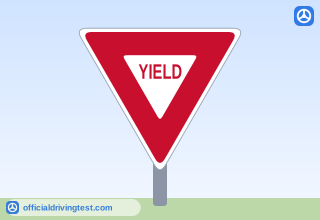
- Come to a complete stop every time before proceeding
- Keep your speed and change lanes to avoid traffic
- Slow down to a reasonable speed and stop if necessary
- Flash your headlights and proceed with caution
Show answer
Correct answer: Slow down to a reasonable speed and stop if necessary
At a yield sign you slow to a speed that is reasonable for existing conditions and stop if necessary.
Source: Georgia Driver's Manual (2023-2024), page 28