Georgia: Freeway driving
Entering, driving on and leaving expressways, interstates and Express Lanes. Split into 4 shorter tests so you're not stuck in one long quiz.
Independent educational site · not affiliated with any government agency or DMV
Choose a part
Freeway driving — Part 1
Questions in this part include: “What is prohibited on a controlled-access roadway?”
StartFreeway driving — Part 2
Questions in this part include: “What do the signs show when the travel direction of the I-75 South Metro Express Lanes is being reversed?”
StartFreeway driving — Part 3
Questions in this part include: “Why are posted exit speeds usually low?”
StartFreeway driving — Part 4
Questions in this part include: “Why is it important to check your gasoline gauge before an expressway trip?”
StartAll 69 Freeway driving questions with answers
Choose a part above to take a practice test, or study every question and answer here.
Show the questions and answersHide the questions
-
What is prohibited on a controlled-access roadway?
- Driving in the right lane
- Using the authorized entrance and exit ramps
- Entering or leaving at unauthorized entrances or exits
- Driving with your headlights on during the day
Show answer
Correct answer: Entering or leaving at unauthorized entrances or exits
The manual prohibits entering or leaving any controlled-access roadway at unauthorized entrances or exits.
Source: Georgia Driver's Manual (2023-2024), page 23
-
What does the manual say about backing up on controlled-access roadways?
- It is allowed on the shoulder only
- It is allowed when no other traffic is nearby
- It is allowed to reach an exit you missed
- It is prohibited
Show answer
Correct answer: It is prohibited
Backing up is prohibited on controlled-access roadways.
Source: Georgia Driver's Manual (2023-2024), page 23
-
When may certain types of vehicles be prohibited on controlled-access roadways?
- If signs are posted to this effect
- Only during morning and evening rush hours
- Only when the roadway is tolled
- Only after dark
Show answer
Correct answer: If signs are posted to this effect
Certain vehicle types may be prohibited on controlled-access roadways if signs are posted.
Source: Georgia Driver's Manual (2023-2024), page 23
-
Which is an example of a controlled-access roadway in Georgia?
- Any unpaved county road with a posted 35 mph limit
- Any two-lane residential street in an urban district
- Any tolled facility, such as the I-85 Express Lanes
- Any road with a grass median strip down the middle
Show answer
Correct answer: Any tolled facility, such as the I-85 Express Lanes
The manual says an example is any tolled facility in Georgia such as the I-85 Express Lanes or the reversible I-75 Express Lanes.
Source: Georgia Driver's Manual (2023-2024), page 23
-
What do tolled lanes in Georgia require motorists to mount in their vehicle to access the lanes?
- A toll sticker issued by the DDS
- A registered Peach Pass transponder
- A GDOT permit plate on the bumper
- A prepaid cash card for each trip
Show answer
Correct answer: A registered Peach Pass transponder
Tolled lanes require motorists to mount a registered Peach Pass transponder in their vehicle.
Source: Georgia Driver's Manual (2023-2024), page 23
-
In which other states can a Peach Pass also be used?
- Florida and North Carolina
- Alabama and Tennessee
- South Carolina and Alabama
- Tennessee and North Carolina
Show answer
Correct answer: Florida and North Carolina
The manual says Peach Pass can also be used in Florida and North Carolina.
Source: Georgia Driver's Manual (2023-2024), page 23
-
What happens to the registered owner of a vehicle that enters a tolled lane without an active Peach Pass?
- The owner's license is suspended on the spot
- The vehicle is towed from the lane immediately
- The owner receives a violation notice in the mail
- The owner is given a warning by phone and no penalty
Show answer
Correct answer: The owner receives a violation notice in the mail
The registered owner of a vehicle that enters the tolled lane without an active Peach Pass will receive a violation notice in the mail.
Source: Georgia Driver's Manual (2023-2024), page 23
-
When are you prohibited from entering the reversible Express Lanes?
- When the gates are fully open
- When the access control gates are closed or closing
- During the daytime hours only
- When another vehicle is already in the lanes
Show answer
Correct answer: When the access control gates are closed or closing
The manual prohibits entering the reversible Express Lanes when the access control gates are closed or closing.
Source: Georgia Driver's Manual (2023-2024), page 23
-
What do Express Lanes offer motorists?
- A free lane reserved for trucks and buses on every interstate
- The option to use the shoulder in congestion, at no charge
- The option to pay a toll to bypass congestion on the interstate
- A lane open only to drivers who have passed a special test
Show answer
Correct answer: The option to pay a toll to bypass congestion on the interstate
Express Lanes let motorists pay a toll to bypass congestion in certain areas on the interstate.
Source: Georgia Driver's Manual (2023-2024), page 33
-
What must a vehicle have to use the Express Lanes?
- A special Express Lane license plate
- A registered Peach Pass
- A signed permit from the Department
- A daily pass bought at the entrance
Show answer
Correct answer: A registered Peach Pass
Vehicles can use Express Lanes if they have a registered Peach Pass.
Source: Georgia Driver's Manual (2023-2024), page 33
-
Which vehicles can use the Express Lanes if they have a registered Peach Pass?
- Vehicles with no more than four axles or up to ten wheels
- Vehicles with no more than three axles or up to eight wheels
- Vehicles with a single axle or up to four wheels only
- Vehicles with no more than two axles or up to six wheels
Show answer
Correct answer: Vehicles with no more than two axles or up to six wheels
The manual limits Express Lanes to vehicles with no more than two axles or up to six wheels.
Source: Georgia Driver's Manual (2023-2024), page 33
-
How is the toll paid when a vehicle travels through an Express Lane?
- It is paid in cash at a booth at the lane exit
- It is automatically deducted from a pre-established account
- It is added to the vehicle registration renewal
- It is paid by mail after the driver receives a bill
Show answer
Correct answer: It is automatically deducted from a pre-established account
The toll amount is automatically deducted from the pre-established account.
Source: Georgia Driver's Manual (2023-2024), page 33
-
How many sets of Express Lanes are there currently in Georgia?
- Two
- One
- Three
- Five
Show answer
Correct answer: Two
The manual says there are currently two sets of Express Lanes in Georgia.
Source: Georgia Driver's Manual (2023-2024), page 33
-
Where are the I-85 Express Lanes located?
- Along I-85 South in Fulton County
- Along I-85 North in Henry County
- Along I-75 North in Cobb County
- Along I-85 North in Gwinnett County
Show answer
Correct answer: Along I-85 North in Gwinnett County
The I-85 Express Lanes are HOT Lanes along I-85 North in Gwinnett County.
Source: Georgia Driver's Manual (2023-2024), page 33
-
When are the I-85 Express Lanes open?
- Only during weekday rush hours
- Only between 6 a.m. and 10 p.m.
- 24 hours per day
- Only on weekends and holidays
Show answer
Correct answer: 24 hours per day
The I-85 Express Lanes are open 24 hours per day.
Source: Georgia Driver's Manual (2023-2024), page 33
-
Which of these may use the I-85 Express Lanes toll-free?
- Carpools of three or more people
- Carpools of two or more people
- Any passenger car with a Peach Pass
- Any vehicle with two axles or fewer
Show answer
Correct answer: Carpools of three or more people
On the I-85 Express Lanes, three or more person carpools are allowed to use the lanes toll-free.
Source: Georgia Driver's Manual (2023-2024), page 33
-
The I-75 South Metro Express Lanes are in which counties?
- Gwinnett and Fulton counties
- Cobb and Cherokee counties
- Henry and Clayton counties
- DeKalb and Rockdale counties
Show answer
Correct answer: Henry and Clayton counties
The I-75 South Metro Express Lanes are reversible lanes along I-75 South in Henry and Clayton counties.
Source: Georgia Driver's Manual (2023-2024), page 33
-
What do reversible lanes do?
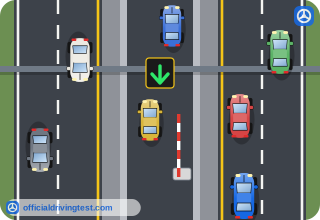
- Switch between toll use and free use at fixed hours of every single day
- Change directions during the day to give additional options at peak times
- Switch between cars-only use and trucks-only use during the day
- Open to all traffic at night and close for repairs during the day
Show answer
Correct answer: Change directions during the day to give additional options at peak times
Reversible lanes change directions during the day to provide additional travel options during peak travel periods.
Source: Georgia Driver's Manual (2023-2024), page 33
-
What do the signs show when the travel direction of the I-75 South Metro Express Lanes is being reversed?
- That the toll amount is doubled
- That the lanes are open to everyone toll-free
- That the speed limit is lowered in the lanes
- That the lanes are closed
Show answer
Correct answer: That the lanes are closed
When the direction is being reversed, signs will show the lanes are closed.
Source: Georgia Driver's Manual (2023-2024), page 33
-
On the I-75 South Metro Express Lanes, which of these vehicles is required to pay a toll?
- Public transit buses
- Motorcycles
- Registered vanpools
- Emergency response vehicles
Show answer
Correct answer: Motorcycles
On the I-75 South Metro Express Lanes, all vehicles, including motorcycles and electric vehicles, must pay a toll.
Source: Georgia Driver's Manual (2023-2024), page 33
-
Which of these may use the I-75 South Metro Express Lanes toll-free if they have a Peach Pass?
- Registered vanpools
- Motorcycles
- Electric vehicles
- Carpools of three people
Show answer
Correct answer: Registered vanpools
Public transit buses, registered vanpools and emergency response vehicles may use the lanes toll-free with a Peach Pass.
Source: Georgia Driver's Manual (2023-2024), page 33
-
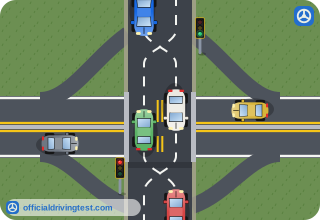
What does a Diverging Diamond Interchange (DDI) do?
- Merges both directions onto a single one-way road
- Closes the on-ramp during evening rush hours
- Adds a lane just for left turns off the freeway
- Shifts traffic flow to the opposite side of the road
Show answer
Correct answer: Shifts traffic flow to the opposite side of the road
A DDI shifts traffic flow to the opposite side of the road so vehicles can turn left onto an on-ramp without stopping.
Source: Georgia Driver's Manual (2023-2024), page 39
-
What is one benefit of a Diverging Diamond Interchange?
- It removes the need for on-ramps
- It eliminates all traffic signals
- It reduces points of conflict
- It raises the freeway speed limit
Show answer
Correct answer: It reduces points of conflict
The manual says a DDI reduces points of conflict and improves traffic flow and safety.
Source: Georgia Driver's Manual (2023-2024), page 39
-
Under normal, free-flowing conditions, by how much can a DDI reduce delays in evening rush hours?
- Up to 20 percent
- Up to 5 percent
- Up to 10 percent
- Up to 50 percent
Show answer
Correct answer: Up to 20 percent
The manual says a DDI can reduce evening rush hour delays up to 20 percent.
Source: Georgia Driver's Manual (2023-2024), page 39
-
What makes an expressway different from normal roads or highways?
- It has no posted speed limit
- It is always a toll road
- Only trucks may use its left lane
- Access to it is controlled
Show answer
Correct answer: Access to it is controlled
An expressway differs from normal roads in that access to it is controlled.
Source: Georgia Driver's Manual (2023-2024), page 40
-
Where can vehicles enter and exit an expressway?
- At any intersection that crosses over it
- At any break in the median strip
- Only at places called interchanges
- Wherever the shoulder is wide enough to exit
Show answer
Correct answer: Only at places called interchanges
Vehicles can only enter and exit the expressway at specific places known as interchanges.
Source: Georgia Driver's Manual (2023-2024), page 40
-
What does the manual say about tolls on Georgia expressways?
- Most are free, but a few require a toll
- All of them require a toll
- Most require a toll, but a few are free
- None of them require a toll
Show answer
Correct answer: Most are free, but a few require a toll
Most expressways in Georgia are free, but there are a few that require a toll.
Source: Georgia Driver's Manual (2023-2024), page 40
-
How are the lanes and the edge of the roadway marked on an expressway?
- Lanes with solid lines; the edge with a dashed line
- Lanes with no markings; the edge with a double solid line
- Lanes with dashed lines; the edge with a dashed line
- Lanes with dashed lines; the edge with a solid line
Show answer
Correct answer: Lanes with dashed lines; the edge with a solid line
On an expressway, lanes are marked with dashed lines and the edge of the roadway with a solid line.
Source: Georgia Driver's Manual (2023-2024), page 40
-
On an expressway, where should slower traffic stay?
- In the left lane
- To the right
- On the shoulder
- In the HOV lane
Show answer
Correct answer: To the right
Slower traffic should keep to the right on an expressway.
Source: Georgia Driver's Manual (2023-2024), page 40
-
What is an expressway entrance ramp?
- A short one-way road leading to the expressway
- A two-way service road beside the expressway
- A long lane used only for passing
- A paved area for stopped vehicles
Show answer
Correct answer: A short one-way road leading to the expressway
The entrance ramp is a short one-way road that leads to the expressway.
Source: Georgia Driver's Manual (2023-2024), page 40
-
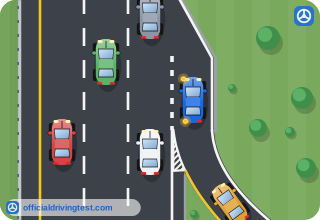
What is the purpose of the acceleration lane on an expressway entrance?
- To stop and wait for a gap in traffic
- To pass slower cars on the entrance ramp
- To match your speed to expressway traffic
- To park briefly and check your mirrors
Show answer
Correct answer: To match your speed to expressway traffic
In the acceleration lane you can adjust your speed to the speed of the expressway traffic.
Source: Georgia Driver's Manual (2023-2024), page 40
-
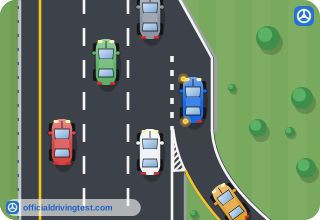
When should you merge into expressway traffic from the acceleration lane?
- As soon as the ramp begins
- When it is safe to do so
- Only after stopping at the end of the lane
- Before your speed matches traffic
Show answer
Correct answer: When it is safe to do so
The manual says to merge into traffic when it is safe to do so.
Source: Georgia Driver's Manual (2023-2024), page 40
-
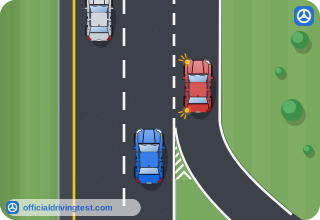
Who has the right of way when you enter an expressway?
- Vehicles entering on the ramp
- The vehicle that arrives first
- Vehicles in the acceleration lane
- Vehicles already on the expressway
Show answer
Correct answer: Vehicles already on the expressway
Vehicles on the expressway have the right of way, though courteous drivers may let you in.
Source: Georgia Driver's Manual (2023-2024), page 40
-
How should you prepare to exit a controlled access highway?
- Stay in the center lane and cross over just at the exit ramp
- Move to the lane farthest from the exit and then turn sharply
- Move right for a right-side exit or left for a left-side exit
- Always move to the right lane, whichever side the exit is on
Show answer
Correct answer: Move right for a right-side exit or left for a left-side exit
You prepare by moving to the right lane for an exit on the right, or the left lane for an exit on the left.
Source: Georgia Driver's Manual (2023-2024), page 40
-
What tells you of an approaching expressway exit?
- Guide signs
- Regulatory signs
- Warning signs
- Pavement arrows
Show answer
Correct answer: Guide signs
Guide signs will tell you of the approaching exit.
Source: Georgia Driver's Manual (2023-2024), page 40
-
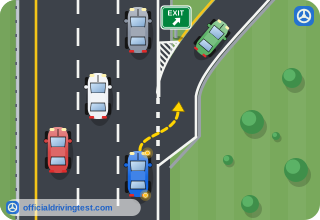
What are deceleration lanes provided for at an expressway exit?
- Passing slow traffic before the exit
- Stopping to wait for a gap in traffic
- Changing lanes without signaling
- Slowing down when leaving the expressway
Show answer
Correct answer: Slowing down when leaving the expressway
Deceleration lanes are provided for slowing down when leaving the expressway.
Source: Georgia Driver's Manual (2023-2024), page 40
-
Why are posted exit speeds usually low?
- Because exits are always in residential areas
- Due to the design of the roadway
- Because exits are close to toll booths
- Because trucks must use the exit lane
Show answer
Correct answer: Due to the design of the roadway
The manual says posted exit speeds are usually low due to the design of the roadway.
Source: Georgia Driver's Manual (2023-2024), page 40
-
If you slow down in the traveling lane while preparing to exit, how should you warn drivers behind you?
- Use either brake lights or a turn signal
- Sound your horn for several seconds
- Flash your high beam headlights
- Wave your hand out of the driver's window
Show answer
Correct answer: Use either brake lights or a turn signal
Drivers should use either brake lights or a turn signal to indicate a change in speed to the drivers behind.
Source: Georgia Driver's Manual (2023-2024), page 40
-
Unless directed otherwise by a sign, traffic control device, or police officer, where must drivers on divided highways drive?
- To the left of the median
- On the shoulder
- To the right of the median
- In the center of the roadway
Show answer
Correct answer: To the right of the median
Drivers on divided highways must drive to the right of the median unless directed otherwise.
Source: Georgia Driver's Manual (2023-2024), page 40
-
Drivers must obey the yellow or white striping on the roadway that indicates what?
- Speed limits, weather hazards, or areas where vehicles may park
- Lanes, merging lanes, or areas vehicles should not use
- Toll lanes, truck routes, or areas reserved for bicycles
- Exit numbers, distances, or places where vehicles must stop
Show answer
Correct answer: Lanes, merging lanes, or areas vehicles should not use
Drivers must obey striping that marks lanes, the convergence of lanes, or areas in which vehicles should not operate.
Source: Georgia Driver's Manual (2023-2024), page 40
-
What does the term "gore" mean?
- A lane reserved for disabled and stopped vehicles
- The paved shoulder area beside an exit ramp
- A painted crosswalk at the top of an on-ramp
- The area where two lanes of traffic converge
Show answer
Correct answer: The area where two lanes of traffic converge
The manual defines "gore" as the area of convergence between two lanes of traffic.
Source: Georgia Driver's Manual (2023-2024), page 40
-
What forms the gore area?
- Double yellow lines between two opposing travel lanes
- Dashed white lines between two adjacent travel lanes
- Solid white lines between a travel lane and a merging lane
- Raised concrete barriers between the ramp and the shoulder
Show answer
Correct answer: Solid white lines between a travel lane and a merging lane
The gore is formed by solid white lines between an existing lane of travel and a merging lane of travel.
Source: Georgia Driver's Manual (2023-2024), page 40
-
Where are gores most often seen?
- Where an acceleration lane meets a travel lane
- Between the median and the far left shoulder of the road
- Where two exit ramps split away from the same lane
- At the end of an HOV lane near a toll booth
Show answer
Correct answer: Where an acceleration lane meets a travel lane
Gores are most often seen at the convergence of an acceleration lane and the adjacent travel lane on a controlled access highway.
Source: Georgia Driver's Manual (2023-2024), page 40
-
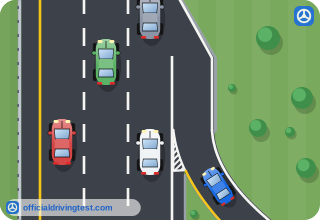
Drivers entering a controlled access highway must continue in the acceleration lane until when?
- They reach the speed of traffic
- They see the next exit sign
- Another driver lets them in
- The solid white line disappears
Show answer
Correct answer: The solid white line disappears
Drivers are prohibited by law from crossing the solid white line and must stay in the acceleration lane until it disappears.
Source: Georgia Driver's Manual (2023-2024), page 40
-
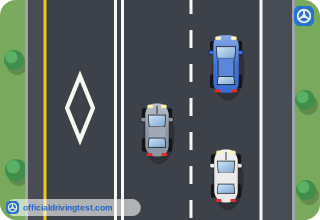
Which vehicles may use a High Occupancy Vehicle (HOV) lane?
- Vehicles with three or more occupants and commercial trucks
- Vehicles with more than one occupant, buses, and motorcycles
- Only buses, taxis and vehicles carrying commercial cargo
- Only buses and emergency vehicles
Show answer
Correct answer: Vehicles with more than one occupant, buses, and motorcycles
HOV lanes are restricted to vehicles with more than one occupant, buses, motorcycles, and vehicles with Alternative Fuel Vehicle license plates.
Source: Georgia Driver's Manual (2023-2024), page 40
-
How are HOV lanes marked?
- A diamond symbol, with the hours of restriction posted
- A triangle symbol, with the hours of restriction posted
- A solid yellow line, with the hours of restriction posted
- A white arrow, with the hours of restriction posted
Show answer
Correct answer: A diamond symbol, with the hours of restriction posted
HOV lanes are marked with a diamond symbol and the hours of restriction are posted.
Source: Georgia Driver's Manual (2023-2024), page 40
-
What is the penalty for a first offense of violating HOV lane restrictions?
- A fine up to $50
- A fine up to $100
- A fine up to $75
- A fine up to $200
Show answer
Correct answer: A fine up to $75
The fine for a first HOV lane offense is up to $75.
Source: Georgia Driver's Manual (2023-2024), page 40
-
What is the penalty for a second offense of violating HOV lane restrictions?
- A fine up to $75
- A fine up to $100
- A fine up to $150
- A fine up to $250
Show answer
Correct answer: A fine up to $100
The fine for a second HOV lane offense is up to $100.
Source: Georgia Driver's Manual (2023-2024), page 40
-
What is the penalty for a third offense of violating HOV lane restrictions?
- A fine up to $75
- A fine up to $100
- A fine up to $200
- A fine up to $150
Show answer
Correct answer: A fine up to $150
The fine for a third HOV lane offense is up to $150.
Source: Georgia Driver's Manual (2023-2024), page 40
-
What is the penalty for a fourth or subsequent offense of violating HOV lane restrictions?
- A fine up to $100 plus one point on your driving record
- A fine up to $150 plus two points on your driving record
- A fine up to $150 plus one point on your driving record
- A fine up to $200 with no points added
Show answer
Correct answer: A fine up to $150 plus one point on your driving record
A fourth or later HOV offense carries a fine up to $150 plus one point added to the driving record.
Source: Georgia Driver's Manual (2023-2024), page 40
-
How many persons must a carpool have to use the I-85 Express Lanes (HOT lanes) toll-free?
- Two or more
- Three or more
- Four or more
- Five or more
Show answer
Correct answer: Three or more
HOT lanes allow a three or more person carpool to use the lanes toll-free.
Source: Georgia Driver's Manual (2023-2024), page 40
-
When planning an expressway trip, what does the manual suggest marking on the map?
- All entrances, service areas, and exits you plan to use
- All speed limits and posted construction zones
- All gas stations and restaurants along the route
- All toll booths and weigh stations on the route
Show answer
Correct answer: All entrances, service areas, and exits you plan to use
The manual says to mark the map to indicate all entrances, service areas, and exits you plan to use.
Source: Georgia Driver's Manual (2023-2024), page 40
-
Why is it important to check your gasoline gauge before an expressway trip?
- Fuel gauges are less accurate at high speeds
- Expressways have no service areas
- There are fewer places to exit the expressway
- Engines use twice as much fuel on expressways
Show answer
Correct answer: There are fewer places to exit the expressway
Because expressways are designed for faster, smoother traffic, there are fewer places to exit, so you need enough fuel.
Source: Georgia Driver's Manual (2023-2024), page 41
-
What should you always do before you change lanes on an expressway?
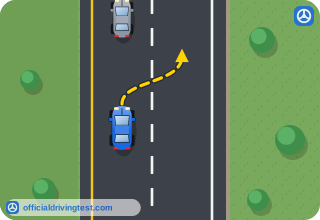
- Sound your horn twice
- Make visual traffic checks
- Flash your headlights once
- Slow to a stop
Show answer
Correct answer: Make visual traffic checks
The manual says to always make visual traffic checks before you change lanes.
Source: Georgia Driver's Manual (2023-2024), page 41
-
When should you activate your turn signal to change lanes on an expressway?
- Before you begin the maneuver
- As you cross the lane line
- After you finish moving over
- Only if a car is behind you
Show answer
Correct answer: Before you begin the maneuver
The manual says to activate your turn signal BEFORE you begin the maneuver.
Source: Georgia Driver's Manual (2023-2024), page 41
-
After passing another vehicle, when may you pull back into the right-hand lane?
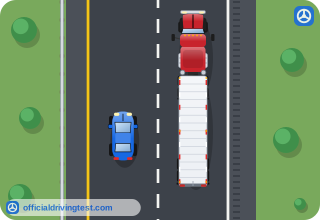
- As soon as you are one car length ahead of it
- After honking to tell the passed driver you are moving over
- When you can see its headlights in your side mirror
- When you can see the passed car clearly in your rear view mirror
Show answer
Correct answer: When you can see the passed car clearly in your rear view mirror
You should not pull back into the right-hand lane until you can see the car you just passed clearly in your rear view mirror.
Source: Georgia Driver's Manual (2023-2024), page 41
-
What should you check carefully before pulling out to pass on an expressway?
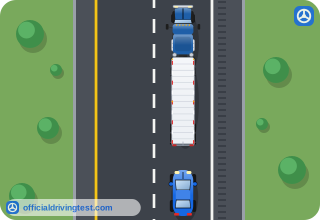
- The right shoulder ahead of you
- The left lane behind you
- The oncoming lane
- The exit signs ahead
Show answer
Correct answer: The left lane behind you
The manual says to carefully check the left lane behind you before pulling out to pass.
Source: Georgia Driver's Manual (2023-2024), page 41
-
What does the manual say about posted speed limits on expressways?
- Always obey the posted maximum and minimum limits
- Obey only the posted maximum limit
- Minimum limits apply only at night
- Speed limits are advisory outside metro areas
Show answer
Correct answer: Always obey the posted maximum and minimum limits
The manual says to always obey the posted maximum and minimum speed limits.
Source: Georgia Driver's Manual (2023-2024), page 41
-
When do metro expressways usually have a dramatically increased amount of traffic?
- Only on weekend mornings and holidays
- Only after midnight on weeknights
- When most drivers go to and from work
- Only during the summer vacation months
Show answer
Correct answer: When most drivers go to and from work
Expressways see much more traffic during the hours most drivers are traveling to and from their places of employment.
Source: Georgia Driver's Manual (2023-2024), page 41
-
What does the manual say about driving in reverse on an expressway?
- It is allowed to reach a missed exit
- It is prohibited under any circumstances
- It is allowed on the shoulder only
- It is allowed with your hazard lights on
Show answer
Correct answer: It is prohibited under any circumstances
Driving in reverse on an expressway is prohibited under any circumstances.
Source: Georgia Driver's Manual (2023-2024), page 41
-
What should you do if you feel drowsy while driving on an expressway?
- Stop driving
- Take a stimulant drug
- Speed up to finish the trip sooner
- Keep driving with the windows open
Show answer
Correct answer: Stop driving
The manual says to stop driving if you feel drowsy.
Source: Georgia Driver's Manual (2023-2024), page 41
-
What does the manual say about relying on stimulant drugs (Stay Awake Drugs) to fight drowsiness?
- They are safe if you take only one dose
- They help on trips under two hours
- They are recommended on long night trips
- They are likely to make driving more hazardous
Show answer
Correct answer: They are likely to make driving more hazardous
Stimulant drugs are likely to make your driving even more hazardous.
Source: Georgia Driver's Manual (2023-2024), page 41
-
What is "highway hypnosis"?
- A sudden fear of high speeds that makes drivers brake hard
- Drowsiness or unawareness brought on by monotony
- A glare from the road surface that blinds drivers
- A reaction to medicine taken before a long trip
Show answer
Correct answer: Drowsiness or unawareness brought on by monotony
Highway hypnosis is a condition of drowsiness or unawareness brought on by monotony, wind sound, tire noise and the hum of the engine.
Source: Georgia Driver's Manual (2023-2024), page 41
-
How can you "exercise your eyes" on long expressway trips?
- Keep shifting them from one area of the road to another
- Stare at the center line to hold your focus steady
- Fix your eyes on the taillights of the car ahead
- Look only at the road directly in front of your hood
Show answer
Correct answer: Keep shifting them from one area of the road to another
On long trips you shift your eyes from one area of the roadway to another and focus on various objects, near and far, left and right.
Source: Georgia Driver's Manual (2023-2024), page 41
-
What is the key to defensive driving?
- Speed
- Patience
- Awareness
- Courtesy
Show answer
Correct answer: Awareness
The manual says the key to defensive driving is awareness.
Source: Georgia Driver's Manual (2023-2024), page 41
-
What should you avoid staring at while driving defensively?
- The rear view mirror
- The center line on the roadway
- The shoulder of the road ahead
- The fuel gauge
Show answer
Correct answer: The center line on the roadway
A defensive driver avoids staring at the center line and instead looks ahead for trouble spots.
Source: Georgia Driver's Manual (2023-2024), page 41
-
According to the manual, what does another driver's flashing left turn signal mean?
- The driver is going to turn left
- The driver is about to stop
- The driver is letting you pass
- The driver may not actually turn left
Show answer
Correct answer: The driver may not actually turn left
The manual says a flashing left turn signal does not necessarily mean the driver is going to make a left turn.
Source: Georgia Driver's Manual (2023-2024), page 41
-
What should you constantly be thinking of as you drive?
- The fastest way to your destination
- The location of the next rest area
- An "escape route"
- The speed of the vehicle behind you
Show answer
Correct answer: An "escape route"
The manual says you should constantly be thinking of an "escape route" as you drive.
Source: Georgia Driver's Manual (2023-2024), page 41
-
When approaching a curve, what should you look closely at to plan for a car from the other direction crossing to your side?
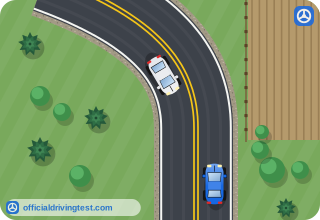
- The shoulder and nearby area
- Your speedometer and gauges
- The other car's license plate
- The center line
Show answer
Correct answer: The shoulder and nearby area
You should look closely at the shoulder and nearby area to determine what you would do.
Source: Georgia Driver's Manual (2023-2024), page 41