Georgia: Freeway driving — Part 2 Practice Test
Questions in this part include: “What do the signs show when the travel direction of the I-75 South Metro Express Lanes is being reversed?” · “Where can vehicles enter and exit an expressway?”
Independent educational site · not affiliated with any government agency or DMV
Ready? Test yourself
- Instant feedback with an explanation
- Every answer cites its source in the manual
- Your best score is saved on this device
Questions are original and based on the official manual "Georgia Driver's Manual" (2023-2024), Georgia Department of Driver Services (DDS).
All 17 questions in this practice test
Take the test above first, then use this list to study. Tap “Show answer” to see the correct answer and explanation.
Show the questions and answersHide the questions
-
What do the signs show when the travel direction of the I-75 South Metro Express Lanes is being reversed?
- That the toll amount is doubled
- That the lanes are open to everyone toll-free
- That the speed limit is lowered in the lanes
- That the lanes are closed
Show answer
Correct answer: That the lanes are closed
When the direction is being reversed, signs will show the lanes are closed.
Source: Georgia Driver's Manual (2023-2024), page 33
-
On the I-75 South Metro Express Lanes, which of these vehicles is required to pay a toll?
- Public transit buses
- Motorcycles
- Registered vanpools
- Emergency response vehicles
Show answer
Correct answer: Motorcycles
On the I-75 South Metro Express Lanes, all vehicles, including motorcycles and electric vehicles, must pay a toll.
Source: Georgia Driver's Manual (2023-2024), page 33
-
Which of these may use the I-75 South Metro Express Lanes toll-free if they have a Peach Pass?
- Registered vanpools
- Motorcycles
- Electric vehicles
- Carpools of three people
Show answer
Correct answer: Registered vanpools
Public transit buses, registered vanpools and emergency response vehicles may use the lanes toll-free with a Peach Pass.
Source: Georgia Driver's Manual (2023-2024), page 33
-
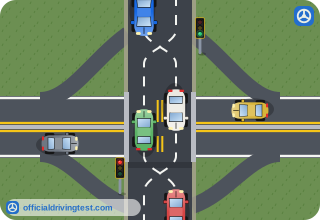
What does a Diverging Diamond Interchange (DDI) do?
- Merges both directions onto a single one-way road
- Closes the on-ramp during evening rush hours
- Adds a lane just for left turns off the freeway
- Shifts traffic flow to the opposite side of the road
Show answer
Correct answer: Shifts traffic flow to the opposite side of the road
A DDI shifts traffic flow to the opposite side of the road so vehicles can turn left onto an on-ramp without stopping.
Source: Georgia Driver's Manual (2023-2024), page 39
-
What is one benefit of a Diverging Diamond Interchange?
- It removes the need for on-ramps
- It eliminates all traffic signals
- It reduces points of conflict
- It raises the freeway speed limit
Show answer
Correct answer: It reduces points of conflict
The manual says a DDI reduces points of conflict and improves traffic flow and safety.
Source: Georgia Driver's Manual (2023-2024), page 39
-
Under normal, free-flowing conditions, by how much can a DDI reduce delays in evening rush hours?
- Up to 20 percent
- Up to 5 percent
- Up to 10 percent
- Up to 50 percent
Show answer
Correct answer: Up to 20 percent
The manual says a DDI can reduce evening rush hour delays up to 20 percent.
Source: Georgia Driver's Manual (2023-2024), page 39
-
What makes an expressway different from normal roads or highways?
- It has no posted speed limit
- It is always a toll road
- Only trucks may use its left lane
- Access to it is controlled
Show answer
Correct answer: Access to it is controlled
An expressway differs from normal roads in that access to it is controlled.
Source: Georgia Driver's Manual (2023-2024), page 40
-
Where can vehicles enter and exit an expressway?
- At any intersection that crosses over it
- At any break in the median strip
- Only at places called interchanges
- Wherever the shoulder is wide enough to exit
Show answer
Correct answer: Only at places called interchanges
Vehicles can only enter and exit the expressway at specific places known as interchanges.
Source: Georgia Driver's Manual (2023-2024), page 40
-
What does the manual say about tolls on Georgia expressways?
- Most are free, but a few require a toll
- All of them require a toll
- Most require a toll, but a few are free
- None of them require a toll
Show answer
Correct answer: Most are free, but a few require a toll
Most expressways in Georgia are free, but there are a few that require a toll.
Source: Georgia Driver's Manual (2023-2024), page 40
-
How are the lanes and the edge of the roadway marked on an expressway?
- Lanes with solid lines; the edge with a dashed line
- Lanes with no markings; the edge with a double solid line
- Lanes with dashed lines; the edge with a dashed line
- Lanes with dashed lines; the edge with a solid line
Show answer
Correct answer: Lanes with dashed lines; the edge with a solid line
On an expressway, lanes are marked with dashed lines and the edge of the roadway with a solid line.
Source: Georgia Driver's Manual (2023-2024), page 40
-
On an expressway, where should slower traffic stay?
- In the left lane
- To the right
- On the shoulder
- In the HOV lane
Show answer
Correct answer: To the right
Slower traffic should keep to the right on an expressway.
Source: Georgia Driver's Manual (2023-2024), page 40
-
What is an expressway entrance ramp?
- A short one-way road leading to the expressway
- A two-way service road beside the expressway
- A long lane used only for passing
- A paved area for stopped vehicles
Show answer
Correct answer: A short one-way road leading to the expressway
The entrance ramp is a short one-way road that leads to the expressway.
Source: Georgia Driver's Manual (2023-2024), page 40
-
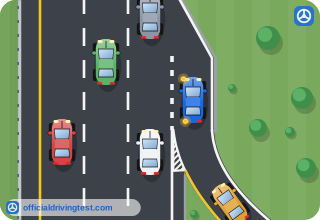
What is the purpose of the acceleration lane on an expressway entrance?
- To stop and wait for a gap in traffic
- To pass slower cars on the entrance ramp
- To match your speed to expressway traffic
- To park briefly and check your mirrors
Show answer
Correct answer: To match your speed to expressway traffic
In the acceleration lane you can adjust your speed to the speed of the expressway traffic.
Source: Georgia Driver's Manual (2023-2024), page 40
-
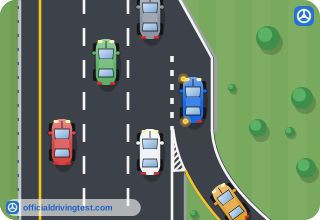
When should you merge into expressway traffic from the acceleration lane?
- As soon as the ramp begins
- When it is safe to do so
- Only after stopping at the end of the lane
- Before your speed matches traffic
Show answer
Correct answer: When it is safe to do so
The manual says to merge into traffic when it is safe to do so.
Source: Georgia Driver's Manual (2023-2024), page 40
-
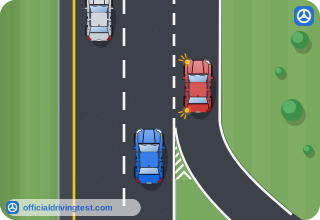
Who has the right of way when you enter an expressway?
- Vehicles entering on the ramp
- The vehicle that arrives first
- Vehicles in the acceleration lane
- Vehicles already on the expressway
Show answer
Correct answer: Vehicles already on the expressway
Vehicles on the expressway have the right of way, though courteous drivers may let you in.
Source: Georgia Driver's Manual (2023-2024), page 40
-
How should you prepare to exit a controlled access highway?
- Stay in the center lane and cross over just at the exit ramp
- Move to the lane farthest from the exit and then turn sharply
- Move right for a right-side exit or left for a left-side exit
- Always move to the right lane, whichever side the exit is on
Show answer
Correct answer: Move right for a right-side exit or left for a left-side exit
You prepare by moving to the right lane for an exit on the right, or the left lane for an exit on the left.
Source: Georgia Driver's Manual (2023-2024), page 40
-
What tells you of an approaching expressway exit?
- Guide signs
- Regulatory signs
- Warning signs
- Pavement arrows
Show answer
Correct answer: Guide signs
Guide signs will tell you of the approaching exit.
Source: Georgia Driver's Manual (2023-2024), page 40