Georgia: Emergency vehicles & work zones
Emergency vehicles, the Move Over law, traffic stops, school buses and work zones. Split into 4 shorter tests so you're not stuck in one long quiz.
Independent educational site · not affiliated with any government agency or DMV
Choose a part
Emergency vehicles & work zones — Part 1
Questions in this part include: “According to the manual, when do police officers conduct traffic stops?”
StartEmergency vehicles & work zones — Part 2
Questions in this part include: “What does your signature on a traffic ticket mean?”
StartEmergency vehicles & work zones — Part 3
Questions in this part include: “What colors are the advisory speed limit signs used in work zones?”
StartEmergency vehicles & work zones — Part 4
Questions in this part include: “What is the maximum fine for violating the law on passing a postal carrier or sanitation workers?”
StartAll 66 Emergency vehicles & work zones questions with answers
Choose a part above to take a practice test, or study every question and answer here.
Show the questions and answersHide the questions
-
According to the manual, when do police officers conduct traffic stops?
- On reasonable suspicion of a traffic or criminal violation
- Only when they have a written warrant for the driver
- Only when another driver files a complaint
- Only when a passenger gives consent to the stop
Show answer
Correct answer: On reasonable suspicion of a traffic or criminal violation
The manual says officers conduct traffic stops when they have reasonable suspicion of a traffic violation or a criminal violation.
Source: Georgia Driver's Manual (2023-2024), page 3
-
When you see emergency lights behind you, what should you do?
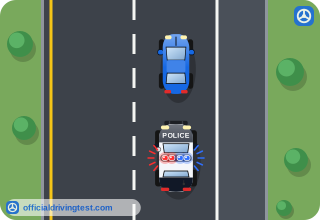
- Stop at once in your lane and turn on your hazard flashers
- Slow down and keep driving until the officer passes you
- Signal and pull off to the side of the road as soon as it is safe
- Drive to the next police station before you stop
Show answer
Correct answer: Signal and pull off to the side of the road as soon as it is safe
You should signal and pull off to the side of the roadway as soon as it is safe to do so.
Source: Georgia Driver's Manual (2023-2024), page 3
-
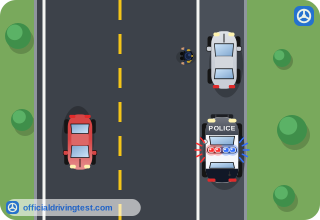
After you pull over for a police stop, what should you do with the engine and audio devices?
- Leave the engine running and only lower the volume
- Turn off the engine and any audio devices
- Turn off the audio devices but leave the engine running
- Leave both on so you can hear the officer's radio
Show answer
Correct answer: Turn off the engine and any audio devices
The manual tells you to turn off the engine and any audio devices.
Source: Georgia Driver's Manual (2023-2024), page 3
-
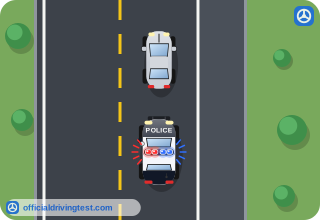
Unless the officer directs you to exit, what should you do during a traffic stop?
- Get out and walk back to the police car
- Step out and stand beside your vehicle
- Get out and open the hood of your vehicle
- Stay in your vehicle
Show answer
Correct answer: Stay in your vehicle
The manual says to stay in your vehicle unless directed by the officer to exit.
Source: Georgia Driver's Manual (2023-2024), page 3
-
If you are pulled over at night, what should you turn on to help with visibility?
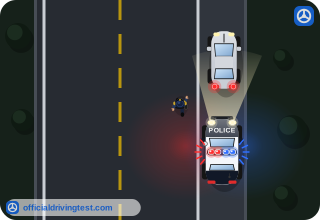
- Your interior lights
- Your high beam headlights
- Your hazard flashers
- Your fog lights
Show answer
Correct answer: Your interior lights
The manual says to turn on your interior lights if you are pulled over at night.
Source: Georgia Driver's Manual (2023-2024), page 3
-
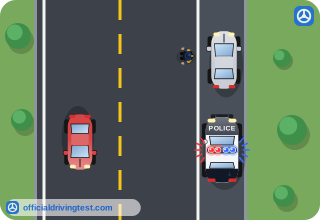
Where should your hands be during a traffic stop?
- In your lap, below the window line
- On the dashboard, out of the officer's sight
- On the steering wheel or in a visible location
- Behind your head, with the fingers laced
Show answer
Correct answer: On the steering wheel or in a visible location
Keep your hands on the steering wheel or in a visible location so they are easily observable.
Source: Georgia Driver's Manual (2023-2024), page 3
-
During a traffic stop, whose instructions should you follow?
- Only the instructions the officer gives to the driver
- All instructions the officer gives you or your passengers
- Only the instructions given while you remain seated
- Only the instructions that explain why you were stopped
Show answer
Correct answer: All instructions the officer gives you or your passengers
The manual says to follow all instructions the officer gives you or your passengers.
Source: Georgia Driver's Manual (2023-2024), page 3
-
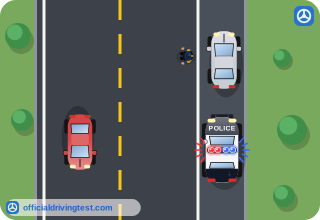
When the officer approaches your vehicle, what should you do about the window?
- Keep all windows closed and speak through the glass
- Lower all four windows of the vehicle
- Lower only the driver's window, even if the officer is on the other side
- Lower the window on the side where the officer is
Show answer
Correct answer: Lower the window on the side where the officer is
Lower the corresponding window so you and the officer can better communicate.
Source: Georgia Driver's Manual (2023-2024), page 3
-
When should you tell the officer that you have a weapon in the vehicle?
- Upon first contact
- Only if the officer asks about it
- After you hand over your documents
- When the officer asks you to exit the vehicle
Show answer
Correct answer: Upon first contact
You should let the officer know about a weapon in the vehicle upon first contact.
Source: Georgia Driver's Manual (2023-2024), page 3
-
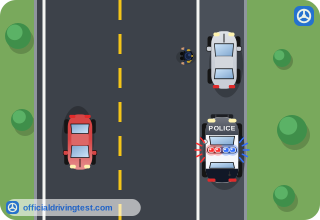
Before reaching for your driver's license or vehicle documents, what should you do?
- Reach for them as soon as the officer arrives
- Place them on the dashboard before the officer walks up
- Wait for the officer's instructions
- Reach for the glove box while you explain your trip
Show answer
Correct answer: Wait for the officer's instructions
The manual says to wait for the officer's instructions before reaching for your license or vehicle documents.
Source: Georgia Driver's Manual (2023-2024), page 3
-
If an officer who is not in uniform does not show law enforcement credentials, what may you do?
- Ignore the stop until a uniformed officer arrives
- Ask to see them
- Ask your passengers to step out of the vehicle
- Drive away slowly and stop at the next light
Show answer
Correct answer: Ask to see them
The manual says that if the officer does not show credentials, you may ask to see them.
Source: Georgia Driver's Manual (2023-2024), page 3
-
Which documents will the officer typically ask you for during a traffic stop?
- Your driver's license, birth certificate, and proof of residence
- Your driver's license, vehicle title, and safety inspection record
- Your driver's license, Social Security card, and vehicle warranty
- Your driver's license, proof of insurance, and vehicle registration
Show answer
Correct answer: Your driver's license, proof of insurance, and vehicle registration
The officer will typically ask for your driver's license, proof of insurance, and vehicle registration.
Source: Georgia Driver's Manual (2023-2024), page 3
-
If the documents the officer asks for are out of your reach, what should you do?
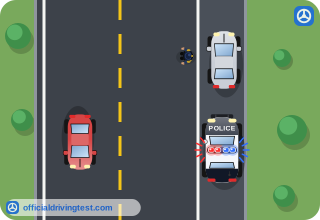
- Tell the officer where they are and wait for acknowledgement before reaching
- Reach for them right away and explain what you are doing afterward
- Ask a passenger to hand them over without telling the officer
- Step out of the vehicle to look for them in the trunk
Show answer
Correct answer: Tell the officer where they are and wait for acknowledgement before reaching
You should tell the officer where the documents are and wait for acknowledgement before reaching for them.
Source: Georgia Driver's Manual (2023-2024), page 3
-
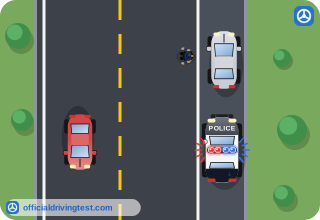
If the officer asks you to exit the vehicle, what should you do?
- Exit quickly and stand behind your vehicle
- Keep your hands in your pockets and wait beside the road
- Keep your hands visible, exit, and stand where the officer directs
- Stay seated until the officer repeats the request
Show answer
Correct answer: Keep your hands visible, exit, and stand where the officer directs
The manual says to keep your hands visible, exit the vehicle, and stand in a location as directed by the officer.
Source: Georgia Driver's Manual (2023-2024), page 3
-
Which of these is listed as a sanction an officer may impose at a traffic stop?
- A roadside court hearing
- A warning, ticket, or arrest
- A mandatory driver education class
- An on-the-spot vehicle inspection
Show answer
Correct answer: A warning, ticket, or arrest
The manual lists a warning, a traffic ticket (which may include a fine), or arrest as possible sanctions.
Source: Georgia Driver's Manual (2023-2024), page 3
-
If the officer does not explain the action being taken, what may you do?
- Drive away until the officer explains it
- Wait silently until the officer leaves
- Ask your passengers to question the officer
- Ask the officer to explain it
Show answer
Correct answer: Ask the officer to explain it
The manual says that if the officer does not explain the action, you may ask them to do so.
Source: Georgia Driver's Manual (2023-2024), page 3
-
If you disagree with the officer's decision, what does the manual say to do?
- Do not argue; contest the decision in court through legal channels
- Argue until the officer reconsiders the decision
- Refuse to sign the ticket until you have spoken to a judge
- Drive away and contact the department later
Show answer
Correct answer: Do not argue; contest the decision in court through legal channels
The manual says not to prolong the contact by arguing, and that you may contest the decision in court through established legal channels.
Source: Georgia Driver's Manual (2023-2024), page 3
-
What does your signature on a traffic ticket mean?
- It is an admission of guilt
- It gives up your right to contest the ticket in court
- It is not an admission of guilt
- It is a promise to pay the fine at the scene
Show answer
Correct answer: It is not an admission of guilt
The manual states that acceptance and signature on a traffic ticket is not an admission of guilt.
Source: Georgia Driver's Manual (2023-2024), page 3
-
What may happen if you refuse to sign a traffic ticket?
- Your license is cancelled on the spot
- You may be arrested
- The ticket is dismissed
- The officer must let you leave with a warning
Show answer
Correct answer: You may be arrested
The manual says that refusing to sign a traffic ticket may result in your arrest.
Source: Georgia Driver's Manual (2023-2024), page 3
-
If you believe the officer acted inappropriately, what may you do?
- Ask your passengers to file a complaint at the scene
- Refuse to answer any further questions from the officer
- Wait a few weeks before raising the matter
- Request to speak to a supervisor, ideally soon after the stop
Show answer
Correct answer: Request to speak to a supervisor, ideally soon after the stop
You may request to speak to a supervisor, and this is best done as soon as possible after the stop.
Source: Georgia Driver's Manual (2023-2024), page 3
-
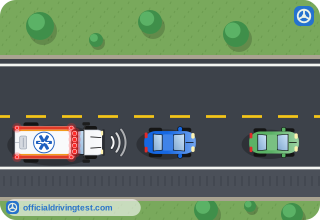
An emergency vehicle is using its emergency lights and siren. What should you do?
- Speed up to clear the road ahead of the emergency vehicle
- Stay where you are, even if you are inside an intersection
- Slow down and move over to the shoulder or as far right as you can, and stop
- Move to the left side of the roadway and keep going at your speed
Show answer
Correct answer: Slow down and move over to the shoulder or as far right as you can, and stop
You slow down, move to the shoulder or as far right as possible, and stop, while making sure not to endanger others.
Source: Georgia Driver's Manual (2023-2024), page 17
-
Emergency vehicles using lights of which colors, along with sirens, require you to maneuver your vehicle out of their way?
- Green or white
- Blue or red
- Orange or purple
- Green or amber
Show answer
Correct answer: Blue or red
The manual describes the emergency lights as blue or red, used together with sirens.
Source: Georgia Driver's Manual (2023-2024), page 17
-
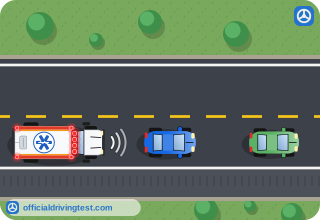
When you move out of the way of an emergency vehicle, which of these must you avoid doing?
- Slowing your vehicle
- Moving toward the shoulder of the road
- Using caution near bicyclists and pedestrians
- Blocking an intersection
Show answer
Correct answer: Blocking an intersection
You must not position your vehicle so that it blocks an intersection or keeps the emergency vehicle from making a necessary turn.
Source: Georgia Driver's Manual (2023-2024), page 17
-
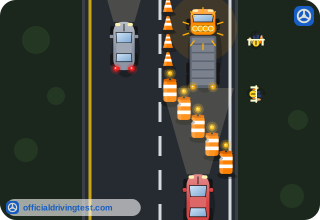
Whom must you yield to in a construction zone?
- All highway maintenance vehicles and workers
- Only workers who are directing traffic
- Only vehicles that have flashing lights on
- Only vehicles that are carrying road materials
Show answer
Correct answer: All highway maintenance vehicles and workers
The manual says to yield to all highway maintenance vehicles and workers in a construction zone.
Source: Georgia Driver's Manual (2023-2024), page 17
-
What causes over half of all fatal injuries to road workers?
- Being struck by a motor vehicle
- Falls from equipment
- Contact with overhead power lines
- Heat exhaustion
Show answer
Correct answer: Being struck by a motor vehicle
The manual says over half of all fatal injuries to road workers are caused by being struck by a motor vehicle.
Source: Georgia Driver's Manual (2023-2024), page 22
-
Of the fatal injuries to road workers caused by being struck by a motor vehicle, what fraction are caused by vehicles intruding into the work space?
- Half
- A quarter
- A third
- Two thirds
Show answer
Correct answer: A third
The manual says a third of these fatal injuries are caused by vehicles intruding into the work space.
Source: Georgia Driver's Manual (2023-2024), page 22
-
Since 1973, how many GDOT workers have lost their lives in work zones, according to the manual?
- 82
- 73
- 196
- 169
Show answer
Correct answer: 169
The manual states that 169 GDOT workers have lost their lives in work zones since 1973.
Source: Georgia Driver's Manual (2023-2024), page 22
-
What share of work zone fatalities nationwide does the general public account for?
- 82%
- 18%
- 45%
- 60%
Show answer
Correct answer: 82%
The manual says the general public accounts for 82% of work zone fatalities nationwide.
Source: Georgia Driver's Manual (2023-2024), page 22
-
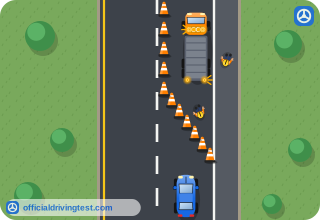
How does the manual define highway work zones?
- Only sections of a road that are completely closed to all traffic while work is done
- Only areas where orange barrels and cones have been placed across a lane of travel
- Areas where construction, reconstruction, or maintenance work is being done on or near the road
- Only stretches of road where a GDOT crew is present together with a flagger
Show answer
Correct answer: Areas where construction, reconstruction, or maintenance work is being done on or near the road
Work zones are portions of a highway or street where construction, reconstruction, or maintenance work is being done on or near the road.
Source: Georgia Driver's Manual (2023-2024), page 22
-
Which of these activities is included in the manual's definition of mobile work in work zones?
- Police speed enforcement
- Land surveying activities
- Delivery truck loading
- School bus stops
Show answer
Correct answer: Land surveying activities
The definition includes mobile work such as underground and overhead utility maintenance, snow removal, and land surveying.
Source: Georgia Driver's Manual (2023-2024), page 22
-
Who is responsible for knowing how to read and react to the directions given by signing, markings and flaggers in a work zone?
- Motorists
- Flaggers
- GDOT crews
- Law enforcement officers
Show answer
Correct answer: Motorists
The manual says motorists are responsible for knowing how to read and react to these directions.
Source: Georgia Driver's Manual (2023-2024), page 22
-
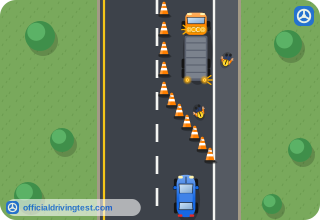
What are the most important steps to preventing crashes while driving through a work zone?
- Driving at the posted speed limit and using high beams
- Following the vehicle ahead closely to keep traffic moving
- Paying attention and driving cautiously and courteously
- Changing lanes often to find the fastest lane
Show answer
Correct answer: Paying attention and driving cautiously and courteously
The manual calls paying attention and driving cautiously and courteously the most important steps.
Source: Georgia Driver's Manual (2023-2024), page 22
-
Which color should you watch for as a sign of road work?
- Green
- Orange
- Blue
- Brown
Show answer
Correct answer: Orange
The manual says to watch for the color orange because it means road work.
Source: Georgia Driver's Manual (2023-2024), page 22
-
What colors do warning signs in work zones have?
- A yellow background with black letters or symbols
- A white background with black letters or symbols
- An orange background with white letters or symbols
- An orange background with black letters or symbols
Show answer
Correct answer: An orange background with black letters or symbols
Warning signs in work zones have an orange background and black letters or symbols.
Source: Georgia Driver's Manual (2023-2024), page 22
-
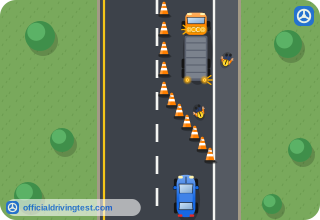
If the speed limit is not reduced in a work zone, what should drivers do?
- Drive 10 mph below the normal posted speed limit for as long as the workers are present
- Obey the normal posted speed limit but be more cautious of road conditions, lane position, and workers
- Drive at whatever speed feels safe to you because the posted limit does not apply there
- Stop and wait for a flagger to wave you through, then speed up to make up lost time
Show answer
Correct answer: Obey the normal posted speed limit but be more cautious of road conditions, lane position, and workers
Drivers should obey the normal posted limit but be more cautious of conditions, lane position, and the presence of workers.
Source: Georgia Driver's Manual (2023-2024), page 22
-
What colors are the advisory speed limit signs used in work zones?
- Black and white
- Red and white
- Green and white
- Black and orange
Show answer
Correct answer: Black and orange
Advisory speed signs in work zones are black and orange and are always used with warning signs.
Source: Georgia Driver's Manual (2023-2024), page 22
-
How are required speed limit reductions in a work zone indicated?
- With the standard black and white speed limit signs
- With black and orange advisory signs
- With flashing amber lights on work vehicles only
- With orange pennant flags along the road
Show answer
Correct answer: With the standard black and white speed limit signs
Official speed limit reduction requirements are shown with the standard black and white speed limit signs.
Source: Georgia Driver's Manual (2023-2024), page 22
-
How is disobeying regulatory speed limits in a work zone classified?
- A felony
- A civil infraction with no criminal penalty
- A misdemeanor of a high and aggravated nature
- A warning only for a first offense
Show answer
Correct answer: A misdemeanor of a high and aggravated nature
The manual says violators may be found guilty of a misdemeanor of a high and aggravated nature.
Source: Georgia Driver's Manual (2023-2024), page 22
-
What fine applies to motorists who disobey regulatory speed limits in a work zone?
- Not less than $50.00 and not more than $500.00
- Not less than $200.00 and not more than $1,000.00
- Not less than $250.00 and not more than $5,000.00
- Not less than $100.00 and not more than $2,000.00
Show answer
Correct answer: Not less than $100.00 and not more than $2,000.00
The manual sets the fine at not less than $100.00 nor more than $2,000.00.
Source: Georgia Driver's Manual (2023-2024), page 22
-
What is the longest imprisonment term for disobeying regulatory speed limits in a work zone?
- 12 months
- 30 days
- 6 months
- 3 years
Show answer
Correct answer: 12 months
The manual says imprisonment for a term not to exceed 12 months, or both with the fine.
Source: Georgia Driver's Manual (2023-2024), page 22
-
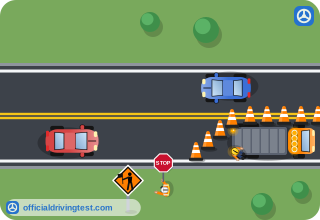
In a work zone, a flagger has the same authority as what?
- A warning sign
- An advisory speed sign
- A regulatory sign
- A guide sign
Show answer
Correct answer: A regulatory sign
The manual says a flagger in a work zone has the same authority as a regulatory sign.
Source: Georgia Driver's Manual (2023-2024), page 22
-
What must you do about work vehicles and heavy equipment that have flashing or revolving amber lights?
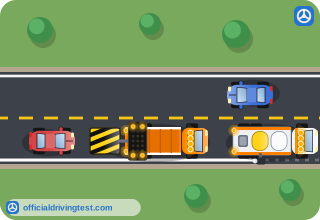
- Pass them as quickly as possible
- Yield the right-of-way to them
- Follow them closely until the work zone ends
- Flash your headlights to signal them
Show answer
Correct answer: Yield the right-of-way to them
The manual says you must yield the right-of-way to work vehicles and heavy equipment with amber lights.
Source: Georgia Driver's Manual (2023-2024), page 22
-
When lanes are closed or narrowed, or workers are operating near traffic, what should you do?
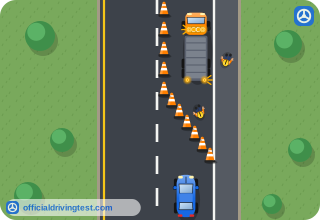
- Change lanes away from them if possible, or shift slightly within your lane for added distance
- Stay in the lane closest to the workers so that you are able to watch what they do
- Move onto the shoulder beside the workers so that you can pass them at a slow speed
- Stop where you are until all of the workers have left the roadway and traffic clears
Show answer
Correct answer: Change lanes away from them if possible, or shift slightly within your lane for added distance
The manual tells drivers to change lanes away from workers if possible or shift slightly within their lane to add distance.
Source: Georgia Driver's Manual (2023-2024), page 22
-
Which of these is an example of road work done while moving in traffic, without closing lanes?
- Bridge demolition
- Building a new interchange
- Paint striping
- Widening the road to add lanes
Show answer
Correct answer: Paint striping
The manual lists pavement maintenance, debris removal, paint striping, utility work, and snow removal as work done while moving in traffic.
Source: Georgia Driver's Manual (2023-2024), page 22
-
Vehicles doing mobile road work may have flashing arrows directing traffic to do what?
- Stop and wait
- Merge left or right
- Make a U-turn
- Increase speed
Show answer
Correct answer: Merge left or right
Mobile work vehicles have flashing amber lights and may have flashing arrows directing traffic to merge left or right.
Source: Georgia Driver's Manual (2023-2024), page 22
-
Mobile road work vehicles usually work at very slow speeds, such as how many miles per hour?
- 10 miles per hour
- 20 miles per hour
- 30 miles per hour
- 5 miles per hour
Show answer
Correct answer: 5 miles per hour
The manual says these vehicles usually work at very slow speeds, such as 5 miles per hour.
Source: Georgia Driver's Manual (2023-2024), page 22
-
What should you do when you approach mobile work vehicles in the roadway?
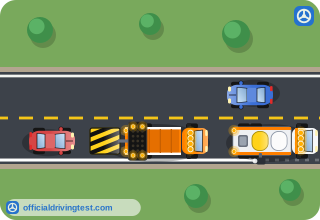
- Speed up to pass them before you reach the next work zone ahead
- Slow down, yield the right-of-way, and follow any directions they display
- Stay close behind and wait for them to stop moving in the lane
- Ignore their signs and arrows if the road ahead of you looks clear
Show answer
Correct answer: Slow down, yield the right-of-way, and follow any directions they display
The manual says to slow down, yield the right-of-way to these work vehicles, and follow any directions displayed.
Source: Georgia Driver's Manual (2023-2024), page 22
-
According to the work zone driving tips, what is true of fines in most work zones?
- They are waived for a first offense
- They are reduced at night
- They are the same as elsewhere
- They are increased
Show answer
Correct answer: They are increased
The tips say to watch for speed limit signs because fines are increased in most work zones.
Source: Georgia Driver's Manual (2023-2024), page 22
-
Which is one of the four work zone driving tips in the manual?
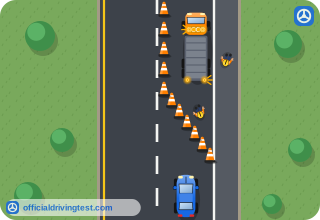
- Adjust your lane position away from workers
- Follow the vehicle ahead closely
- Use high beams day and night
- Pass slower vehicles on the shoulder
Show answer
Correct answer: Adjust your lane position away from workers
The four tips are to reduce your speed, watch for speed limit signs, adjust your lane position away from workers, and prepare for the unexpected.
Source: Georgia Driver's Manual (2023-2024), page 22
-
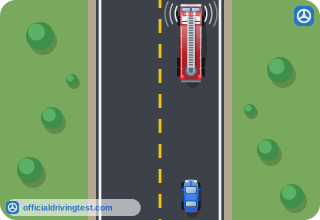
A driver not on official business must not follow a fire fighting apparatus responding to a fire alarm, or other emergency vehicles, closer than what distance?
- 100 feet
- 200 feet
- 300 feet
- 500 feet
Show answer
Correct answer: 200 feet
The manual says not to follow fire fighting apparatus or other emergency vehicles closer than 200 feet.
Source: Georgia Driver's Manual (2023-2024), page 24
-
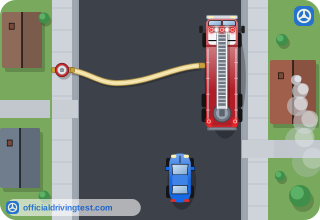
A driver not on official business must not park within what distance of any fire apparatus stopped in answer to a fire alarm?
- 200 feet
- 300 feet
- 1,000 feet
- 500 feet
Show answer
Correct answer: 500 feet
The manual says not to park any vehicle within 500 feet of fire apparatus stopped in answer to a fire alarm.
Source: Georgia Driver's Manual (2023-2024), page 24
-
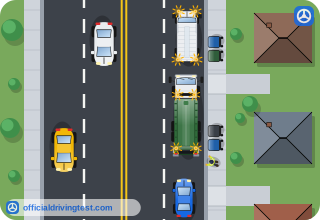
A motor vehicle approaches a postal service vehicle or a vehicle with active sanitation workers displaying flashing lights. What is the first action the law directs if it is possible and safe?
- Stop behind the vehicle until the lights stop flashing
- Pass the vehicle as quickly as possible in the adjacent lane
- Change into a lane not adjacent to that vehicle
- Sound your horn to warn the workers
Show answer
Correct answer: Change into a lane not adjacent to that vehicle
The law directs a lane change into a lane not adjacent to the vehicle if possible in the existing safety and traffic conditions.
Source: Georgia Driver's Manual (2023-2024), page 25
-
Which flashing lights on a postal service vehicle or a vehicle with active sanitation workers trigger the requirement to approach with due caution?
- Blue or green lights only
- Yellow, amber, white, or red
- Red only
- Blue only
Show answer
Correct answer: Yellow, amber, white, or red
The law applies to vehicles displaying flashing yellow, amber, white, or red lights.
Source: Georgia Driver's Manual (2023-2024), page 25
-
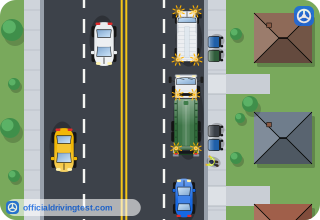
If a lane change is impossible, prohibited by law, or unsafe near a postal service vehicle or active sanitation workers, how far must you reduce your speed?
- At least five mph less than the posted limit or 15 mph, whichever is less, and be prepared to stop
- At least twenty mph less than the posted limit or 35 mph, whichever is more, and be prepared to stop
- To a complete stop, then proceed only when the lights stop flashing
- At least ten mph less than the posted limit or 25 mph, whichever is more, and be prepared to stop
Show answer
Correct answer: At least ten mph less than the posted limit or 25 mph, whichever is more, and be prepared to stop
The law requires a speed at least ten miles per hour less than the posted speed limit or 25 miles per hour, whichever is more, and to be prepared to stop.
Source: Georgia Driver's Manual (2023-2024), page 25
-
What is the maximum fine for violating the law on passing a postal carrier or sanitation workers?
- $100.00
- $250.00
- $500.00
- $1,000.00
Show answer
Correct answer: $250.00
The manual says a violation is punished by a fine of not more than $250.00.
Source: Georgia Driver's Manual (2023-2024), page 25
-
To which vehicles does Georgia's "Move Over" law apply when they are parked on the shoulder of the roadway?
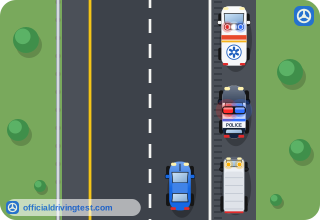
- Only police vehicles displaying flashing blue lights
- Any emergency, sanitation, or utility service vehicle
- Only ambulances and fire trucks responding to an emergency
- Only vehicles belonging to highway construction workers
Show answer
Correct answer: Any emergency, sanitation, or utility service vehicle
The manual says the law applies to any emergency, sanitation, or utility service vehicle parked on the shoulder.
Source: Georgia Driver's Manual (2023-2024), page 18
-
The "Move Over" law works by maintaining what between passing highway traffic and authorized roadside emergency vehicles?
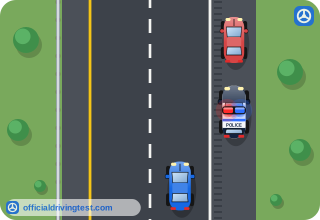
- A reduced speed zone of one mile
- A flashing light warning zone
- A 500-foot no-passing area
- An open buffer lane
Show answer
Correct answer: An open buffer lane
The manual says the law maintains an open buffer lane between passing traffic and authorized roadside emergency vehicles.
Source: Georgia Driver's Manual (2023-2024), page 18
-
The "Move Over" law covers authorized roadside emergency vehicles displaying flashing lights of which colors?
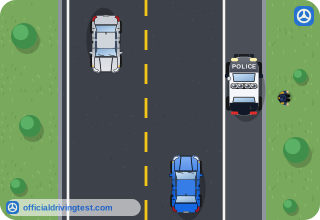
- Only flashing red or blue lights
- Only flashing yellow or amber lights
- Yellow, amber, white, red, or blue
- Only flashing amber, green, or purple lights
Show answer
Correct answer: Yellow, amber, white, red, or blue
The manual lists flashing yellow, amber, white, red, or blue lights.
Source: Georgia Driver's Manual (2023-2024), page 18
-
Georgia's "Move Over" law was amended to include which additional workers?
- Bus drivers and package delivery drivers
- Active sanitation workers and utility service workers
- Parking enforcement officers and meter readers
- Landscapers and road surveyors working near the road
Show answer
Correct answer: Active sanitation workers and utility service workers
The manual says the law was amended to include active sanitation workers and utility service workers who use traffic cones or vehicles with flashing lights.
Source: Georgia Driver's Manual (2023-2024), page 18
-
If you are unable to move over for a stopped emergency vehicle, what does Georgia's "Move Over" law require?
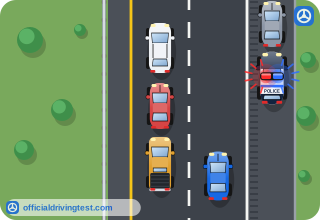
- Stop completely and wait until the vehicle has left the shoulder
- Maintain your speed and sound your horn as you pass
- Slow down and flash your headlights as you pass
- Slow down below the speed limit and be prepared to stop
Show answer
Correct answer: Slow down below the speed limit and be prepared to stop
The manual says that if you cannot move over, you must slow down below the speed limit and be prepared to stop.
Source: Georgia Driver's Manual (2023-2024), page 18
-
What is the maximum fine for a first offense under the "Move Over" law?
- $500
- $250
- $1,000
- $100
Show answer
Correct answer: $500
The manual says violations can result in a fine of no more than $500 for the first offense.
Source: Georgia Driver's Manual (2023-2024), page 18
-
How many states have "Move Over" laws, according to the manual?
- Forty states
- All 50 states
- Thirty states
- Only a few states
Show answer
Correct answer: All 50 states
The manual says all 50 states have "Move Over" laws.
Source: Georgia Driver's Manual (2023-2024), page 18
-
Which of these causes more line-of-duty deaths of police officers than any other cause, according to the manual?
- Shootings
- Fires
- Assaults
- Traffic crashes
Show answer
Correct answer: Traffic crashes
The manual says more police officers are killed by traffic crashes than by any other line-of-duty cause of death.
Source: Georgia Driver's Manual (2023-2024), page 18
-
Of the police officers killed in traffic crashes, what share are struck by passing vehicles while working outside their patrol cars?
- More than one fourth
- Fewer than one tenth
- About one twentieth
- Fewer than one in fifty
Show answer
Correct answer: More than one fourth
The manual says more than one fourth of those killed are struck by passing vehicles while they work outside their patrol cars.
Source: Georgia Driver's Manual (2023-2024), page 18
-
Thirty percent of all crashes occur as the result of what, according to the manual?
- Drivers using wireless devices
- Wet or icy roads
- Another crash
- Tire blow-outs
Show answer
Correct answer: Another crash
The manual says thirty percent of all crashes occur as the result of another crash.
Source: Georgia Driver's Manual (2023-2024), page 18
-
What does providing a buffer lane for vehicles parked on the roadway shoulder actually do?
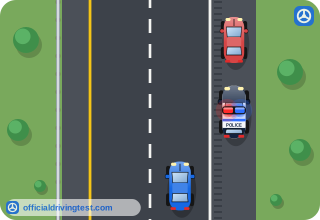
- Increases the speed of passing traffic
- Makes flashing emergency lights unnecessary
- Removes the need to slow down on the interstate
- Reduces the risk of another crash
Show answer
Correct answer: Reduces the risk of another crash
The manual says a buffer lane for vehicles parked on the shoulder actually reduces the risk of another crash.
Source: Georgia Driver's Manual (2023-2024), page 18