Georgia: Emergency vehicles & work zones — Part 3 Practice Test
Questions in this part include: “What colors are the advisory speed limit signs used in work zones?” · “What is the longest imprisonment term for disobeying regulatory speed limits in a work zone?”
Independent educational site · not affiliated with any government agency or DMV
Ready? Test yourself
- Instant feedback with an explanation
- Every answer cites its source in the manual
- Your best score is saved on this device
Questions are original and based on the official manual "Georgia Driver's Manual" (2023-2024), Georgia Department of Driver Services (DDS).
All 16 questions in this practice test
Take the test above first, then use this list to study. Tap “Show answer” to see the correct answer and explanation.
Show the questions and answersHide the questions
-
If the speed limit is not reduced in a work zone, what should drivers do?
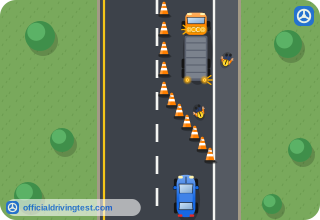
- Drive 10 mph below the normal posted speed limit for as long as the workers are present
- Obey the normal posted speed limit but be more cautious of road conditions, lane position, and workers
- Drive at whatever speed feels safe to you because the posted limit does not apply there
- Stop and wait for a flagger to wave you through, then speed up to make up lost time
Show answer
Correct answer: Obey the normal posted speed limit but be more cautious of road conditions, lane position, and workers
Drivers should obey the normal posted limit but be more cautious of conditions, lane position, and the presence of workers.
Source: Georgia Driver's Manual (2023-2024), page 22
-
What colors are the advisory speed limit signs used in work zones?
- Black and white
- Red and white
- Green and white
- Black and orange
Show answer
Correct answer: Black and orange
Advisory speed signs in work zones are black and orange and are always used with warning signs.
Source: Georgia Driver's Manual (2023-2024), page 22
-
How are required speed limit reductions in a work zone indicated?
- With the standard black and white speed limit signs
- With black and orange advisory signs
- With flashing amber lights on work vehicles only
- With orange pennant flags along the road
Show answer
Correct answer: With the standard black and white speed limit signs
Official speed limit reduction requirements are shown with the standard black and white speed limit signs.
Source: Georgia Driver's Manual (2023-2024), page 22
-
How is disobeying regulatory speed limits in a work zone classified?
- A felony
- A civil infraction with no criminal penalty
- A misdemeanor of a high and aggravated nature
- A warning only for a first offense
Show answer
Correct answer: A misdemeanor of a high and aggravated nature
The manual says violators may be found guilty of a misdemeanor of a high and aggravated nature.
Source: Georgia Driver's Manual (2023-2024), page 22
-
What fine applies to motorists who disobey regulatory speed limits in a work zone?
- Not less than $50.00 and not more than $500.00
- Not less than $200.00 and not more than $1,000.00
- Not less than $250.00 and not more than $5,000.00
- Not less than $100.00 and not more than $2,000.00
Show answer
Correct answer: Not less than $100.00 and not more than $2,000.00
The manual sets the fine at not less than $100.00 nor more than $2,000.00.
Source: Georgia Driver's Manual (2023-2024), page 22
-
What is the longest imprisonment term for disobeying regulatory speed limits in a work zone?
- 12 months
- 30 days
- 6 months
- 3 years
Show answer
Correct answer: 12 months
The manual says imprisonment for a term not to exceed 12 months, or both with the fine.
Source: Georgia Driver's Manual (2023-2024), page 22
-
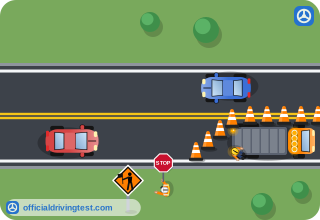
In a work zone, a flagger has the same authority as what?
- A warning sign
- An advisory speed sign
- A regulatory sign
- A guide sign
Show answer
Correct answer: A regulatory sign
The manual says a flagger in a work zone has the same authority as a regulatory sign.
Source: Georgia Driver's Manual (2023-2024), page 22
-
What must you do about work vehicles and heavy equipment that have flashing or revolving amber lights?

- Pass them as quickly as possible
- Yield the right-of-way to them
- Follow them closely until the work zone ends
- Flash your headlights to signal them
Show answer
Correct answer: Yield the right-of-way to them
The manual says you must yield the right-of-way to work vehicles and heavy equipment with amber lights.
Source: Georgia Driver's Manual (2023-2024), page 22
-
When lanes are closed or narrowed, or workers are operating near traffic, what should you do?
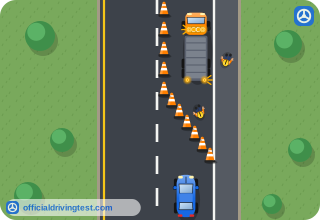
- Change lanes away from them if possible, or shift slightly within your lane for added distance
- Stay in the lane closest to the workers so that you are able to watch what they do
- Move onto the shoulder beside the workers so that you can pass them at a slow speed
- Stop where you are until all of the workers have left the roadway and traffic clears
Show answer
Correct answer: Change lanes away from them if possible, or shift slightly within your lane for added distance
The manual tells drivers to change lanes away from workers if possible or shift slightly within their lane to add distance.
Source: Georgia Driver's Manual (2023-2024), page 22
-
Which of these is an example of road work done while moving in traffic, without closing lanes?
- Bridge demolition
- Building a new interchange
- Paint striping
- Widening the road to add lanes
Show answer
Correct answer: Paint striping
The manual lists pavement maintenance, debris removal, paint striping, utility work, and snow removal as work done while moving in traffic.
Source: Georgia Driver's Manual (2023-2024), page 22
-
Vehicles doing mobile road work may have flashing arrows directing traffic to do what?
- Stop and wait
- Merge left or right
- Make a U-turn
- Increase speed
Show answer
Correct answer: Merge left or right
Mobile work vehicles have flashing amber lights and may have flashing arrows directing traffic to merge left or right.
Source: Georgia Driver's Manual (2023-2024), page 22
-
Mobile road work vehicles usually work at very slow speeds, such as how many miles per hour?
- 10 miles per hour
- 20 miles per hour
- 30 miles per hour
- 5 miles per hour
Show answer
Correct answer: 5 miles per hour
The manual says these vehicles usually work at very slow speeds, such as 5 miles per hour.
Source: Georgia Driver's Manual (2023-2024), page 22
-
What should you do when you approach mobile work vehicles in the roadway?

- Speed up to pass them before you reach the next work zone ahead
- Slow down, yield the right-of-way, and follow any directions they display
- Stay close behind and wait for them to stop moving in the lane
- Ignore their signs and arrows if the road ahead of you looks clear
Show answer
Correct answer: Slow down, yield the right-of-way, and follow any directions they display
The manual says to slow down, yield the right-of-way to these work vehicles, and follow any directions displayed.
Source: Georgia Driver's Manual (2023-2024), page 22
-
According to the work zone driving tips, what is true of fines in most work zones?
- They are waived for a first offense
- They are reduced at night
- They are the same as elsewhere
- They are increased
Show answer
Correct answer: They are increased
The tips say to watch for speed limit signs because fines are increased in most work zones.
Source: Georgia Driver's Manual (2023-2024), page 22
-
Which is one of the four work zone driving tips in the manual?
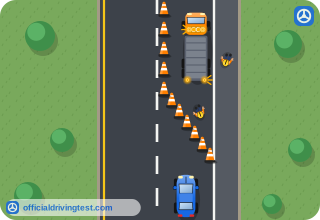
- Adjust your lane position away from workers
- Follow the vehicle ahead closely
- Use high beams day and night
- Pass slower vehicles on the shoulder
Show answer
Correct answer: Adjust your lane position away from workers
The four tips are to reduce your speed, watch for speed limit signs, adjust your lane position away from workers, and prepare for the unexpected.
Source: Georgia Driver's Manual (2023-2024), page 22
-
A driver not on official business must not follow a fire fighting apparatus responding to a fire alarm, or other emergency vehicles, closer than what distance?
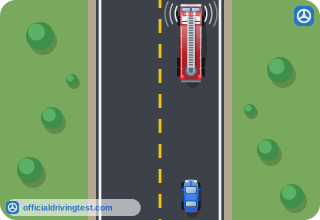
- 100 feet
- 200 feet
- 300 feet
- 500 feet
Show answer
Correct answer: 200 feet
The manual says not to follow fire fighting apparatus or other emergency vehicles closer than 200 feet.
Source: Georgia Driver's Manual (2023-2024), page 24