Delaware: Speed and following distance — Part 4 Practice Test
Delaware speed limits, adjusting speed to the road and traffic, night driving, and the space around your vehicle. — Part 4
Independent educational site · not affiliated with any government agency or DMV
Ready? Test yourself
- Instant feedback with an explanation
- Every answer cites its source in the manual
- Your best score is saved on this device
Questions are original and based on the official manual "Delaware Driver Manual" (July 2026), Delaware Division of Motor Vehicles (DMV).
All 33 questions in this practice test
Take the test above first, then use this list to study. Tap “Show answer” to see the correct answer and explanation.
Show the questions and answersHide the questions
-
Why do you need more following distance when you have a heavy load or are pulling a trailer?
- The extra weight increases your stopping distance
- Heavy loads make your brake lights dim
- Trailers cannot be seen by drivers behind
- The posted speed limit is lower for trailers
Show answer
Correct answer: The extra weight increases your stopping distance
The manual says the extra weight increases your stopping distance.
Source: Delaware Driver Manual (July 2026), page 128 · Open this page in the manual (Manual page 128)
-
What should you do with your following distance when it is hard to see ahead because of darkness or bad weather?
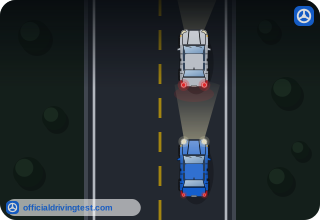
- Keep it the same
- Decrease it
- Increase it
- Follow the taillights closely
Show answer
Correct answer: Increase it
The manual says to increase your following distance when darkness or bad weather makes it hard to see ahead.
Source: Delaware Driver Manual (July 2026), page 128 · Open this page in the manual (Manual page 128)
-
If you are being followed closely, what should you try to do?
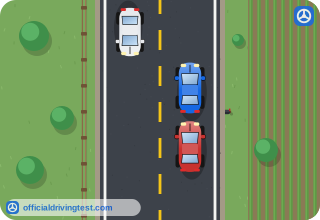
- Brake sharply to warn the driver
- Make extra space in front of you
- Speed up to get away from the driver
- Move in line with the driver’s bumper
Show answer
Correct answer: Make extra space in front of you
The manual says to try to make extra space so you can stop without being hit from behind.
Source: Delaware Driver Manual (July 2026), page 128 · Open this page in the manual (Manual page 128)
-
Why should you leave extra space when stopped on a hill or incline?
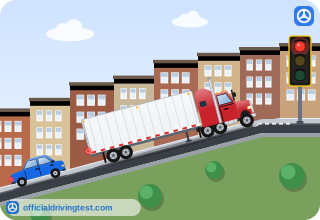
- The vehicle ahead will always stop short of you
- Your brakes work only when you are on level ground
- The vehicle ahead may roll back when it starts up
- The vehicle behind you will always pass you
Show answer
Correct answer: The vehicle ahead may roll back when it starts up
The manual says the vehicle ahead may roll back when it starts up or takes off.
Source: Delaware Driver Manual (July 2026), page 128 · Open this page in the manual (Manual page 128)
-
How can you help keep the driver behind you at a safe distance?
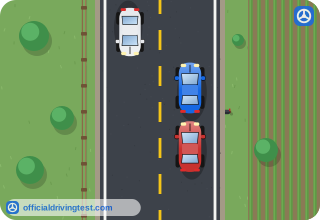
- Tap your brakes often so the driver sees your brake lights
- Keep a steady speed and signal in advance when slowing or turning
- Drive slightly below the speed limit at all times
- Flash your headlights at the driver behind you
Show answer
Correct answer: Keep a steady speed and signal in advance when slowing or turning
The manual says keeping a steady speed and signaling in advance when you slow down or turn helps keep the driver behind at a safe distance.
Source: Delaware Driver Manual (July 2026), page 129 · Open this page in the manual (Manual page 129)
-
When you stop to pick up or let off passengers, what should you try to do?
- Stop in the lane for the shortest time
- Stop beside the nearest crosswalk
- Stop in the left lane with hazard lights on
- Find a safe place out of traffic to stop
Show answer
Correct answer: Find a safe place out of traffic to stop
The manual says to try to find a safe place out of traffic to stop.
Source: Delaware Driver Manual (July 2026), page 129 · Open this page in the manual (Manual page 129)
-
If you want to parallel park and there is traffic coming behind you, what should you do?
- Signal, pull next to the space, and let following vehicles pass
- Brake hard and back into the space as fast as possible
- Stop in the traffic lane and wave the other traffic around you
- Speed up and park in the next block ahead of you
Show answer
Correct answer: Signal, pull next to the space, and let following vehicles pass
The manual says to put on your turn signal, pull next to the space, and allow following vehicles to pass before you park.
Source: Delaware Driver Manual (July 2026), page 129 · Open this page in the manual (Manual page 129)
-
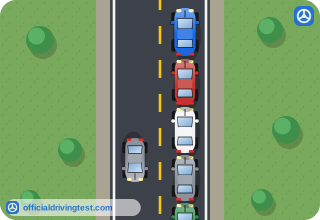
What should you do when you have to drive so slowly that you slow down other vehicles?
- Speed up until they stop following
- Stay in the lane and flash your hazard lights
- Pull to the side of the road when safe and let them pass
- Move to the left lane so they can pass on the right
Show answer
Correct answer: Pull to the side of the road when safe and let them pass
The manual says to pull to the side of the road when safe to do so and let other vehicles pass.
Source: Delaware Driver Manual (July 2026), page 129 · Open this page in the manual (Manual page 129)
-
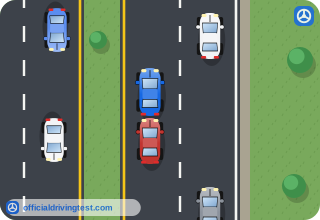
If you are being tailgated and there is a right lane, what should you do?
- Move over to the left
- Move over to the right
- Speed up to gain distance
- Stop in your lane
Show answer
Correct answer: Move over to the right
The manual says that if you are followed too closely and there is a right lane, you should move over to the right.
Source: Delaware Driver Manual (July 2026), page 129 · Open this page in the manual (Manual page 129)
-
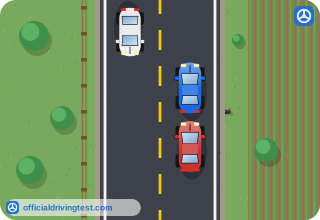
If you are being tailgated and there is no right lane, what should you do?
- Brake quickly so that the driver behind will back off
- Stay at the same speed and ignore the driver
- Move onto the shoulder and stop
- Wait until the road ahead is clear, then reduce speed slowly
Show answer
Correct answer: Wait until the road ahead is clear, then reduce speed slowly
The manual says to wait until the road ahead is clear and then reduce speed slowly, which encourages the tailgater to drive around you.
Source: Delaware Driver Manual (July 2026), page 129 · Open this page in the manual (Manual page 129)
-
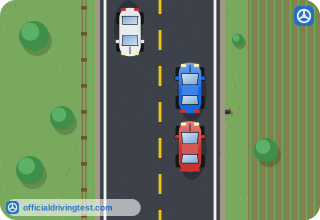
Why should you never slow down quickly to discourage a tailgater?
- It only increases your risk of being hit from behind
- It is not allowed on roads with only two lanes
- It makes the tailgater follow even more closely
- It confuses drivers in the oncoming lane
Show answer
Correct answer: It only increases your risk of being hit from behind
The manual says slowing down quickly to discourage a tailgater only increases your risk of being hit from behind.
Source: Delaware Driver Manual (July 2026), page 129 · Open this page in the manual (Manual page 129)
-
On a multi-lane road, what should you avoid doing to keep space to the side?
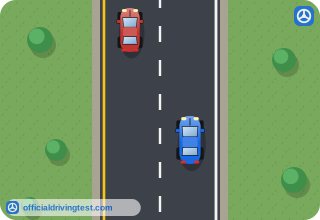
- Driving in the center lane
- Using the left lane
- Driving next to other vehicles
- Driving with your signal on
Show answer
Correct answer: Driving next to other vehicles
The manual says to avoid driving next to other vehicles on multi-lane roads and to move ahead or drop in back of the other vehicle.
Source: Delaware Driver Manual (July 2026), page 129 · Open this page in the manual (Manual page 129)
-
On a two-lane road, how do you keep as much space as you can between yourself and oncoming vehicles?
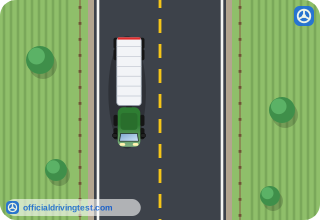
- By driving on the right edge of the lane
- By not crowding the center line
- By driving on the shoulder
- By driving on the center line
Show answer
Correct answer: By not crowding the center line
The manual says that on a two-lane road, keeping space from oncoming vehicles means not crowding the center line.
Source: Delaware Driver Manual (July 2026), page 129 · Open this page in the manual (Manual page 129)
-
In general, where in your lane is it safest to drive?
- Near the left edge of your lane
- Near the right edge of your lane
- Over the lane line
- In the center of your lane
Show answer
Correct answer: In the center of your lane
The manual says that in general it is safest to drive in the center of your lane.
Source: Delaware Driver Manual (July 2026), page 129 · Open this page in the manual (Manual page 129)
-
What should you do to make room for vehicles entering a roadway that has two or more lanes, if no one is next to you?
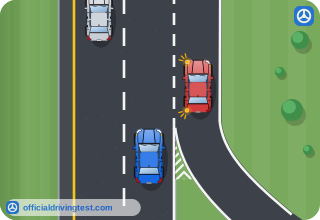
- Move over a lane
- Slow down to a stop
- Speed up and stay in your lane
- Move onto the shoulder
Show answer
Correct answer: Move over a lane
The manual says to make room for entering vehicles and, if there is no one next to you, move over a lane.
Source: Delaware Driver Manual (July 2026), page 129 · Open this page in the manual (Manual page 129)
-
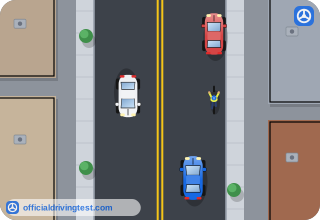
Why should you keep extra space between your vehicle and parked cars?
- Parked cars are usually about to be towed away soon
- Parked cars block the beams of your headlights
- Someone could step out, or a parked vehicle could pull out
- Your tires wear faster when you drive near the curb
Show answer
Correct answer: Someone could step out, or a parked vehicle could pull out
The manual says someone could step out from a parked vehicle or from between vehicles, or a parked vehicle could pull out.
Source: Delaware Driver Manual (July 2026), page 129 · Open this page in the manual (Manual page 129)
-
About how large a gap do you need whenever you change lanes, enter a roadway, or merge with other traffic?
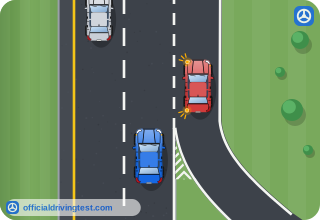
- About two seconds
- About six seconds
- About four seconds
- About eight seconds
Show answer
Correct answer: About four seconds
You need a gap of about four seconds to merge with other traffic.
Source: Delaware Driver Manual (July 2026), page 130 · Open this page in the manual (Manual page 130)
-
If you move into the middle of a four-second gap, what following distance do you and the vehicle now behind you each have?
- Two seconds
- Three seconds
- Four seconds
- One second
Show answer
Correct answer: Three seconds
Moving into the middle of a four-second gap gives both vehicles a three-second following distance.
Source: Delaware Driver Manual (July 2026), page 130 · Open this page in the manual (Manual page 130)
-
Why should you not try to merge into a gap that is too small?
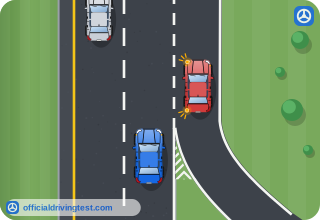
- Other drivers will always speed up to close it
- It is illegal to merge between two vehicles
- Your turn signal will not be seen in time
- A small gap can quickly become even smaller
Show answer
Correct answer: A small gap can quickly become even smaller
The manual warns that a small gap can quickly become even smaller, so enter a gap with a big enough space cushion.
Source: Delaware Driver Manual (July 2026), page 130 · Open this page in the manual (Manual page 130)
-
As a general rule, how many vehicles should you pass at a time?
- Two
- Up to three
- Only one
- As many as the road markings permit
Show answer
Correct answer: Only one
Do not count on having time to pass several vehicles at once; as a general rule only pass one vehicle at a time.
Source: Delaware Driver Manual (July 2026), page 131 · Open this page in the manual (Manual page 131)
-
At 55 mph, about how many seconds do you need to pass?
- About 4 seconds
- About 10 seconds
- About 6 seconds
- About 15 seconds
Show answer
Correct answer: About 10 seconds
At 55 mph you need about 10 seconds to pass, so you need a 10-second gap in oncoming traffic.
Source: Delaware Driver Manual (July 2026), page 131 · Open this page in the manual (Manual page 131)
-
At 55 mph, how much space do you need to pass safely, counting the oncoming vehicle's travel too?
- Over 800 feet, about one-sixth of a mile
- Over 2400 feet, about one-half of a mile
- Over 3200 feet, about two-thirds of a mile
- Over 1600 feet, about one-third of a mile
Show answer
Correct answer: Over 1600 feet, about one-third of a mile
Both vehicles travel over 800 feet in 10 seconds, so you need over 1600 feet, about one-third of a mile.
Source: Delaware Driver Manual (July 2026), page 131 · Open this page in the manual (Manual page 131)
-
How does a vehicle that is far away generally appear?
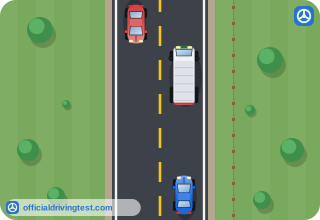
- To be standing still
- To be moving much faster than it is
- To be closer than it really is
- To be moving in the wrong lane
Show answer
Correct answer: To be standing still
Oncoming vehicles far away do not seem to be coming as fast as they really are; they generally appear to stand still.
Source: Delaware Driver Manual (July 2026), page 131 · Open this page in the manual (Manual page 131)
-
You should not start to pass if you are within what distance of a hill or curve?
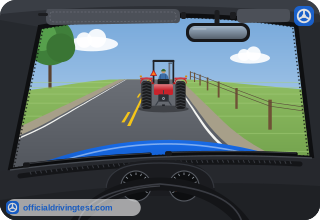
- One-tenth of a mile
- One-half of a mile
- One-third of a mile
- One mile
Show answer
Correct answer: One-third of a mile
You should not start to pass if you are within one-third of a mile of a hill or curve.
Source: Delaware Driver Manual (July 2026), page 131 · Open this page in the manual (Manual page 131)
-
If your view is blocked by a curve or a hill, what should you assume?
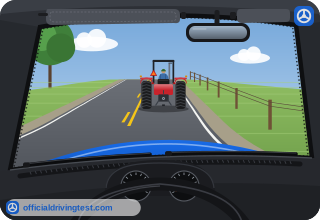
- That the road ahead is clear
- That an oncoming vehicle is just out of sight
- That oncoming drivers will see you and slow down
- That the vehicle ahead will speed up
Show answer
Correct answer: That an oncoming vehicle is just out of sight
Treat a curve or hill like an oncoming vehicle: assume one is just out of sight.
Source: Delaware Driver Manual (July 2026), page 131 · Open this page in the manual (Manual page 131)
-
Why is it dangerous to pass at intersections, railroad crossings, and shopping center entrances?
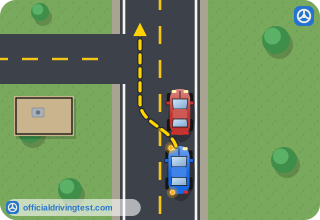
- Speed limits are always lower at these places
- Road surfaces there are usually uneven or wet
- Traffic lights there change too quickly to pass
- A vehicle is likely to enter or cross the road there
Show answer
Correct answer: A vehicle is likely to enter or cross the road there
The manual says it is dangerous to pass where a vehicle is likely to enter or cross the road.
Source: Delaware Driver Manual (July 2026), page 131 · Open this page in the manual (Manual page 131)
-
While you pass at an intersection, who will not expect to find you approaching in their lane?
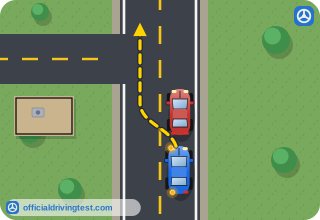
- Drivers turning right into the approaching lane
- Drivers waiting at a red light behind you
- Pedestrians walking on the sidewalk
- Drivers parked at the curb ahead
Show answer
Correct answer: Drivers turning right into the approaching lane
Drivers turning right into the approaching lane do not expect you there and may not even look your way.
Source: Delaware Driver Manual (July 2026), page 131 · Open this page in the manual (Manual page 131)
-
While you are passing, what can block your view of people, vehicles, or trains?
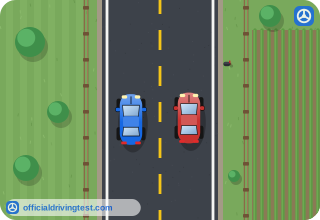
- Your rearview mirror
- The oncoming vehicle’s headlights
- The vehicle you are passing
- Your side window frame
Show answer
Correct answer: The vehicle you are passing
While passing, the vehicle you are passing can block your view of people, vehicles, or trains.
Source: Delaware Driver Manual (July 2026), page 131 · Open this page in the manual (Manual page 131)
-
Before you pass, which of these might cause other vehicles to move into your lane?
- A traffic light turning green behind you
- A narrow bridge or other reduced lane width
- A vehicle stopped at a light behind you
- A driver following you closely
Show answer
Correct answer: A narrow bridge or other reduced lane width
The manual lists a narrow bridge or other situation that reduces lane width as something that can cost you your passing space.
Source: Delaware Driver Manual (July 2026), page 132 · Open this page in the manual (Manual page 132)
-
When you pass, what should you not count on other drivers to do?
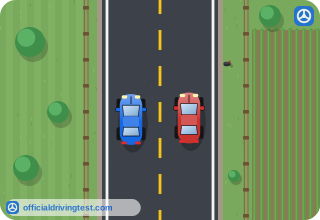
- Honk to warn you of oncoming traffic
- Slow down when you signal
- Move onto the shoulder to let you by
- Make room for you to return to your lane
Show answer
Correct answer: Make room for you to return to your lane
Do not pass unless you have enough space to return to the driving lane; do not count on other drivers to make room for you.
Source: Delaware Driver Manual (July 2026), page 132 · Open this page in the manual (Manual page 132)
-
What tells you it is safe to return to the driving lane after passing?
- Seeing the other vehicle’s brake lights come on
- Counting to three after you pass the other vehicle
- Seeing both of its headlights in your rearview mirror
- Seeing the front of the other vehicle in your side mirror
Show answer
Correct answer: Seeing both of its headlights in your rearview mirror
When you can see both headlights of the vehicle you passed in your rearview mirror, it is safe to return.
Source: Delaware Driver Manual (July 2026), page 132 · Open this page in the manual (Manual page 132)
-
What does the manual suggest if you are impatient on a driving trip?
- Drive a little over the limit to make up time
- Give yourself extra time and leave a few minutes early
- Skip rest stops and drive in one stretch
- Follow the car ahead more closely
Show answer
Correct answer: Give yourself extra time and leave a few minutes early
The manual says impatient drivers should give themselves extra time and leave early.
Source: Delaware Driver Manual (July 2026), page 135 · Open this page in the manual (Manual page 135)
-
According to the manual, what causes skids?
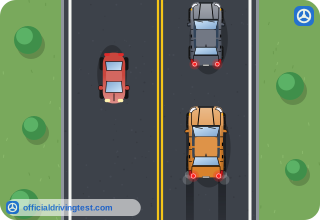
- Drivers traveling too fast for conditions
- Tires that have too much air in them
- Windshield wipers that are badly worn
- Using the high beams in fog or rain
Show answer
Correct answer: Drivers traveling too fast for conditions
The manual says skids are caused by drivers traveling too fast for conditions.
Source: Delaware Driver Manual (July 2026), page 139 · Open this page in the manual (Manual page 139)