Delaware: Pedestrians
Yielding to people on foot, crosswalks and pedestrian signals, and the rules pedestrians must follow. Split into 2 shorter tests so you're not stuck in one long quiz.
Independent educational site · not affiliated with any government agency or DMV
All 47 Pedestrians questions with answers
Choose a part above to take a practice test, or study every question and answer here.
Show the questions and answersHide the questions
-
What is a safety zone according to the manual?
- An area beside the shoulder where vehicles may stop for repairs
- A lane at an intersection set aside for bicyclists only
- An area officially set aside within a highway for pedestrians and so marked
- An area near a railroad crossing where drivers wait for trains
Show answer
Correct answer: An area officially set aside within a highway for pedestrians and so marked
The manual defines a safety zone as an area officially set aside within a highway for exclusive use of pedestrians and so marked.
Source: Delaware Driver Manual (July 2026), page 13 · Open this page in the manual (Manual page 13)
-
At intersections that have both pedestrian signals and vehicular traffic signals, which signals must drivers obey?
- The WALK and DON’T WALK signals
- The vehicular traffic signals
- Whichever signal changes first
- The pedestrian signals when pedestrians are present
Show answer
Correct answer: The vehicular traffic signals
The manual says drivers must obey the vehicular traffic signals, while pedestrians obey the WALK and DON’T WALK signals.
Source: Delaware Driver Manual (July 2026), page 72 · Open this page in the manual (Manual page 72)
-
What does the WALK signal mean for a pedestrian?
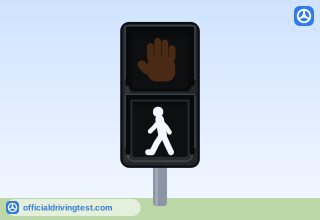
- The pedestrian may proceed without watching for vehicles
- The pedestrian should wait for vehicles to clear the intersection
- The pedestrian may proceed only if no vehicles are visible
- The pedestrian may proceed but must watch for turning vehicles
Show answer
Correct answer: The pedestrian may proceed but must watch for turning vehicles
The manual says the WALK signal means the pedestrian may proceed but must watch for turning vehicles.
Source: Delaware Driver Manual (July 2026), page 72 · Open this page in the manual (Manual page 72)
-
What are drivers required to do for pedestrians who have a "WALK" indicator?
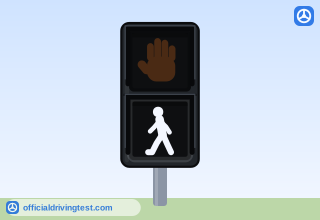
- Yield to them
- Sound the horn and proceed slowly
- Stop only if they are in the driver’s lane
- Continue if turning right on green
Show answer
Correct answer: Yield to them
The manual says drivers are required to yield to pedestrians who have a "WALK" indicator.
Source: Delaware Driver Manual (July 2026), page 72 · Open this page in the manual (Manual page 72)
-
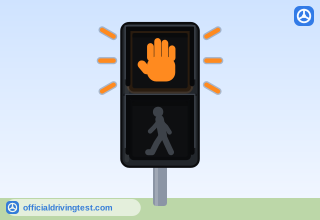
What does a flashing DON’T WALK signal mean for a pedestrian who has already started to cross?
- Stop in the middle of the street and wait
- Turn back to the starting curb
- Finish crossing as rapidly as possible
- Walk slowly until the signal turns steady
Show answer
Correct answer: Finish crossing as rapidly as possible
The manual says that if a pedestrian has started to cross, they should finish as rapidly as possible; if not, they should not start.
Source: Delaware Driver Manual (July 2026), page 72 · Open this page in the manual (Manual page 72)
-
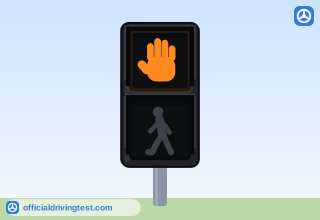
What does a steady DON’T WALK signal mean?
- The pedestrian may cross if no vehicles are coming
- The pedestrian should not start to cross the street at all
- The pedestrian should finish crossing as rapidly as possible
- The pedestrian may cross after waiting a few seconds
Show answer
Correct answer: The pedestrian should not start to cross the street at all
The manual says a steady DON’T WALK signal means the pedestrian should not start to cross at all.
Source: Delaware Driver Manual (July 2026), page 72 · Open this page in the manual (Manual page 72)
-
On the manual’s countdown pedestrian signal, what does the number shown beside the flashing DON’T START hand tell the pedestrian?
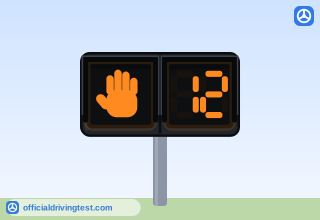
- The time until the next WALK signal
- The number of vehicles waiting to turn
- The speed limit of the street being crossed
- The time remaining to finish crossing
Show answer
Correct answer: The time remaining to finish crossing
The manual’s picture labels the countdown number as the time remaining to finish crossing.
Source: Delaware Driver Manual (July 2026), page 73 · Open this page in the manual (Manual page 73)
-
In what kinds of formats does an Accessible Pedestrian Signal (APS) communicate pedestrian signal information?
- Audible tones, verbal messages, or vibrating surfaces
- Only bright flashing lights that are visible from far away
- Only printed instructions on the curb
- Only a bell that rings for all crossings
Show answer
Correct answer: Audible tones, verbal messages, or vibrating surfaces
The manual says an APS communicates in non-visual formats such as audible tones, verbal messages, and/or vibrating surfaces.
Source: Delaware Driver Manual (July 2026), page 73 · Open this page in the manual (Manual page 73)
-
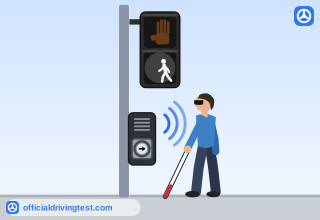
What does an Accessible Pedestrian Signal let pedestrians who are blind or visually impaired know?
- The speed of approaching vehicles
- Which direction vehicles are turning
- When the WALK interval begins and terminates
- The name of the street they are crossing
Show answer
Correct answer: When the WALK interval begins and terminates
The manual says APS lets blind or visually impaired pedestrians know when the WALK interval begins and terminates.
Source: Delaware Driver Manual (July 2026), page 73 · Open this page in the manual (Manual page 73)
-
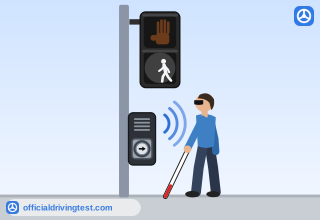
Audible signals can provide directional guidance. Where is this particularly useful?
- At crossings in school zones only
- At non-perpendicular and wide multi-lane crossings
- At railroad crossings and on narrow two-lane streets
- At crossings with no traffic signal
Show answer
Correct answer: At non-perpendicular and wide multi-lane crossings
The manual says directional guidance is particularly useful at non-perpendicular intersections and wide multi-lane crossings.
Source: Delaware Driver Manual (July 2026), page 73 · Open this page in the manual (Manual page 73)
-
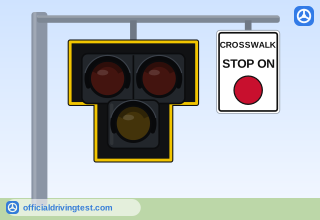
How is the High Intensity Activated Crosswalk (HAWK) signal activated?
- When a vehicle drives over a sensor in the road
- At fixed times throughout the day
- When traffic backs up at the crosswalk
- When a pedestrian presses the crosswalk button
Show answer
Correct answer: When a pedestrian presses the crosswalk button
The manual says the HAWK signal is activated when a pedestrian presses the crosswalk button.
Source: Delaware Driver Manual (July 2026), page 73 · Open this page in the manual (Manual page 73)
-
What happens once a HAWK signal has been activated?
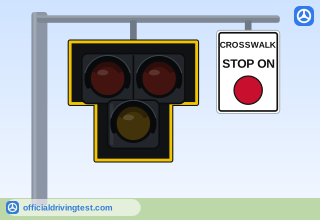
- It goes through stages that stop traffic for pedestrians to cross
- It stays red until the pedestrian presses the button again
- It flashes yellow for traffic and never stops it
- It turns green for traffic and red for pedestrians immediately
Show answer
Correct answer: It goes through stages that stop traffic for pedestrians to cross
The manual says the signal goes through a series of stages that stop traffic, then traffic proceeds and the signal resets.
Source: Delaware Driver Manual (July 2026), page 73 · Open this page in the manual (Manual page 73)
-
Where are Rectangular Rapid Flashing Beacons mounted, and how are they activated?
- On the road surface, by a sensor buried in the pavement
- On traffic signal poles, by approaching vehicles
- Above or below pedestrian warning signs, by push button
- Beside stop signs, by a timer
Show answer
Correct answer: Above or below pedestrian warning signs, by push button
The manual says the beacons are mounted above or below warning signs at crosswalks and activated via a push button by pedestrians or bicyclists.
Source: Delaware Driver Manual (July 2026), page 73 · Open this page in the manual (Manual page 73)
-
How do Rectangular Rapid Flashing Beacons flash compared with most beacons?
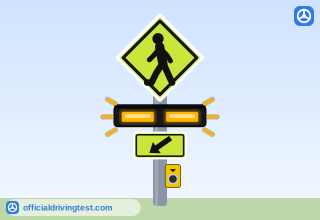
- More slowly and in a steady pattern
- More rapidly and in a "stutter" pattern
- At the same rate as most beacons
- Alternately red and yellow
Show answer
Correct answer: More rapidly and in a "stutter" pattern
The manual says they flash more rapidly and in a "stutter" pattern, as opposed to the regular flash rate of most beacons.
Source: Delaware Driver Manual (July 2026), page 73 · Open this page in the manual (Manual page 73)
-
What should you do as a motorist when you see Rectangular Rapid Flashing Beacons flashing?
- Come to a complete stop and wait for the beacons to turn green
- Maintain your speed and sound your horn
- Treat them as an ordinary flashing red light
- Slow down, look for pedestrians and bicyclists, and yield
Show answer
Correct answer: Slow down, look for pedestrians and bicyclists, and yield
The manual tells motorists to slow down, look for pedestrians and bicyclists, and yield as necessary.
Source: Delaware Driver Manual (July 2026), page 73 · Open this page in the manual (Manual page 73)
-
What do crosswalks define?
- The area where vehicles may park briefly
- The area where pedestrians may cross the roadway
- The area where bicyclists must stop
- The area where vehicles may change lanes
Show answer
Correct answer: The area where pedestrians may cross the roadway
The manual says crosswalks define the area where pedestrians may cross the roadway.
Source: Delaware Driver Manual (July 2026), page 84 · Open this page in the manual (Manual page 84)
-
Are all crosswalks marked on the road?
- Yes, every crosswalk has painted lines
- Yes, but only in school zones
- No, so pedestrians may cross only where lines are painted
- No, so be alert for pedestrians when crossing intersections
Show answer
Correct answer: No, so be alert for pedestrians when crossing intersections
The manual says not all crosswalks are marked and you must be alert for pedestrians at intersections.
Source: Delaware Driver Manual (July 2026), page 85 · Open this page in the manual (Manual page 85)
-
What must drivers crossing a sidewalk to enter or exit a driveway, alley, or parking lot do?
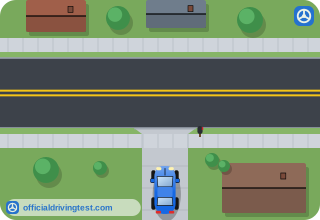
- Sound the horn and proceed
- Proceed if no vehicle is coming
- Stop only if a pedestrian is in the driveway
- Yield to pedestrians
Show answer
Correct answer: Yield to pedestrians
The manual says drivers crossing a sidewalk entering or exiting a driveway, alley, or parking lot must yield to pedestrians.
Source: Delaware Driver Manual (July 2026), page 88 · Open this page in the manual (Manual page 88)
-
When is it legal to drive on a sidewalk?
- Only to cross it
- To bypass stopped traffic
- To pass a slow vehicle on the right
- To make a right turn when the road is blocked
Show answer
Correct answer: Only to cross it
The manual says it is illegal to drive on a sidewalk except to cross it.
Source: Delaware Driver Manual (July 2026), page 88 · Open this page in the manual (Manual page 88)
-
Which pedestrians have absolute right-of-way?
- Pedestrians wearing bright or reflective clothing
- Pedestrians walking with a group of young children
- Pedestrians using a guide dog or carrying a white cane
- Pedestrians who are crossing at a marked crosswalk
Show answer
Correct answer: Pedestrians using a guide dog or carrying a white cane
The manual says pedestrians using a guide dog or carrying a white cane have absolute right-of-way.
Source: Delaware Driver Manual (July 2026), page 88 · Open this page in the manual (Manual page 88)
-
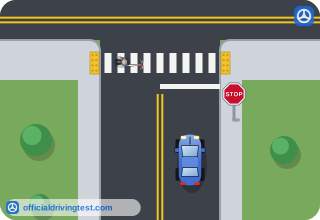
Why should you not use your horn near a blind pedestrian?
- It is illegal to sound a horn within city limits
- It could confuse or frighten the blind pedestrian
- It could startle other drivers who are nearby
- It may damage the hearing of a guide dog
Show answer
Correct answer: It could confuse or frighten the blind pedestrian
The manual says not to use your horn because it could confuse or frighten the blind pedestrian.
Source: Delaware Driver Manual (July 2026), page 88 · Open this page in the manual (Manual page 88)
-
A pedestrian is actively crossing in a marked or unmarked crosswalk. What must you do as a driver?
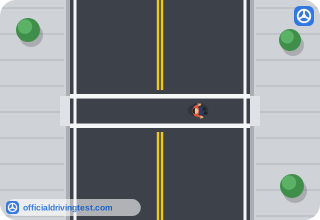
- Tap your horn and keep moving
- Slow down and drive around the pedestrian
- Continue if the pedestrian is not in your lane
- Stop for the pedestrian
Show answer
Correct answer: Stop for the pedestrian
The manual says to stop if a pedestrian is actively crossing in a marked or unmarked crosswalk.
Source: Delaware Driver Manual (July 2026), page 94 · Open this page in the manual (Manual page 94)
-
A pedestrian is standing safely stopped on the sidewalk. What may you do as a driver?
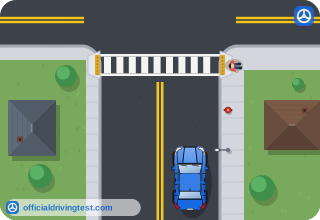
- Stop and wait until the pedestrian waves you on
- Proceed with caution
- Sound your horn and stop
- Stop and wait until the pedestrian leaves
Show answer
Correct answer: Proceed with caution
You may proceed with caution if a pedestrian is standing or stopped safely on the sidewalk.
Source: Delaware Driver Manual (July 2026), page 94 · Open this page in the manual (Manual page 94)
-
What does the manual say about sounding your horn near pedestrians?
- Sounding the horn is not a substitute for yielding to pedestrians
- A horn warning satisfies the duty to yield when the pedestrian is not in the crosswalk
- A horn warning replaces yielding in business districts
- A horn warning replaces yielding at night
Show answer
Correct answer: Sounding the horn is not a substitute for yielding to pedestrians
You may lightly tap the horn if necessary, but sounding the horn is not considered a substitute for yielding to pedestrians.
Source: Delaware Driver Manual (July 2026), page 94 · Open this page in the manual (Manual page 94)
-
To which pedestrians must you in particular yield the right-of-way, according to the driver responsibilities list?
- Only pedestrians who are crossing the road with a guide dog
- Only pedestrians who are crossing at a traffic signal
- Pedestrians who are hearing impaired or use canes or wheelchairs
- Pedestrians only when they are crossing inside a school zone
Show answer
Correct answer: Pedestrians who are hearing impaired or use canes or wheelchairs
Drivers must yield to pedestrians who are hearing impaired or have physical disabilities requiring canes, crutches, walkers, guide dogs, wheelchairs, or motorized scooters.
Source: Delaware Driver Manual (July 2026), page 94 · Open this page in the manual (Manual page 94)
-
What must you not do regarding a pedestrian safety zone or a crosswalk?
- Slow down when you approach a pedestrian safety zone
- Drive through a pedestrian safety zone or block a crosswalk
- Yield to pedestrians who are waiting on the sidewalk
- Lightly tap your horn near a crosswalk if necessary
Show answer
Correct answer: Drive through a pedestrian safety zone or block a crosswalk
You must not drive through a pedestrian safety zone or block a crosswalk.
Source: Delaware Driver Manual (July 2026), page 94 · Open this page in the manual (Manual page 94)
-
A vehicle ahead has stopped to allow a pedestrian to cross the highway. What must you not do?
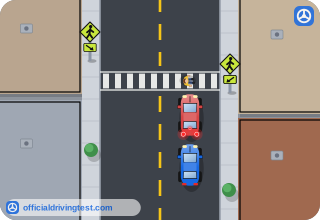
- Stop behind it
- Wait for the pedestrian to finish crossing
- Slow down as you approach it
- Pass the stopped vehicle
Show answer
Correct answer: Pass the stopped vehicle
You must not pass a vehicle stopped to allow a pedestrian to cross the highway.
Source: Delaware Driver Manual (July 2026), page 95 · Open this page in the manual (Manual page 95)
-
Where should you be especially watchful for children?
- Near hospitals and in business districts
- Near parks and on expressways
- Near schools and in residential districts
- Near shopping areas and on turnpikes
Show answer
Correct answer: Near schools and in residential districts
You should be especially watchful for children near schools and in residential districts, and not speed in school zones.
Source: Delaware Driver Manual (July 2026), page 95 · Open this page in the manual (Manual page 95)
-
What does the manual say you should do carefully before leaving your vehicle, so you do not become a pedestrian casualty?
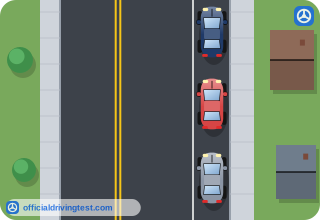
- Check your mirrors for school buses
- Lock all the doors
- Sound your horn
- Look carefully for traffic
Show answer
Correct answer: Look carefully for traffic
The manual says you should look carefully for traffic before leaving your vehicle.
Source: Delaware Driver Manual (July 2026), page 95 · Open this page in the manual (Manual page 95)
-
When a sidewalk is provided, where must a pedestrian walk?
- On the shoulder facing traffic
- On the sidewalk
- In the roadway facing oncoming traffic
- On the shoulder with traffic coming from behind
Show answer
Correct answer: On the sidewalk
When a sidewalk is provided, pedestrians must walk on it.
Source: Delaware Driver Manual (July 2026), page 95 · Open this page in the manual (Manual page 95)
-
Where must a pedestrian walk when there is no sidewalk?
- On the shoulder facing oncoming traffic, as far from the road as possible
- On the shoulder with traffic coming from behind, close to the road edge
- In the travel lane facing oncoming traffic
- In the travel lane with the flow of traffic
Show answer
Correct answer: On the shoulder facing oncoming traffic, as far from the road as possible
With no sidewalk, a pedestrian walks on the shoulder facing oncoming traffic, as far away from the road as possible.
Source: Delaware Driver Manual (July 2026), page 95 · Open this page in the manual (Manual page 95)
-
What is illegal when walking along a roadway at night?
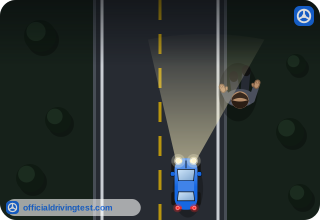
- Walking on the sidewalk where one is provided
- Walking facing oncoming traffic
- Walking without carrying a light or reflector
- Walking without wearing a reflective vest
Show answer
Correct answer: Walking without carrying a light or reflector
It is illegal to walk along any roadway at night without carrying a light or reflector.
Source: Delaware Driver Manual (July 2026), page 95 · Open this page in the manual (Manual page 95)
-
What kind of clothing does the manual say a pedestrian should wear at night if possible?
- Dark-colored clothing
- Light-colored clothing
- Brightly patterned clothing
- Loose, heavy clothing
Show answer
Correct answer: Light-colored clothing
The manual says pedestrians should wear light-colored clothing if possible.
Source: Delaware Driver Manual (July 2026), page 95 · Open this page in the manual (Manual page 95)
-
As a pedestrian, when must you not walk on a highway?
- When you are walking on the shoulder facing oncoming traffic
- When you are wearing light-colored clothing and carrying a reflector
- When you are walking in daylight on a road with light traffic
- When under the influence of intoxicating liquor or narcotic drugs
Show answer
Correct answer: When under the influence of intoxicating liquor or narcotic drugs
A pedestrian must not walk on a highway when under the influence of intoxicating liquor or narcotic drugs.
Source: Delaware Driver Manual (July 2026), page 95 · Open this page in the manual (Manual page 95)
-
What must a pedestrian not do while standing on the highway?
- Wait for a Walk signal
- Look in both directions for traffic
- Ask for a ride or conduct any kind of business
- Wait for a break in traffic before crossing
Show answer
Correct answer: Ask for a ride or conduct any kind of business
A pedestrian must not stand on the highway to ask for a ride or to conduct any kind of business.
Source: Delaware Driver Manual (July 2026), page 95 · Open this page in the manual (Manual page 95)
-
Where should a pedestrian cross the roadway and its shoulders?
- Only at marked crosswalks
- At any point that is free of traffic
- Only at intersections, even where marked crosswalks exist
- Only where there is a pedestrian signal
Show answer
Correct answer: Only at marked crosswalks
A pedestrian should cross the roadway and its shoulders only at marked crosswalks.
Source: Delaware Driver Manual (July 2026), page 95 · Open this page in the manual (Manual page 95)
-
Where crosswalks are not present, where must a pedestrian cross?
- At the middle of the block
- At any driveway entrance
- At any point after looking in both directions
- At intersections
Show answer
Correct answer: At intersections
Where crosswalks are not present, pedestrians must cross at intersections.
Source: Delaware Driver Manual (July 2026), page 95 · Open this page in the manual (Manual page 95)
-
Where there is no crosswalk or intersection and a pedestrian needs to cross the road, how must they do it?
- Slowly, so drivers have plenty of time to see them and stop
- Quickly, and only after looking in both directions for oncoming traffic
- At a walking pace after waving to the approaching drivers
- By stepping into the road so that approaching drivers will stop
Show answer
Correct answer: Quickly, and only after looking in both directions for oncoming traffic
Where intersections are not present, a pedestrian crosses quickly and only after looking in both directions for oncoming traffic.
Source: Delaware Driver Manual (July 2026), page 95 · Open this page in the manual (Manual page 95)
-
What does a blinking “Don’t Walk” signal mean for a pedestrian?
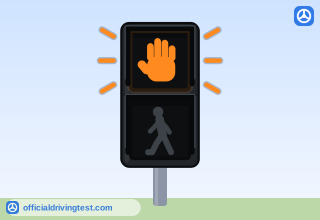
- Do not enter the intersection
- Enter only if no vehicles are approaching
- Vehicles must now yield to you, so you may start
- Cross diagonally to save time
Show answer
Correct answer: Do not enter the intersection
A blinking “Don’t Walk” signal means do not enter the intersection.
Source: Delaware Driver Manual (July 2026), page 95 · Open this page in the manual (Manual page 95)
-
What should a pedestrian be alert for before crossing a highway at an intersection?
- Cyclists on the sidewalk
- Parked vehicles pulling out
- Turning cars
- Vehicles stopped at the light behind them
Show answer
Correct answer: Turning cars
The manual says to be alert for turning cars before crossing a highway at an intersection.
Source: Delaware Driver Manual (July 2026), page 95 · Open this page in the manual (Manual page 95)
-
When may a pedestrian cross an intersection diagonally?
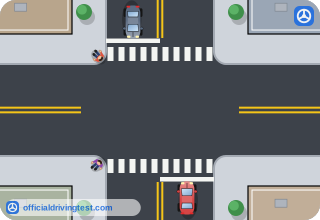
- When no vehicles are approaching from any direction
- When authorized by traffic-control signals
- When the intersection has no marked crosswalks
- When you have the green light and no turning cars are present
Show answer
Correct answer: When authorized by traffic-control signals
A pedestrian must not cross an intersection diagonally except when authorized by traffic-control signals.
Source: Delaware Driver Manual (July 2026), page 95 · Open this page in the manual (Manual page 95)
-
At an intersection, when do pedestrians crossing the highway have the right-of-way?
- Only when they cross in a group of two or more
- Only when no turning vehicles are present
- Only when a traffic officer is present
- When the green light or walk signal is in their favor
Show answer
Correct answer: When the green light or walk signal is in their favor
Pedestrians have the right-of-way when crossing at an intersection and the green light or walk signal is in their favor.
Source: Delaware Driver Manual (July 2026), page 95 · Open this page in the manual (Manual page 95)
-
Who has the right-of-way when a pedestrian on a sidewalk crosses an alley, entrance, or driveway?
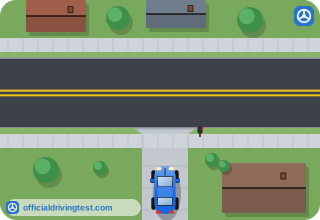
- The driver entering or leaving
- The vehicle that arrives first
- The pedestrian
- The larger vehicle
Show answer
Correct answer: The pedestrian
Pedestrians have the right-of-way when on a sidewalk as it crosses an alley, entrance, or driveway.
Source: Delaware Driver Manual (July 2026), page 95 · Open this page in the manual (Manual page 95)
-
Which pedestrians have the right-of-way when crossing with white canes or guide dogs?
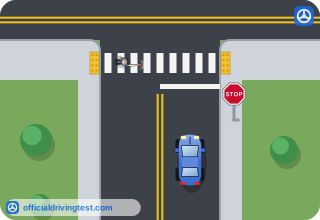
- Pedestrians who are blind
- Only senior citizens crossing at an intersection
- Only children crossing near a school
- Only pedestrians in a marked school crosswalk
Show answer
Correct answer: Pedestrians who are blind
Pedestrians have the right-of-way when they are blind and crossing with white canes or guide dogs.
Source: Delaware Driver Manual (July 2026), page 95 · Open this page in the manual (Manual page 95)
-
When must a pedestrian yield the right-of-way to vehicles?
- When crossing within a marked crosswalk while the walk signal is in their favor
- When walking on a sidewalk as it crosses an alley, entrance, or driveway
- When blind and crossing at an intersection with a white cane or guide dog
- When crossing outside a marked crosswalk or an unmarked crosswalk at an intersection
Show answer
Correct answer: When crossing outside a marked crosswalk or an unmarked crosswalk at an intersection
Pedestrians must yield when crossing a highway other than within a marked crosswalk or an unmarked crosswalk at an intersection.
Source: Delaware Driver Manual (July 2026), page 95 · Open this page in the manual (Manual page 95)
-
Where a pedestrian tunnel or overhead crossing is provided, who must yield when crossing the roadway?
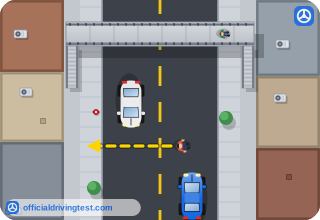
- The driver
- The pedestrian
- Whichever of them arrives first
- The larger of the two
Show answer
Correct answer: The pedestrian
Pedestrians must yield the right-of-way when crossing the roadway where a pedestrian tunnel or overhead crossing is provided.
Source: Delaware Driver Manual (July 2026), page 95 · Open this page in the manual (Manual page 95)
-
Why should you give extra space to pedestrians or bicycles, especially children?
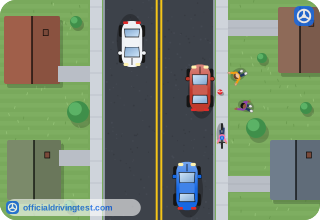
- They are required to stay on the sidewalk at all times
- They can move into your path quickly and without warning
- They always stop at the curb before they cross
- They always travel at a steady speed
Show answer
Correct answer: They can move into your path quickly and without warning
The manual says pedestrians and bicycles, especially children, can move into your path quickly and without warning.
Source: Delaware Driver Manual (July 2026), page 129 · Open this page in the manual (Manual page 129)