Delaware: Pedestrians — Part 2 Practice Test
Questions in this part include: “To which pedestrians must you in particular yield the right-of-way, according to the driver responsibilities list?” · “What must a pedestrian not do while standing on the highway?”
Independent educational site · not affiliated with any government agency or DMV
Ready? Test yourself
- Instant feedback with an explanation
- Every answer cites its source in the manual
- Your best score is saved on this device
Questions are original and based on the official manual "Delaware Driver Manual" (July 2026), Delaware Division of Motor Vehicles (DMV).
All 23 questions in this practice test
Take the test above first, then use this list to study. Tap “Show answer” to see the correct answer and explanation.
Show the questions and answersHide the questions
-
To which pedestrians must you in particular yield the right-of-way, according to the driver responsibilities list?
- Only pedestrians who are crossing the road with a guide dog
- Only pedestrians who are crossing at a traffic signal
- Pedestrians who are hearing impaired or use canes or wheelchairs
- Pedestrians only when they are crossing inside a school zone
Show answer
Correct answer: Pedestrians who are hearing impaired or use canes or wheelchairs
Drivers must yield to pedestrians who are hearing impaired or have physical disabilities requiring canes, crutches, walkers, guide dogs, wheelchairs, or motorized scooters.
Source: Delaware Driver Manual (July 2026), page 94 · Open this page in the manual (Manual page 94)
-
What must you not do regarding a pedestrian safety zone or a crosswalk?
- Slow down when you approach a pedestrian safety zone
- Drive through a pedestrian safety zone or block a crosswalk
- Yield to pedestrians who are waiting on the sidewalk
- Lightly tap your horn near a crosswalk if necessary
Show answer
Correct answer: Drive through a pedestrian safety zone or block a crosswalk
You must not drive through a pedestrian safety zone or block a crosswalk.
Source: Delaware Driver Manual (July 2026), page 94 · Open this page in the manual (Manual page 94)
-
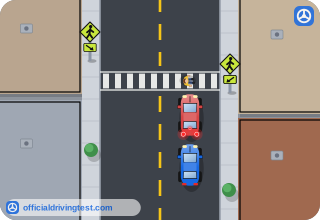
A vehicle ahead has stopped to allow a pedestrian to cross the highway. What must you not do?
- Stop behind it
- Wait for the pedestrian to finish crossing
- Slow down as you approach it
- Pass the stopped vehicle
Show answer
Correct answer: Pass the stopped vehicle
You must not pass a vehicle stopped to allow a pedestrian to cross the highway.
Source: Delaware Driver Manual (July 2026), page 95 · Open this page in the manual (Manual page 95)
-
Where should you be especially watchful for children?
- Near hospitals and in business districts
- Near parks and on expressways
- Near schools and in residential districts
- Near shopping areas and on turnpikes
Show answer
Correct answer: Near schools and in residential districts
You should be especially watchful for children near schools and in residential districts, and not speed in school zones.
Source: Delaware Driver Manual (July 2026), page 95 · Open this page in the manual (Manual page 95)
-
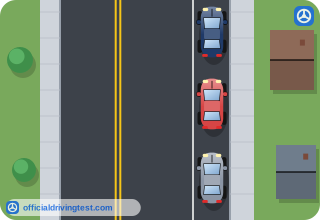
What does the manual say you should do carefully before leaving your vehicle, so you do not become a pedestrian casualty?
- Check your mirrors for school buses
- Lock all the doors
- Sound your horn
- Look carefully for traffic
Show answer
Correct answer: Look carefully for traffic
The manual says you should look carefully for traffic before leaving your vehicle.
Source: Delaware Driver Manual (July 2026), page 95 · Open this page in the manual (Manual page 95)
-
When a sidewalk is provided, where must a pedestrian walk?
- On the shoulder facing traffic
- On the sidewalk
- In the roadway facing oncoming traffic
- On the shoulder with traffic coming from behind
Show answer
Correct answer: On the sidewalk
When a sidewalk is provided, pedestrians must walk on it.
Source: Delaware Driver Manual (July 2026), page 95 · Open this page in the manual (Manual page 95)
-
Where must a pedestrian walk when there is no sidewalk?
- On the shoulder facing oncoming traffic, as far from the road as possible
- On the shoulder with traffic coming from behind, close to the road edge
- In the travel lane facing oncoming traffic
- In the travel lane with the flow of traffic
Show answer
Correct answer: On the shoulder facing oncoming traffic, as far from the road as possible
With no sidewalk, a pedestrian walks on the shoulder facing oncoming traffic, as far away from the road as possible.
Source: Delaware Driver Manual (July 2026), page 95 · Open this page in the manual (Manual page 95)
-
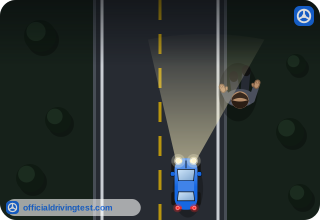
What is illegal when walking along a roadway at night?
- Walking on the sidewalk where one is provided
- Walking facing oncoming traffic
- Walking without carrying a light or reflector
- Walking without wearing a reflective vest
Show answer
Correct answer: Walking without carrying a light or reflector
It is illegal to walk along any roadway at night without carrying a light or reflector.
Source: Delaware Driver Manual (July 2026), page 95 · Open this page in the manual (Manual page 95)
-
What kind of clothing does the manual say a pedestrian should wear at night if possible?
- Dark-colored clothing
- Light-colored clothing
- Brightly patterned clothing
- Loose, heavy clothing
Show answer
Correct answer: Light-colored clothing
The manual says pedestrians should wear light-colored clothing if possible.
Source: Delaware Driver Manual (July 2026), page 95 · Open this page in the manual (Manual page 95)
-
As a pedestrian, when must you not walk on a highway?
- When you are walking on the shoulder facing oncoming traffic
- When you are wearing light-colored clothing and carrying a reflector
- When you are walking in daylight on a road with light traffic
- When under the influence of intoxicating liquor or narcotic drugs
Show answer
Correct answer: When under the influence of intoxicating liquor or narcotic drugs
A pedestrian must not walk on a highway when under the influence of intoxicating liquor or narcotic drugs.
Source: Delaware Driver Manual (July 2026), page 95 · Open this page in the manual (Manual page 95)
-
What must a pedestrian not do while standing on the highway?
- Wait for a Walk signal
- Look in both directions for traffic
- Ask for a ride or conduct any kind of business
- Wait for a break in traffic before crossing
Show answer
Correct answer: Ask for a ride or conduct any kind of business
A pedestrian must not stand on the highway to ask for a ride or to conduct any kind of business.
Source: Delaware Driver Manual (July 2026), page 95 · Open this page in the manual (Manual page 95)
-
Where should a pedestrian cross the roadway and its shoulders?
- Only at marked crosswalks
- At any point that is free of traffic
- Only at intersections, even where marked crosswalks exist
- Only where there is a pedestrian signal
Show answer
Correct answer: Only at marked crosswalks
A pedestrian should cross the roadway and its shoulders only at marked crosswalks.
Source: Delaware Driver Manual (July 2026), page 95 · Open this page in the manual (Manual page 95)
-
Where crosswalks are not present, where must a pedestrian cross?
- At the middle of the block
- At any driveway entrance
- At any point after looking in both directions
- At intersections
Show answer
Correct answer: At intersections
Where crosswalks are not present, pedestrians must cross at intersections.
Source: Delaware Driver Manual (July 2026), page 95 · Open this page in the manual (Manual page 95)
-
Where there is no crosswalk or intersection and a pedestrian needs to cross the road, how must they do it?
- Slowly, so drivers have plenty of time to see them and stop
- Quickly, and only after looking in both directions for oncoming traffic
- At a walking pace after waving to the approaching drivers
- By stepping into the road so that approaching drivers will stop
Show answer
Correct answer: Quickly, and only after looking in both directions for oncoming traffic
Where intersections are not present, a pedestrian crosses quickly and only after looking in both directions for oncoming traffic.
Source: Delaware Driver Manual (July 2026), page 95 · Open this page in the manual (Manual page 95)
-
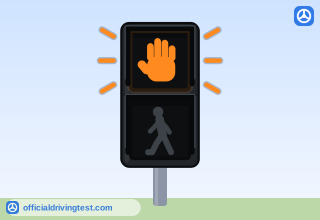
What does a blinking “Don’t Walk” signal mean for a pedestrian?
- Do not enter the intersection
- Enter only if no vehicles are approaching
- Vehicles must now yield to you, so you may start
- Cross diagonally to save time
Show answer
Correct answer: Do not enter the intersection
A blinking “Don’t Walk” signal means do not enter the intersection.
Source: Delaware Driver Manual (July 2026), page 95 · Open this page in the manual (Manual page 95)
-
What should a pedestrian be alert for before crossing a highway at an intersection?
- Cyclists on the sidewalk
- Parked vehicles pulling out
- Turning cars
- Vehicles stopped at the light behind them
Show answer
Correct answer: Turning cars
The manual says to be alert for turning cars before crossing a highway at an intersection.
Source: Delaware Driver Manual (July 2026), page 95 · Open this page in the manual (Manual page 95)
-
When may a pedestrian cross an intersection diagonally?
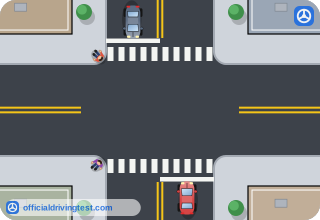
- When no vehicles are approaching from any direction
- When authorized by traffic-control signals
- When the intersection has no marked crosswalks
- When you have the green light and no turning cars are present
Show answer
Correct answer: When authorized by traffic-control signals
A pedestrian must not cross an intersection diagonally except when authorized by traffic-control signals.
Source: Delaware Driver Manual (July 2026), page 95 · Open this page in the manual (Manual page 95)
-
At an intersection, when do pedestrians crossing the highway have the right-of-way?
- Only when they cross in a group of two or more
- Only when no turning vehicles are present
- Only when a traffic officer is present
- When the green light or walk signal is in their favor
Show answer
Correct answer: When the green light or walk signal is in their favor
Pedestrians have the right-of-way when crossing at an intersection and the green light or walk signal is in their favor.
Source: Delaware Driver Manual (July 2026), page 95 · Open this page in the manual (Manual page 95)
-
Who has the right-of-way when a pedestrian on a sidewalk crosses an alley, entrance, or driveway?
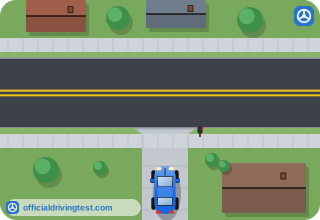
- The driver entering or leaving
- The vehicle that arrives first
- The pedestrian
- The larger vehicle
Show answer
Correct answer: The pedestrian
Pedestrians have the right-of-way when on a sidewalk as it crosses an alley, entrance, or driveway.
Source: Delaware Driver Manual (July 2026), page 95 · Open this page in the manual (Manual page 95)
-
Which pedestrians have the right-of-way when crossing with white canes or guide dogs?
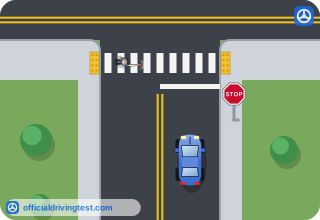
- Pedestrians who are blind
- Only senior citizens crossing at an intersection
- Only children crossing near a school
- Only pedestrians in a marked school crosswalk
Show answer
Correct answer: Pedestrians who are blind
Pedestrians have the right-of-way when they are blind and crossing with white canes or guide dogs.
Source: Delaware Driver Manual (July 2026), page 95 · Open this page in the manual (Manual page 95)
-
When must a pedestrian yield the right-of-way to vehicles?
- When crossing within a marked crosswalk while the walk signal is in their favor
- When walking on a sidewalk as it crosses an alley, entrance, or driveway
- When blind and crossing at an intersection with a white cane or guide dog
- When crossing outside a marked crosswalk or an unmarked crosswalk at an intersection
Show answer
Correct answer: When crossing outside a marked crosswalk or an unmarked crosswalk at an intersection
Pedestrians must yield when crossing a highway other than within a marked crosswalk or an unmarked crosswalk at an intersection.
Source: Delaware Driver Manual (July 2026), page 95 · Open this page in the manual (Manual page 95)
-
Where a pedestrian tunnel or overhead crossing is provided, who must yield when crossing the roadway?
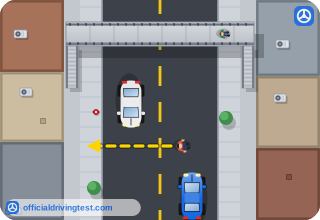
- The driver
- The pedestrian
- Whichever of them arrives first
- The larger of the two
Show answer
Correct answer: The pedestrian
Pedestrians must yield the right-of-way when crossing the roadway where a pedestrian tunnel or overhead crossing is provided.
Source: Delaware Driver Manual (July 2026), page 95 · Open this page in the manual (Manual page 95)
-
Why should you give extra space to pedestrians or bicycles, especially children?
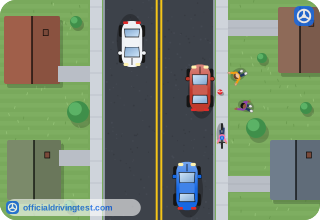
- They are required to stay on the sidewalk at all times
- They can move into your path quickly and without warning
- They always stop at the curb before they cross
- They always travel at a steady speed
Show answer
Correct answer: They can move into your path quickly and without warning
The manual says pedestrians and bicycles, especially children, can move into your path quickly and without warning.
Source: Delaware Driver Manual (July 2026), page 129 · Open this page in the manual (Manual page 129)