Connecticut: Sharing the road — Part 3 Practice Test
Bicyclists, motorcycles, large trucks and their No-Zones, buses, horses and other road users. — Part 3
Independent educational site · not affiliated with any government agency or DMV
Ready? Test yourself
- Instant feedback with an explanation
- Every answer cites its source in the manual
- Your best score is saved on this device
Questions are original and based on the official manual "Connecticut Driver's Manual" (Revised March 2023), Connecticut Department of Motor Vehicles (DMV).
All 31 questions in this practice test
Take the test above first, then use this list to study. Tap “Show answer” to see the correct answer and explanation.
Show the questions and answersHide the questions
-
How much clear road may you need to pass a truck and its tow vehicle?
- About 100 feet
- More than half a mile
- About 300 feet
- Less than a quarter of a mile
Show answer
Correct answer: More than half a mile
Because of their length, it may take you more than half a mile of clear road to pass.
Source: Connecticut Driver's Manual (Revised March 2023), page 19 · Open this page in the manual (Manual page 19)
-
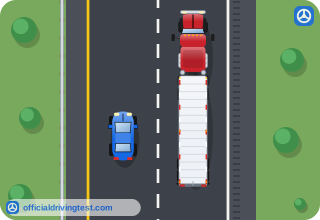
Before pulling in front of a truck you have just passed, what should you see in your rearview mirror?
- The truck’s taillights
- The truck driver’s face in his mirror
- The truck’s turn signal flashing
- The entire front of the truck
Show answer
Correct answer: The entire front of the truck
The manual says to look for the entire front of the truck in your rearview mirror before pulling in front.
Source: Connecticut Driver's Manual (Revised March 2023), page 19 · Open this page in the manual (Manual page 19)
-
Why may a truck, bus or RV need to swing wide to the left or right?
- To make a turn safely
- To avoid the vehicle behind it
- To let faster traffic pass
- To warn cars that it is stopping
Show answer
Correct answer: To make a turn safely
These vehicles sometimes need to swing wide in order to safely make a turn.
Source: Connecticut Driver's Manual (Revised March 2023), page 19 · Open this page in the manual (Manual page 19)
-
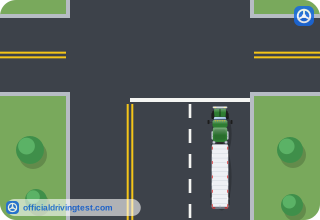
Which cars can the driver of a truck, bus or RV not see during a wide turn?
- Only cars far ahead of it
- Only oncoming cars
- Cars directly behind or beside it
- Cars more than 500 feet away
Show answer
Correct answer: Cars directly behind or beside it
They can’t see the cars directly behind or beside them.
Source: Connecticut Driver's Manual (Revised March 2023), page 19 · Open this page in the manual (Manual page 19)
-
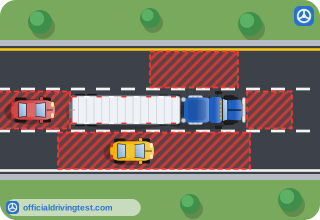
How far in front of the cab may a truck driver’s blind spots stretch?
- Up to 5 feet
- Up to 20 feet
- Up to 50 feet
- Up to 100 feet
Show answer
Correct answer: Up to 20 feet
Their blind spots may stretch up to 20 feet in front of the cab.
Source: Connecticut Driver's Manual (Revised March 2023), page 19 · Open this page in the manual (Manual page 19)
-
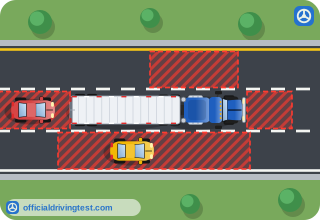
Approximately how far behind a truck may its blind spots stretch?
- Approximately 20 feet
- Approximately 50 feet
- Approximately 500 feet
- Approximately 200 feet
Show answer
Correct answer: Approximately 200 feet
Their blind spots may stretch approximately 200 feet behind the truck.
Source: Connecticut Driver's Manual (Revised March 2023), page 19 · Open this page in the manual (Manual page 19)
-
What does the manual say about trying to squeeze between a truck, bus or RV and the curb, or another vehicle?
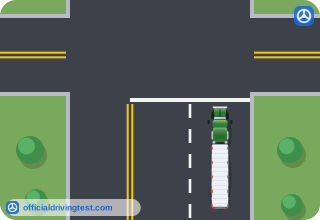
- It is an invitation to disaster
- It is safe as long as you use your signal
- It is only risky on highways
- It is only dangerous at night
Show answer
Correct answer: It is an invitation to disaster
The manual calls trying to squeeze between a large vehicle and the curb or another vehicle an invitation to disaster.
Source: Connecticut Driver's Manual (Revised March 2023), page 19 · Open this page in the manual (Manual page 19)
-
Why is it harder for a truck driver to safely take evasive action?
- Trucks are wider than they are high
- Trucks always travel faster than cars
- Trucks are higher than they are wide
- Trucks cannot use their brakes in an emergency
Show answer
Correct answer: Trucks are higher than they are wide
Because trucks are higher than they are wide, evasive action is harder for the truck driver.
Source: Connecticut Driver's Manual (Revised March 2023), page 19 · Open this page in the manual (Manual page 19)
-
If you make a mistake near a truck, what can an evasive maneuver by the truck driver result in?
- The truck driver safely avoiding a crash every time
- The truck driver crashing, even if you are unharmed
- The truck stopping instantly without risk to anyone
- Your vehicle being struck, while the truck is unharmed
Show answer
Correct answer: The truck driver crashing, even if you are unharmed
An evasive maneuver in a truck can result in the truck driver crashing, even though you may get away unscathed.
Source: Connecticut Driver's Manual (Revised March 2023), page 19 · Open this page in the manual (Manual page 19)
-
Before passing a truck, what should you make sure of?
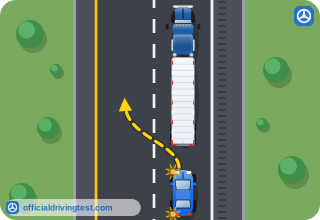
- The truck driver has signaled that it is safe to pass
- Another vehicle is already passing the truck ahead of you
- You can speed up briefly above the limit if needed
- You have room to complete the pass without excessive speed
Show answer
Correct answer: You have room to complete the pass without excessive speed
The manual says to make sure you have room to complete your pass without having to resort to excessive speed.
Source: Connecticut Driver's Manual (Revised March 2023), page 19 · Open this page in the manual (Manual page 19)
-
Before passing a truck, which traffic should you check?
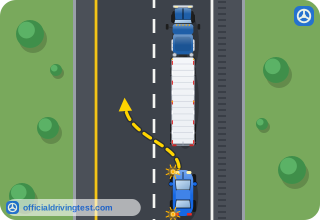
- Traffic in both the front and the rear
- Only the traffic that is ahead of the truck
- Only the traffic that is behind your vehicle
- Only the traffic in the lane next to the truck
Show answer
Correct answer: Traffic in both the front and the rear
The manual says to check traffic in both the front and rear before signaling and changing lanes.
Source: Connecticut Driver's Manual (Revised March 2023), page 19 · Open this page in the manual (Manual page 19)
-
Where should you never complete your pass of a truck?
- On a straight, dry road
- On a two-lane road
- In a no-passing zone
- In a lane that is free of traffic
Show answer
Correct answer: In a no-passing zone
Pass only where it is safe, never where you will have to complete your pass in a no-passing zone.
Source: Connecticut Driver's Manual (Revised March 2023), page 19 · Open this page in the manual (Manual page 19)
-
Why should you not linger alongside a truck’s cab when passing?
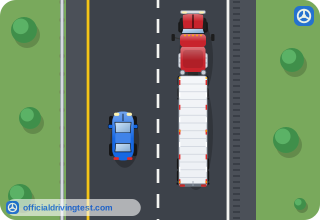
- The truck’s wind turbulence will slow your engine down
- The truck driver may be unable to see you in the mirrors
- The truck driver is required by law to speed up
- The truck’s exhaust may reduce your visibility
Show answer
Correct answer: The truck driver may be unable to see you in the mirrors
If you linger alongside the cab, you may be where the truck driver cannot see you in the mirrors.
Source: Connecticut Driver's Manual (Revised March 2023), page 19 · Open this page in the manual (Manual page 19)
-
When may you signal and return to the right lane after passing a truck?
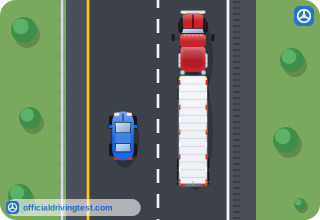
- When the truck driver flashes his headlights at you
- When your front bumper is even with the truck’s cab
- When you are at least 65 feet ahead of the truck
- When you see the front of the truck in your inside mirror
Show answer
Correct answer: When you see the front of the truck in your inside mirror
You should signal and return to the right lane when you can see the front of the truck in your inside mirror.
Source: Connecticut Driver's Manual (Revised March 2023), page 19 · Open this page in the manual (Manual page 19)
-
What should you do with your speed after passing a truck?
- Keep your speed up
- Slow down immediately
- Brake to increase space
- Match the truck’s speed
Show answer
Correct answer: Keep your speed up
After passing, keep your speed up, because passing a vehicle and then slowing down is both dangerous and irritating.
Source: Connecticut Driver's Manual (Revised March 2023), page 19 · Open this page in the manual (Manual page 19)
-
Why should you avoid pulling in front of a truck when traffic may stop or slow down?
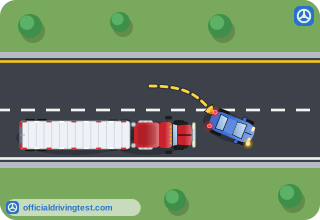
- You will block the truck driver’s view of oncoming traffic
- The truck driver will be unable to see your brake lights
- You take away the truck driver’s margin of safety
- You will have to pay a penalty for cutting off the truck
Show answer
Correct answer: You take away the truck driver’s margin of safety
Pulling in front takes away the truck driver’s margin of safety and risks causing a crash.
Source: Connecticut Driver's Manual (Revised March 2023), page 20 · Open this page in the manual (Manual page 20)
-
What should you do when a truck is passing you?
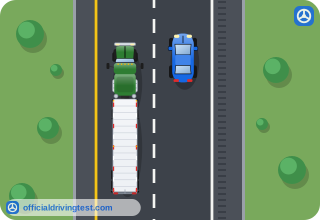
- Speed up slightly so the truck has less distance to pass
- Slow down slightly to shorten the time the truck needs to pass
- Move onto the shoulder to give the truck more room
- Move to the left edge of your lane and keep your speed
Show answer
Correct answer: Slow down slightly to shorten the time the truck needs to pass
Slowing down slightly helps the truck driver pass safely; speeding up is dangerous and illegal.
Source: Connecticut Driver's Manual (Revised March 2023), page 20 · Open this page in the manual (Manual page 20)
-
What should you do when you meet a truck going the other way?
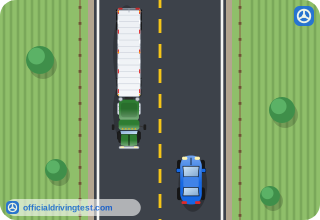
- Move toward the center line to keep clear of the truck
- Brake hard and stop until the truck has passed
- Flash your high beams to warn the driver
- Keep as far to the right as you safely can
Show answer
Correct answer: Keep as far to the right as you safely can
Keeping as far to the right as you safely can gives a greater margin of safety and minimizes wind turbulence.
Source: Connecticut Driver's Manual (Revised March 2023), page 20 · Open this page in the manual (Manual page 20)
-
Why should you never use your high beams when following a truck at night?
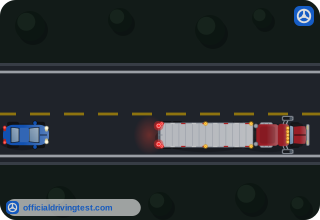
- High beams make the truck’s brake lights hard to see
- The glare in the large side mirrors can blind the truck driver
- High beams reflect off the truck’s cargo and blind you
- High beams make the truck look farther away than it is
Show answer
Correct answer: The glare in the large side mirrors can blind the truck driver
The glare of high beams in the truck’s large side mirrors can blind the truck driver.
Source: Connecticut Driver's Manual (Revised March 2023), page 20 · Open this page in the manual (Manual page 20)
-
Why should you avoid stopping too close behind a truck on an upgrade?
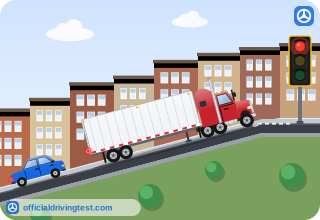
- Its exhaust fumes can stall your engine on a hill
- Its driver cannot see your brake lights on an incline
- Its tires can throw rocks onto your windshield
- The truck could roll back and damage your vehicle
Show answer
Correct answer: The truck could roll back and damage your vehicle
If the truck rolls back when starting up, your vehicle could be damaged.
Source: Connecticut Driver's Manual (Revised March 2023), page 20 · Open this page in the manual (Manual page 20)
-
Where can you stop behind a truck so that its driver will be able to see your vehicle in the mirrors?
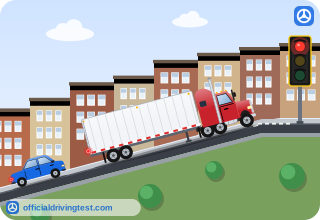
- A little to either side of the truck
- Directly behind the truck’s rear bumper
- As close behind the truck as possible
- Exactly in line with the truck’s center
Show answer
Correct answer: A little to either side of the truck
If you stop a little to either side of the truck, the driver will be able to see your vehicle in the mirrors.
Source: Connecticut Driver's Manual (Revised March 2023), page 20 · Open this page in the manual (Manual page 20)
-
What is it called when a vehicle’s rear wheels follow a shorter path than its front wheels in a turn?
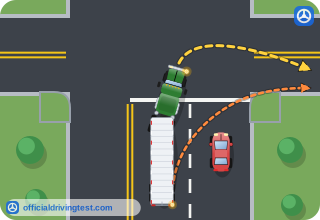
- Wheel drift
- Tail swing
- Off-track
- Back-track
Show answer
Correct answer: Off-track
On every vehicle the rear wheels follow a shorter path than the front wheels, which is called off-track.
Source: Connecticut Driver's Manual (Revised March 2023), page 20 · Open this page in the manual (Manual page 20)
-
How does the length of a vehicle affect the path followed by its rear wheels in a turn?
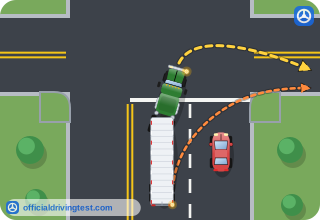
- The longer the vehicle, the longer the path
- The longer the vehicle, the shorter the path
- The shorter the vehicle, the shorter the path
- Length has no effect on the path
Show answer
Correct answer: The longer the vehicle, the shorter the path
The longer the vehicle, the shorter the path followed by the rear wheels.
Source: Connecticut Driver's Manual (Revised March 2023), page 20 · Open this page in the manual (Manual page 20)
-
On which turns does off-track present a greater safety problem?
- Left turns
- U-turns
- Turns made in reverse
- Right turns
Show answer
Correct answer: Right turns
Off-track occurs on both left and right turns but is a greater safety problem on right turns.
Source: Connecticut Driver's Manual (Revised March 2023), page 20 · Open this page in the manual (Manual page 20)
-
On a right turn, what may a truck driver have to do first so the rear wheels won’t jump the curb?
- Move to the left
- Move to the right
- Stop completely
- Speed up
Show answer
Correct answer: Move to the left
A truck driver may first move to the left so the rear wheels won’t jump the curb on a right turn.
Source: Connecticut Driver's Manual (Revised March 2023), page 20 · Open this page in the manual (Manual page 20)
-
Why should you resist the temptation to pass on the right of a truck approaching an intersection?
- Its driver will always signal a stop before the intersection
- Its trailer will swing to the left and strike your car
- It could turn right and trap you between it and the curb
- It will accelerate faster than any car on a green light
Show answer
Correct answer: It could turn right and trap you between it and the curb
If the truck driver makes a right turn, you could be caught between the truck and the curb.
Source: Connecticut Driver's Manual (Revised March 2023), page 20 · Open this page in the manual (Manual page 20)
-
What should you do if you see a truck driver attempting to back into a loading area?
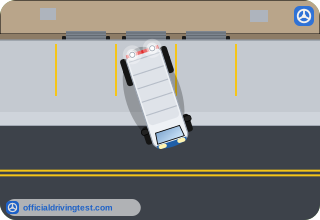
- Drive around the truck quickly on the left side
- Stop to give the driver a chance to back safely
- Move close behind the truck and signal your intent
- Speed up to get past before the truck backs out
Show answer
Correct answer: Stop to give the driver a chance to back safely
You should stop to give the truck driver a chance to back safely.
Source: Connecticut Driver's Manual (Revised March 2023), page 20 · Open this page in the manual (Manual page 20)
-
Why should you never attempt to drive around a backing truck?
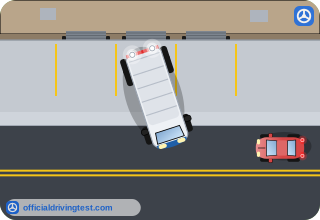
- Backing trucks are always followed by a police escort
- Its driver will already have seen you in the mirrors
- Your vehicle will be hit by the truck’s load
- You may leave the truck driver’s field of view
Show answer
Correct answer: You may leave the truck driver’s field of view
You are likely to get out of the truck driver’s field of view and may be needlessly involved in a crash.
Source: Connecticut Driver's Manual (Revised March 2023), page 20 · Open this page in the manual (Manual page 20)
-
If a truck driver slows, stops, signals or changes lanes, what should you do?
- Be alert, slow down and hold your position
- Pass at once before the truck blocks the lane
- Speed up to stay beside the truck
- Follow closely so the driver can see you
Show answer
Correct answer: Be alert, slow down and hold your position
There is a good reason for the truck driver’s action, so be alert, slow down and hold your position.
Source: Connecticut Driver's Manual (Revised March 2023), page 20 · Open this page in the manual (Manual page 20)
-
Which kind of vehicle's turn signals does the manual say often do not cancel by themselves?
- Motorcycles
- Trucks
- School buses
- Vans
Show answer
Correct answer: Motorcycles
The manual says this is particularly true of motorcycles, as their signals often do not cancel by themselves.
Source: Connecticut Driver's Manual (Revised March 2023), page 21 · Open this page in the manual (Manual page 21)
-
Why do you need extra following distance behind a motorcycle?
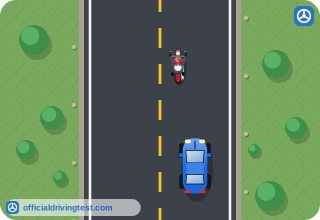
- If the motorcycle falls, you need room to avoid the rider
- Motorcycles always travel faster than most other vehicles
- Motorcycles are too small to be seen in your rearview mirror
- Motorcycles do not have working brake lights at night
Show answer
Correct answer: If the motorcycle falls, you need room to avoid the rider
The manual says that if the motorcycle should fall, you need extra distance to avoid the rider.
Source: Connecticut Driver's Manual (Revised March 2023), page 21 · Open this page in the manual (Manual page 21)