Connecticut: Distracted driving and fitness — Part 3 Practice Test
Questions in this part include: “On long trips, how often does the manual suggest scheduling breaks?” · “What does the manual call the best way to prevent fatigue?”
Independent educational site · not affiliated with any government agency or DMV
Ready? Test yourself
- Instant feedback with an explanation
- Every answer cites its source in the manual
- Your best score is saved on this device
Questions are original and based on the official manual "Connecticut Driver's Manual" (Revised March 2023), Connecticut Department of Motor Vehicles (DMV).
All 20 questions in this practice test
Take the test above first, then use this list to study. Tap “Show answer” to see the correct answer and explanation.
Show the questions and answersHide the questions
-
On long trips, how often does the manual suggest scheduling breaks?
- About every 50 miles or 1 hour
- About every 200 miles or 4 hours
- About every 100 miles or 2 hours
- About every 300 miles or 5 hours
Show answer
Correct answer: About every 100 miles or 2 hours
The manual says to schedule proper breaks about every 100 miles or 2 hours during long trips.
Source: Connecticut Driver's Manual (Revised March 2023), page 28 · Open this page in the manual (Manual page 28)
-
Why does the manual suggest arranging a travel companion before a trip?
- To have someone watch the speedometer for you
- To have someone to talk with and share the driving
- To have someone read the map aloud as you drive
- To have someone handle the radio and phone for you
Show answer
Correct answer: To have someone to talk with and share the driving
To prevent fatigue, the manual suggests arranging for a travel companion, someone to talk with and share the driving.
Source: Connecticut Driver's Manual (Revised March 2023), page 28 · Open this page in the manual (Manual page 28)
-
You keep turning up the radio and rolling down the window to wake yourself up. What does the manual say this is?
- A safe way to stay alert for hours
- A warning sign of fatigue
- A good substitute for a rest stop
- A problem only for new drivers
Show answer
Correct answer: A warning sign of fatigue
The manual lists turning up the radio or rolling down the window to wake yourself up as a warning sign of fatigue.
Source: Connecticut Driver's Manual (Revised March 2023), page 28 · Open this page in the manual (Manual page 28)
-
Which of these does the manual list as a warning sign of fatigue?
- You check your mirrors every few seconds
- You keep a steady speed below the limit
- You signal well before every lane change
- You drift from your lane or miss signs or exits
Show answer
Correct answer: You drift from your lane or miss signs or exits
Drifting from your lane, tailgating, or missing signs or exits are listed in the manual among the warning signs of fatigue.
Source: Connecticut Driver's Manual (Revised March 2023), page 28 · Open this page in the manual (Manual page 28)
-
How long a nap does the manual suggest taking in a safe parking area to prevent a fatigue-related crash?
- 15 to 20 minutes
- 5 minutes or less
- 45 to 60 minutes
- 2 to 3 hours
Show answer
Correct answer: 15 to 20 minutes
The manual says to find a safe parking area to take a 15 to 20 minute nap.
Source: Connecticut Driver's Manual (Revised March 2023), page 28 · Open this page in the manual (Manual page 28)
-
According to the manual, about how much caffeine can increase alertness for several hours?
- About 6 cups of coffee
- Half a cup of coffee
- About 2 cups of coffee
- About 10 cups of coffee
Show answer
Correct answer: About 2 cups of coffee
The manual says the equivalent of 2 cups of coffee can increase alertness for several hours, but warns not to drink too much caffeine.
Source: Connecticut Driver's Manual (Revised March 2023), page 28 · Open this page in the manual (Manual page 28)
-
What does the manual say about relying on caffeine to prevent fatigue?
- It is the best way to prevent fatigue
- It lasts all night if taken early enough
- It removes the need for rest breaks
- Do not rely on it, because it wears off
Show answer
Correct answer: Do not rely on it, because it wears off
The manual warns that caffeine will wear off and says not to rely on caffeine to prevent fatigue.
Source: Connecticut Driver's Manual (Revised March 2023), page 28 · Open this page in the manual (Manual page 28)
-
What does the manual suggest doing to get the benefits of both caffeine and a short nap?
- Consume caffeine before taking the nap
- Consume caffeine only after waking up
- Take the nap while still driving slowly
- Skip caffeine entirely before napping
Show answer
Correct answer: Consume caffeine before taking the nap
The manual suggests trying to consume caffeine before taking a short nap to get the benefits of both.
Source: Connecticut Driver's Manual (Revised March 2023), page 28 · Open this page in the manual (Manual page 28)
-
To prevent a fatigue-related crash, between which hours does the manual say to try not to drive late at night?
- 9 p.m. and 3 a.m.
- 10 p.m. and 4 a.m.
- Midnight and 6 a.m.
- 2 a.m. and 8 a.m.
Show answer
Correct answer: Midnight and 6 a.m.
The manual advises trying not to drive late at night between the hours of midnight and 6 a.m.
Source: Connecticut Driver's Manual (Revised March 2023), page 28 · Open this page in the manual (Manual page 28)
-
What does the manual call the best way to prevent fatigue?
- Caffeine
- Sleep
- Cold air
- Loud music
Show answer
Correct answer: Sleep
The manual states that the best way to prevent fatigue is sleep.
Source: Connecticut Driver's Manual (Revised March 2023), page 28 · Open this page in the manual (Manual page 28)
-
What kind of crash do fatigue-related crashes tend to be?
- A single vehicle leaving the road and rolling or hitting an object
- A rear-end crash between two cars stopped at a red light
- A crash with a pedestrian who is crossing at a crosswalk
- A low-speed head-on crash between two cars in a parking lot
Show answer
Correct answer: A single vehicle leaving the road and rolling or hitting an object
The manual says fatigue-related crashes tend to be single-vehicle crashes in which a car or truck leaves the roadway and then turns over or hits a fixed object.
Source: Connecticut Driver's Manual (Revised March 2023), page 28 · Open this page in the manual (Manual page 28)
-
What are rumble strips?
- Painted lines that glow in the dark at night
- Reflectors mounted along the guardrails
- Raised or grooved patterns in the pavement
- Speed bumps placed across parking lots
Show answer
Correct answer: Raised or grooved patterns in the pavement
The manual describes rumble strips as raised or grooved patterns installed in the pavement of shoulders or directly in travel lanes, which help prevent fatigue-related crashes.
Source: Connecticut Driver's Manual (Revised March 2023), page 28 · Open this page in the manual (Manual page 28)
-
What should you do if you run over a shoulder rumble strip?
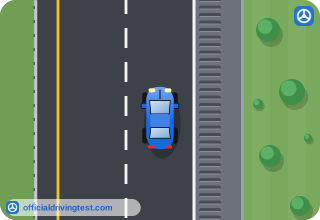
- Speed up a little to get past the strip more quickly
- Pull off the road safely right away and check your alertness
- Move to the far left lane and keep driving as before
- Turn up the radio loudly and continue to your destination
Show answer
Correct answer: Pull off the road safely right away and check your alertness
The manual says that if you run over a shoulder rumble strip, pull off the road at a safe place immediately and check your alertness level.
Source: Connecticut Driver's Manual (Revised March 2023), page 28 · Open this page in the manual (Manual page 28)
-
If you are not feeling well and need to go somewhere, what does the manual advise?
- Drive only on highways
- Drive with windows open
- Drive below the limit
- Let someone else drive
Show answer
Correct answer: Let someone else drive
The manual says health problems such as a bad cold, infection or virus can affect your driving, so if you are not feeling well, let someone else drive.
Source: Connecticut Driver's Manual (Revised March 2023), page 28 · Open this page in the manual (Manual page 28)
-
Can little health problems such as a stiff neck, a cough or a sore leg affect your driving?
- No, only serious illnesses affect driving
- Yes, even little problems like these can
- Only if you take medicine to treat them
- Only on trips lasting more than two hours
Show answer
Correct answer: Yes, even little problems like these can
The manual says even little problems like a stiff neck, a cough or a sore leg can affect your driving.
Source: Connecticut Driver's Manual (Revised March 2023), page 28 · Open this page in the manual (Manual page 28)
-
What should you do if you feel you may have a health condition that could prevent you from driving safely?
- Drive only in daylight
- Wait for license renewal
- Have a passenger watch you
- Check with your doctor
Show answer
Correct answer: Check with your doctor
The manual says many health conditions and medications can affect your driving, and to check with your doctor if you feel you may have such a condition.
Source: Connecticut Driver's Manual (Revised March 2023), page 28 · Open this page in the manual (Manual page 28)
-
According to the manual, how can emotions affect your driving?
- They can increase risk taking
- They sharpen your attention
- They speed up your reactions
- They improve your judgment
Show answer
Correct answer: They can increase risk taking
The manual says emotions can interfere with your ability to think, create mental distractions, increase risk taking, create a lack of attention and interrupt your ability to process information.
Source: Connecticut Driver's Manual (Revised March 2023), page 28 · Open this page in the manual (Manual page 28)
-
If you are angry or excited, what does the manual advise?
- Drive faster so that you get home sooner
- Play loud music while driving to calm down
- Cool off and stay off the road until you are calm
- Drive only in the left lane until you calm down
Show answer
Correct answer: Cool off and stay off the road until you are calm
The manual says to give yourself time to cool off, take a short walk or nap if necessary, and stay off the road until you have calmed down.
Source: Connecticut Driver's Manual (Revised March 2023), page 28 · Open this page in the manual (Manual page 28)
-
If you are worried or upset, what does the manual say some drivers find helpful?
- Talking on a hands-free phone while they drive
- Driving with all of the windows rolled down
- Driving a little faster than they usually do
- Listening to the radio, if it does not distract
Show answer
Correct answer: Listening to the radio, if it does not distract
The manual says to keep your mind on your driving, and that some drivers find listening to the radio helps, as long as it is not distracting from safe driving.
Source: Connecticut Driver's Manual (Revised March 2023), page 28 · Open this page in the manual (Manual page 28)
-
If you are impatient, what does the manual advise?
- Give yourself extra time and leave a few minutes early
- Drive a little faster than the flow of traffic
- Change lanes often to get around slower traffic
- Use the shoulder to pass vehicles that are slow
Show answer
Correct answer: Give yourself extra time and leave a few minutes early
The manual says to give yourself extra time and leave a few minutes early, and warns not to drive faster than the flow of traffic, since darting around other traffic can be fatal.
Source: Connecticut Driver's Manual (Revised March 2023), page 28 · Open this page in the manual (Manual page 28)