Colorado: Sharing the road — Part 1 Practice Test
Questions in this part include: “Where may a bicyclist ride in a lane marked with a sharrow?” · “Which of these is something the handbook says to be aware of when mountain driving?”
Independent educational site · not affiliated with any government agency or DMV
Ready? Test yourself
- Instant feedback with an explanation
- Every answer cites its source in the manual
- Your best score is saved on this device
Questions are original and based on the official manual "Colorado Driver Handbook" (DR 2337, January 2025), Colorado Division of Motor Vehicles (DMV).
All 18 questions in this practice test
Take the test above first, then use this list to study. Tap “Show answer” to see the correct answer and explanation.
Show the questions and answersHide the questions
-
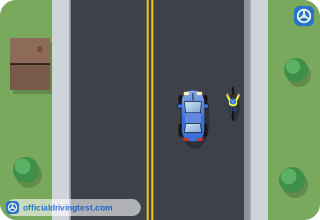
When must a driver passing or overtaking a bicyclist allow 3 feet of clearance?
- Only on roadways where a PASS 3 FT MIN sign is posted
- Only on roadways that have a marked bike lane
- Only on roadways with a speed limit above 25 miles per hour
- On all roadways, even if no sign is posted
Show answer
Correct answer: On all roadways, even if no sign is posted
Motorists must allow 3 feet of clearance when passing bicyclists on all roadways, even if a sign is not posted.
Source: Colorado Driver Handbook (DR 2337, January 2025), page 9 · Open this page in the manual (Manual page 9)
-
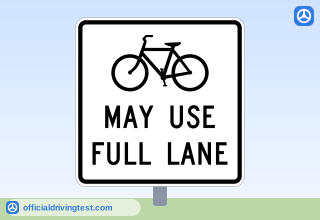
Why may a bicyclist ride in the center of the lane under a "MAY USE FULL LANE" sign?
- Hazards or poor visibility make the right side of the lane unsafe
- The bicyclist is traveling faster than the cars around them
- The lane is reserved for bicycles during morning and evening hours
- The bicyclist is turning left at the next intersection
Show answer
Correct answer: Hazards or poor visibility make the right side of the lane unsafe
The sign reminds drivers that bicyclists have a right to ride in the center of the lane if hazards or poor visibility compromise their safety on the right side.
Source: Colorado Driver Handbook (DR 2337, January 2025), page 9 · Open this page in the manual (Manual page 9)
-
Where may a bicyclist ride in a lane marked with a sharrow?
- Only on the far right edge of the lane
- Only on the sidewalk beside the road
- In the center of the lane
- Only on the left edge of the lane
Show answer
Correct answer: In the center of the lane
Bicyclists may ride in the center of a lane with a sharrow.
Source: Colorado Driver Handbook (DR 2337, January 2025), page 9 · Open this page in the manual (Manual page 9)
-
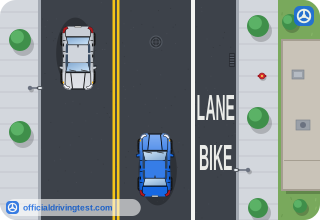
Which statement about drivers and a bike lane is correct?
- Drivers may park in it briefly when loading or unloading
- Drivers may not drive, idle or park in it or obstruct it
- Drivers may drive in it when no bicyclists are in sight
- Drivers may idle in it but may not park there
Show answer
Correct answer: Drivers may not drive, idle or park in it or obstruct it
Drivers are prohibited from driving, idling or parking in or otherwise obstructing a bike lane; the handbook allows crossing a bike lane when turning, entering or leaving another road, driveway or alley.
Source: Colorado Driver Handbook (DR 2337, January 2025), page 10 · Open this page in the manual (Manual page 10)
-
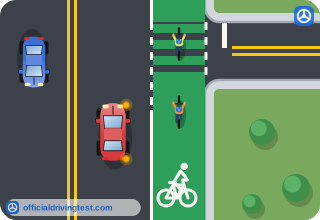
Who has the right-of-way in a bike lane?
- Drivers turning right at the intersection
- Any vehicle that arrived in the lane first
- Slow moving vehicles and bicyclists
- Bicyclists and other authorized users
Show answer
Correct answer: Bicyclists and other authorized users
Bicyclists and other authorized users have the right-of-way in a bike lane.
Source: Colorado Driver Handbook (DR 2337, January 2025), page 10 · Open this page in the manual (Manual page 10)
-
Does a bike lane continue through an intersection where no paint connects the two sides?
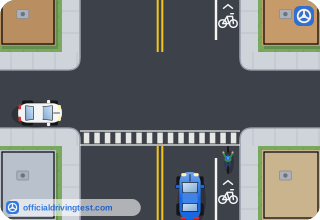
- Yes, the bike lane still extends through the intersection
- No, the bike lane ends where the paint stops
- No, it ends at every intersection with a traffic signal
- Only if a sign at the intersection says so
Show answer
Correct answer: Yes, the bike lane still extends through the intersection
A bike lane extends through an intersection regardless of whether paint connects the bike lane on either side.
Source: Colorado Driver Handbook (DR 2337, January 2025), page 10 · Open this page in the manual (Manual page 10)
-
How does the handbook describe bicycles on the road?
- As vehicles that must always give way to every motor vehicle
- As vehicles with many of the same rights and responsibilities
- As devices that have the same rights as pedestrians in every lane
- As vehicles that may ignore traffic signs on narrow roads
Show answer
Correct answer: As vehicles with many of the same rights and responsibilities
Bicycles on the road are considered vehicles with many of the same rights and responsibilities as motor vehicles.
Source: Colorado Driver Handbook (DR 2337, January 2025), page 11 · Open this page in the manual (Manual page 11)
-
When must drivers yield the right-of-way to bicyclists in a designated bike lane?
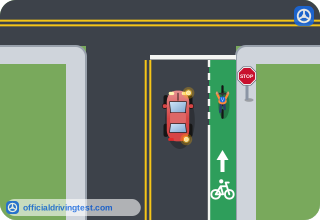
- Only when the bicyclist has a green signal
- Only when the bike lane is painted green
- Only when the bicyclist is traveling faster than traffic
- When merging with or crossing the bike lane to turn
Show answer
Correct answer: When merging with or crossing the bike lane to turn
Drivers must yield to bicyclists in a designated bike lane when merging with or crossing it to turn.
Source: Colorado Driver Handbook (DR 2337, January 2025), page 11 · Open this page in the manual (Manual page 11)
-
A bicyclist is riding on a sidewalk or crosswalk. What rights and responsibilities does the bicyclist have?
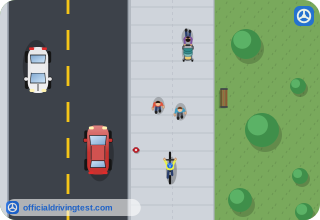
- The same as a pedestrian
- The same as a motor vehicle
- None, because bicycles are not allowed there
- Fewer than a pedestrian, because bicycles are vehicles
Show answer
Correct answer: The same as a pedestrian
Bicyclists riding on a sidewalk or crosswalk have the same rights and responsibilities as pedestrians.
Source: Colorado Driver Handbook (DR 2337, January 2025), page 11 · Open this page in the manual (Manual page 11)
-
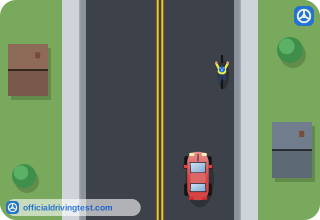
When passing a bicyclist, when may you briefly cross a solid yellow line?
- When the bicyclist is riding on the shoulder
- When the bicyclist is traveling slower than 10 miles per hour
- When there is no oncoming traffic and you have a clear view ahead
- When you have signaled and the road is straight
Show answer
Correct answer: When there is no oncoming traffic and you have a clear view ahead
The handbook says you can briefly cross a solid yellow line when there is no oncoming traffic and you have a clear view ahead.
Source: Colorado Driver Handbook (DR 2337, January 2025), page 15 · Open this page in the manual (Manual page 15)
-
Why should you give a bicyclist more space on rural roadways, when operating a large vehicle or in windy conditions?
- Bicyclists cannot hear large vehicles coming
- Wind blasts can knock a bicyclist off their bike
- Bicyclists must always ride on the shoulder
- Bicyclists cannot judge distance very well
Show answer
Correct answer: Wind blasts can knock a bicyclist off their bike
The handbook warns of wind blasts that can knock a bicyclist off their bike and says to give more space in those conditions.
Source: Colorado Driver Handbook (DR 2337, January 2025), page 15 · Open this page in the manual (Manual page 15)
-
After sunset, what should you be alert to?
- Traffic signals that have been turned off for the night
- Parked vehicles that always have their lights on
- Roadside signs that no longer reflect light
- Vehicles, including bicyclists, with no lights on
Show answer
Correct answer: Vehicles, including bicyclists, with no lights on
Be alert to vehicles, including bicyclists, traveling after sunset without their lights on.
Source: Colorado Driver Handbook (DR 2337, January 2025), page 16 · Open this page in the manual (Manual page 16)
-
At night, what should you look for to spot bicyclists and motorcyclists?
- Two red tail lamps
- Reflective stripes on their helmets
- The single front light
- A pair of headlights
Show answer
Correct answer: The single front light
Look for the single front light of bicyclists and motorcyclists traveling at night.
Source: Colorado Driver Handbook (DR 2337, January 2025), page 16 · Open this page in the manual (Manual page 16)
-
Which of these is something the handbook says to be aware of when mountain driving?
- Toll booths at every summit
- Traffic signals at every curve
- Wildlife and rocks on the roadway
- Roundabouts on every hill
Show answer
Correct answer: Wildlife and rocks on the roadway
Mountain driving calls for awareness of steep hills, changing weather, bicyclists, wildlife and rocks on the roadway.
Source: Colorado Driver Handbook (DR 2337, January 2025), page 17 · Open this page in the manual (Manual page 17)
-
What should you be prepared for when mountain driving, regarding intersections?
- Intersections that are always marked by signs
- Intersections closed in winter
- Intersections with extra turn lanes
- Intersections hidden by trees, brush or crops
Show answer
Correct answer: Intersections hidden by trees, brush or crops
Be prepared for intersections hidden by trees, brush or crops and for animals on or near the roadway.
Source: Colorado Driver Handbook (DR 2337, January 2025), page 17 · Open this page in the manual (Manual page 17)
-
Your vehicle has difficulty traveling up a steep roadway. What should you do?
- Pull off at the first safe place or stay in the right lane
- Stop in the travel lane and turn on your hazard lights
- Move to the left lane and slow down to a crawl
- Speed up and ride close behind the next vehicle
Show answer
Correct answer: Pull off at the first safe place or stay in the right lane
Pull off the road at the first safe place or stay in the right lane to let other vehicles pass.
Source: Colorado Driver Handbook (DR 2337, January 2025), page 17 · Open this page in the manual (Manual page 17)
-
Why can it be difficult to pass other vehicles on rural roads?
- Rural roads are narrow
- Rural roads have too many traffic signals
- Rural roads are always closed to passing
- Rural roads have too many lanes
Show answer
Correct answer: Rural roads are narrow
Rural roads are narrow, which can make it difficult to pass other vehicles.
Source: Colorado Driver Handbook (DR 2337, January 2025), page 17 · Open this page in the manual (Manual page 17)
-
Which statement about rural roads is correct?
- All have wide paved shoulders and guard rails
- All have shoulders, but few have guard rails
- Many have no shoulders, and some have no guard rails
- Most have guard rails, but few have shoulders
Show answer
Correct answer: Many have no shoulders, and some have no guard rails
The handbook says many rural roads have no shoulders and some have no guard rails.
Source: Colorado Driver Handbook (DR 2337, January 2025), page 17 · Open this page in the manual (Manual page 17)