Pavement markings in Colorado
The Colorado Driver Handbook shows or names everything on this page: 16 in all, on pages 9–10.
Independent educational site · not affiliated with any government agency or DMV
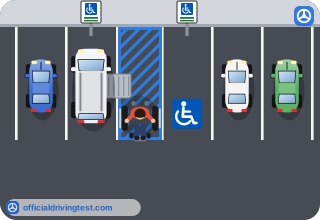
Disabled Parking Pavement Marking
Disabled parking indicators may also appear on the pavement in designated parking spaces. Crosshatched sections are for van access only and parking is not allowed at any time.
Manual page 9 · Open this page in the manual (Manual page 9)
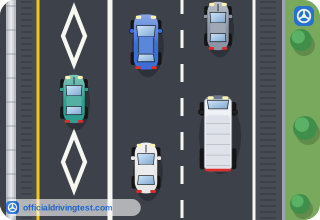
HOV Lane Diamond Marking
Restricted lanes are marked by signs or pavement markings stating that the lane is restricted for special use. There will be a white diamond painted on the road within the lane, and/or a sign posted at the side of the road which specifies its use. Some examples are transit or bicycle lanes.
Manual page 10 · Open this page in the manual (Manual page 10)
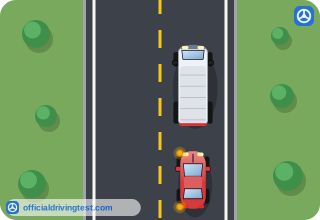
Broken Yellow Line
Yellow lines: Separate traffic moving in opposite directions. Broken yellow line: Passing is permitted.
Manual page 9 · Open this page in the manual (Manual page 9)
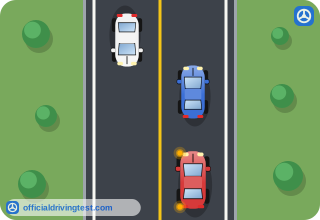
Solid Yellow Line
No passing is permitted, unless to pass a bicyclist with a minimum of three feet of space when the oncoming travel lane is clear.
Manual page 9 · Open this page in the manual (Manual page 9)
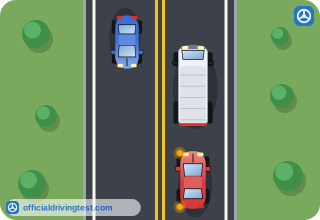
Double Solid Yellow Lines
Neither side can pass, unless to pass a bicyclist with a minimum of three feet of space when the oncoming travel lane is clear.
Manual page 9 · Open this page in the manual (Manual page 9)
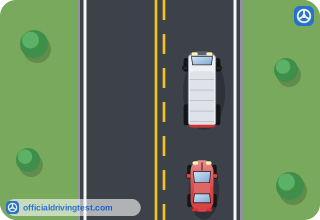
Solid and Broken Yellow Lines
You may not pass if the solid yellow line is on your side. If the broken yellow line is on your side, you may pass if it is safe to do so. You must return to your lane before the broken lines turn solid. You may cross a solid yellow line for a left turn into an alley, private road or driveway or to pass a bicyclist with a minimum of three feet of space when such movement can be made safely.
Manual page 9 · Open this page in the manual (Manual page 9)
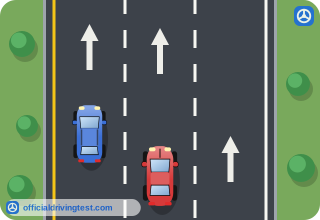
Broken White Line
White lines: Separate lanes of traffic moving in the same direction. Broken white line: You may change lanes if it is safe.
Manual page 9 · Open this page in the manual (Manual page 9)
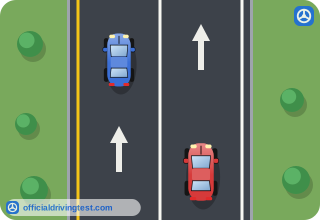
Solid White Line
Requires you to stay within the lane and also marks the shoulder of the roadway.
Manual page 9 · Open this page in the manual (Manual page 9)
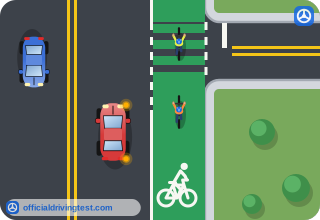
Green Paint (Bike Lane)
A lane or area on the roadway designated for bicyclists, and increases visibility of bicyclists.
Manual page 9 · Open this page in the manual (Manual page 9)
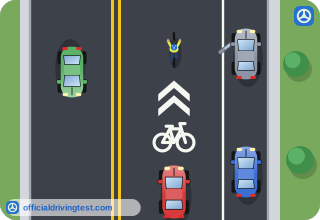
Sharrow (Shared Lane Marking)
Some streets have shared lane markings or “sharrows” painted on them letting road users know that the lane may be too narrow for drivers and bicyclists to travel side-by-side. Bicyclists may ride in the center of a lane with a sharrow or in any situation where they need to avoid obstacles or increase visibility for their safety.
Manual page 9 · Open this page in the manual (Manual page 9)
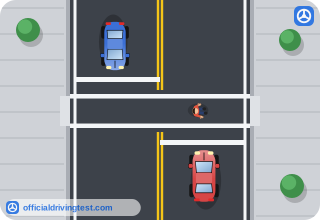
Marked Crosswalk (Two Lines)
A crosswalk is a marked or unmarked part of a road where pedestrians have the right-of-way to cross. The driver of a vehicle shall yield the right-of-way by slowing down or stopping, if need be, for pedestrians crossing the roadway within a crosswalk. Whenever you approach a vehicle from the rear that is stopped at a crosswalk, you must not pass and must stop behind the vehicle or behind the crosswalk in the adjacent lane if a multi-lane roadway.
Manual page 9 · Open this page in the manual (Manual page 9)
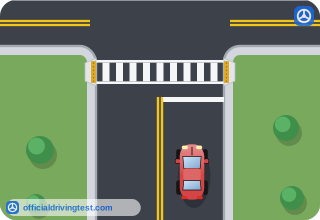
Marked Crosswalk (Ladder)
A crosswalk is a marked or unmarked part of a road where pedestrians have the right-of-way to cross. The driver of a vehicle shall yield the right-of-way by slowing down or stopping, if need be, for pedestrians crossing the roadway within a crosswalk. Whenever you approach a vehicle from the rear that is stopped at a crosswalk, you must not pass and must stop behind the vehicle or behind the crosswalk in the adjacent lane if a multi-lane roadway.
Manual page 9 · Open this page in the manual (Manual page 9)
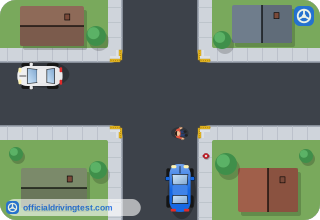
Unmarked Crosswalk
A crosswalk is a marked or unmarked part of a road where pedestrians have the right-of-way to cross. The driver of a vehicle shall yield the right-of-way by slowing down or stopping, if need be, for pedestrians crossing the roadway within a crosswalk. Whenever you approach a vehicle from the rear that is stopped at a crosswalk, you must not pass and must stop behind the vehicle or behind the crosswalk in the adjacent lane if a multi-lane roadway.
Manual page 9 · Open this page in the manual (Manual page 9)
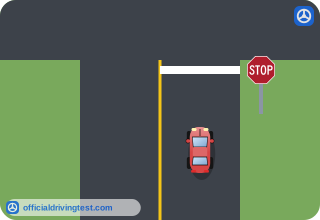
Stop Line
Stay behind white-painted stop bars at stop signs and traffic lights because many are carefully measured to give trucks the room they need for turns. (p20)
Manual page 9 · Open this page in the manual (Manual page 9)
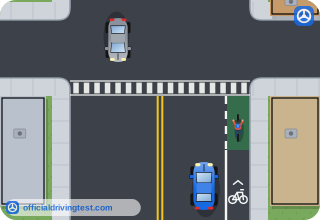
Conflict Zone (Broken Bike Lane Lines)
Broken lines in a bike or bus lane that alert drivers and bicyclists that they will be crossing each other’s path.
Manual page 9 · Open this page in the manual (Manual page 9)
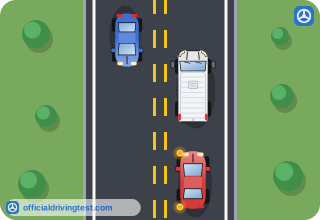
Double Broken Yellow Lines (Reversible Lane)
Some travel lanes are designed to carry traffic in one direction at certain times and in the opposite direction at other times. These lanes are separated by a barrier or marked by double-broken yellow lines.
Manual page 10 · Open this page in the manual (Manual page 10)