Colorado: Pavement markings and lane controls Practice Test
Yellow and white lines, bike lanes, restricted lanes, reversible lanes and the other lane markings in the Colorado handbook.
Independent educational site · not affiliated with any government agency or DMV
Ready? Test yourself
- Instant feedback with an explanation
- Every answer cites its source in the manual
- Your best score is saved on this device
Questions are original and based on the official manual "Colorado Driver Handbook" (DR 2337, January 2025), Colorado Division of Motor Vehicles (DMV).
All 23 questions in this practice test
Take the test above first, then use this list to study. Tap “Show answer” to see the correct answer and explanation.
Show the questions and answersHide the questions
-
Which of these is a job of lines and symbols on the roadway?
- Show the legal speed limit for each lane
- Identify which vehicles have passed inspection
- Tell drivers the distance to the next exit
- Mark where you must stop for traffic signals or signs
Show answer
Correct answer: Mark where you must stop for traffic signals or signs
Lines and symbols divide lanes, tell when you may pass, indicate turn lanes, define pedestrian walkways and mark where you must stop for signals or signs.
Source: Colorado Driver Handbook (DR 2337, January 2025), page 9 · Open this page in the manual (Manual page 9)
-
What do yellow lines on the roadway separate?
- Traffic moving in opposite directions
- Traffic moving in the same direction
- The travel lanes from the bike lane
- The roadway from the shoulder
Show answer
Correct answer: Traffic moving in opposite directions
Yellow lines separate traffic moving in opposite directions.
Source: Colorado Driver Handbook (DR 2337, January 2025), page 9 · Open this page in the manual (Manual page 9)
-
What does a broken yellow line mean?
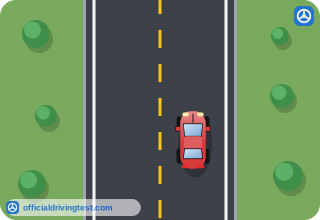
- Passing is never permitted
- Only left turns are allowed
- Passing is permitted
- Traffic on both sides must stop
Show answer
Correct answer: Passing is permitted
A broken yellow line means passing is permitted.
Source: Colorado Driver Handbook (DR 2337, January 2025), page 9 · Open this page in the manual (Manual page 9)
-
Double solid yellow lines mean that:
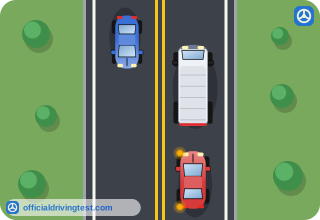
- Either side may pass when the road ahead is clear
- Only the side with heavier traffic may pass
- Passing is allowed only during daylight hours
- Neither side can pass, with a bicyclist exception
Show answer
Correct answer: Neither side can pass, with a bicyclist exception
With double solid yellow lines neither side can pass, unless to pass a bicyclist with a minimum of three feet of space when the oncoming lane is clear.
Source: Colorado Driver Handbook (DR 2337, January 2025), page 9 · Open this page in the manual (Manual page 9)
-
A solid yellow line and a broken yellow line are side by side. When may you pass?
- Only if the broken yellow line is on your side and it is safe
- Only if the solid yellow line is on your side and it is safe
- Never, because both sides are marked with yellow
- Only if the oncoming lane is empty, whichever line is on your side
Show answer
Correct answer: Only if the broken yellow line is on your side and it is safe
You may not pass if the solid line is on your side; if the broken line is on your side you may pass if it is safe.
Source: Colorado Driver Handbook (DR 2337, January 2025), page 9 · Open this page in the manual (Manual page 9)
-
When passing where the center line is broken on your side, you must return to your lane before:
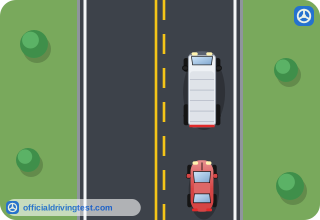
- The driver you are passing flashes the headlights
- The oncoming vehicle comes into view
- The broken lines turn solid
- You pass a second vehicle ahead
Show answer
Correct answer: The broken lines turn solid
You must return to your lane before the broken lines turn solid.
Source: Colorado Driver Handbook (DR 2337, January 2025), page 9 · Open this page in the manual (Manual page 9)
-
You may cross a solid yellow line to make a left turn into:
- A one-way street or a freeway on-ramp
- An alley, private road or driveway
- Another travel lane on the same road
- A roundabout or a railroad crossing
Show answer
Correct answer: An alley, private road or driveway
You may cross a solid yellow line for a left turn into an alley, private road or driveway when it can be done safely.
Source: Colorado Driver Handbook (DR 2337, January 2025), page 9 · Open this page in the manual (Manual page 9)
-
What do white lines on the roadway separate?
- Lanes of traffic moving in opposite directions
- Parked vehicles from moving traffic
- Bike lanes from sidewalks
- Lanes of traffic moving in the same direction
Show answer
Correct answer: Lanes of traffic moving in the same direction
White lines separate lanes of traffic moving in the same direction.
Source: Colorado Driver Handbook (DR 2337, January 2025), page 9 · Open this page in the manual (Manual page 9)
-
What does a broken white line mean?
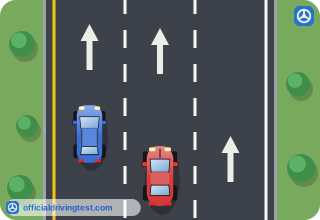
- You may change lanes if it is safe
- You must stay within your lane
- You may not change lanes at all
- It marks the shoulder of the roadway
Show answer
Correct answer: You may change lanes if it is safe
A broken white line means you may change lanes if it is safe.
Source: Colorado Driver Handbook (DR 2337, January 2025), page 9 · Open this page in the manual (Manual page 9)
-
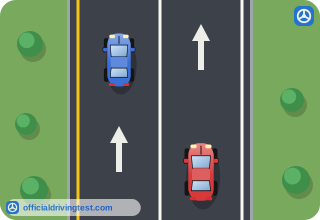
What does a solid white line require of drivers?
- To change lanes to the left only
- To slow down to 25 miles per hour
- To stay within the lane
- To yield to oncoming traffic
Show answer
Correct answer: To stay within the lane
A solid white line requires you to stay within the lane.
Source: Colorado Driver Handbook (DR 2337, January 2025), page 9 · Open this page in the manual (Manual page 9)
-
A solid white line also marks which part of the roadway?
- The center of the roadway
- The shoulder
- The start of a no-passing zone
- A pedestrian walkway
Show answer
Correct answer: The shoulder
A solid white line also marks the shoulder of the roadway.
Source: Colorado Driver Handbook (DR 2337, January 2025), page 9 · Open this page in the manual (Manual page 9)
-
What is green paint on the roadway used for?
- A lane or area reserved for buses and light rail vehicles during rush hours
- A lane or area where drivers must stop to let pedestrians cross
- A lane or area reserved for vehicles carrying several passengers
- A lane or area designated for bicyclists that increases their visibility
Show answer
Correct answer: A lane or area designated for bicyclists that increases their visibility
Green paint designates a lane or area for bicyclists and increases visibility of bicyclists.
Source: Colorado Driver Handbook (DR 2337, January 2025), page 9 · Open this page in the manual (Manual page 9)
-
What do shared lane markings, or "sharrows", tell road users?
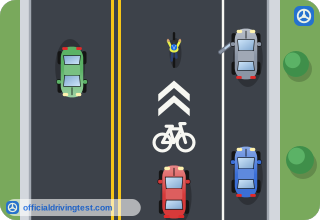
- The lane may be too narrow for drivers and bicyclists to travel side-by-side
- The lane is reserved for bicyclists and drivers may not enter it
- Drivers must yield to bicyclists at every intersection ahead
- A bike lane ahead is separated from traffic by a barrier
Show answer
Correct answer: The lane may be too narrow for drivers and bicyclists to travel side-by-side
Sharrows let road users know that the lane may be too narrow for drivers and bicyclists to travel side-by-side.
Source: Colorado Driver Handbook (DR 2337, January 2025), page 9 · Open this page in the manual (Manual page 9)
-
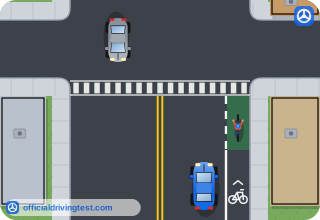
Broken lines in a bike or bus lane that alert drivers and bicyclists they will be crossing each other's path are called:
- Sharrows
- Green paint
- Conflict zones
- Reversible lanes
Show answer
Correct answer: Conflict zones
Conflict zones are broken lines in a bike or bus lane that alert drivers and bicyclists that they will be crossing each other's path.
Source: Colorado Driver Handbook (DR 2337, January 2025), page 9 · Open this page in the manual (Manual page 9)
-
How are restricted lanes marked?
- By a solid yellow line along the right edge only
- By cones placed in the lane every morning
- By a green painted stripe in the middle of the lane
- By signs or markings stating the lane is for special use
Show answer
Correct answer: By signs or markings stating the lane is for special use
Restricted lanes are marked by signs or pavement markings stating that the lane is restricted for special use.
Source: Colorado Driver Handbook (DR 2337, January 2025), page 10 · Open this page in the manual (Manual page 10)
-
What marking may be painted on the road within a restricted lane?
- A white diamond
- A yellow diamond
- A white triangle
- A double white line
Show answer
Correct answer: A white diamond
There will be a white diamond painted on the road within the lane, and/or a sign posted at the side of the road.
Source: Colorado Driver Handbook (DR 2337, January 2025), page 10 · Open this page in the manual (Manual page 10)
-
Which are examples of restricted lanes?
- Shoulders and acceleration lanes
- Turn lanes and passing lanes
- Transit lanes and bicycle lanes
- Merge lanes and exit lanes
Show answer
Correct answer: Transit lanes and bicycle lanes
The handbook gives transit or bicycle lanes as examples of restricted lanes.
Source: Colorado Driver Handbook (DR 2337, January 2025), page 10 · Open this page in the manual (Manual page 10)
-
Transit lanes are reserved for the preferential or exclusive use of which vehicles?
- Bicycles and motorcycles only
- Vehicles carrying two or more occupants
- Transit vehicles, such as buses or light rail
- Emergency and utility vehicles only
Show answer
Correct answer: Transit vehicles, such as buses or light rail
A transit lane is reserved for the preferential or exclusive use of transit vehicles, for example bus or light rail.
Source: Colorado Driver Handbook (DR 2337, January 2025), page 10 · Open this page in the manual (Manual page 10)
-
Which marking identifies a High Occupancy Vehicle (HOV) lane?
- A white arrow painted on the roadway
- A white diamond painted on the roadway
- A yellow diamond painted on the roadway
- A solid green stripe on the roadway
Show answer
Correct answer: A white diamond painted on the roadway
HOV lanes are identified by a white diamond painted on the roadway.
Source: Colorado Driver Handbook (DR 2337, January 2025), page 10 · Open this page in the manual (Manual page 10)
-
What do the signs at a High Occupancy Vehicle (HOV) lane identify?
- The speed limit and minimum following distance for the lane
- The toll amount and how to pay it before entering the lane
- The maximum vehicle weight and height allowed in the lane
- The types of vehicles and number of occupants required per vehicle
Show answer
Correct answer: The types of vehicles and number of occupants required per vehicle
Signs identify the types of vehicles and the number of occupants required per vehicle to use the HOV lane.
Source: Colorado Driver Handbook (DR 2337, January 2025), page 10 · Open this page in the manual (Manual page 10)
-
What is a reversible lane designed to do?
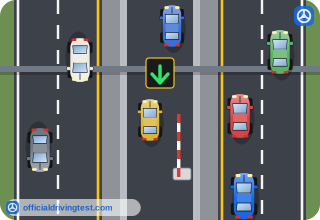
- Carry traffic in one direction at certain times and the opposite direction at other times
- Carry only bicycles during rush hour and general traffic the rest of the day
- Let drivers turn around without leaving the roadway at any time
- Carry traffic in both directions at once at all times of the day
Show answer
Correct answer: Carry traffic in one direction at certain times and the opposite direction at other times
Reversible lanes carry traffic in one direction at certain times and in the opposite direction at other times.
Source: Colorado Driver Handbook (DR 2337, January 2025), page 10 · Open this page in the manual (Manual page 10)
-
How may reversible lanes be separated or marked?
- By solid white lines on both sides of the lane
- By a green painted stripe down the middle
- By a barrier or double-broken yellow lines
- By a raised bicycle curb along the edge
Show answer
Correct answer: By a barrier or double-broken yellow lines
Reversible lanes are separated by a barrier or marked by double-broken yellow lines.
Source: Colorado Driver Handbook (DR 2337, January 2025), page 10 · Open this page in the manual (Manual page 10)
-
What may be posted or used to control a reversible lane?
- Only flagger signals posted at the start of the lane
- Signs beside or above the road, sometimes special lights
- Only a gate that closes the lane during the night hours
- Only solid yellow pavement lines painted on the road
Show answer
Correct answer: Signs beside or above the road, sometimes special lights
There may be signs posted by the side of the road or overhead, and sometimes special lights are used.
Source: Colorado Driver Handbook (DR 2337, January 2025), page 10 · Open this page in the manual (Manual page 10)