Colorado: Emergency vehicles and work zones
Yielding to emergency vehicles, the Move Over law, snow plows, construction zones and what to do when an officer stops you. Split into 2 shorter tests so you're not stuck in one long quiz.
Independent educational site · not affiliated with any government agency or DMV
Choose a part
Emergency vehicles and work zones — Part 1
Questions in this part include: “To which vehicles must you yield right of way when they are in use and showing flashing yellow and blue warning lights?”
StartEmergency vehicles and work zones — Part 2
Questions in this part include: “Which of these can be part of a complex work zone on a large construction project?”
StartAll 44 Emergency vehicles and work zones questions with answers
Choose a part above to take a practice test, or study every question and answer here.
Show the questions and answersHide the questions
-
You must yield the right-of-way to emergency vehicles that are using which of these?
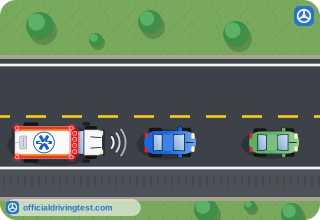
- Only a siren together with flashing red lights on the roof
- Only flashing red and blue lights when there is no sound
- A siren, air horn and/or flashing red, blue, white or yellow lights
- Only flashing white lights that are visible from the front
Show answer
Correct answer: A siren, air horn and/or flashing red, blue, white or yellow lights
The handbook lists a siren, air horn and/or flashing red, blue, white or yellow lights.
Source: Colorado Driver Handbook (DR 2337, January 2025), page 11 · Open this page in the manual (Manual page 11)
-
An emergency vehicle is approaching with its siren and lights on. Where possible, what must you do?
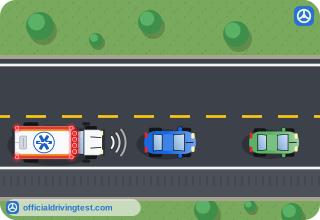
- Pull to the left edge of the road and keep moving slowly
- Pull to the right edge of the road and come to a stop
- Stop in your lane, even if you are in an intersection
- Speed up so that you clear the way ahead
Show answer
Correct answer: Pull to the right edge of the road and come to a stop
Where possible you must pull to the right edge of the road and stop.
Source: Colorado Driver Handbook (DR 2337, January 2025), page 11 · Open this page in the manual (Manual page 11)
-
An emergency vehicle approaches while you are in an intersection. What should you do?
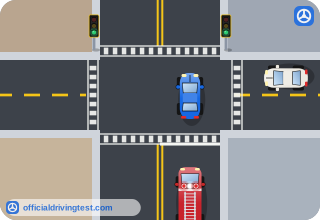
- Stop where you are in the middle of the intersection
- Back up to the stop line and pull over
- Turn left at once and pull over
- Drive through the intersection, then pull over
Show answer
Correct answer: Drive through the intersection, then pull over
If you are in an intersection, you drive through it and then pull over.
Source: Colorado Driver Handbook (DR 2337, January 2025), page 11 · Open this page in the manual (Manual page 11)
-
You are approaching an emergency vehicle stopped along the side of the road. What should you try to do?
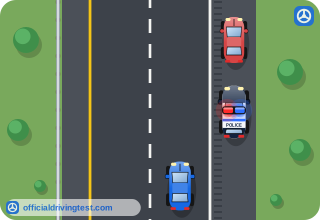
- Leave at least one lane between your vehicle and the emergency vehicle
- Stay in the lane next to the emergency vehicle and speed up
- Stop completely behind the emergency vehicle until it leaves
- Honk your horn to warn the emergency personnel
Show answer
Correct answer: Leave at least one lane between your vehicle and the emergency vehicle
The handbook says to try to leave at least one lane between your vehicle and the stopped emergency vehicle.
Source: Colorado Driver Handbook (DR 2337, January 2025), page 11 · Open this page in the manual (Manual page 11)
-
You approach a stopped emergency vehicle, but the road has only one lane on your side or you cannot change lanes. What should you do?
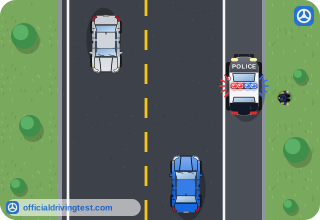
- Stop and wait until the emergency vehicle has left
- Pass at the posted speed limit and keep the lane
- Slow down to a safe speed and use care as you pass
- Move onto the shoulder and pass at a safe speed
Show answer
Correct answer: Slow down to a safe speed and use care as you pass
If you cannot change lanes you slow down to a safe speed and use care and caution as you pass.
Source: Colorado Driver Handbook (DR 2337, January 2025), page 11 · Open this page in the manual (Manual page 11)
-
You pass a stopped emergency vehicle where the posted speed limit is above 45 MPH. How much should you slow down, unless directed otherwise or conditions prohibit it?
- To 10 MPH under the posted speed limit
- To 30 MPH under the posted speed limit
- To 25 MPH, whatever the limit is
- To 20 MPH under the posted speed limit
Show answer
Correct answer: To 20 MPH under the posted speed limit
Above 45 MPH, you slow to 20 MPH under the posted speed limit.
Source: Colorado Driver Handbook (DR 2337, January 2025), page 11 · Open this page in the manual (Manual page 11)
-
To which vehicles must you yield right of way when they are in use and showing flashing yellow and blue warning lights?
- Service vehicles and maintenance equipment
- Only school buses and transit buses
- Only vehicles that are hauling trash
- Only snow plows that are in a formation
Show answer
Correct answer: Service vehicles and maintenance equipment
You must yield right of way to service vehicles and maintenance equipment when in use and flashing yellow and blue warning lights.
Source: Colorado Driver Handbook (DR 2337, January 2025), page 11 · Open this page in the manual (Manual page 11)
-
Why should you be especially cautious around snow plows?
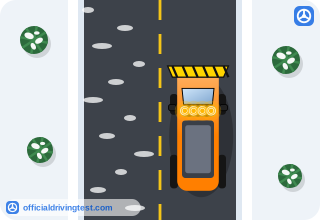
- Snow plows always travel faster than other traffic
- Snow plows may not have lights that flash
- Their size and speed can create clouds of blowing snow
- Snow plows may cross into your lane at any time
Show answer
Correct answer: Their size and speed can create clouds of blowing snow
The handbook says the size and speed of a snow plow can create clouds of blowing snow that conceal it.
Source: Colorado Driver Handbook (DR 2337, January 2025), page 11 · Open this page in the manual (Manual page 11)
-
When is it illegal to pass an authorized snow plow?
- When it is traveling slower than 25 mph
- When it is working in a staggered diagonal formation
- When it is plowing alone on the shoulder
- When it is plowing a road with only one lane
Show answer
Correct answer: When it is working in a staggered diagonal formation
It is illegal to pass an authorized snow plow working in a diagonally staggered formation.
Source: Colorado Driver Handbook (DR 2337, January 2025), page 11 · Open this page in the manual (Manual page 11)
-
A school bus is stopped with its red lights flashing. How far before reaching it must you stop your vehicle at the minimum?
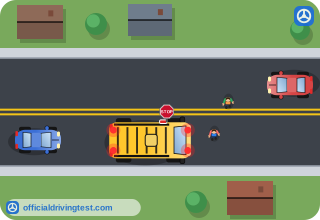
- 10 feet
- 30 feet
- 50 feet
- 20 feet
Show answer
Correct answer: 20 feet
You must stop at least 20 feet before reaching a school bus stopped with its red lights flashing.
Source: Colorado Driver Handbook (DR 2337, January 2025), page 11 · Open this page in the manual (Manual page 11)
-
When are you NOT required to stop for a school bus that is stopped with its red lights flashing?
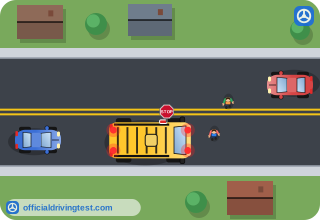
- When the bus is stopped on a two-lane road ahead of you
- When no children are visible near the bus
- When a median or physical barrier separates the bus
- When the bus is stopped at an intersection you are approaching
Show answer
Correct answer: When a median or physical barrier separates the bus
You are not required to stop if a median or other physical barrier separates the bus from your vehicle.
Source: Colorado Driver Handbook (DR 2337, January 2025), page 11 · Open this page in the manual (Manual page 11)
-
You must remain stopped for a school bus with flashing red lights until when?
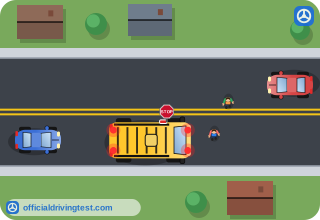
- Until the bus driver waves you through
- Until the flashing red lights are no longer flashing
- Until 10 seconds have passed
- Until the children have crossed to your side of the road
Show answer
Correct answer: Until the flashing red lights are no longer flashing
You must remain stopped until the flashing red lights are no longer flashing.
Source: Colorado Driver Handbook (DR 2337, January 2025), page 11 · Open this page in the manual (Manual page 11)
-
When must you yield right-of-way to a transit bus?
- Whenever the bus is stopped at a bus stop with its doors open
- Whenever the bus has its hazard lights flashing in traffic
- Whenever the bus is carrying passengers on a city route
- When it signals to enter a lane and its rear yield sign is lit
Show answer
Correct answer: When it signals to enter a lane and its rear yield sign is lit
You must yield to a transit bus signaling to enter a traffic lane when the yield sign on the rear of the bus is illuminated.
Source: Colorado Driver Handbook (DR 2337, January 2025), page 11 · Open this page in the manual (Manual page 11)
-
What should you do in a work or construction zone to keep construction crews and road users safe?
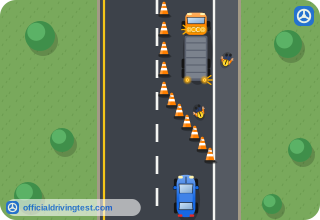
- Adjust your lane position away from workers and slow down
- Keep to the center of the roadway and maintain your speed
- Drive close to the workers so other vehicles can pass
- Use your horn to warn workers as you approach
Show answer
Correct answer: Adjust your lane position away from workers and slow down
The handbook says to adjust your lane position away from workers and slow down to navigate obstacles or changes in the flow of traffic.
Source: Colorado Driver Handbook (DR 2337, January 2025), page 11 · Open this page in the manual (Manual page 11)
-
How are reduced speed limits in work or construction zones shown?
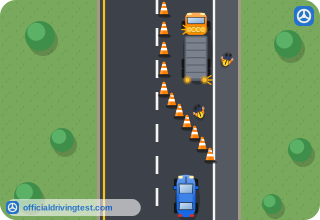
- They are not posted, so you must judge the speed
- They are shown only by flashing lights on workers' vehicles
- They are clearly marked
- They are shown only on the pavement
Show answer
Correct answer: They are clearly marked
Normal speed limits may be reduced in work zones, and any reduced limit is clearly marked.
Source: Colorado Driver Handbook (DR 2337, January 2025), page 12 · Open this page in the manual (Manual page 12)
-
What can result from failing to follow the speed limit in a work or construction zone?
- License suspension for a year
- Double fines
- A fine only if workers are present
- A warning only
Show answer
Correct answer: Double fines
Failure to follow the speed limit in a work or construction zone can result in double fines.
Source: Colorado Driver Handbook (DR 2337, January 2025), page 12 · Open this page in the manual (Manual page 12)
-
What should drivers do when approaching or passing a snowplow that is clearing snow and has flashing yellow lights?
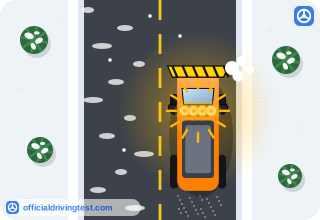
- Pass it as quickly as possible
- Be extra careful
- Follow it closely to use the cleared lane
- Stay in your lane and speed up
Show answer
Correct answer: Be extra careful
Drivers should be extra careful when approaching or passing a snowplow clearing snow with flashing yellow lights.
Source: Colorado Driver Handbook (DR 2337, January 2025), page 17 · Open this page in the manual (Manual page 17)
-
When is it illegal to pass a city, county or state-operated snow plow?
- Only when it travels faster than the speed limit
- Only when it is on a road with three or more lanes
- Only when it is spreading sand or salt on the road
- While working in tandem with others, lights flashing
Show answer
Correct answer: While working in tandem with others, lights flashing
Passing is illegal while the plow is working with yellow lights flashing and driving in tandem with one or more other plows.
Source: Colorado Driver Handbook (DR 2337, January 2025), page 17 · Open this page in the manual (Manual page 17)
-
What colors of flashing lights do snow plows and sanding trucks use to warn you to use extreme caution?
- Red and white
- Yellow and blue
- Red and blue
- Green and yellow
Show answer
Correct answer: Yellow and blue
Snow plows and sanding trucks use flashing yellow and blue lights as a warning to use extreme caution.
Source: Colorado Driver Handbook (DR 2337, January 2025), page 17 · Open this page in the manual (Manual page 17)
-
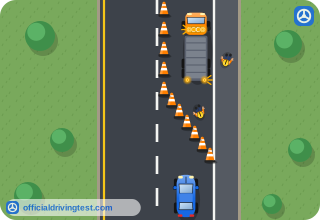
Because work zone conditions can change, what do drivers need to do?
- Drive in the center lane at all times
- Rely on their memory of the route
- Stay alert and focused at all times while driving
- Follow other vehicles closely to learn the route
Show answer
Correct answer: Stay alert and focused at all times while driving
Signs, cones and warning devices warn of changing conditions, which require you to stay alert and focused at all times.
Source: Colorado Driver Handbook (DR 2337, January 2025), page 18 · Open this page in the manual (Manual page 18)
-
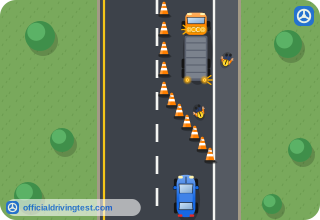
What should you be prepared to do in a work zone?
- Increase your speed
- Stop suddenly
- Pass slow vehicles
- Change lanes often
Show answer
Correct answer: Stop suddenly
The handbook says to be prepared to stop suddenly in a work zone.
Source: Colorado Driver Handbook (DR 2337, January 2025), page 18 · Open this page in the manual (Manual page 18)
-
What should you avoid doing in a work zone?
- Obeying flaggers
- Slowing down for workers
- Watching for pedestrians
- Following too closely
Show answer
Correct answer: Following too closely
The handbook says not to tailgate in a work zone.
Source: Colorado Driver Handbook (DR 2337, January 2025), page 18 · Open this page in the manual (Manual page 18)
-
Which of these can be part of a complex work zone on a large construction project?
- Flaggers and concrete barriers
- Toll gates and weigh scales
- Rest areas and gas stations
- Roundabouts and parking meters
Show answer
Correct answer: Flaggers and concrete barriers
Large projects can have flaggers, portable concrete barriers, complicated directional signing and reduced speed limits.
Source: Colorado Driver Handbook (DR 2337, January 2025), page 18 · Open this page in the manual (Manual page 18)
-
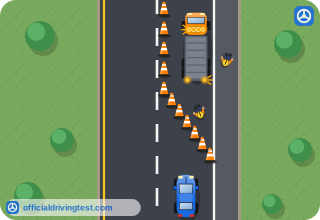
Why are reduced speed limits critical in work zones?
- They keep drivers out of the lanes that are closed
- They stop workers from stepping into traffic
- They give drivers more time to understand and react
- They reduce fuel use on construction projects
Show answer
Correct answer: They give drivers more time to understand and react
Reduced speed limits give drivers more time to understand and react to the information and devices around them.
Source: Colorado Driver Handbook (DR 2337, January 2025), page 18 · Open this page in the manual (Manual page 18)
-
What is routinely added to construction projects to ensure drivers comply with work zone signs and directions?
- Additional traffic signals
- Extra toll booths
- Gates that close the road
- Increased police enforcement
Show answer
Correct answer: Increased police enforcement
Increased police enforcement is routinely added to construction projects.
Source: Colorado Driver Handbook (DR 2337, January 2025), page 18 · Open this page in the manual (Manual page 18)
-
What happens to fines in work zones?
- They are doubled
- They are cut in half
- They stay the same as elsewhere
- They are tripled
Show answer
Correct answer: They are doubled
Like school zones, the fines are doubled in work zones.
Source: Colorado Driver Handbook (DR 2337, January 2025), page 18 · Open this page in the manual (Manual page 18)
-
In a work zone, you should obey construction signs, including work zone speed limit signs, and what else?
- Your GPS directions
- The instructions of the vehicle ahead
- Flagger instructions
- Routes remembered from before
Show answer
Correct answer: Flagger instructions
The handbook says to obey construction signs, work zone speed limit signs and flagger instructions.
Source: Colorado Driver Handbook (DR 2337, January 2025), page 18 · Open this page in the manual (Manual page 18)
-
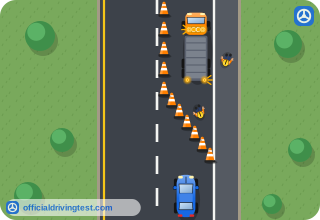
Why should you watch the vehicle in front of you in a work zone?
- Most work zone crashes happen when drivers stop too early
- Most work zone crashes are rear-end collisions
- Most work zone crashes are caused by workers in the roadway
- Most work zone crashes involve oncoming traffic
Show answer
Correct answer: Most work zone crashes are rear-end collisions
Most work zone crashes are rear-end collisions due to an inattentive driver.
Source: Colorado Driver Handbook (DR 2337, January 2025), page 18 · Open this page in the manual (Manual page 18)
-
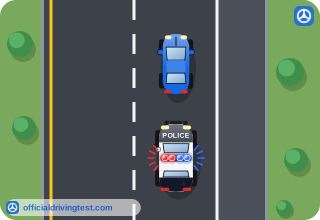
When you see emergency lights behind you or hear a siren from a law enforcement vehicle, what should you do as soon as it is safe?
- Stop immediately in your lane and turn on your hazard flashers
- Continue to the next intersection and stop in the left turn lane
- Activate your turn signal and pull off or to the right side of the roadway
- Slow down and drive on until you find a well-lit parking lot
Show answer
Correct answer: Activate your turn signal and pull off or to the right side of the roadway
The handbook says to signal and pull off or to the right side of the roadway as soon as it is safe to do so.
Source: Colorado Driver Handbook (DR 2337, January 2025), page 19 · Open this page in the manual (Manual page 19)
-
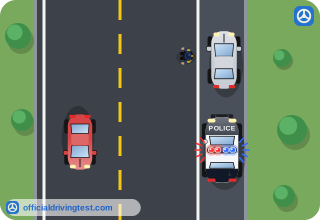
After pulling over for a law enforcement officer, what should you do with the engine and any audio devices?
- Leave the engine on but turn the audio down
- Turn off both the engine and the audio devices
- Turn off the engine but keep the audio on
- Leave both on so the officer can see you are ready
Show answer
Correct answer: Turn off both the engine and the audio devices
The handbook lists turning off the engine and any audio devices as part of the stop.
Source: Colorado Driver Handbook (DR 2337, January 2025), page 19 · Open this page in the manual (Manual page 19)
-
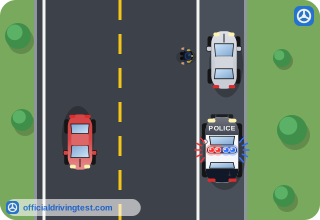
During a traffic stop, when should you leave your vehicle?
- As soon as you have stopped, to meet the officer
- When the officer's lights are turned off
- Whenever you want to show your documents
- Only if the officer directs you to exit
Show answer
Correct answer: Only if the officer directs you to exit
The handbook says to stay in your vehicle unless directed by the officer to exit.
Source: Colorado Driver Handbook (DR 2337, January 2025), page 19 · Open this page in the manual (Manual page 19)
-
If you are pulled over at night, what should you do to help visibility?
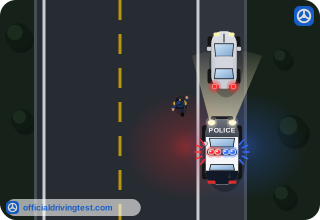
- Turn on your interior lights
- Turn off all of your vehicle's lights
- Turn on your high-beam headlights
- Flash your headlights at the officer
Show answer
Correct answer: Turn on your interior lights
The handbook says to turn on your interior lights at night to assist with visibility.
Source: Colorado Driver Handbook (DR 2337, January 2025), page 19 · Open this page in the manual (Manual page 19)
-
Where should you keep your hands during a traffic stop?
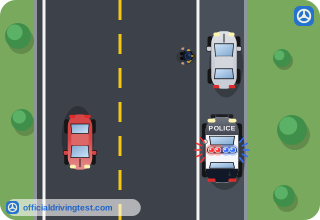
- In your pockets, out of the officer's way
- Out of sight, so the officer is not alarmed
- On the steering wheel or in a visible location
- Reaching toward the glove box for your documents
Show answer
Correct answer: On the steering wheel or in a visible location
Keeping your hands on the steering wheel or in a visible location lets the officer easily observe them.
Source: Colorado Driver Handbook (DR 2337, January 2025), page 19 · Open this page in the manual (Manual page 19)
-
If you have a weapon in the vehicle during a traffic stop, what should you do?
- Hand it to the officer so it is out of your reach
- Tell the officer at first contact, without reaching for it
- Say nothing unless the officer asks about it
- Place it on the dashboard where the officer can see it
Show answer
Correct answer: Tell the officer at first contact, without reaching for it
The handbook says to let the officer know upon first contact, but not to reach for it or hand it to the officer.
Source: Colorado Driver Handbook (DR 2337, January 2025), page 19 · Open this page in the manual (Manual page 19)
-
When should you reach for your driver’s license or vehicle documents during a traffic stop?
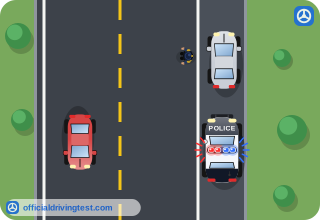
- As soon as the officer reaches your window
- Before the officer arrives at your vehicle
- While the officer is returning to the patrol car
- After the officer gives you instructions
Show answer
Correct answer: After the officer gives you instructions
The handbook says to wait for the officer’s instructions before reaching for your license or vehicle documents.
Source: Colorado Driver Handbook (DR 2337, January 2025), page 19 · Open this page in the manual (Manual page 19)
-
What should you do if your documents are out of your reach during a traffic stop?
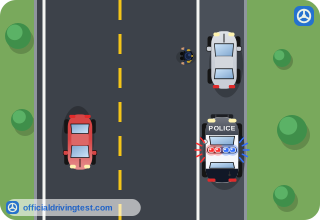
- Tell the officer where they are, then wait for acknowledgement
- Reach for them right away so the officer does not wait
- Ask a passenger to hand them directly to the officer
- Step out of the vehicle and retrieve them from outside
Show answer
Correct answer: Tell the officer where they are, then wait for acknowledgement
You should tell the officer where the documents are and wait for the officer’s acknowledgement before reaching for them.
Source: Colorado Driver Handbook (DR 2337, January 2025), page 19 · Open this page in the manual (Manual page 19)
-
When the officer approaches your vehicle during a stop, what should you do about the window?
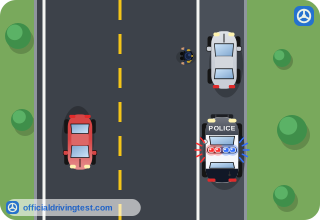
- Keep the windows closed until asked to open them
- Open every window in the vehicle
- Lower the window on the officer's side
- Lower only the driver's window, whichever side the officer is on
Show answer
Correct answer: Lower the window on the officer's side
The handbook says the officer may approach either side, and you should lower the corresponding window so you can communicate better.
Source: Colorado Driver Handbook (DR 2337, January 2025), page 19 · Open this page in the manual (Manual page 19)
-
If an officer who is not in uniform does not show law enforcement credentials, what may you do?
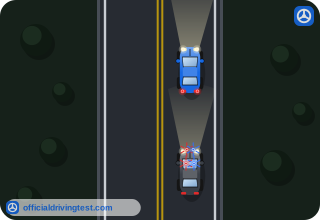
- Call the officer's supervisor before stopping
- Ask the officer to show them to you
- Keep your window closed until the officer leaves
- Nothing, because credentials are never required
Show answer
Correct answer: Ask the officer to show them to you
The handbook says an officer not in uniform will show credentials, and if not, you may ask to see them.
Source: Colorado Driver Handbook (DR 2337, January 2025), page 19 · Open this page in the manual (Manual page 19)
-
If an officer asks you to exit the vehicle, what should you do?
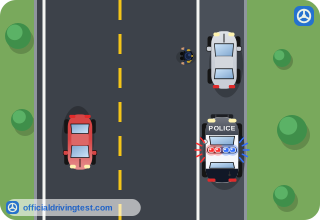
- Exit with your hands in your pockets and stand beside your car
- Stay in the vehicle until a second officer arrives
- Exit and stand wherever you feel safest from traffic
- Keep your hands visible, exit, and stand where the officer directs
Show answer
Correct answer: Keep your hands visible, exit, and stand where the officer directs
You should keep your hands visible, exit the vehicle and stand in the location the officer directs.
Source: Colorado Driver Handbook (DR 2337, January 2025), page 19 · Open this page in the manual (Manual page 19)
-
If you disagree with the officer’s decision during a traffic stop, what should you do?
- Argue your case at the roadside until the officer listens
- Do not argue; seek to contest it in court through legal channels
- Ask the passengers to speak on your behalf immediately
- Explain your side until the officer changes the decision
Show answer
Correct answer: Do not argue; seek to contest it in court through legal channels
The handbook says not to prolong the contact by arguing, and that you may contest the decision in court through established legal channels.
Source: Colorado Driver Handbook (DR 2337, January 2025), page 19 · Open this page in the manual (Manual page 19)
-
If you believe an officer acted inappropriately, what may you do?
- Wait several weeks before asking to speak to a supervisor
- Argue with the officer until the matter is settled on the spot
- Refuse to leave until a supervisor comes to the scene
- Request to speak to a supervisor, ideally soon after the stop
Show answer
Correct answer: Request to speak to a supervisor, ideally soon after the stop
You may request to speak to a supervisor, and this is best done as soon as possible after the stop.
Source: Colorado Driver Handbook (DR 2337, January 2025), page 19 · Open this page in the manual (Manual page 19)
-
When are law enforcement officers responsible for conducting traffic stops, according to the handbook?
- When they have reasonable suspicion of a traffic or criminal violation
- Only when a violation has already caused a crash or an injury
- Whenever a driver is traveling alone on a dark road at night
- Only when they have a signed complaint from another driver
Show answer
Correct answer: When they have reasonable suspicion of a traffic or criminal violation
Officers conduct traffic stops when they have reasonable suspicion of a traffic violation or a criminal violation.
Source: Colorado Driver Handbook (DR 2337, January 2025), page 19 · Open this page in the manual (Manual page 19)
-
Under Colorado’s Move Over Law, what must you do when you encounter a stationary vehicle on a highway with its hazards flashing?
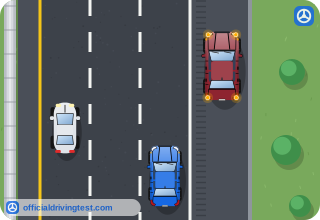
- Stop behind the vehicle until it leaves
- Honk to warn the driver and keep your lane
- Move over one lane if you can do so safely
- Slow to 10 mph below the posted limit and stay in your lane
Show answer
Correct answer: Move over one lane if you can do so safely
The handbook says to move over one lane if you can do so safely.
Source: Colorado Driver Handbook (DR 2337, January 2025), page 27 · Open this page in the manual (Manual page 27)
-
Whom does Colorado’s Move Over Law protect?
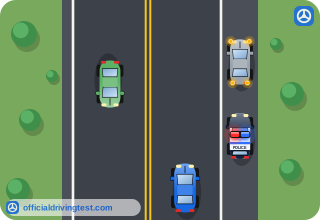
- Only law enforcement and fire personnel who are working on a highway
- Only drivers of vehicles that have their flashing lights turned on
- Only maintenance workers who are working inside a posted work zone
- Emergency and maintenance personnel, tow truck drivers and you
Show answer
Correct answer: Emergency and maintenance personnel, tow truck drivers and you
The handbook says the law protects law enforcement, fire, maintenance, other emergency personnel, tow truck drivers and you.
Source: Colorado Driver Handbook (DR 2337, January 2025), page 27 · Open this page in the manual (Manual page 27)